
Protein engineering, the discipline scientists also call rational protein design or directed evolution depending on the method, is reshaping medicine, industrial chemistry, and genomics simultaneously. The examples of protein engineering applications emerging from 2026 research alone cover everything from correcting pathogenic variants in human cells to manufacturing pharmaceutical precursors at industrial scale. For biotechnology professionals trying to identify where their next project opportunity lies, concrete case studies cut through the theory faster than any textbook. This article breaks down eight of the most technically significant applications currently in active use.
Table of Contents
- Key takeaways
- 1. Examples of protein engineering applications in prime editing
- 2. Computational design of PAM-relaxed Cas9 variants
- 3. Engineered tryptophan synthase for pharmaceutical manufacturing
- 4. Multi-objective enzyme optimization with the ORI framework
- 5. Terminal deoxynucleotidyl transferase engineering for DNA synthesis
- 6. Directed evolution of halogenase enzymes for bioactive compound production
- 7. Chemical protein engineering for site-selective functionalization
- 8. Workflow acceleration with the MIDAS rapid assembly method
- My perspective on where protein engineering is heading
- How Innovabiotech supports your protein engineering projects
- FAQ
Key takeaways
| Point | Details |
|---|---|
| AI accelerates therapeutic design | AI-guided reverse transcriptase redesign improves prime editing efficiency across hundreds of pathogenic variants. |
| Computational design expands genome tools | Fully computational Cas9 engineering relaxes PAM constraints without compromising nuclease function. |
| Industrial enzymes benefit from generative AI | Engineered tryptophan synthase variants are already in commercial pharmaceutical manufacturing pipelines. |
| Multi-objective frameworks outperform single-trait optimization | Closed-loop ORI methods simultaneously improve activity, stability, and multifunctionality in a single scaffold. |
| Expression engineering matters as much as catalytic tuning | TdT variants with 26-fold expression gains show that production yield is an equally critical engineering target. |
1. Examples of protein engineering applications in prime editing
Therapeutic genome editing has become one of the most demanding protein engineering use cases because the prime editor complex must function inside mammalian cells under tight delivery constraints. The core challenge is not just catalytic efficiency. Prime editors require the reverse transcriptase (RT) domain to remain stable, soluble, and highly expressed once delivered by mRNA-LNP or engineered virus-like particles (eVLPs).
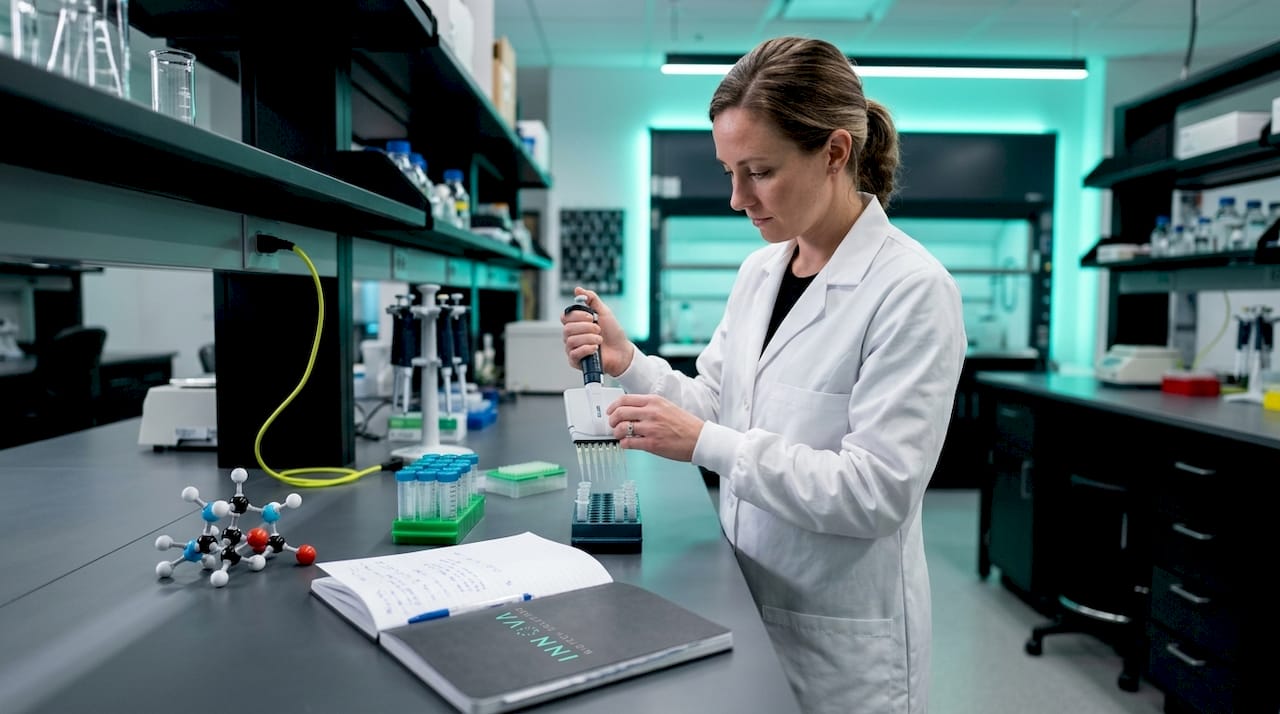
Recent work published in Nature Biotechnology demonstrates exactly how far AI-guided RT redesign has pushed those limits. The redesigned RT domains achieved better mammalian cell expression, higher thermal stability, and measurable in vivo editing improvements across approximately 700 pathogenic variants. The key insight from that study is worth noting: improving biophysical properties directly raises the effective intracellular concentration of the editor, which is the actual lever for correction efficiency.
What the field has learned is that therapeutic protein editing must optimize beyond catalytic activity. Stability and intracellular expression are equally load-bearing parameters.
- Redesigned RT domains show improved thermal stability and solubility compared to laboratory-evolved counterparts
- mRNA-LNP and eVLP delivery both benefit from the improved expression profiles
- Efficiency gains span ~700 pathogenic variant correction tasks, not just a handful of model loci
- The AI-guided design approach accelerates variant screening far beyond what wet-lab evolution alone can achieve
Pro Tip: When planning a prime editing project, benchmark your RT domain's Tm and intracellular expression level early. These two parameters predict in vivo performance more reliably than in vitro editing rates measured in simple buffer conditions.
2. Computational design of PAM-relaxed Cas9 variants
Most Cas9 proteins require a specific protospacer adjacent motif (PAM) sequence near the target site. This constraint limits which genomic loci are actually editable, which matters enormously when you are targeting rare pathogenic variants in non-ideal sequence contexts.
A fully computational Cas9 design published in eLife addressed this directly by engineering a Staphylococcus aureus Cas9 variant called KRH. The design logic did not rely on random mutagenesis or directed evolution libraries. Instead, it remodeled the energetic landscape at the PAM interface by tuning the balance between sequence-specific and nonspecific DNA contacts.
The result was a variant with expanded PAM specificity and editing efficiency improved up to 116-fold over wild-type, placing its performance alongside variants derived from experimental evolution. This is a strong proof-of-concept that computational protein design can match or exceed what evolution achieves, at least for nuclease interface remodeling. For researchers working on genome editing tool development, the KRH case demonstrates that minimal targeted mutations can remodel a PAM interface without broadly disrupting nuclease integrity.
- KRH was designed entirely in silico with no directed evolution libraries required
- Editing efficiency improvement: up to 116-fold over wild-type S. aureus Cas9
- Performance is comparable to evolution-derived PAM-relaxed variants
- Mechanistic insight centers on energetic rebalancing at the PAM interface, not indiscriminate residue substitution
3. Engineered tryptophan synthase for pharmaceutical manufacturing
Industrial biocatalysis is one of the clearest areas where the benefits of protein engineering translate directly to economic and sustainability outcomes. Tryptophan synthase beta subunit (TrpB) enzymes have been a prime target because they can catalyze C-C bond-forming reactions that synthetic chemistry handles poorly.
Generative AI and sequence-guided engineering have now produced TrpB variants with broad substrate promiscuity, enabling the scalable production of tryptophan analogs including 5-fluorotryptophan. Merck and AralezBio have adopted engineered TrpB variants in their manufacturing pipelines, which moves this from a research curiosity into a validated real-world protein engineering case study. The combination of directed evolution with computational sequence guidance is what produced variants capable of handling non-native substrates at commercial scale.
| Engineering approach | Outcome | Industrial relevance |
|---|---|---|
| Directed evolution alone | Narrow substrate scope improvement | Limited to close analogs |
| Generative AI sequence design | Broad substrate promiscuity, including fluorinated substrates | Scalable pharmaceutical precursor synthesis |
| Combined directed evolution and AI | Versatile variants with strong kinetics | Adopted by Merck and AralezBio for production |
The fluorotryptophan application specifically matters because fluorinated amino acids appear in multiple drug candidates and are difficult to access through traditional organic synthesis without toxic reagents. Engineered TrpB variants remove that synthesis bottleneck. This is one of the cleaner examples of protein engineering applications crossing from academic study into active commercial deployment.
4. Multi-objective enzyme optimization with the ORI framework
Single-trait optimization, improving just activity or just stability, captures only part of what industrial and biomedical applications actually require. A chitinase that is 100-fold more active but denatures at 50°C has limited use in many processing environments. The field has recognized this for years, but execution has lagged.
The Ontology Reinforcement Iteration (ORI) framework addresses this directly. By integrating iterative experimental feedback into a closed-loop design cycle, ORI optimizes multiple enzyme properties simultaneously rather than treating them as sequential problems. Published results in Nature Communications show a lysozyme variant with 100-fold higher activity and a chitinase that remains stable at 85°C. Dual-function enzymes that outperform their natural counterparts were also reported, which is an outcome that standard prediction-only models rarely achieve.
The reason ORI works better than prediction-only approaches is straightforward: experimental feedback integration continuously corrects the model's blind spots as new data comes in rather than propagating initial errors through successive design rounds.
- Define target properties with quantitative thresholds before engineering begins
- Generate an initial variant library using structure-guided predictions
- Screen experimentally and feed results back into the model
- Use ontology-mapped property relationships to guide the next design cycle
- Iterate until convergence on multi-property targets
Pro Tip: For any multi-objective engineering campaign, set explicit numeric thresholds for each property before you start, not after. Vague goals like "improve stability" produce ambiguous stopping criteria and make cross-project comparisons impossible.
5. Terminal deoxynucleotidyl transferase engineering for DNA synthesis
Enzymatic DNA synthesis is positioned to replace phosphoramidite chemistry for producing long, complex oligonucleotides. Terminal deoxynucleotidyl transferase (TdT) is the central enzyme in that vision, but wild-type TdT has serious practical limitations including low expression yields and poor thermostability that undermine its viability at production scale.
A study in Applied Biochemistry and Biotechnology tackled both problems simultaneously using iterative site-saturation mutagenesis paired with computational modeling. The engineered TdT variants achieved 26-fold higher expression and greater than 120-fold improvement in thermostability while also showing increased catalytic activity at 37°C. These are not incremental gains. They represent the difference between a lab-bench curiosity and a manufacturable biocatalyst.
This case also illustrates a point that gets underemphasized in many protein engineering case studies: expression yield is an engineering target of equal standing to catalytic performance. A highly active enzyme that expresses at 0.1 mg/L is not industrially useful regardless of its kinetics. The TdT work shows that rational thermostable enzyme design targeting flexibility hotspots and destabilizing regions can achieve substantial stability gains without sacrificing the activity you engineered in the first place.
- Site-saturation mutagenesis identified the key stability bottlenecks across the TdT scaffold
- Computational modeling prioritized which mutational combinations were worth testing experimentally
- The 26-fold expression gain reflects signal peptide and expression system engineering as much as direct TdT optimization
- Results directly enable enzymatic DNA synthesis at scales relevant to pharmaceutical and synthetic biology production
6. Directed evolution of halogenase enzymes for bioactive compound production
Halogenated compounds appear throughout antibiotic and antifungal drug classes, yet chemical halogenation typically requires harsh conditions and generates significant waste. Flavin-dependent tryptophan halogenases offer a clean enzymatic alternative, except wild-type variants are notoriously insoluble and poorly active in standard expression hosts.
Continuous directed evolution using phage-assisted continuous evolution (PACE) produced RebHEvo4, a halogenase variant with markedly improved solubility and activity for halogenated compound synthesis in E. coli. The RebHEvo4 variant enabled efficient production of halogenated antimicrobial peptides, with engineered biosensors driving selection throughout the PACE process. This represents one of the more technically sophisticated real-world protein engineering examples currently in the literature because it combines continuous evolution infrastructure with biosensor design, both of which require independent engineering expertise.
The practical takeaway for biotech researchers is that PACE and analogous continuous evolution platforms are no longer specialized tools limited to a handful of academic groups. They are increasingly accessible, and the RebHEvo4 case makes a strong argument for applying them to any enzyme where solubility and activity improvements are both needed simultaneously.
7. Chemical protein engineering for site-selective functionalization
Recombinant protein expression gives you the protein. Chemical protein engineering gives you control over what gets attached to it and exactly where. Site-selective functionalization using solid-phase peptide synthesis and chemoselective ligation strategies enables researchers to install non-natural functionalities, including specific redox centers, fluorophores, or drug payloads, at defined positions without the limitations of genetic code expansion.
Chemical protein engineering methods documented in Communications Chemistry describe programmable activity modifications and enhanced stability outcomes that recombinant methods cannot replicate. For drug development specifically, this opens routes to antibody-drug conjugates with defined drug-to-antibody ratios and enzyme conjugates with tunable catalytic properties. The site-selectivity is the critical differentiator here. Random conjugation chemistry has been used for decades, but the pharmacokinetic and efficacy profiles of site-specifically functionalized proteins are consistently superior in head-to-head comparisons.
For researchers working in computational protein design, the chemical engineering perspective is worth integrating early. Designing in a specific reactive handle, whether a non-canonical amino acid site or a cysteine at a solvent-exposed loop, dramatically expands downstream functionalization options without requiring a new protein engineering campaign.
8. Workflow acceleration with the MIDAS rapid assembly method
Even the best protein engineering strategy is only as good as the speed at which you can test it. The MIDAS method compresses the design-build-test cycle from weeks to approximately 24 hours using PCR-based rapid assembly combined with next-day synthesis ordering. That is an order-of-magnitude improvement in throughput, which has direct implications for how quickly AI training datasets can be generated from experimental results.
When you consider how many protein engineering use cases now rely on machine learning models trained on variant fitness data, the ability to generate high-quality training data at 10 times the previous rate becomes a genuine competitive advantage. MIDAS does not replace good design judgment. It amplifies the value of that judgment by removing the bottleneck between a hypothesis and the experimental result that confirms or refutes it.
My perspective on where protein engineering is heading
I've spent years watching protein engineering shift from a craft-driven discipline into something that looks increasingly like systematic product development. What strikes me about the examples covered here is not any single breakthrough. It's the pattern they collectively reveal.
Every high-impact application I've seen recently involves at least two of these three elements working together: AI-guided design, multi-objective optimization, and careful attention to expression and stability alongside catalytic function. The groups still engineering for activity alone are leaving significant performance on the table.
My honest read on where early-career researchers and mid-career professionals should place their attention: get fluent with closed-loop optimization frameworks like ORI. Prediction-only models will always hit walls because they cannot account for what the experiment reveals. The AI-driven enzyme engineering approaches that consistently produce deployable proteins are the ones that treat experimental data as a continuous input, not a final checkpoint.
The other thing I would push back on is the tendency to treat computational design and directed evolution as competing philosophies. The TrpB and TdT cases both show that the combination outperforms either approach alone. If your group is firmly in one camp or the other, that is probably limiting your outcomes more than your target protein is.
— Hooman
How Innovabiotech supports your protein engineering projects
Protein engineering projects rarely fail because of a single wrong mutation. They stall because the computational design, experimental validation, and expression optimization are treated as separate workstreams rather than an integrated process. At Innovabiotech, every protein engineering engagement is built around closing that loop from the start.
Whether you are developing therapeutic proteins with specific stability requirements, engineering industrial enzymes for new substrate scopes, or building custom peptide design workflows for drug discovery, Innovabiotech provides the computational and bioinformatics infrastructure to move faster and with greater confidence. Our protein design services integrate structural modeling, AI-guided variant prediction, and expression optimization to cover the full engineering cycle. We also offer virtual screening services for groups that need to prioritize candidates before committing to wet-lab resources. Explore how Innovabiotech's tailored solutions can accelerate your next project at innovabiotech.com.
FAQ
What are the most impactful examples of protein engineering applications today?
Current high-impact applications include prime editing enhancement, PAM-relaxed Cas9 design, industrial enzyme manufacturing, and enzymatic DNA synthesis, with most advances combining AI design and directed evolution methods.
How is protein engineering applied in pharmaceutical manufacturing?
Engineered enzymes like TrpB variants are used by companies including Merck to produce tryptophan analogs and fluorinated amino acid precursors at commercial scale through AI-guided biocatalytic processes.
What is the ORI framework in protein engineering?
Ontology Reinforcement Iteration is a closed-loop design method that integrates iterative experimental feedback to simultaneously optimize enzyme activity, stability, and multifunctionality within a single scaffold.
How does computational design compare to directed evolution for Cas9 engineering?
The fully computational KRH variant of S. aureus Cas9 achieved up to 116-fold editing efficiency improvement over wild-type, matching the performance of evolution-derived variants without requiring experimental library screening.
Why does thermostability matter so much in real-world protein engineering?
Thermostability determines whether a protein remains functional under industrial processing conditions and in vivo delivery contexts. TdT engineering showed that greater than 120-fold stability improvements are achievable and critical for deployment viability.