

Protein stability engineering is routinely treated as a downstream formulation concern. Most drug development teams encounter it late, after a promising candidate has already been selected, only to discover that the molecule degrades under physiological conditions, aggregates during storage, or loses bioactivity before reaching the patient. That framing is wrong, and it costs the industry billions. Understanding why protein stability engineering is important from the earliest stages of therapeutic design is not a refinement strategy. It is a prerequisite for clinical and commercial success in modern biopharmaceuticals.
Table of Contents
- Key takeaways
- Fundamentals of protein stability
- Why protein stability engineering matters in drug development
- Modern strategies for engineering stability
- Challenges and nuances in stability engineering
- Applications and future outlook in biopharma
- My perspective on stability engineering's real impact
- How Innovabiotech can support your stability engineering work
- FAQ
Key takeaways
| Point | Details |
|---|---|
| Stability determines therapeutic viability | Unstable proteins fail through aggregation, immunogenicity, and loss of bioactivity before reaching patients. |
| Engineering stability early reduces costs | Addressing stability at the design stage prevents expensive late-stage failures in formulation and clinical trials. |
| AI and automation accelerate progress | Tools like ProteinMPNN and MIDAS compress protein engineering cycles from months to days at a fraction of traditional costs. |
| Trade-offs require precision design | Mutations that improve activity often reduce stability, making computational redesign a necessity rather than an option. |
| Market demand is growing fast | The protein stability screening market is projected to reach $2.29 billion by 2030, reflecting industry-wide recognition of its importance. |
Fundamentals of protein stability
Before you can engineer stability, you need a precise understanding of what you are actually controlling. Protein stability is not a single property. It encompasses two distinct but related concepts: thermodynamic stability and kinetic stability.
Thermodynamic stability refers to the free energy difference between a protein's folded and unfolded states. A protein with high thermodynamic stability strongly favors its folded conformation at equilibrium. Kinetic stability, by contrast, describes how slowly a protein unfolds regardless of thermodynamic preference. A protein can be kinetically stable while thermodynamically marginal, which is why both parameters matter in therapeutic contexts.
What makes this particularly challenging is the concept of marginal stability. Native proteins operate near a delicate energy threshold/01%3A_Unit_I-Structure_and_Catalysis/04%3A_The_Three-Dimensional_Structure_of_Proteins/4.09%3A_Protein_Stability-_Thermodynamics) where single-residue disruptions can trigger unfolding. This is not a flaw in natural proteins. It is an evolutionary feature that enables conformational flexibility and functional regulation. For therapeutic proteins, however, that same marginal stability becomes a liability.
The molecular interactions that maintain the folded state include:
- Hydrogen bonds between backbone amides and carbonyls, and between polar side chains
- Hydrophobic packing of nonpolar residues in the protein core, which drives burial away from solvent
- Electrostatic interactions, including salt bridges between charged residues at physiological pH
- Disulfide bonds in oxidizing environments, providing covalent cross-links that dramatically constrain unfolding
When these interactions are disrupted, whether by heat, pH shifts, oxidative stress, or mechanical agitation during processing, the protein populates partially unfolded states. Those states expose hydrophobic patches that drive intermolecular aggregation, the single most common cause of biologic drug failure.
Pro Tip: When assessing a new therapeutic candidate, measure both melting temperature and aggregation onset temperature early. A wide gap between the two indicates a protein that unfolds before it aggregates, giving you more engineering latitude.
Why protein stability engineering matters in drug development
The importance of protein stability in biopharmaceuticals extends well beyond keeping a molecule intact on the shelf. Stability directly governs formulation feasibility, cold-chain requirements, immunogenicity risk, and ultimately patient safety.
Protein instability during formulation and storage can cause reduced bioactivity, increased immunogenicity, and outright therapeutic failure. When a biologic aggregates, the immune system may recognize those aggregates as foreign, triggering anti-drug antibody responses that neutralize efficacy or cause adverse events. This is not a rare edge case. It is a documented mechanism behind multiple late-stage clinical failures and post-market withdrawals.
The commercial implications are equally significant. The protein stability screening platforms market is growing at a CAGR of 9.7% and is projected to reach $2.29 billion by 2030. That growth reflects industry-wide recognition that stability assessment can no longer be treated as a final checkpoint.
The specific benefits of engineering intrinsic protein stability include:
- Extended shelf life without relying on complex excipient cocktails or specialized storage conditions
- Reduced cold-chain dependence, which directly improves access in low-resource settings and simplifies global distribution
- Lower immunogenicity risk by preventing the formation of aggregated species that trigger immune responses
- Improved manufacturability, since stable proteins express better, purify more cleanly, and tolerate the mechanical stresses of large-scale bioprocessing
Engineering intrinsic stability reduces dependency on stabilizing excipients and cold-chain storage, which has direct implications for biologics accessibility in global markets. For biosimilar developers and emerging-market biopharma companies, this is not a nice-to-have. It determines whether a product is commercially viable at all.
The role of protein stability in enzyme optimization follows the same logic. Industrial enzymes operating at elevated temperatures or in non-aqueous solvents fail rapidly without deliberate stabilization. The principles translate directly from therapeutics to biocatalysis.
Modern strategies for engineering stability
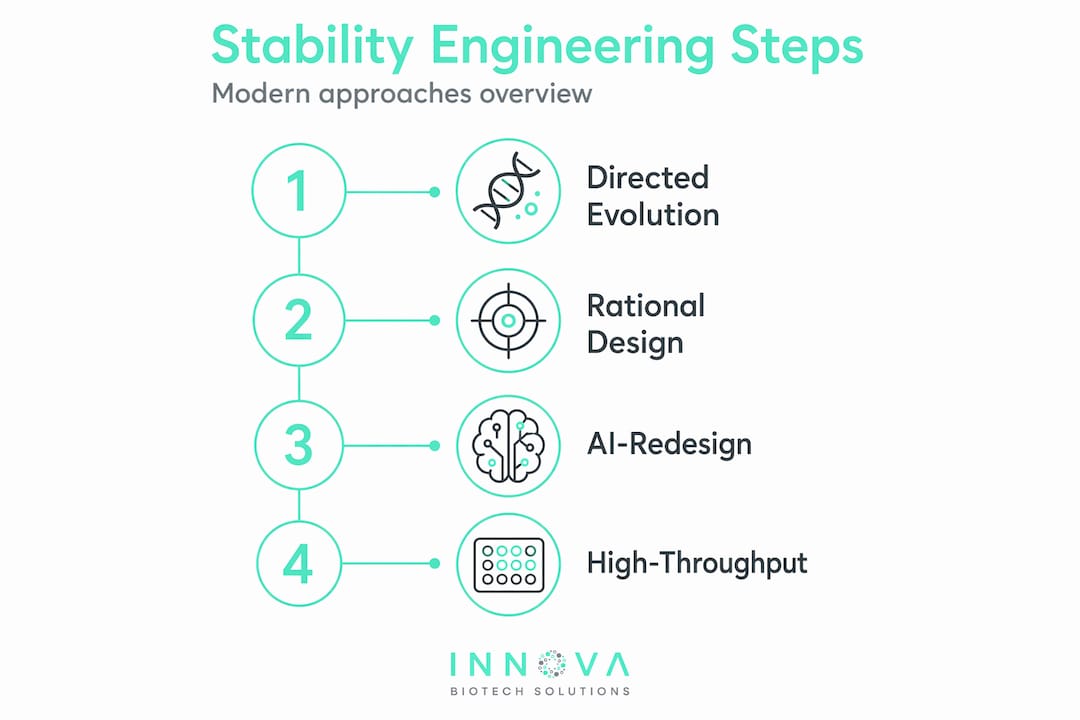
The toolkit for improving protein stability has expanded dramatically over the past decade. Three broad approaches now define the field, and the most effective programs combine all three.
Directed evolution and rational design
Directed evolution generates stability variants through iterative rounds of random mutagenesis and selection. It requires no prior structural knowledge and can identify stabilizing mutations in regions that rational design would overlook. Rational design, by contrast, uses structural and thermodynamic data to make targeted substitutions at positions predicted to improve packing, eliminate buried charges, or introduce new disulfide bonds. Each approach has blind spots the other compensates for.
Computational and AI-guided redesign
This is where the field is moving fastest. AI-guided redesign using ProteinMPNN improved prime editor folding thermodynamics, boosting editing efficiency up to 22-fold without reducing catalytic activity. That result is significant because it demonstrates that computational tools can recover stability lost during directed evolution without sacrificing the functional gains that motivated the evolution in the first place.

De novo protein design, enabled by physical principles rather than natural evolution, is becoming a transformative approach for designing highly stable, tailor-made proteins from scratch. Unlike optimization of natural scaffolds, de novo design can access stability profiles that evolution never explored. Innovabiotech's protein design services incorporate these computational approaches to address stability from the sequence level up.
High-throughput screening platforms
The bottleneck in stability engineering has historically been throughput. Evaluating thousands of variants for both stability and function requires infrastructure that most academic and early-stage industrial labs cannot sustain. MIDAS condenses protein building and testing to 24 hours at one-tenth the cost of traditional cloning-based approaches, running nearly 50 times faster. That kind of acceleration changes what is feasible in a drug development timeline.
| Approach | Key advantage | Primary limitation |
|---|---|---|
| Directed evolution | No structural knowledge required | Can reduce stability while improving activity |
| Rational design | Targeted, hypothesis-driven mutations | Requires high-quality structural data |
| Computational/AI redesign | Simultaneous optimization of stability and function | Needs experimental validation of predictions |
| High-throughput screening (MIDAS) | Rapid, low-cost variant evaluation | Requires specialized infrastructure |
Pro Tip: Do not treat computational design and experimental screening as sequential steps. Run them in parallel. Use AI-guided predictions to prioritize which variants enter the high-throughput pipeline, and feed screening results back into the model to improve the next design cycle.
Autonomous closed-loop platforms that integrate robotics, machine learning, and FAIR data management compress protein engineering cycles from months to days. For biopharma programs under competitive pressure, that compression is a genuine strategic advantage.
Challenges and nuances in stability engineering
The field would be simpler if stability were a single dial you could turn up without consequences. It is not. Several challenges define the real difficulty of this work.
The most persistent is the stability-function trade-off. Directed evolution mutations that enhance catalytic properties often impair solubility and folding thermodynamics. The active site residues that enable catalysis are frequently the same residues that destabilize the folded state, because binding and catalytic geometry requires precise, often strained conformations. Engineering around this requires tools that can discriminate between stability-neutral, stability-improving, and stability-impairing mutations at near-residue resolution.
A second challenge involves the non-uniform nature of protein energy landscapes. Protein folding is not uniformly cooperative. Unstable residue clusters exist within otherwise stable proteins, identified by techniques like HDX-NMR. These regions can function as allosteric switches essential for biological activity. Globally stabilizing such a protein without understanding its energy substate heterogeneity can abolish the very function you are trying to preserve.
Key considerations for navigating these challenges include:
- Mapping instability hotspots before designing mutations, rather than applying uniform stabilization strategies
- Using ensemble-based computational methods that model multiple conformational states rather than a single static structure
- Validating stability gains in the actual formulation buffer and temperature conditions the drug product will experience, not just in idealized assay conditions
- Monitoring aggregation kinetics alongside thermodynamic stability, since a protein can have a high melting temperature but still aggregate rapidly through non-thermal pathways
Tailored engineering of instability clusters can actually create dynamic protein regions that function as allosteric switches, offering design strategies that go beyond global stabilization. This reframes instability not purely as a problem to eliminate but as a feature to control.
Applications and future outlook in biopharma
The practical impact of protein stability engineering is already visible across multiple therapeutic categories. The 22-fold improvement in prime editing efficiency achieved through AI-guided stability redesign demonstrates what becomes possible when stability is treated as a design parameter rather than a constraint. Gene editing tools with improved thermostability perform more consistently across cell types and delivery conditions, which directly affects their clinical utility.
Looking forward, several trends will shape how stability engineering integrates into biopharma development:
- Personalized biologics will require rapid stability optimization of patient-specific sequences, making high-throughput and AI-guided methods indispensable
- Expanded biologics pipelines targeting historically difficult protein classes, including membrane proteins and intrinsically disordered regions, will demand new stability engineering frameworks
- Regulatory expectations around aggregation characterization and forced degradation studies are tightening, making stability data a more prominent part of IND and BLA submissions
- Industrial biocatalysis applications, from protein stability in biocatalysis for green chemistry to biosensor development, will continue to drive demand for thermostable, solvent-tolerant enzymes
The convergence of virtual screening technologies, AI-guided design, and automated experimental platforms is compressing the timeline from sequence to stable, functional protein. Teams that build these capabilities now will have a structural advantage as the biologics pipeline grows more complex.
My perspective on stability engineering's real impact
I have watched protein stability get treated as a formulation team's problem for years, and I think that framing has caused real damage to drug development programs. By the time a molecule reaches formulation, the sequence is fixed, the expression system is optimized, and changing anything fundamental is prohibitively expensive. Stability has to be a design criterion from day one.
What I find most underappreciated is the compounding effect. A protein that is 5°C more thermostable does not just survive slightly warmer storage. It expresses better, purifies with fewer losses, tolerates manufacturing stress, and often shows improved pharmacokinetics in vivo. The benefits stack in ways that are not obvious from any single assay.
The AI-guided redesign results coming out of prime editing research are the clearest signal I have seen that the field has crossed a threshold. Getting a 22-fold improvement in editing efficiency through stability engineering alone, without touching the active site, is not a marginal gain. It is a demonstration that stability engineering is a primary performance lever, not a secondary one.
My practical advice: treat stability screening as a parallel workstream from the earliest lead identification stage, not a gate you pass through before formulation. The teams doing this are moving faster and failing less.
— Hooman
How Innovabiotech can support your stability engineering work
If the challenges described above sound familiar, Innovabiotech was built specifically to address them. The team at Innovabiotech combines computational protein design, AI-guided sequence optimization, and bioinformatics expertise to help biopharma and biotech clients engineer stable, functional proteins from the earliest stages of development.
Whether you need custom protein and peptide design with built-in stability optimization, computational protein engineering services for therapeutic or industrial applications, or support navigating the stability-function trade-offs in your current pipeline, Innovabiotech provides project-specific solutions backed by scientific rigor. Every engagement starts with a direct consultation to understand your molecule, your constraints, and your timeline. Reach out to discuss how targeted stability engineering can accelerate your program.
FAQ
Why is protein stability engineering important for biologics?
Protein stability engineering prevents aggregation, immunogenicity, and loss of bioactivity during formulation, storage, and delivery. Without it, therapeutic proteins fail before reaching patients, regardless of how potent they are in early assays.
What are the main methods used to improve protein stability?
The primary approaches include directed evolution, rational design, computational and AI-guided redesign using tools like ProteinMPNN, and high-throughput screening platforms like MIDAS. Effective programs typically combine computational prediction with experimental validation.
How does protein stability affect drug shelf life?
Engineering intrinsic stability reduces reliance on excipients and cold-chain storage by increasing the thermodynamic and kinetic resistance of the protein to unfolding and aggregation, directly extending viable shelf life under real-world storage conditions.
What is the stability-function trade-off in protein engineering?
Mutations that improve catalytic activity or binding often destabilize the folded protein. Computational redesign tools can selectively restore stability without reversing functional gains, but this requires precise residue-level analysis rather than broad stabilization strategies.
How fast is the protein stability screening market growing?
The market is projected to reach $2.29 billion by 2030 at a CAGR of 9.7%, driven by growing demand for stable biologics across drug development, biosimilars, and industrial biocatalysis applications.