
What AI drug discovery services actually deliver
AI drug discovery services combine machine learning, virtual screening, and generative molecular design to compress timelines that traditionally stretch beyond a decade. The core value is straightforward: AI narrows the search space before any compound touches a lab bench.
Key capabilities these services cover:
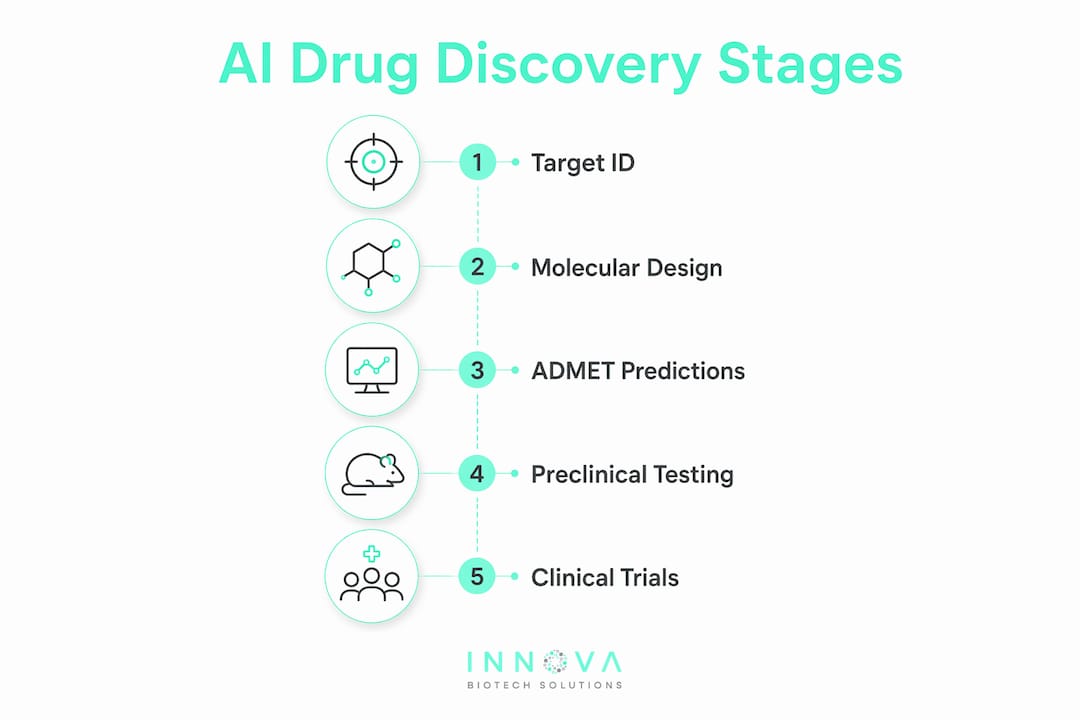
- Target identification using deep learning on genomic and proteomic datasets
- Virtual screening across billions of compounds to rank candidates by binding affinity
- De novo molecular design generating novel structures with optimized ADMET profiles
- Toxicity prediction flagging safety liabilities before synthesis
- Clinical trial optimization through cohort modeling and real-time monitoring
The regulatory environment is catching up fast. The FDA's CDER AI Council, established in 2024, now coordinates AI policy across drug submissions. From 2016 to 2023, over 500 submissions to the FDA incorporated AI components, spanning nonclinical, clinical, and manufacturing phases. IQVIA is one example of a large-scale data and analytics firm that has embedded AI across clinical development workflows.
How AI transforms every stage of drug research

Machine learning in drug discovery is not a single tool. It is a layered architecture applied at each pipeline stage.

At target identification, graph convolutional networks sift through protein interaction networks to rank disease-relevant genes with a precision that bulk sequencing cannot match. At lead optimization, generative models explore chemical space that no human team could manually survey. Graph neural networks predict hERG blockade and QT prolongation with AUC-ROC values above 0.90 on independent test sets, outperforming traditional QSAR models. Pharmaceutical teams using these models in early screening have excluded 30%–40% of high-risk compounds before synthesis.
| Pipeline stage | AI method | Practical impact |
|---|---|---|
| Target identification | Graph neural networks, multi-omics | Faster gene prioritization |
| Virtual screening | ML-based ADMET prediction | Billions of compounds ranked in hours |
| Lead optimization | Generative AI, diffusion models | Novel scaffolds with tuned properties |
| Toxicity screening | Deep learning on public bioactivity datasets | Early elimination of unsafe candidates |
| Clinical prediction | Transformer models, real-world data | Improved trial design and cohort selection |
The persistent challenge is data scarcity and hidden biases, which limit how well models generalize to novel targets. Biological complexity means AI predictions still require rigorous experimental validation. A shortage of scientists fluent in both machine learning and pharmaceutics compounds the problem at most organizations.
Pro Tip: Treat AI outputs as a prioritization filter, not a final answer. Every in silico prediction needs wet-lab confirmation before advancing a candidate.
What to look for when choosing an AI service provider
Selecting the right partner comes down to more than algorithm quality. Interdisciplinary expertise combining ML and pharmaceutical science is the most commonly cited gap in the industry, and it is the first thing to probe in any vendor conversation.
Critical evaluation criteria:
- Regulatory alignment: Explainable AI is now a regulatory necessity. Providers must demonstrate model transparency to satisfy FDA expectations.
- Data governance: Assess how the provider handles proprietary compound data, IP ownership, and compliance with data privacy standards.
- Technology depth: Look beyond marketing claims. Ask specifically about graph neural networks, generative architectures, and whether their platform supports integrated data strategies across the full development lifecycle.
- Clinical translation record: AI-discovered candidates still face high clinical-stage failure rates. Prioritize providers with documented success moving compounds from in silico to Phase I.
- Pricing structure: Most providers offer project-based or platform-subscription models. Clarify what deliverables are included and where costs scale.
Understanding the benefits of interdisciplinary biotech research before entering vendor negotiations gives your team a sharper framework for asking the right questions.
Innovabiotech: a specialized US-based AI discovery partner
Innovabiotech (Innova Biotech Solutions) launched in San Francisco in 2024 with a focused mandate: deliver computational biology and bioinformatics services tailored to each project's specific biology, not off-the-shelf software access.
Their service portfolio covers:
- Virtual screening with AI-powered candidate ranking
- De novo peptide design for novel therapeutic targets
- Protein engineering and chimeric protein design with computational modeling
- Enzyme optimization for biocatalysis and metabolic pathway work
- Hit-to-lead (H2A) optimization with full bioinformatics validation
The firm's DRAGONFLY model is their proprietary approach to molecular design, integrating generative AI with structural validation to accelerate candidate generation. What sets Innovabiotech apart from platform-only vendors is the client collaboration model: dedicated scientific teams stay engaged from initial consultation through project delivery, providing technical guidance at every decision point.
Leading AI drug discovery service approaches in the United States
The US market has developed along two distinct tracks. Large integrated platforms embed AI across the full development lifecycle, while specialized boutique providers focus on specific pipeline stages with deeper domain expertise.
Enterprise-scale platforms typically offer API-based access to computational chemistry tools, ADMET prediction, and molecular docking within a single environment. These suit organizations that need broad coverage and can manage their own scientific interpretation. The prompt-to-drug pipeline concept, where multi-agent AI systems link legacy biochemical software with lab robotics, represents the frontier of this category.
Specialized boutique providers like Innovabiotech focus on specific modalities, such as peptide design or protein engineering, with hands-on scientific teams rather than self-service dashboards. For biotech companies without large internal computational teams, this model often delivers faster, more interpretable results.
AI solutions for biotech teams also benefit from external AI optimization platforms that support workflow coordination across discovery programs.
Real-world outcomes from AI-assisted drug programs
Pfizer's development of Paxlovid® is the clearest documented example of AI accelerating a clinical program. The company used AI-driven discovery platforms to shorten its research timeline and achieved a clinical success rate above the industry average. Pfizer's 2025 strategy explicitly centers high-quality data as the prerequisite for all AI initiatives.
On the research side, an AI-designed TNIK inhibitor advanced to Phase IIa with encouraging efficacy signals, demonstrating what compressed timelines can look like in practice. A separate candidate stalled in Phase I when safety signals surfaced, which is the honest picture: AI accelerates early stages but does not yet solve the in vivo unpredictability that drives late-stage attrition.
Data privacy, IP, and regulatory compliance in AI discovery
Proprietary compound data is among the most sensitive assets a pharmaceutical company holds. Before signing with any AI service provider, clarify three things: who owns model weights trained on your data, how the provider isolates your datasets from other clients, and what happens to your IP if the partnership ends.
On the regulatory side, the FDA's 2025 draft guidance on AI in regulatory decision-making sets expectations for documentation, validation, and explainability. Any AI output intended to support a regulatory submission must be traceable and interpretable. Federated learning is gaining traction as a way to train models on distributed datasets without exposing raw proprietary data, though it introduces its own validation complexity.
What comes next in automated drug development
The near-term trajectory points toward self-driving laboratories, where AI agents design experiments, robotics execute them, and real-time feedback refines the model in a closed loop. The prompt-to-drug vision is no longer theoretical. Modular AI platforms, multi-agent reasoning systems, and lab automation hardware are each individually operational; the work now is integrating them end-to-end.
Multimodal foundation models trained on genomics, proteomics, imaging, and clinical text simultaneously are beginning to outperform single-modality approaches on target identification tasks. Quantum machine learning remains early-stage but is attracting serious investment for its potential to handle molecular simulations that classical hardware cannot efficiently solve.
Innovabiotech brings specialized AI discovery capabilities to your pipeline
Pharmaceutical and biotech teams that need more than platform access get something different with Innovabiotech: a dedicated scientific team that owns the problem alongside you, from virtual screening through validated lead candidates.
Their peptide design services combine de novo design with full bioinformatics validation, while their protein engineering work integrates computational modeling with experimental-ready outputs. Every project runs with direct scientific communication, clear milestone reporting, and no handoff to a generic support queue. For pharma R&D teams that need specialized expertise without building a full computational biology department internally, Innovabiotech offers a focused, project-scoped alternative.
FAQ
What are AI drug discovery services?
AI drug discovery services apply machine learning, virtual screening, and generative molecular design to accelerate target identification, lead optimization, and toxicity prediction across the pharmaceutical pipeline.
How does the FDA regulate AI in drug development?
The FDA published a 2025 draft guidance on AI in regulatory decision-making and established the CDER AI Council in 2024 to coordinate policy. Explainable AI is required for any AI output supporting a regulatory submission.
What is the biggest challenge with AI-driven drug discovery?
Data scarcity, hidden biases, and the shortage of scientists with both ML and pharmaceutical expertise remain the primary barriers, alongside the persistent gap between in silico predictions and clinical outcomes.
How does Innovabiotech differ from platform-only AI vendors?
Innovabiotech provides dedicated scientific teams for each project rather than self-service software access, covering virtual screening, peptide design, protein engineering, and enzyme optimization with full bioinformatics validation.
What should pharma teams prioritize when selecting an AI discovery partner?
Prioritize interdisciplinary expertise, explainable AI capabilities, clear IP and data governance terms, and documented evidence of moving candidates from computational prediction to experimental validation.
Key takeaways
AI drug discovery services deliver the most value when machine learning is embedded across the full development lifecycle, not applied as a standalone tool at a single pipeline stage.
| Point | Details |
|---|---|
| Regulatory alignment is mandatory | FDA's 2025 draft guidance requires explainable, traceable AI outputs for any regulatory submission. |
| Data quality drives model performance | Scarcity and hidden biases in training data remain the primary limit on AI predictive reliability. |
| Clinical translation still requires validation | AI-discovered candidates face high late-stage failure rates; experimental confirmation is non-negotiable. |
| Specialized partners outperform platforms for complex modalities | Boutique providers with interdisciplinary teams deliver more interpretable results for peptide and protein programs. |
| Innovabiotech offers project-scoped AI discovery | San Francisco-based Innovabiotech covers virtual screening, peptide design, protein engineering, and enzyme optimization with dedicated scientific teams. |