
TL;DR:
- Virtual screening streamlines drug discovery by filtering large chemical libraries through multiple computational stages before experimental validation.
- Tools like DiffDock, DeepDocking, and DrugCLIP enable large-scale screening, significantly reducing costs and improving hit rates compared to traditional methods.
Virtual screening drug discovery workflow is a multi-stage computational process that identifies potential drug candidates by progressively filtering chemical libraries through drug-likeness rules, molecular docking, and ADMET evaluation. Standard pipelines reduce 1,000+ compounds to 10–50 candidates ready for experimental validation. Physical high-throughput screening costs $500,000–$2,000,000 per campaign. Virtual screening cuts that cost dramatically while delivering hit rates of 5–20%, compared to 0.01–0.1% for random physical screening. Tools like DiffDock, DeepDocking, and DrugCLIP now sit at the center of modern in silico drug design, making this workflow the first serious filter in any competitive drug discovery process.
What are the main stages of a virtual screening drug discovery workflow?
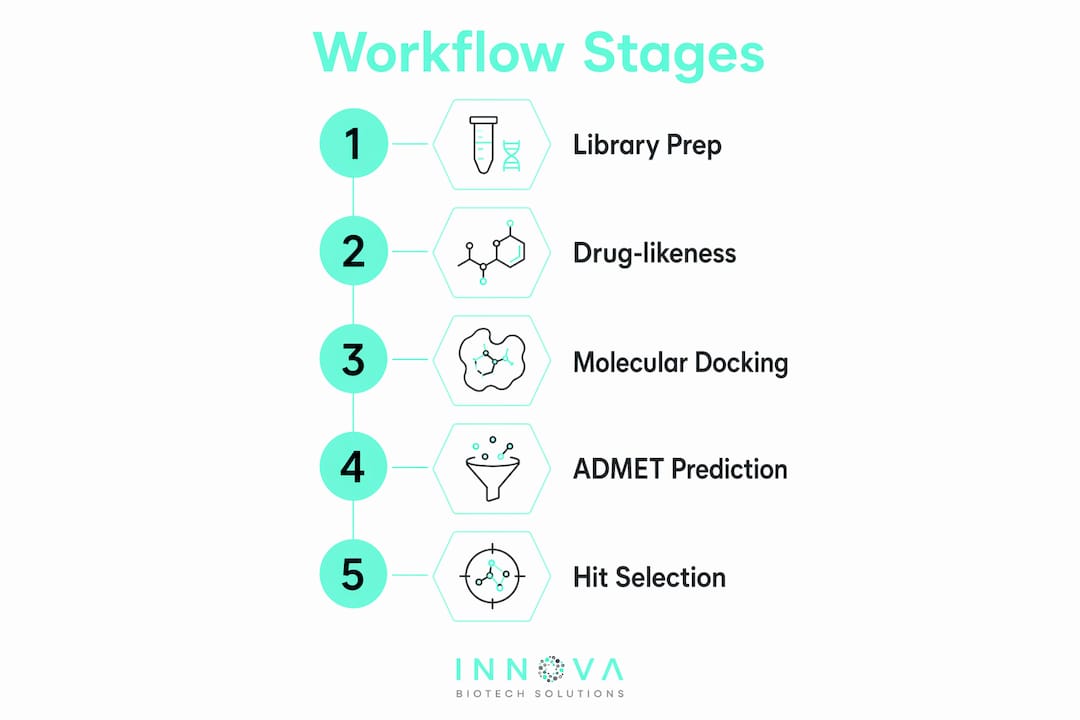
The virtual screening drug discovery workflow follows a funnel structure. Each stage removes poor candidates before the next, more expensive step begins. This design keeps computational costs manageable while preserving the most promising molecules.

Stage 1: Library preparation
Library preparation is the foundation of any reliable screening campaign. Researchers curate chemical libraries by correcting tautomers, assigning protonation states, and resolving stereochemistry. Input data quality is the most common point of failure in virtual screening. No AI method compensates for a poorly prepared library.
Stage 2: Drug-likeness filtering
Lipinski's Rule of Five is the standard filter at this stage. It removes compounds with poor oral bioavailability before any docking calculation runs. This step alone can eliminate 30–60% of a raw library, saving significant compute time downstream.
Stage 3: Molecular docking
Molecular docking places each remaining compound into the target protein's binding site and scores the interaction. Structure-based virtual screening (SBVS) requires a high-quality 3D protein structure, typically from X-ray crystallography or AlphaFold2 predictions. Ligand-based virtual screening (LBVS) skips the protein structure and instead compares candidates against known active molecules using pharmacophore models or shape similarity.
Stage 4: ADMET prediction
ADMET prediction evaluates absorption, distribution, metabolism, excretion, and toxicity for the top-ranked docking hits. Tools like SwissADME and pkCSM generate these profiles computationally. Compounds that fail ADMET at this stage would almost certainly fail in vivo, so removing them now protects downstream resources.
| Stage | Input | Output | Key Tools |
|---|---|---|---|
| Library preparation | Raw compound files | Cleaned, normalized structures | RDKit, OpenBabel |
| Drug-likeness filter | Normalized library | Filtered subset | Lipinski filters, FAF-Drugs |
| Molecular docking | Filtered library + protein structure | Ranked pose list | DiffDock, AutoDock Vina |
| ADMET prediction | Top-ranked docked hits | Prioritized lead candidates | SwissADME, pkCSM |
Pro Tip: Run ADMET filters before docking on very large libraries. Removing metabolically unstable compounds early reduces the docking queue by 20–40% without sacrificing hit quality.
Which platforms and AI tools are best for virtual screening in drug discovery?
The best virtual screening platforms for drug discovery combine classical docking engines with AI acceleration. The field has moved well beyond brute-force scoring.
DeepDocking uses a deep learning model to pre-screen ultra-large libraries and identify the top fraction worth full docking. It reduces the number of compounds that reach expensive docking by orders of magnitude. This approach is critical when working with libraries containing billions of enumerated molecules.
DiffDock applies diffusion models to predict protein-ligand binding poses. It outperforms classical docking on several benchmark datasets and handles flexible binding sites more reliably than rigid-receptor methods. Researchers working on targets with known conformational flexibility should prioritize DiffDock.
DrugCLIP takes a different approach entirely. It encodes protein pockets and small molecules into a shared latent space using contrastive learning. This enables scoring of over 10 trillion protein-ligand pairs genome-wide in under 24 hours using 8 GPUs. That scale is simply not achievable with traditional docking.
GenMolVS represents the next generation of screening platforms. It integrates generative AI with virtual screening using NVIDIA BioNeMo and the NeMo Agentic Toolkit. The platform runs end-to-end adaptive pipelines that generate, screen, and rank molecules without manual intervention between steps.
Ultra-large chemical spaces with trillions of compounds require vector-based similarity search combined with machine learning rather than brute-force docking. This approach also surfaces new chemotypes that classical docking would never reach.
Combining SBVS and LBVS methods with AI and machine learning tools including deep generative models and transfer learning reduces attrition across all drug discovery stages. No single platform dominates every use case. The right choice depends on library size, target class, and available computational resources.
How to execute a virtual screening workflow step by step
A well-executed computational drug screening campaign follows a defined sequence. Skipping steps or reordering them is the most common source of poor results.
-
Define your target and obtain a structure. Download the protein structure from the Protein Data Bank (PDB) or generate a model with AlphaFold2. Identify the binding site using co-crystallized ligands or prediction tools like FPocket.
-
Curate your chemical library. Select a source library from ZINC20, Enamine REAL, or a proprietary collection. Run RDKit or OpenBabel to standardize formats, assign protonation states at physiological pH, and enumerate stereoisomers. Do not skip tautomer normalization.
-
Apply drug-likeness filters. Run Lipinski's Rule of Five and any additional physicochemical filters relevant to your target class. For CNS targets, apply BBB permeability filters at this stage.
-
Run molecular docking. Set up the docking grid around the binding site with at least 10 Å padding on each side. Use AutoDock Vina for standard campaigns or DiffDock for flexible targets. Run docking on a GPU cluster to manage compute time on libraries above 100,000 compounds.
-
Apply consensus scoring. Single docking scores are unreliable as the sole ranking criterion. Cross-rank your top hits using a pharmacophore model, a shape-based score, and the primary docking score. Compounds that rank well across all three methods are genuine priorities.
-
Run ADMET profiling. Submit the top 200–500 consensus-ranked compounds to SwissADME or pkCSM. Flag compounds with predicted hERG toxicity, poor solubility, or reactive functional groups.
-
Conduct medicinal chemistry review. Have a medicinal chemist visually inspect docking poses for the top 50–100 compounds. Check for hydrogen bond geometry, hydrophobic contact quality, and synthetic accessibility. Visual inspection by medicinal chemists after automated scoring is a critical step that beginners routinely skip.
-
Prepare the final hit list. Compile 10–50 compounds for in vitro validation. Document every filtering decision and scoring threshold. Traceability matters when results need to be reproduced or defended.
Pro Tip: Always keep a record of compounds removed at each stage and the reason for removal. This audit trail helps you diagnose failures when hit rates are lower than expected.
What are the common challenges in virtual screening and how do you avoid them?
Virtual screening produces reliable results only when researchers treat it as a prioritization filter, not a replacement for physical testing. Enriching candidate pools computationally reduces downstream attrition. It does not guarantee active compounds.
The most frequent challenges are:
- Poor library quality. Tautomer errors, incorrect protonation, and unresolved stereochemistry corrupt docking results. No scoring function fixes bad input chemistry.
- Over-reliance on a single score. One docking score reflects one model's assumptions. Consensus scoring across multiple methods produces more reliable rankings.
- Ignoring synthetic feasibility. A compound with a perfect docking score is worthless if it cannot be synthesized. Medicinal chemistry review catches this before resources are committed.
- Skipping ADMET early. Running ADMET only at the end wastes compute on compounds that would have been eliminated in minutes.
- Treating AI as a black box. AI tools like DrugCLIP and DeepDocking require careful validation against known actives before deployment on a new target class.
Successful virtual screening requires shifting from static manual workflows to adaptive, traceable AI-driven pipelines where input chemistry quality dictates success.
Agentic workflows that integrate generative AI, structure prediction, and automated ranking represent the direction the field is moving. Platforms like GenMolVS already demonstrate that autonomous hit-to-lead acceleration is achievable at scale. The researchers who adopt these pipelines now will have a measurable advantage in cycle time and hit quality.
Key takeaways
The most effective virtual screening drug discovery workflow combines rigorous library preparation, multi-stage filtering, consensus scoring, and medicinal chemistry review to deliver high-confidence leads at a fraction of the cost of physical screening.
| Point | Details |
|---|---|
| Library quality is the top priority | Correct tautomers, protonation, and stereochemistry before any docking begins. |
| Use a multi-stage funnel | Apply drug-likeness filters first, then docking, then ADMET to control compute costs. |
| Never rely on one docking score | Consensus scoring across pharmacophore, shape, and docking metrics improves hit reliability. |
| Medicinal chemistry review is non-negotiable | Visual inspection of top poses prevents false positives and synthetic dead ends. |
| AI tools change the scale equation | Platforms like DrugCLIP and DeepDocking make trillion-compound screening feasible in under 24 hours. |
Why I think most virtual screening campaigns fail before the docking even starts
After working through dozens of virtual screening projects, the pattern is consistent. Teams invest heavily in selecting the right docking software and spend almost no time on library preparation. They run a sophisticated AI model on a library full of tautomer errors and wonder why the hit rate is low.
The uncomfortable truth is that the quality of your input chemistry matters more than your choice of docking engine. A well-curated library of 50,000 compounds will outperform a poorly prepared library of 5 million every time. I have seen campaigns with access to GPU clusters and state-of-the-art diffusion models produce zero viable leads because the protonation states were never assigned correctly.
The second failure mode is treating the docking score as a final answer. Researchers who learn to validate screening results with orthogonal methods consistently report better hit rates. Consensus scoring is not optional. It is the difference between a prioritized list and a random one.
The future of this field is agentic. Pipelines that generate molecules, screen them, rank them, and loop back to generate better candidates without manual handoffs will define the next generation of drug discovery. The researchers building those pipelines now, with traceable and adaptive workflows, are the ones who will close the gap between computational prediction and clinical success.
— Hooman
Innovabiotech's virtual screening services for drug discovery teams
Innovabiotech works with biotech researchers and pharmaceutical teams who need more than off-the-shelf software. The team at Innovabiotech designs and executes custom virtual screening campaigns from library preparation through ADMET profiling and medicinal chemistry review, with full documentation at every stage.
For projects that extend beyond small molecules, Innovabiotech also provides peptide design services including de novo peptide design and hit-to-lead optimization. Every project is handled with direct communication from initial consultation through final delivery. Teams that need a reliable computational partner for their next drug discovery campaign can reach Innovabiotech through the website to discuss project scope and timelines.
FAQ
What is virtual screening in drug discovery?
Virtual screening is a computational method that filters large chemical libraries to identify potential drug candidates before physical testing. It uses drug-likeness rules, molecular docking, and ADMET prediction to rank compounds by their likelihood of binding a target protein.
How does virtual screening differ from high-throughput screening?
High-throughput screening tests physical compounds in the lab at a cost of $500,000–$2,000,000 per campaign. Virtual screening performs the same prioritization computationally at a fraction of the cost, with hit rates of 5–20% compared to 0.01–0.1% for random physical screening.
What is the difference between structure-based and ligand-based virtual screening?
Structure-based virtual screening uses a 3D protein structure to dock and score compounds directly. Ligand-based virtual screening uses known active molecules as templates when no reliable protein structure is available, comparing candidates by pharmacophore or shape similarity.
Which AI tools are most effective for large-scale virtual screening?
DrugCLIP uses contrastive learning to score over 10 trillion protein-ligand pairs in under 24 hours. DeepDocking pre-screens ultra-large libraries with deep learning before full docking. GenMolVS runs end-to-end agentic pipelines using NVIDIA BioNeMo for autonomous hit generation and ranking.
How many compounds does a typical virtual screening campaign validate in vitro?
A standard pipeline reduces an initial library of 1,000 or more compounds to 10–50 candidates for experimental validation. Only the top 50–500 compounds from larger libraries proceed to in vitro testing, depending on available resources and project scope.