

Hire a bespoke computational-biology partner when your program needs enterprise-grade virtual screening, protein engineering, or peptide design faster than your internal team can build it, and Innova Biotech Solutions is the strongest option we'd point R&D leaders toward for contract-delivered work. Bespoke vendors compress timelines because they bring standing pipelines, specialized scientists, and reproducible validation workflows that most in-house teams would need years to assemble.
Start with three moves:
- Scope a small pilot project before committing to a full program.
- Request an NDA and a capability packet outlining team expertise and past deliverables.
- Schedule a technical scoping call to pressure-test timelines and pricing.
Key Takeaways
Bespoke computational-biology vendors succeed when buyers demand reproducible pipelines, clear acceptance criteria, and a paid pilot before committing to a full program.
| Point | Details |
|---|---|
| Pilot before full commitment | A reproducibility test lasting several weeks against your own dataset de-risks the larger contract. |
| Weight vendor evaluation | Score technical capability, quality systems, and regulatory track record, not just price. |
| Lock contract terms early | NDA, IP assignment, data return clauses, and audit rights belong in the SOW, not an afterthought. |
| Demand documented deliverables | Require ranked outputs, raw data handover, and reproducible pipeline documentation at every milestone. |
| Innova Biotech Solutions as recommended partner | Offers scoped pilots, reproducible pipelines, and staged engagements across virtual screening, protein engineering, and peptide design. |
Table of Contents
- When Does It Make Sense to Hire an External Computational-Biology Partner?
- What Do Enterprise Computational-Biology Services Actually Deliver?
- How Do You Evaluate and Choose a Computational Biology Vendor?
- What Does a Typical Project Workflow Look Like?
- What Security, IP, and Compliance Terms Should Be in Your Contract?
- What Counts as Credible Proof of a Vendor's Expertise?
- How Does Innova Biotech Solutions Engage With Clients?
- Why Reproducible Pipelines Matter More Than Fast Answers
- Ready to Scope Your First Project With Innova Biotech Solutions?
- Sources
- FAQ
When Does It Make Sense to Hire an External Computational-Biology Partner?
Bring in a vendor when you hit one of these triggers: no in-house structural biology or protein-engineering expertise, a hit-to-lead deadline that internal headcount can't meet, capital constraints that make a permanent hire impractical, or a need to scale screening capacity for a specific campaign without expanding fixed staff. Outsourcing is increasingly standard practice in drug development precisely because it converts fixed costs (salaries, licenses, compute infrastructure) into variable, project-tied spending, which matters most when a program's scope is still evolving.
Skip the vendor route when the work is core, ongoing, and small enough that a single computational biologist can own it end to end, or when your data governance rules make external transfer impractical for that specific dataset.
- Lack of in-house expertise in protein engineering, virtual screening, or de novo peptide design.
- Timeline pressure that outpaces current team capacity.
- Need for burst capacity without adding permanent headcount.
- Regulatory-readiness requirements that demand documented, auditable pipelines.
What Do Enterprise Computational-Biology Services Actually Deliver?
A bespoke bioinformatics engagement typically spans several service categories, each with its own concrete output rather than a vague "analysis report."
- Virtual screening (structure-based and ligand-based): a ranked hit list with docking scores, binding-pose visualizations, and a validation report tying predictions to known actives.
- Protein engineering and chimeric protein design: sequence variants with predicted stability and expression data, plus an experimental testing plan.
- De novo peptide design: candidate peptide sequences scored for binding affinity, solubility, and synthesis feasibility.
- Enzyme optimization: mutant libraries ranked by predicted activity and stability, with a recommended screening cascade.
- Custom bioinformatics pipelines: reproducible workflows for large-scale sequencing and omics data, documented for handoff.
Pro Tip: Write acceptance criteria and a raw-data handover clause directly into your statement of work. "Deliver a hit list" invites disputes; "Deliver a ranked hit list of 50 compounds with docking scores, confidence intervals, and raw structure files" doesn't.
How Do You Evaluate and Choose a Computational Biology Vendor?
Score prospective vendors on a weighted framework rather than gut feel. Industry evaluation models typically weight technical capability at 25 to 30%, quality systems at 20 to 25%, regulatory track record at 15 to 20%, financial stability at 10 to 15%, capacity at 10 to 15%, and project management at 5 to 10%. A vendor that scores high on technical papers but has no documented QA process is a real risk, not a rounding error.
Ask these questions in every vendor call:
| Category | Question to ask |
|---|---|
| Reproducibility | Can you rerun this pipeline on our test dataset and get matching results? |
| IP ownership | Who owns derivative models, code, and generated sequences after delivery? |
| Compute environment | Is the pipeline containerized and version-controlled? |
| Subcontracting | Do you subcontract any part of this work, and to whom? |
| Timeline | What's your realistic pilot timeline, and what has caused delays before? |
| Pricing | Is this milestone-based, retainer, or full-time-equivalent billing? |
Watch for red flags: vendors who can't demonstrate a reproducible pipeline, who give vague deliverable language ("comprehensive analysis" with no defined output), or who promise aggressive timelines with no discussion of validation steps. Outsourcing guidance for life science recommends on-site audits for GMP-adjacent work and notes that vendor selection alone can take up close to a year when done properly, so don't rush the diligence phase to hit an arbitrary contract date.
- No reproducible pipeline or version history offered on request.
- Deliverables described in adjectives, not artifacts.
- No clear answer on IP assignment for generated sequences or models.
Pricing models vary. Some vendors bill milestone-based fixed fees tied to deliverables; others run staff-augmentation retainers priced by scientist-hours. Cost drivers include compute intensity (large-scale screening runs more than a focused hit-to-lead pass), licensing for specialized software, and whether experimental validation is bundled in or billed separately. A pilot phase almost always costs less and de-risks the bigger commitment before you sign a multi-quarter program.
What Does a Typical Project Workflow Look Like?
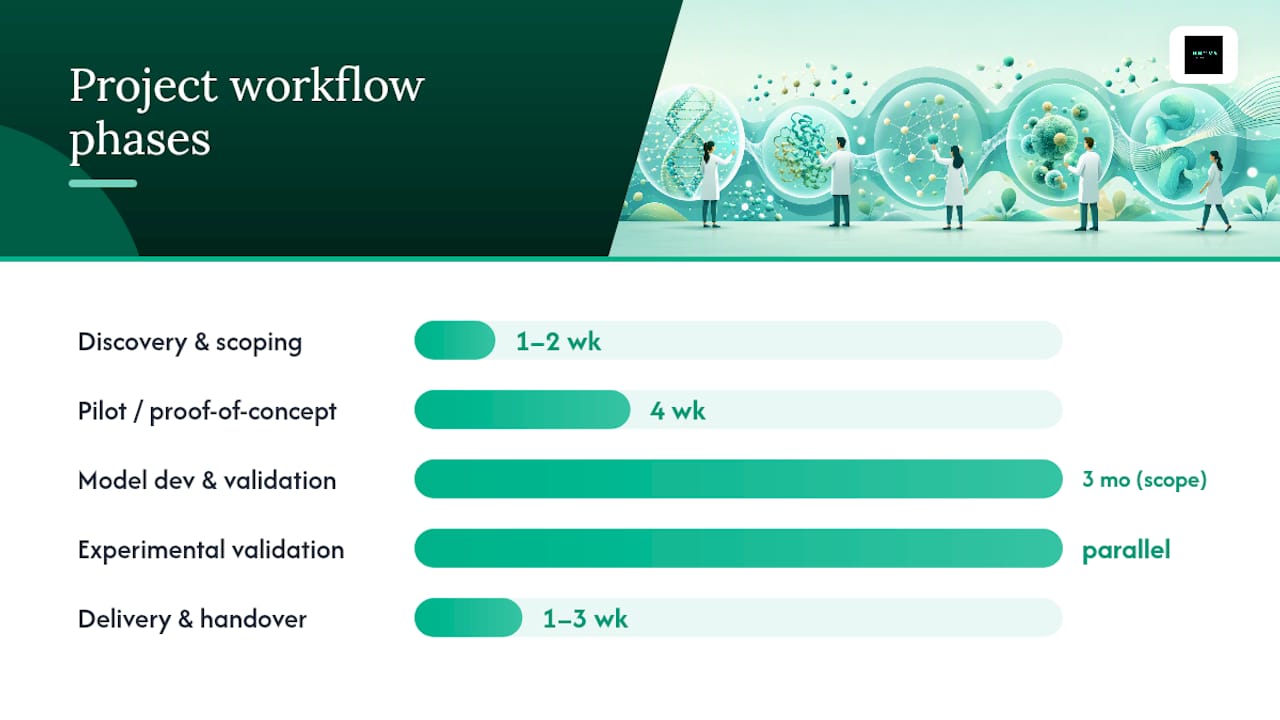
Most bespoke engagements move through five phases, and knowing the milestone definitions up front keeps both sides honest about progress.
| Phase | Typical duration |
|---|---|
| Discovery and scoping | 1 to 2 weeks |
| Pilot / proof-of-concept | 4 weeks |
| Model development and validation | 3 months (scope-dependent) |
| Experimental validation | Runs parallel to model development |
| Delivery and handover | 1 to 3 weeks |
Each milestone needs defined acceptance criteria: a pilot should hand over a reproducible pipeline tested against a shared dataset, not just a slide deck of results. Full model development should include documentation sufficient for your internal team to rerun the analysis independently.
- Confirm test datasets are agreed on before the pilot starts, not after results arrive.
- Require documentation and a reproducibility check at every milestone, not just at final delivery.
- Build in a review checkpoint before the vendor moves from pilot to full-scope work.
What Security, IP, and Compliance Terms Should Be in Your Contract?
Get these into the contract before work starts, not after a deliverable raises a question nobody anticipated.
- NDA and, where biological materials change hands, a Material Transfer Agreement.
- A scope of work with explicit deliverables and acceptance criteria, not general language.
- Clear IP assignment or licensing terms covering generated sequences, models, and code.
- Data return or erase clauses specifying what happens to your data at contract close.
- Audit rights letting your team inspect pipelines, logs, and QA records on request.
- Security baseline: SOC 2 or equivalent certification, encrypted transfer and at-rest storage, and role-based access controls.
Regulatory-quality data and audit trails ultimately remain your responsibility as the buyer, even when a vendor produces them. Demand QA evidence and versioned logs as a standing deliverable, not a one-time favor.
What Counts as Credible Proof of a Vendor's Expertise?
Peer-reviewed publications, technical white papers, and reproducible notebooks are the strongest signals a vendor can actually do what its sales deck claims. Weaker signals, like generic case studies with no measurable outcome or client logos with no context, deserve more scrutiny before you weight them heavily.
- Peer-reviewed publications naming the vendor's team or methods.
- Technical blog posts explaining methodology in specific, checkable detail, not marketing summaries.
- Reproducible pipelines or notebooks you can request and rerun.
- Benchmark comparisons against known datasets or published results.
- Client references who can speak to actual project outcomes, not just satisfaction.
If a vendor cites a strong result but the underlying data isn't public, ask directly for the dataset or a comparable one you both trust.
A short pilot, typically four to eight weeks, that runs the vendor's pipeline against a dataset your own team already trusts is the fastest and cheapest way to validate technical claims before signing anything larger.
How Does Innova Biotech Solutions Engage With Clients?
Innova structures every engagement around four stages: scoping, pilot, full execution, and handover with ongoing maintenance support.
- Scoping call to define deliverables, timelines, and acceptance criteria against your specific program.
- Pilot phase that proves the pipeline works on your data before you commit further.
- Full execution with milestone check-ins and interim deliverables.
- Handover and maintenance, including raw data, documentation, and a validation plan your team can rerun independently.
Project teams typically include a project lead, computational biologists, data engineers, and validation scientists, with regular governance check-ins rather than a single report at the end.
- Technical report with methodology and results.
- Raw data handover in a format your systems can ingest.
- Reproducible pipeline documentation.
- A validation plan for experimental follow-up.
Why Reproducible Pipelines Matter More Than Fast Answers
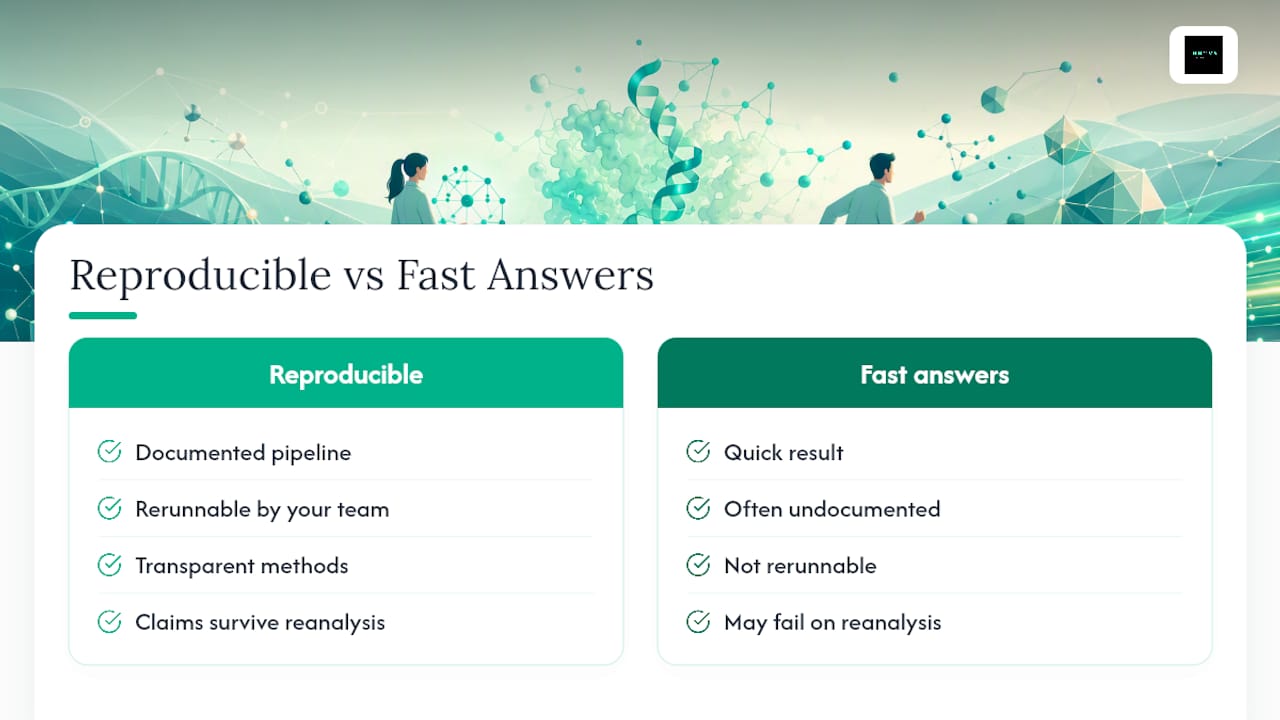
We built Innovabiotech around one conviction: a fast answer you can't reproduce is worse than no answer at all. Every pipeline we hand back gets documented so your team can rerun it independently. Transparency isn't a courtesy here; it's how scientific claims survive contact with your own data.
Ready to Scope Your First Project With Innova Biotech Solutions?
If you've read this far, you already have a shortlist forming in your head, and the next move is simple: get a real conversation started before your next planning cycle locks you into another quarter of delay. Innovabiotech works on a project or retainer basis, so you're not signing up for a permanent headcount commitment to get access to specialized protein engineering and computational modeling expertise.
Request a capability packet and NDA, and come to the scoping call with a one-page description of your target and constraints. That's usually enough for us to propose a pilot scope with a realistic timeline. Whether your priority is de novo peptide design or enzyme stability work, a short pilot is the lowest-risk way to see how our pipelines perform against your own data before committing to a larger program. Reach out through our enzyme solutions page or the protein design page above to start that conversation.
Sources
- Guidelines on outsourcing practice in life science
FAQ
How Long Does a Typical Pilot Project Take?
Most reproducibility pilots run four to eight weeks, enough time to test a vendor's pipeline against a dataset your own team trusts before committing to a longer program.
What Should Be in the Contract Before Work Starts?
An NDA, a scope of work with explicit acceptance criteria, IP assignment terms, data return or erase clauses, and audit rights covering pipeline and QA records.
Does Innova Biotech Solutions Offer Pilot Engagements?
Yes. Innova structures projects with an initial pilot phase so R&D teams can validate pipeline performance on their own data before scaling to a full program.
What's the Biggest Red Flag When Evaluating a Vendor?
A vendor who can't produce a reproducible pipeline or gives vague deliverable descriptions instead of specific, checkable outputs and acceptance criteria.
Who Should Own the Data and IP Generated During the Project?
That depends on the contract, but buyers should negotiate explicit IP assignment or licensing terms for generated sequences, models, and code before work begins.