
A compliant regulatory bioinformatics data submission packages reproducible workflows documented as a BioCompute Object (IEEE 2791-2020), raw and processed files with full provenance, validation evidence, and signed manifests, all structured for eCTD/ESG transfer to the FDA. Three anchors drive every successful package: the FDA's accepted standard (IEEE 2791-2020 / BioCompute), the eCTD/ESG transmission path, and HIPAA-compliant data handling.
Immediate submission checklist:
- BioCompute Object (BCO) in IEEE 2791-2020 JSON format, covering all required domains
- Raw sequencing files (FASTQ/BAM) and processed outputs (VCF, count matrices) with sample manifests
- Container images (Docker) with pinned digests; workflow descriptors (CWL or WDL)
- Verification kit: representative test datasets, expected outputs, and execution commands
- Validation summary report, SOPs, and signed QA/RA attestations
- Signed manifest with SHA-256 checksums for every file
- eCTD-packaged dossier, uploaded via the FDA Electronic Submissions Gateway (ESG)
- Privacy review: HIPAA de-identification or controlled-access routing (dbGaP/NCBI SRA) for identifiable genomic data; GDPR DPIA if EU-sourced data is involved
Table of Contents
- What does the FDA actually expect from bioinformatics evidence?
- How do you build the bioinformatics submission package step by step?
- What goes inside a BioCompute Object for regulatory use?
- What validation evidence and documentation do regulators expect?
- How do HIPAA and GDPR affect what you can include in the submission?
- Where and how do you transmit the package?
- What timelines and pitfalls should you plan for?
- When should you use an external vendor instead of doing it in-house?
- Key Takeaways
- The case for getting the BCO right before anything else
- Innova Biotech Solutions handles the full submission package for you
- Authoritative sources and further reading
- FAQ
What does the FDA actually expect from bioinformatics evidence?
The FDA's expectations center on four properties: reproducibility, traceability, provenance, and standards conformance. When bioinformatics software influences a clinical decision, FDA software guidance becomes a required compliance layer on top of standard data security, meaning risk management and validation must go well beyond file formatting.
The FDA formally announced support for the IEEE BioCompute standard for submitting high-throughput sequencing (HTS) data in NDAs, ANDAs, BLAs, and INDs, and added it to the FDA Data Standards Catalog. This applies across CDER, CBER, and CFSAN submissions. Reviewers across those centers now expect to see a BCO as the primary workflow descriptor.
Trust signals reviewers look for in practice: versioned workflow descriptors, container digests, SHA-256 checksums on every file, SOPs with change-control logs, and signed QA attestations. The regulatory compliance stack for bioinformatics also includes HIPAA, NIH GDS, ISO 27001, FISMA, and NIST SP 800-53, each with concrete engineering requirements. eCTD/ESG is the mandatory packaging and transmission path; the BCO and validation artifacts sit inside the dossier modules.
How do you build the bioinformatics submission package step by step?
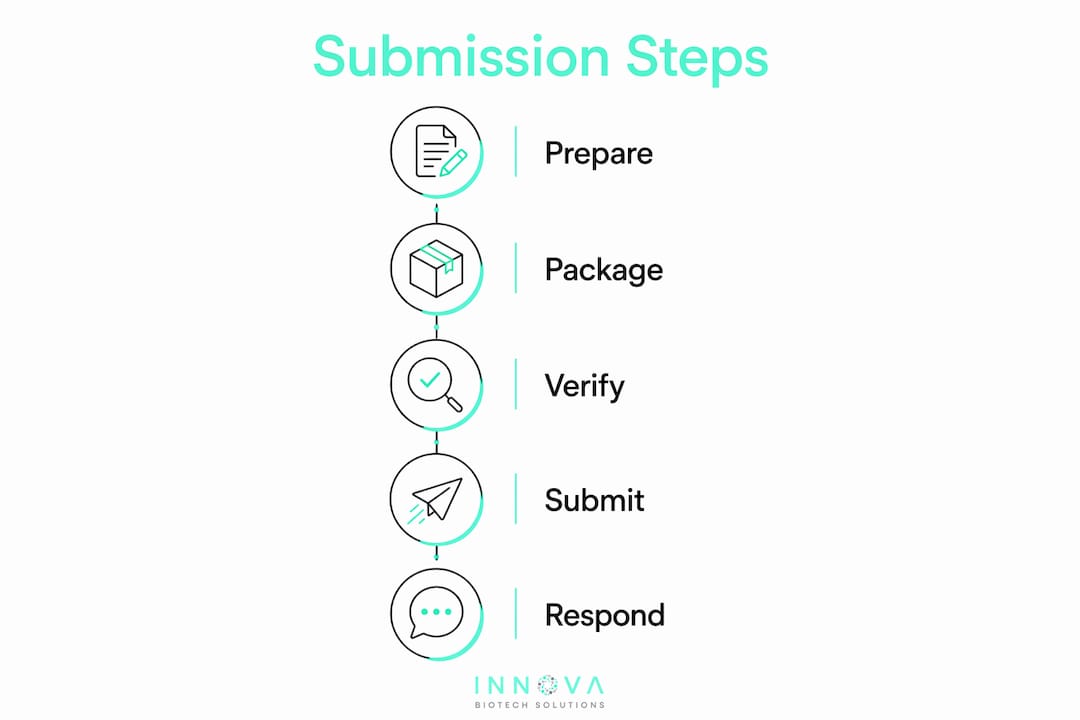
Follow this sequence. Each step names the artifact to produce and who owns it.
- Classify data sensitivity. Identify PHI, genomic identifiers, and consent scope. Regulatory Affairs owns this gate.
- Finalize consent and legal basis. Confirm participant consent covers the regulatory use case; document the legal basis for any cross-border transfer.
- Freeze pipeline versions. Pin all software versions, container image digests, and reference database releases. Bioinformatics Engineering owns this.
- Generate the BCO. Author the IEEE 2791-2020 JSON, linking to containers, input manifests, and output summaries. See the artifact table below.
- Assemble raw and processed files with manifests. Collect FASTQ/BAM/VCF files, generate SHA-256 checksums, and produce a signed sample manifest.
- Run the verification kit. Execute the test dataset against the frozen pipeline; confirm outputs match expected results. Document concordance.
- Prepare SOPs and QA attestations. Compile change-control logs, validation summary report, and signed QA/RA sign-off.
- Package for eCTD/ESG and transfer. Place artifacts in the correct eCTD modules, validate the package, and upload via the FDA ESG.
Pro Tip: Include a verification kit alongside the BCO. A simulation study found that BCOs paired with verification kits produced very high concordance between submitter and reviewer analyses, which directly reduces reviewer back-and-forth and deficiency notices.
| Artifact | Required metadata | Recommended format |
|---|---|---|
| Raw sequencing reads | Sample ID, run ID, instrument, read length | FASTQ (gzipped) |
| Aligned reads | Reference genome version, aligner version | BAM + BAI index |
| Variant calls | Caller version, filtering thresholds | VCF / gVCF |
| BioCompute Object | All IEEE 2791-2020 domains, container digest | JSON |
| Sample manifest | SHA-256 checksums, file paths, sample metadata | TSV or CSV |
| Verification kit | Expected outputs, execution commands | Archived directory |
Operational platform controls such as scoped roles, structured audit events, and retention labels materially reduce compliance risk and make this assembly repeatable across submissions.
What goes inside a BioCompute Object for regulatory use?
The six domains regulators need to see in every BCO are: provenance, usability, description, execution, parametric, and extension. Missing any one of them typically triggers a reviewer question.

| BCO domain | What to attach | Why reviewers need it |
|---|---|---|
| Provenance | Input file manifests, checksums, consent references | Establishes data lineage and legal basis |
| Usability | Plain-language summary, intended use, limitations | Lets non-bioinformaticians assess scope |
| Description | Pipeline steps, tool names and versions, reference databases | Enables independent reproduction |
| Execution | Container image URI + digest, workflow descriptor (CWL/WDL) | Guarantees the exact computational environment |
| Parametric | All tunable parameters and their values | Prevents ambiguity in re-runs |
| Extension | Links to raw data locations (dbGaP accession or eCTD path) | Connects the BCO to the actual files |
Minimal metadata to include for fast reviewer comprehension: software name and version for every tool, container digest (SHA-256), input manifest with checksums, and a one-paragraph output summary. Link FASTQ/BAM/VCF locations in the Extension domain; reference container images in Execution. The BCO JSON itself should be placed in eCTD Module 5 alongside the clinical study reports it supports.
What validation evidence and documentation do regulators expect?
Non-negotiable validation items: a verification kit with representative test cases and expected outputs, a reproducibility record showing concordance between independent runs, unit and integration test logs, and a signed validation summary report. When bioinformatics software influences diagnosis or treatment, FDA software guidance requires a full software lifecycle record, not just a data security checklist.
Software lifecycle evidence to compile: version control commit history (Git tags or equivalent), container digests for every release, CI/CD traceability records, release notes, and signed change-control records. SOPs must be signed; supporting detail can be summarized in the submission with full records available on request. See bioinformatics validation guidance for concrete artifact checklists.
Pro Tip: Package validation evidence so reviewers can re-run key steps without accessing PHI. Use synthetic or de-identified test datasets in the verification kit, and document the exact commands needed to reproduce each result.
Structured audit logs using system identifiers rather than raw patient identifiers preserve auditability without leaking PHI, a design principle that satisfies both HIPAA and FDA 21 CFR Part 11 requirements for electronic records and signatures.
How do HIPAA and GDPR affect what you can include in the submission?
The decision rule is straightforward: if genomic data contains or can reasonably re-identify a participant, it must be de-identified under HIPAA Safe Harbor or Expert Determination before inclusion in the dossier, or routed to a controlled-access repository (dbGaP or NCBI SRA) with access instructions referenced in the eCTD.
HIPAA requires breach notification "without unreasonable delay." Under GDPR Article 33, organizations must notify regulators of a genetic-data breach within 72 hours of discovery. When EU-sourced genomic data is involved, a Data Protection Impact Assessment (DPIA) is required before large-scale processing because genetic data is a special category under Article 9. Cross-border transfers require either Standard Contractual Clauses or a federated analysis approach that keeps data in-country.
Consent management must be dynamic: systems need to track evolving participant permissions and support withdrawal or restriction of specific uses across the data lifecycle. Minimal consent language should explicitly cover regulatory review as a permitted use.
Pro Tip: Separate participant identifiers from analysis artifacts at the platform level. Use security controls such as encryption at rest and in transit, role-scoped access, and structured audit logs to satisfy both HIPAA and FDA 21 CFR Part 11 simultaneously.
Where and how do you transmit the package?
eCTD/ESG is the primary channel for all dossier content. Large raw datasets are typically referenced via controlled-access repositories rather than embedded directly in the eCTD.
Placement inside eCTD:
- BCO JSON and validation reports: Module 5 (clinical study reports)
- Analytical methods and SOPs: Module 2.7 (clinical summary) or Module 5 appendices
- Sample manifests and checksums: alongside the relevant study datasets
When to use dbGaP or NCBI SRA instead of eCTD embedding:
- Raw FASTQ/BAM files for studies with identifiable participants
- Datasets subject to NIH Genomic Data Sharing (GDS) policy
- Any file set where cross-border transfer rules prohibit direct inclusion
ESG transfer steps:
- Validate the eCTD package against FDA technical criteria (pass/fail and best-practice checks).
- Generate SHA-256 checksums for the full package; include a sha256.txt at the submission root.
- Encrypt the transfer using TLS; confirm receipt acknowledgment from the ESG.
- Retain the signed manifest and ESG receipt as part of the submission record.
For large biological datasets, pre-staging files and running a local eCTD validator before ESG upload catches the majority of technical rejections before they happen.
What timelines and pitfalls should you plan for?
The most common triggers for deficiency notices are reproducibility failures, missing provenance, mismatched checksums, and absent verification kits. Any of these can add weeks to the review cycle.
Common pitfalls: container images referenced without a pinned digest (a tag like "latest" is not reproducible), consent documentation that does not explicitly cover regulatory review, and BCO Extension domains that point to files not included in the manifest.
Pro Tip: Run a pre-flight check 48 hours before submission: verify every checksum, confirm all container digests resolve, re-run the verification kit on a clean environment, and cross-reference the BCO Extension domain against the actual file manifest.
When responding to an FDA data deficiency notice, lead with the corrected BCO and a change summary, then attach the updated verification kit output. Never resubmit raw data without a revised manifest and updated checksums.
When should you use an external vendor instead of doing it in-house?
Use an external specialist when any of the following apply: the submission involves more than a few hundred gigabytes of HTS data, your team lacks direct BCO authoring experience, the timeline is under 12 weeks, or the program requires FedRAMP-aligned or ISO 27001-audited infrastructure.
In-house preparation makes sense when your bioinformatics team already maintains versioned, containerized pipelines with CI traceability and your regulatory affairs team has authored BCOs before. The decision comes down to auditability and speed, not just cost.
What to require from any vendor: BCO authoring in IEEE 2791-2020 JSON, a verification kit with documented test cases, containerized reproducible runs with pinned digests, signed SOPs, and a transfer-ready eCTD package with manifests. Understanding why regulatory science matters for cross-functional governance helps procurement teams ask the right questions when evaluating proposals.
Pro Tip: Ask vendors for a sample BCO from a prior engagement (redacted). If they cannot produce one, they have not done this before.
Key Takeaways
A compliant regulatory bioinformatics data submission requires a BioCompute Object (IEEE 2791-2020), a verification kit, signed manifests with SHA-256 checksums, and eCTD/ESG packaging, with HIPAA de-identification or controlled-access routing for identifiable genomic data.
| Point | Details |
|---|---|
| BioCompute Object is mandatory | Author a complete IEEE 2791-2020 JSON covering all six domains before assembling the dossier. |
| Verification kit reduces deficiencies | Pair the BCO with representative test datasets and expected outputs to prevent reproducibility failures. |
| Checksums and manifests are non-negotiable | Generate SHA-256 checksums for every file and include a signed manifest in the eCTD package. |
| HIPAA/GDPR gate raw data routing | De-identify or route identifiable genomic data to dbGaP/SRA; run a GDPR DPIA for EU-sourced data. |
| Innovabiotech delivers submission-ready packages | Innova Biotech Solutions authors BCOs, builds verification kits, containerizes pipelines, and packages eCTD-ready dossiers for NDA/ANDA/BLA/IND submissions. |
The case for getting the BCO right before anything else
Most teams treat the BioCompute Object as a documentation task they complete after the analysis is done. That sequencing is backwards, and it shows up in submissions as missing container digests, BCO domains that do not match the actual pipeline, and verification kits assembled from memory rather than from a frozen environment.
The BCO should be drafted in parallel with pipeline development, not after. When the Execution domain is written while the container is being built, the digest is accurate by construction. When the Parametric domain is filled in during analysis, parameter drift gets caught before it becomes a deficiency. The teams that get through FDA review without a bioinformatics-related information request are almost always the ones that treat the BCO as a living engineering document, not a submission artifact.
The other underestimated factor is the verification kit. Reviewers are not going to re-run your full pipeline on production data. They will run the verification kit. If it fails, or if the expected outputs do not match, the entire submission's reproducibility claim is in question. Picking three to five representative test cases that exercise the critical decision points in the pipeline, and documenting the exact commands to run them, takes a day. The alternative is a deficiency notice and a six-week delay.
Innova Biotech Solutions handles the full submission package for you
Preparing a BioCompute-first submission package from scratch takes specialized expertise most regulatory teams do not have on staff, and the cost of a deficiency notice far exceeds the cost of getting it right the first time.
Innova Biotech Solutions, based in San Francisco, authors IEEE 2791-2020 BCOs, builds verification kits with documented test cases, containerizes pipelines with pinned digests, and delivers eCTD-ready packages with signed manifests for NDA, ANDA, BLA, and IND submissions. The engagement starts with a gap analysis of your current pipeline documentation and data handling against FDA expectations, so you know exactly what is missing before the clock starts. Explore Innovabiotech's peptide design and validation services to see how the team operationalizes submission-ready bioinformatics from the ground up, or contact Innova Biotech Solutions directly to scope a compliance audit for your next submission.
Authoritative sources and further reading
- FDA Federal Register Notice: Support for IEEE BioCompute Standard — the formal regulatory backing for BCO use in NDAs, ANDAs, BLAs, and INDs.
- BioCompute Objects and Verification Kits (bioRxiv) — simulation study demonstrating high concordance when BCOs are paired with verification kits.
- GDPR Article 33: Breach Notification — 72-hour notification requirement for genetic data breaches.
- GDPR Article 35: Data Protection Impact Assessment — DPIA obligation for large-scale processing of genetic data.
- Compliance for Bioinformatics Engineers — maps HIPAA, GDPR, NIH GDS, ISO 27001, FISMA, NIST SP 800-53, and FDA software guidance to engineering requirements.
- Compliance Controls for Bioinformatics Platforms — operational engineering controls including scoped roles, audit events, and retention labels.
- Genomic Data Analysis Compliance Requirements — guidance on federated analysis and controlled-access repositories for cross-border genomic data.
- ICH eCTD v4.0 Support Documentation — technical specification for eCTD packaging, SHA-256 checksums, and submission unit structure.
- NIH dbGaP (controlled-access genomic data repository): www.ncbi.nlm.nih.gov/gap — primary repository for identifiable genomic data referenced in regulatory submissions.
- NCBI Sequence Read Archive (SRA): www.ncbi.nlm.nih.gov/sra — open-access repository for raw HTS data not subject to controlled-access requirements.
FAQ
What is a BioCompute Object and why does the FDA require it?
A BioCompute Object (BCO) is a structured JSON document conforming to IEEE 2791-2020 that describes a bioinformatics pipeline in enough detail to reproduce it. The FDA added it to the Data Standards Catalog for HTS submissions in NDAs, ANDAs, BLAs, and INDs.
Where do bioinformatics files go inside an eCTD submission?
Place the BCO JSON and validation reports in Module 5 alongside the clinical study reports they support; analytical SOPs go in Module 2.7 or Module 5 appendices; sample manifests and checksums accompany the relevant study datasets.
When must raw genomic data go to dbGaP or NCBI SRA instead of the eCTD?
Route raw FASTQ/BAM files to dbGaP or NCBI SRA when participants are identifiable, when the study falls under the NIH Genomic Data Sharing policy, or when cross-border transfer rules prohibit direct eCTD inclusion; reference the repository accession in the dossier.
What does HIPAA require for genomic data in a regulatory submission?
HIPAA requires that any PHI, including genomic identifiers, be de-identified under Safe Harbor or Expert Determination before inclusion in the submission dossier, or that access be restricted through a controlled-access repository with documented consent.
How can Innovabiotech help with a bioinformatics submission package?
Innova Biotech Solutions authors IEEE 2791-2020 BCOs, builds verification kits, containerizes pipelines with pinned digests, and delivers eCTD-ready packages with signed manifests for NDA, ANDA, BLA, and IND submissions, starting with a gap analysis of your current documentation.