
TL;DR:
- Computational protein design uses algorithms to find amino acid sequences that fold into desired structures. It has become a central tool in drug discovery, reducing costs and timelines. The field now integrates advanced AI tools to generate and validate protein candidates efficiently.
Computational protein design is the process of engineering proteins with targeted structures and functions by using algorithms to identify amino acid sequences that fold into a desired 3D shape. The field received its highest validation when the 2024 Nobel Prize in Chemistry recognized David Baker and Demis Hassabis for advances in computational protein design and structure prediction. That recognition marked a turning point: the scientific community now treats this discipline as a primary driver of drug discovery, not a supplementary tool. Tools like ProteinMPNN, RFdiffusion, and ESMFold have moved the field from theoretical modeling to practical pipeline deployment, and understanding how they work together is now a core competency for biotech and pharma professionals.
How does computational protein design work?
Computational protein design solves what researchers call the inverse folding problem. Traditional protein science asks: given a sequence, what structure does it fold into? Computational design reverses the question. You start with a target 3D backbone and ask: which amino acid sequences will reliably fold into that shape?
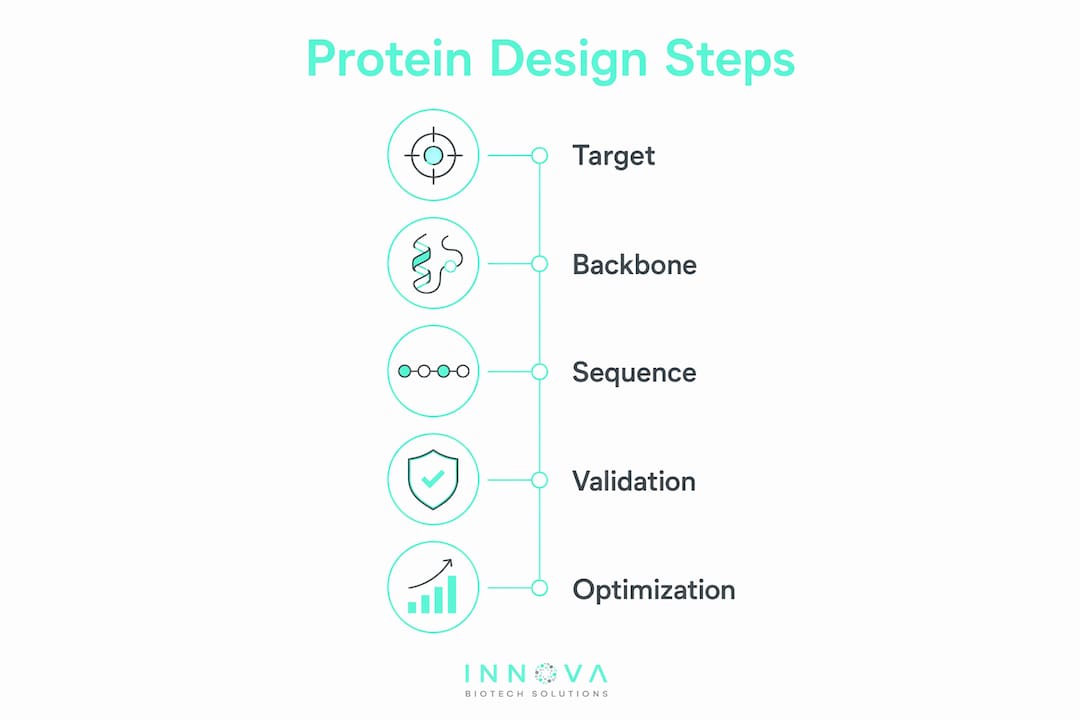
The standard workflow runs in three stages. First, a backbone is selected or generated from scratch. Second, a sequence design model populates that backbone with amino acids. Third, a structure prediction model validates whether the designed sequence actually folds as intended.
- Backbone generation. RFdiffusion generates novel protein backbones by treating structure generation as a diffusion process, similar to how image generation models work. This step produces backbones with geometries that do not exist in nature, which is critical for designing proteins with entirely new functions.
- Sequence design. ProteinMPNN and RFdiffusion are complementary steps in de novo design pipelines. ProteinMPNN takes the backbone coordinates and outputs amino acid sequences predicted to fold into that structure. It replaces evolutionary constraints with explicit design intent.
- Round-trip validation. ESMFold or AlphaFold2 then predicts the structure of the designed sequence independently. If the predicted structure matches the original backbone, the design passes. If not, the sequence is discarded before any lab work begins.
This approach differs fundamentally from random mutagenesis, which screens large libraries of random variants and hopes to find a functional hit. Computational design narrows the candidate pool before any physical synthesis occurs. Physics-based methods like Rosetta calculate energy functions to evaluate sequence-structure compatibility. Machine learning methods like ProteinMPNN learn sequence-structure relationships from millions of known protein structures and generalize across novel backbones.
Pro Tip: Run multiple ProteinMPNN sequences per backbone (typically 50–100 variants) and use ESMFold to filter for high confidence scores before ordering any synthesis. This single step eliminates the majority of non-folding candidates at near-zero cost.
What are the advantages and challenges of current approaches?
The performance gap between AI-driven design and legacy methods is measurable. ProteinMPNN increased experimental validation success rates to 50–70%, compared to 10–30% for Rosetta-based methods. That difference translates directly into fewer synthesis runs, less reagent waste, and faster timelines.
The cost and time reductions are equally significant:
- Timeline compression. Computational filtering reduces experimental testing timelines from months to days by eliminating non-viable sequences before lab work begins.
- Cost reduction. The same filtering approach cuts experimental costs by approximately 90% compared to unguided screening methods. That figure reflects the elimination of synthesis, expression, and assay costs for sequences that would have failed anyway.
- Sequence space coverage. The total sequence search space for a protein of length N is 20^N possibilities. Exhaustive experimental screening of that space is physically impossible. Computational heuristics and machine learning make the problem tractable by scoring and ranking candidates before any physical testing.
- Closed-loop refinement. Successful design workflows use closed-loop systems where computational generations are continuously refined by experimental feedback. Each wet-lab result trains the next design cycle, compounding accuracy over time.
The challenges are real and should not be minimized. Current models predict static structures well but struggle with conformational dynamics, allosteric effects, and multi-step catalytic mechanisms. Designing a protein that binds a target is now routine. Designing one that performs a catalytic reaction with precise kinetics remains genuinely hard. Model selection also matters: AlphaFold2 excels for apo states, while homology modeling is sometimes preferable for ligand-bound conformations. Choosing the wrong tool for the structural context produces misleading validation results.
Which tools lead the field in computational protein design today?
The current toolkit divides into backbone generators, sequence designers, structure validators, and property predictors. Each fills a distinct role in the pipeline.
| Tool | Primary function | Typical use case | Key strength | Limitation |
|---|---|---|---|---|
| RFdiffusion | Backbone generation | De novo protein creation | Generates novel folds not found in nature | Requires downstream sequence design |
| ProteinMPNN | Sequence design | Populating any backbone with sequences | High experimental success rates | Does not predict functional properties |
| ESMFold | Structure prediction | Fast round-trip validation | Speed; no multiple sequence alignment needed | Lower accuracy than AlphaFold2 on some targets |
| AlphaFold2/3 | Structure prediction | High-accuracy validation | Best-in-class accuracy for apo structures | Slower; less suited for ligand-bound states |
| ThermoMPNN | Stability prediction | Filtering thermostable variants | Predicts melting temperature shifts | Trained on limited stability datasets |
| SoluProt | Solubility prediction | Filtering expressible candidates | Reduces insoluble expression failures | Organism-specific training data |
The emerging ORI framework (Ontology Reinforcement Iteration) represents a different design philosophy. ORI combines semantic prompts with reinforcement learning to produce controllable and interpretable protein designs. Instead of specifying a backbone geometry, a researcher describes desired functional properties in structured language, and the system generates sequences that satisfy those constraints. This approach is particularly relevant for multi-objective design problems where binding affinity, stability, and solubility must all be optimized simultaneously.
Pro Tip: Do not treat ESMFold and AlphaFold2 as interchangeable. Use ESMFold for rapid screening of hundreds of candidates, then apply AlphaFold2 to the top-ranked subset for high-confidence structural validation before committing to synthesis.
How is computational protein design applied in drug discovery?
The global protein engineering market is projected to exceed $500 billion by 2035, driven by tools like RFdiffusion and ProteinMPNN. That projection reflects the breadth of applications now active across pharmaceutical pipelines.
The most direct applications in drug discovery include:
- Enzyme engineering. Computational design produces enzymes with active sites tailored to non-natural substrates. This is central to biocatalytic drug synthesis, where a designed enzyme replaces multiple chemical synthesis steps with a single enzymatic reaction.
- Therapeutic binder design. Designing proteins that bind specific disease targets with high affinity and selectivity is now a primary use case. This includes miniproteins, designed ankyrin repeat proteins (DARPins), and other non-antibody scaffolds that reach targets inaccessible to conventional antibodies.
- Monoclonal and bispecific antibody optimization. Computational methods redesign antibody CDR loops to improve affinity, reduce immunogenicity, and add bispecific functionality. This accelerates the hit-to-lead stage by filtering thousands of CDR variants computationally before any cell-based assay.
- Fusion protein design. Linking two functional domains requires careful design of the linker region and interface geometry. Computational tools predict whether a fusion construct will fold correctly and maintain both activities.
- De novo peptide design. Advanced iterative workflows cycle through sequence design, structural prediction, property evaluation, and wet-lab testing to refine peptide candidates efficiently. This closed-loop approach is particularly effective for peptide therapeutics where stability and membrane permeability must be balanced.
The practical workflow in a pharma setting typically runs as follows. A target structure is obtained or modeled. RFdiffusion generates candidate binder backbones against the target surface. ProteinMPNN designs sequences for each backbone. ESMFold validates folding. ThermoMPNN and SoluProt filter for stability and solubility. The surviving candidates, often fewer than 1% of the original set, go to synthesis and assay. The fold-design-validate pipeline filters millions of hypothetical sequences to a small, testable set. That compression is what makes the economics of computational design so compelling for pharma R&D budgets.
The field is also shifting in its ambitions. The central challenge is moving from "how to design" to "what to design," focusing on integrating complex functionality like binding, catalysis, and conformational switching into single protein constructs. Protein nanomachines that perform multiple coordinated functions represent the frontier of this work.
Key takeaways
Computational protein design delivers measurable improvements in success rates, cost, and timeline when integrated properly into drug discovery workflows.
| Point | Details |
|---|---|
| Inverse folding is the core principle | Design starts with a target structure and works backward to find sequences that fold into it. |
| AI tools outperform legacy methods | ProteinMPNN achieves 50–70% experimental success rates versus 10–30% for Rosetta-based design. |
| Computational filtering cuts costs sharply | Filtering sequences before synthesis reduces experimental costs by approximately 90% and compresses timelines from months to days. |
| Tool selection determines accuracy | AlphaFold2 suits apo state validation; ESMFold suits rapid screening; model mismatch produces misleading results. |
| Closed-loop workflows compound gains | Integrating wet-lab feedback into each design cycle continuously improves candidate quality over time. |
Why the computational-experimental divide is the wrong frame
The most persistent misconception I encounter is that computational design and experimental biology are competing approaches. They are not. Every computational design still requires wet-lab validation. The question is never "compute or experiment." The question is how many experiments you run, and on what quality of candidates.
What I have seen shift most dramatically is the starting point of a project. Five years ago, a team designing a therapeutic binder would synthesize hundreds of variants and screen them broadly. Now, the same team runs computational filtering first and synthesizes fewer than twenty candidates with a much higher probability of success. The integration of robotics and automated learning into closed-loop workflows is accelerating this further. Automated platforms can run design-test-learn cycles faster than any manual process.
My practical advice for teams adopting these tools: do not start with the most sophisticated model. Start with a clear structural question, choose the tool matched to that question, and build the closed-loop feedback process before worrying about which generative model to use. The biggest gains in my experience come not from switching tools but from tightening the feedback loop between computation and experiment. The shift from random to structure-based design is already complete at the leading edge of pharma. The teams that will lead the next decade are those that master the integration, not just the individual tools.
— Hooman
Accelerate your protein design projects with Innovabiotech
Innovabiotech, based in San Francisco, applies ProteinMPNN, RFdiffusion, and AlphaFold-based validation pipelines to client protein and peptide design projects across drug discovery and enzyme engineering. Every project runs through a structured computational-to-experimental workflow, with bioinformatics validation built into each stage.
Whether you need custom protein engineering for a therapeutic target or end-to-end peptide design and optimization with solubility and stability filtering, Innovabiotech delivers tailored solutions matched to your specific research question. Explore Innovabiotech's service pages to find the right computational biology support for your pipeline.
FAQ
What is computational protein design in simple terms?
Computational protein design is the process of using algorithms to identify amino acid sequences that fold into a specific target structure. It reverses the traditional protein folding problem by starting with a desired shape and working backward to find sequences that produce it.
How does ProteinMPNN differ from Rosetta?
ProteinMPNN uses a machine learning model trained on known protein structures to design sequences, achieving experimental success rates of 50–70%. Rosetta uses physics-based energy calculations and typically achieves success rates of 10–30% on the same benchmarks.
What is de novo protein design?
De novo protein design creates proteins with structures and functions that do not exist in nature, starting from scratch rather than modifying a natural template. Tools like RFdiffusion generate the novel backbone, and ProteinMPNN then designs sequences to match it. You can find recent de novo design examples across therapeutic and enzymatic applications.
Why is closed-loop optimization important in protein design?
Closed-loop optimization feeds experimental results back into the computational design cycle, improving candidate quality with each iteration. Without this feedback, computational models cannot correct for the gap between predicted and observed protein behavior in wet-lab conditions.
How is computational protein design used in pharmaceutical development?
Pharma teams use computational design to engineer therapeutic binders, optimize antibody CDR loops, design fusion proteins, and create biocatalysts for drug synthesis. The approach compresses hit-to-lead timelines by filtering millions of sequence candidates computationally before any synthesis or assay work begins. For a broader view of protein engineering for therapeutics, the applications now span nearly every stage of the drug development pipeline.
Recommended
- De Novo Peptide Design Benefits for Drug Discovery
- Examples of De Novo Protein Design: 2026 Research Guide
- Protein engineering, Chimeric Protein Design Services, computational modeling
- Innova Biotech Solutions: Expert Peptide Design and Optimization Services.bioinformatics validation, custom peptides, peptide design services