
TL;DR:
- Protein engineering integrates computational design, modality-specific developability screening, and iterative experimental feedback to optimize therapeutic candidates. De novo design, structure-informed models, and closed-loop workflows like ORI enable faster, more efficient development with higher success potential. Early, targeted developability assessment and multi-objective optimization are critical for translating proteins into successful biologic drugs.
Protein engineering for therapeutics is the systematic design and optimization of proteins to produce safer, more efficacious, and manufacturable biological drugs. The field now spans rational design, directed evolution, de novo protein creation, and AI-guided workflows that compress what once took years into iterative cycles measured in weeks. For biotech researchers and pharmaceutical professionals, mastering these methods is no longer optional. The gap between teams that integrate computational and experimental design and those that do not is widening fast, and the clinical pipeline reflects it.
What are the core approaches in protein engineering for therapeutics?
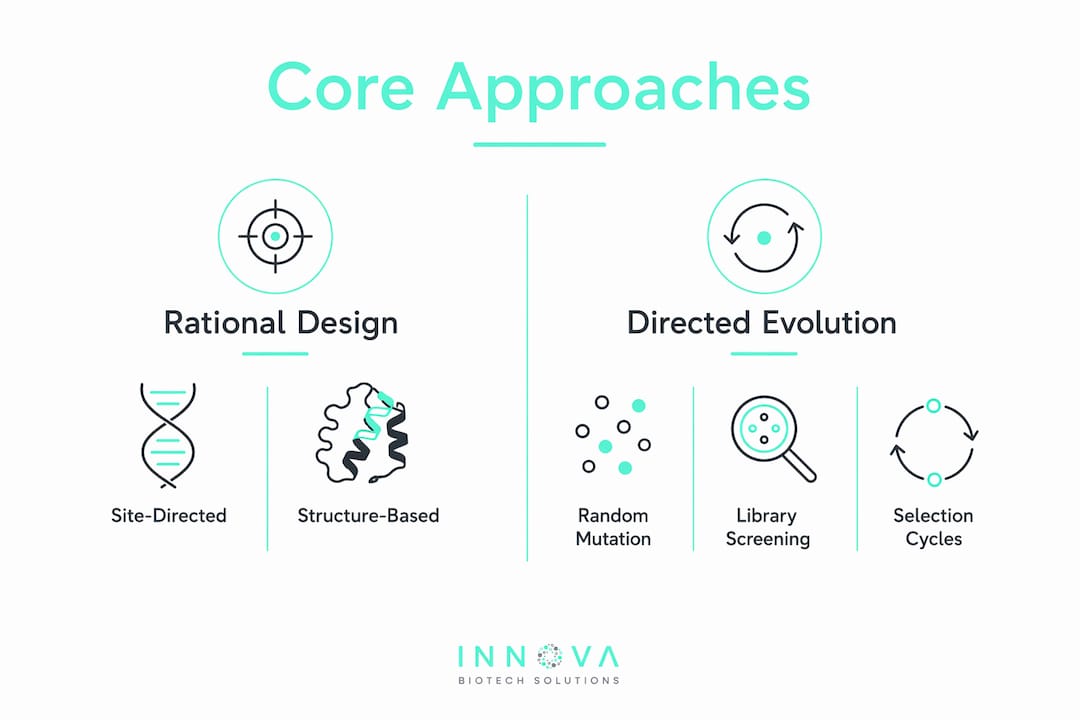
Protein engineering in drug development draws from three foundational strategies, each with distinct strengths and trade-offs.

Rational design and site-directed mutagenesis remain the starting point for most programs. You identify residues that govern binding, stability, or post-translational modification, then introduce targeted substitutions. This approach requires a solved or modeled structure and works best when the mechanism is well understood.
Directed evolution bypasses that structural requirement by generating sequence diversity through random or semi-random mutagenesis and selecting for function. Phage display, yeast display, and ribosome display are the dominant selection platforms. The method is powerful but resource-intensive, and it explores sequence space inefficiently without computational guidance.
De novo protein design is the most transformative shift in the field. De novo design creates entirely new protein structures from physical principles rather than modifying native scaffolds, which removes the evolutionary constraints that limit what native proteins can do. The 2026 literature identifies translational barriers and clinical uptake as the primary remaining challenges, not the design itself.
Computational platforms like Rosetta, RFdiffusion, and structure-informed protein language models now sit at the center of biotherapeutic protein design workflows. AI/ML hybrid workflows that couple in silico design with wet-lab validation are recognized as the standard for optimizing binding affinity, stability, and manufacturability simultaneously. This matters because optimizing one property in isolation routinely degrades another.
- Rational design: high precision, requires structural data, limited sequence space coverage
- Directed evolution: broad diversity, selection-driven, computationally unguided without ML integration
- De novo design: unconstrained by natural scaffolds, enables novel folds and functions
- AI/ML-guided workflows: scalable, multi-objective, predictive, and increasingly validated in clinical programs
Pro Tip: When selecting an engineering strategy, map your structural data availability first. If you have a high-resolution co-crystal structure, rational design or structure-informed language models will outperform directed evolution alone. If you are working with a novel target with no structural data, de novo design combined with AlphaFold2 predictions is the faster path.
How does protein developability influence therapeutic success?
Developability is the collection of physicochemical and biophysical properties that determine whether a protein candidate can survive manufacturing, formulation, storage, and administration without losing function or causing adverse responses. Poor developability is one of the leading causes of late-stage attrition in biologic drug programs, and it is largely predictable if assessed early.
The most common failure modes are aggregation, thermal instability, polyspecificity, and self-association. Each of these can disqualify a candidate that performs perfectly in binding assays. Orthogonal assay panels, including size-exclusion chromatography (SEC), hydrophobic interaction chromatography (HIC), differential scanning fluorimetry (DSF), dynamic light scattering (DLS), and ELISA-based polyspecificity assays, provide complementary readouts that no single assay can replicate alone.
A critical finding from 2026 research: standard developability parameters often fail to predict agitation-induced aggregation in monoclonal antibodies. Interfacial stability metrics, specifically surface pressure and elastic modulus measured under manufacturing-relevant conditions, are stronger predictors of aggregation risk. This means your developability screen must mimic actual handling conditions, not just baseline thermal stability.
| Modality | Key failure modes | Recommended assays | Specialized tools |
|---|---|---|---|
| Monoclonal antibodies (mAbs) | Agitation aggregation, polyspecificity, charge variants | SEC, HIC, DSF, interfacial stability assays | Biophysical panel per ICH Q6B |
| Nanobodies (VHH) | Thermal instability, non-specific binding, renal clearance | SEC, DSF, DLS, ELISA polyspecificity | Therapeutic Nanobody Profiler (TNP) |
Developability tools trained on antibodies do not transfer reliably to nanobodies. The Therapeutic Nanobody Profiler (TNP) was calibrated against 108 nanobody experimental datasets and 36 clinical-stage nanobodies specifically to address this gap. Using an antibody-centric tool on a nanobody program introduces systematic blind spots that will not surface until late-stage testing.
Pro Tip: Build your developability panel before lead selection, not after. Retrofitting developability fixes onto a selected candidate costs far more time and resources than filtering for developability-compatible sequences during the design phase. Protein stability engineering integrated at the design stage consistently reduces downstream attrition.
What strategies enable the design of high-affinity therapeutic binders?
Designing high-affinity binders against therapeutic targets requires more than optimizing a known antibody sequence. The most productive strategies in 2026 combine structural targeting logic with generative models and multi-objective scoring.
Beta-edge strand targeting is one of the most productive approaches for de novo binder design against hydrophilic protein surfaces. Beta-pairing RFdiffusion conditioning outperforms unconditioned diffusion methods by engineering geometrically complementary beta-sheet structures against exposed edge strands on receptor surfaces. Validated designs against KIT, PDGFRα, and ALK achieved picomolar to mid-nanomolar affinities, confirmed by co-crystal structures. This is not a marginal improvement. It represents a qualitative shift in what computational binder generation can deliver against historically difficult targets.
A concrete example of what this enables: a de novo binder targeting the human transferrin receptor beta edge strand achieved approximately 20 nM binding affinity and demonstrated blood-brain barrier crossing in organ-on-a-chip assays. That combination of affinity and CNS delivery functionality would be extremely difficult to engineer from a natural scaffold.
For antibody optimization, structure-informed protein language models offer a distinct advantage over sequence-only evolution. Integrating 3D backbone constraints into language model-guided evolution produced up to 25-fold improvements in neutralization and 37-fold improvements in affinity against SARS-CoV-2 escaped variants, screening only approximately 30 variants. That efficiency is what separates structure-informed from sequence-only approaches at scale.
Key strategies for high-affinity binder design in 2026:
- Target exposed beta-edge strands on receptor surfaces using RFdiffusion with beta-pairing conditioning
- Apply structure-informed protein language models for antibody affinity maturation against escaped or mutated targets
- Use generative protein design to control receptor dissociation kinetics and stabilize allosteric states for signaling pathway modulation
- Optimize multi-objective scores covering binding affinity, thermal stability, solubility, and manufacturability simultaneously rather than sequentially
- Validate top computational candidates with crystallographic or cryo-EM structural confirmation to verify design accuracy
The multi-objective framing is worth emphasizing. Optimizing binding affinity alone and then trying to recover stability or solubility is a losing strategy. Generative frameworks that score all objectives simultaneously during sequence generation produce candidates that survive the full development pipeline at a higher rate. For real-world applications of protein engineering, this integrated approach is what separates programs that reach the clinic from those that stall in lead optimization.
How to implement closed-loop protein engineering for therapeutic optimization?
One-off computational design without experimental feedback is the single biggest source of wasted cycles in therapeutic protein programs. A model that predicts well on training data but receives no correction from wet-lab results will drift from reality with each design iteration. Closed-loop frameworks solve this by treating experimental assay outputs as reward signals that continuously update the design model.
The ORI (Ontology Reinforcement Iteration) framework is the most technically complete closed-loop platform documented in 2026. ORI integrates a protein design agent, a generative sequence model, and a unified sequence model with ontology-conditioned decoding. The result is a system that can accept sparse, non-differentiable experimental objectives, the kind that come from real assay data rather than differentiable loss functions, and use them to drive iterative sequence generation. Demonstrated outcomes include substantial enzymatic activity gains and improved thermal stability across multiple protein families.
Here is how to implement a closed-loop design cycle in a therapeutic project:
- Define your design objectives explicitly: binding affinity, thermal stability, expression yield, and any modality-specific developability criteria.
- Generate an initial sequence library using a generative model such as RFdiffusion, ProteinMPNN, or an in-house language model.
- Express and assay the top-ranked candidates using your orthogonal panel. Capture quantitative outputs, not just pass/fail calls.
- Assign reward scores to each assayed candidate based on how well it satisfies the defined objectives.
- Feed reward scores back into the model to update sequence generation priorities. This is the reinforcement learning step.
- Repeat the cycle, reducing library size and increasing candidate quality with each iteration.
Pro Tip: Do not wait for a perfect computational model before starting wet-lab cycles. The first round of experimental data is almost always more informative than additional in silico refinement. Start with a smaller, diverse library and let the experimental feedback shape the model rather than trying to predict your way to a clinical candidate.
The practical benefit of closed-loop design is not just efficiency. It is the ability to optimize against objectives that cannot be fully specified in silico, including formulation behavior, cell-based potency, and in vivo half-life. Structural bioinformatics integration at each feedback cycle further sharpens the model's predictive accuracy for the next round.
Key takeaways
Protein engineering for therapeutics requires integrating computational design, modality-specific developability screening, and closed-loop experimental feedback to produce candidates that survive the full development pipeline.
| Point | Details |
|---|---|
| De novo design expands therapeutic space | Creating proteins from first principles removes natural scaffold constraints, enabling novel folds and delivery functions. |
| Developability must be modality-specific | Antibody-trained tools do not transfer to nanobodies; use TNP and tailored assay panels for each modality. |
| Structure-informed models outperform sequence-only | Adding 3D backbone constraints to language models yields up to 37-fold affinity improvements with minimal screening. |
| Closed-loop frameworks reduce attrition | ORI and similar platforms use experimental reward signals to iteratively improve sequence generation quality. |
| Multi-objective optimization is non-negotiable | Optimizing binding, stability, solubility, and manufacturability simultaneously produces higher clinical survival rates. |
Where conventional wisdom on protein engineering falls short
I have worked across enough therapeutic protein programs to say this plainly: the field overestimates what a single computational pass can deliver and underestimates how fast experimental feedback corrects a model. The instinct to run more in silico refinement before committing to wet-lab work is almost always wrong. The first 20 expressed candidates teach you more about your target and your model's blind spots than 500 additional computational predictions.
The second thing I see consistently underweighted is manufacturability. Researchers optimize binding and stability, then hand a candidate to process development and discover it aggregates at the air-liquid interface during fill-finish. That failure mode is predictable. Interfacial stability assays that mimic agitation conditions during infusion are not exotic. They are standard practice in programs that reach the clinic. The programs that skip them pay for it later.
On the AI side, I am genuinely optimistic about structure-informed language models and closed-loop platforms like ORI. But I would caution against treating them as black boxes. The teams getting the most out of these tools are the ones who understand what the model is optimizing, what data it was trained on, and where its predictions are likely to be overconfident. AI-directed design is a force multiplier for a team with strong experimental intuition. It is not a substitute for it.
The future of biotherapeutic protein design belongs to programs that treat computational and experimental work as a single integrated cycle, not sequential handoffs. That shift in workflow philosophy is more important than any individual tool.
— Hooman
How Innovabiotech supports your therapeutic protein engineering projects
Innovabiotech brings together computational protein design, bioinformatics validation, and experimental optimization under one team for therapeutic development programs that need to move fast without sacrificing rigor.
Whether you are designing de novo binders, optimizing antibody affinity against escaped variants, or building a developability-aware lead selection pipeline, Innovabiotech's protein and chimeric design services cover the full workflow from sequence generation to structural validation. The team also supports custom peptide design and enzyme optimization for programs requiring specialized biocatalytic or delivery components. Every project is scoped to your specific objectives, with transparent milestones and direct scientific communication throughout. Contact Innovabiotech to discuss how a tailored protein engineering workflow can accelerate your next therapeutic candidate.
FAQ
What is protein engineering for therapeutics?
Protein engineering for therapeutics is the design and optimization of proteins to create biological drugs with improved efficacy, selectivity, stability, and manufacturability. Methods include rational design, directed evolution, de novo computational design, and AI-guided workflows.
How does de novo protein design differ from traditional protein engineering?
Traditional protein engineering modifies existing natural scaffolds, while de novo design builds entirely new protein structures from physical principles. This removes evolutionary constraints and enables functions that natural proteins cannot perform.
Why is developability screening critical in therapeutic protein programs?
Developability failures, including aggregation, instability, and polyspecificity, are a leading cause of late-stage attrition. Early orthogonal screening using SEC, HIC, DSF, and interfacial stability assays identifies these risks before they reach costly clinical stages.
What advantage do structure-informed language models offer over sequence-only models?
Structure-informed protein language models incorporate 3D backbone constraints, which produced up to 37-fold affinity improvements in antibody evolution against SARS-CoV-2 variants while screening only approximately 30 candidates. Sequence-only models miss the geometric context that drives affinity.
What is a closed-loop protein engineering framework?
A closed-loop framework couples computational sequence generation with experimental assay feedback in iterative cycles. The ORI platform uses reinforcement learning from wet-lab reward signals to continuously improve design quality, reducing the number of experimental rounds needed to reach a clinical-grade candidate.