
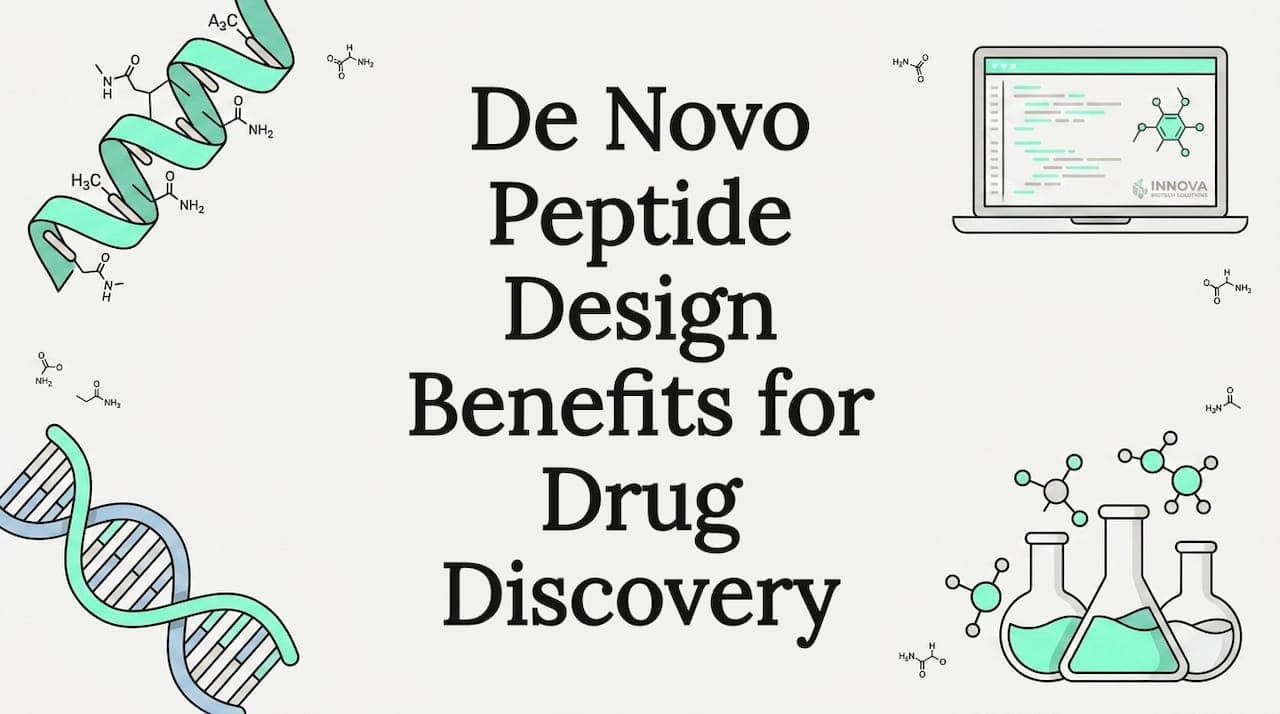
De novo peptide design is the computational creation of entirely new peptide sequences and structures tailored for specific therapeutic functions, with no dependence on naturally evolved templates. The de novo peptide design benefits are concrete and measurable: generative AI methods compress discovery timelines from years to months by combining deep learning architectures with peptide chemistry and high-throughput screening. Tools like ProtGPT2 and the M3-CAD pipeline now generate candidates with predicted bioactivity, stability, and toxicity profiles before a single wet-lab experiment runs. For biotech researchers working on targeted therapeutics, this shift from reactive screening to proactive design is the most significant change in peptide drug development in a decade.
1. De novo peptide design benefits start with computational generative modeling
Generative deep learning is the engine behind modern de novo peptide design pipelines. Transformer architectures and diffusion models explore peptide sequence space at a scale no library screen can match, producing novel sequences with defined structural and functional properties. ProtGPT2, trained on millions of protein sequences, generates candidates outside the natural sequence distribution, which is exactly where novel therapeutics often live.
The speed advantage is real. AI-driven generative pipelines reduce discovery timelines from years to months by parallelizing sequence generation across CPU clusters and embedding property predictions directly into the generation loop. Bioactivity, metabolic stability, toxicity, and membrane permeability are all scored in silico before synthesis is ever considered.
- Transformer models generate diverse sequence libraries in hours, not weeks
- Diffusion models sample from learned structural distributions to produce foldable candidates
- Ensemble property predictors filter candidates by bioactivity, toxicity, and stability simultaneously
- Parallel computation scales design to thousands of candidates per run
Pro Tip: When setting up a generative design run, constrain the model with mechanism-relevant physicochemical features from the start. Unconstrained generation produces novelty; constrained generation produces novelty that works.
2. Peptide chemistry innovations that amplify computational design

Computational design produces sequences. Peptide chemistry makes them viable drugs. The two disciplines are inseparable in any serious de novo peptide design pipeline, and the chemistry side has advanced as rapidly as the modeling side.
Cyclization, stapling, and non-canonical amino acids are the three most impactful modifications for improving pharmacokinetics and bioavailability in computationally designed peptides. Cyclization locks conformation and dramatically reduces proteolytic degradation. Stapling, particularly hydrocarbon stapling of alpha-helical segments, improves cell penetration and target binding affinity. Non-canonical amino acids introduce metabolic resistance that natural sequences simply cannot provide.
Formulation advances extend these gains further. Nanoparticle encapsulation and permeation enhancers address the delivery challenges that have historically limited peptide therapeutics to injectable routes. When these formulation strategies are selected based on computational predictions of membrane permeability and solubility, the hit rate for orally bioavailable candidates increases substantially. The key insight is that chemistry and computation must inform each other from day one of the design process, not at the end when a candidate is already failing in assays.
3. Experimental validation frameworks that reduce pipeline attrition
Generating a thousand computationally promising sequences means nothing if the validation workflow cannot separate real hits from false positives efficiently. The most effective de novo peptide design pipelines organize validation as a generation-evaluation-validation loop rather than a linear sequence of steps.
Organizing design as a generation-evaluation-validation loop ensures functional phenotype alignment at each stage and reduces downstream attrition. The Nature Communications pipeline for antimicrobial peptides demonstrated this directly: nine top-ranked candidates from a deep learning pipeline all showed verified antimicrobial mechanisms and minimal hemolysis, a result that reflects the power of multi-stage filtering.
| Validation stage | Method | Benefit |
|---|---|---|
| In silico evaluation | Ensemble property models | Filters thousands of sequences before synthesis |
| Sequence confirmation | DiNovo mirror-protease sequencing | Achieves 2-3x higher confident coverage vs. single protease |
| Phenotypic wet-lab validation | Antimicrobial and cytotoxicity assays | Confirms mechanism and rules out off-target effects |
| Resistance profiling | Evolution assays | Identifies durable candidates early |
DiNovo's mirror-protease strategy delivers two to three times higher confident peptide sequencing coverage compared to traditional single-protease approaches. This matters because sequence errors at the validation stage propagate into synthesis and clinical development, costing time and resources that most biotech programs cannot afford.
Pro Tip: Add resistance evolution assays at the validation stage, not after lead selection. Early resistance profiling differentiates candidates that will hold up in the clinic from those that look good on paper.
4. Therapeutic applications unlocked by de novo design
The advantages of peptide design become most visible in therapeutic categories where natural peptides and small molecules both fall short. Three application areas stand out in 2026: D-peptide antivirals, multi-mechanism antimicrobials, and inhibitors targeting proteins previously considered undruggable.
De novo designed D-peptides bind specific viral proteins with improved metabolic stability and minimal immunogenicity, without requiring the synthesis of D-enantiomeric target proteins. The PNAS study targeting influenza hemagglutinin confirmed binding by crystallography, demonstrating that computational mirror-image design produces real structural interactions, not just predicted ones.
Multi-mechanism antimicrobial peptides represent a separate breakthrough. The M3-CAD pipeline designs peptides active against multidrug-resistant organisms with low host toxicity and no significant resistance development in vitro or in vivo. This is the direct result of integrating biological mechanism data during model training, which forces the generative model to balance novelty with functional constraints.
- D-peptides: protease-resistant, low immunogenicity, confirmed by crystallography for influenza hemagglutinin
- Multi-mechanism AMPs: broad-spectrum efficacy, durable against resistance, validated in vivo
- Biofilm inhibitors: structural data-guided design targeting surface proteins inaccessible to small molecules
- Undruggable targets: extended peptide structures access protein-protein interaction interfaces that small molecules cannot reach
5. How de novo pipelines compare to traditional peptide discovery methods
Traditional peptide discovery relies on two approaches: screening natural peptide libraries and modifying known bioactive sequences. Both have hard ceilings on novelty and efficiency that de novo design does not share.
| Attribute | De novo design | Traditional methods |
|---|---|---|
| Discovery timeline | Months (AI-accelerated) | Years (iterative screening) |
| Sequence novelty | Unrestricted by natural templates | Constrained by known scaffolds |
| Target scope | Includes undruggable and novel targets | Limited to tractable, characterized targets |
| Wet-lab screening burden | Minimal (in silico pre-filtering) | Extensive (exhaustive library screening) |
| Resistance durability | Designed in from the start | Addressed reactively after failure |
Computational design benefits include large-scale exploration of sequence and property space, with predictions for bioactivity, stability, toxicity, and permeability generated before any synthesis occurs. The MDPI review notes that clinical validation remains the essential bottleneck, but the pre-clinical efficiency gains are not marginal. They are structural. Traditional peptide library screening produces hits within the chemical space you already know. De novo design produces hits in chemical space you have never explored.
The cost argument follows directly. Reducing wet-lab screening from exhaustive to confirmatory cuts reagent costs, instrument time, and personnel hours at the most expensive stage of early drug discovery. For biotech programs operating under capital constraints, that efficiency is not a convenience. It is a survival factor.
6. De novo peptide sequence design steps in a practical pipeline
Understanding the de novo peptide design benefits in abstract terms is less useful than knowing what a functional pipeline actually looks like. The steps below reflect current best practice for biotech teams building or evaluating a de novo design capability.
The pipeline starts with target characterization: structural data, binding site geometry, and mechanism-relevant physicochemical constraints are assembled before any generation begins. This front-loading of biological knowledge is what separates productive pipelines from those that generate novelty without function. Peptide binding affinity prediction methods are integrated at this stage to define the fitness landscape the generative model will sample.
Generation follows, using transformer or diffusion models constrained by the target-specific parameters defined in step one. Thousands of candidate sequences are produced and immediately scored by ensemble property models for bioactivity, toxicity, stability, and permeability. The top-ranked candidates, typically the top one to five percent, advance to in silico structural evaluation using docking and molecular dynamics. Only sequences that pass structural filters proceed to synthesis and wet-lab validation. This modular structure is what makes de novo pipelines faster and cheaper than traditional approaches, not any single technology in isolation.
Key takeaways
De novo peptide design delivers its greatest benefits when computational generation, peptide chemistry, and experimental validation are integrated as a single system rather than sequential handoffs.
| Point | Details |
|---|---|
| AI compresses timelines | Generative models reduce discovery from years to months by pre-filtering thousands of sequences in silico. |
| Chemistry must be co-designed | Cyclization, stapling, and non-canonical amino acids must be planned alongside computational design, not added after. |
| Validation loops prevent attrition | Multi-stage generation-evaluation-validation workflows cut downstream failure rates significantly. |
| D-peptides expand target access | Mirror-image design enables protease-resistant binders for viral and other targets without synthesizing D-enantiomeric proteins. |
| De novo outpaces traditional screening | In silico pre-filtering reduces wet-lab burden and unlocks chemical space inaccessible to library-based methods. |
Why the integration layer is where most teams actually fail
Most biotech teams I work with understand the individual components of de novo peptide design. They know what a transformer model does. They know cyclization improves half-life. What they consistently underestimate is the cost of poor integration between those components.
The computational team generates sequences optimized for binding affinity. The chemistry team synthesizes them and discovers half are insoluble under physiological conditions. The validation team runs assays and finds the soluble fraction has off-target cytotoxicity that was never modeled. Three months of work, and you are back at generation. I have seen this pattern repeat across programs that had genuinely strong individual capabilities but no shared language between disciplines.
The pipelines that work in 2026 treat mechanism data, chemistry constraints, and formulation requirements as inputs to the generative model, not as filters applied afterward. The M3-CAD approach is instructive here: integrating mechanism data during training produced peptides with durable antimicrobial effects and low resistance emergence because the model was never allowed to optimize for novelty alone.
The other thing I would push back on is the assumption that computational acceleration eliminates experimental bottlenecks. It shifts them. You now synthesize fewer sequences, but the ones you do synthesize carry higher expectations. When a computationally validated candidate fails in a phenotypic assay, the diagnostic work is harder because the failure is less expected. Build your validation framework to handle that, and the speed gains from AI design become real and durable.
— Hooman
How Innovabiotech accelerates your peptide design projects
Innovabiotech provides end-to-end support for biotech teams building de novo peptide design programs, from target characterization and generative modeling through bioinformatics validation and candidate optimization.
Our peptide design services cover the full pipeline: computational sequence generation, in silico property evaluation, structural modeling, and integration with custom peptide synthesis workflows. For teams working on protein-peptide interactions, our protein design capabilities extend the same computational rigor to chimeric and engineered constructs. If you are evaluating a de novo design approach for your therapeutic program, our team works directly with you from the first consultation through candidate delivery, with full transparency at every stage. Contact Innovabiotech to discuss your project requirements.
FAQ
What is de novo peptide design?
De novo peptide design is the computational creation of novel peptide sequences and structures from scratch, without relying on naturally occurring peptide templates. It uses generative AI models, structural data, and property predictions to produce candidates optimized for specific therapeutic functions.
How does de novo design differ from peptide library screening?
De novo design generates new sequences computationally and filters them in silico before synthesis, while library screening tests pre-existing sequences experimentally. De novo approaches access chemical space outside known natural sequences and reduce wet-lab screening burden substantially.
What are the top de novo peptide design tools in 2026?
ProtGPT2 and the M3-CAD pipeline are among the most validated tools for generative peptide design, with DiNovo providing high-confidence sequencing validation. These tools address generation, multi-mechanism design, and sequence confirmation respectively within a complete pipeline.
How long does a de novo peptide design pipeline take?
AI-driven de novo pipelines compress discovery from years to months by parallelizing sequence generation and embedding property predictions in silico. Wet-lab validation of top candidates typically adds weeks, not months, when the computational pre-filtering stage is executed correctly.
Can de novo designed peptides address drug-resistant pathogens?
Yes. The M3-CAD pipeline produced multi-mechanism antimicrobial peptides with broad-spectrum efficacy against multidrug-resistant organisms and no significant resistance development in validated in vitro and in vivo studies.
Recommended
- Innova Biotech Solutions: Expert Peptide Design and Optimization Services.bioinformatics validation, custom peptides, peptide design services
- Biotechnology Advancements: Innovations at Innova Biotech Solutions
- Peptide Binding Affinity Prediction: A Practical Guide
- What Is Peptide Library Screening for Drug Discovery