

TL;DR:
- Effective domain selection in protein design relies on deterministic scoring frameworks that consider biological context rather than general benchmarks. AI-driven methods like NISE enable iterative optimization of sequence, structure, and ligand conformation, leading to significant affinity improvements. Combining computational models with high-throughput validation accelerates the development of functional and stable engineered proteins.
Domain selection in protein design is the process of choosing and configuring protein domains to achieve targeted function and stability in engineered proteins. The right domain choice determines whether a designed protein folds correctly, binds its target, and performs under biological conditions. Frameworks like ProteinDossier now apply weighted, context-specific scoring to guide these decisions, while AI-driven methods such as neural iterative selection-expansion (NISE) push affinity and specificity beyond what traditional approaches can reach. For researchers working on protein engineering for therapeutics, domain architecture is the first and most consequential design variable.
What prerequisites and data are essential for domain selection in protein design?
Effective domain selection starts with three categories of input: sequence data, structural information, and functional annotations. Gaps in any of these categories force the design pipeline to make assumptions, and assumptions compound into errors downstream.

Sequence data is the foundation. High-quality, curated sequences from validated databases give the multiple sequence alignment (MSA) the depth it needs. MSA depth directly affects how well a model captures evolutionary conservation across a protein family. Shallow MSAs produce noisy coevolution signals, which mislead domain boundary predictions.
Structural information narrows the search space. When an experimental structure exists, whether from X-ray crystallography, cryo-EM, or NMR, it anchors domain boundary assignments to physical reality. Without structural data, computational predictions carry higher uncertainty, particularly for intrinsically disordered regions.
Functional annotations connect sequence and structure to biology. Gene Ontology terms, enzyme classification numbers, and literature-curated binding data tell you what a domain is supposed to do. Without annotations, you cannot evaluate whether a selected domain architecture actually serves the intended function.
Beyond raw data, the computational pipeline matters. The table below summarizes the key data inputs and their roles in domain selection workflows.
| Input type | Role in domain selection | Quality indicator |
|---|---|---|
| Multiple Sequence Alignment | Captures evolutionary conservation and coevolution | MSA depth (number of sequences) |
| Experimental structure | Anchors domain boundaries to physical coordinates | Resolution in Ångströms |
| Functional annotations | Links domain to biological activity | Database coverage and curation level |
| Organism taxa context | Validates model relevance to target organism | Taxonomic specificity of training data |
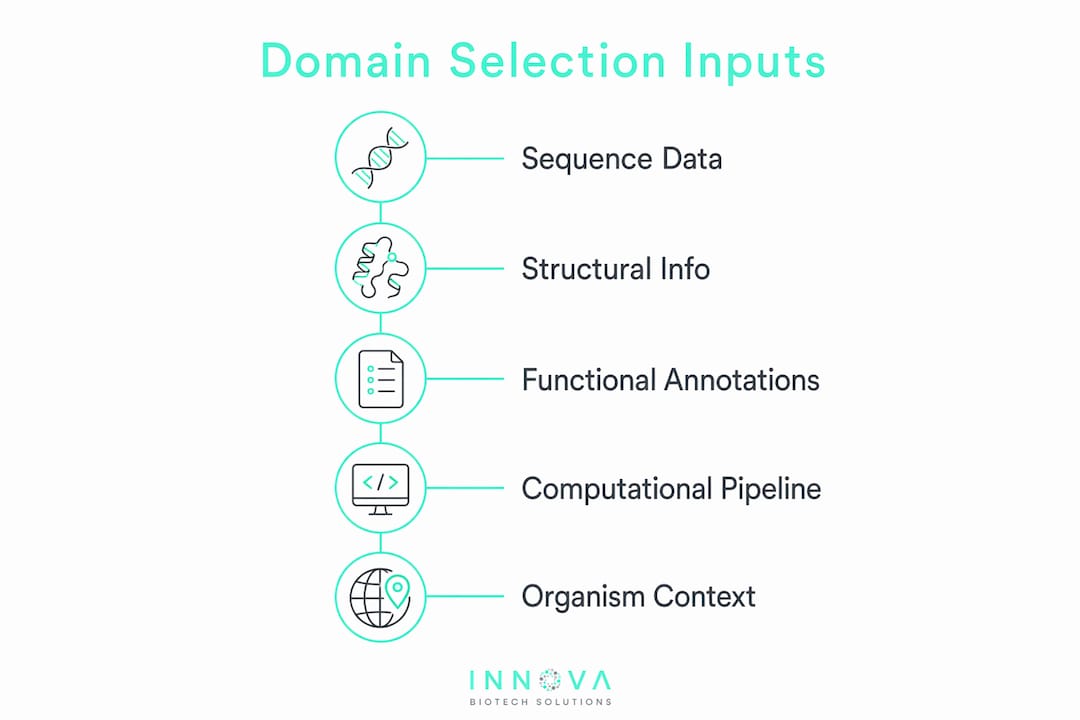
Organism taxa context deserves special attention. A model trained predominantly on bacterial sequences will underperform when applied to a mammalian protein. Context-specific model validation against organism taxa and MSA depth is more reliable than relying on generic benchmark rankings alone.
How does the ProteinDossier framework enable deterministic domain and model selection?
ProteinDossier is a deterministic pipeline that scores protein design models based on the specific context of the target protein, not on generic leaderboard performance. This distinction matters because a model that ranks first on a public benchmark may perform poorly on your particular protein family, organism, or functional class.
The ProteinDossier scoring system assigns weights across five criteria:
- Function performance (30%): How well the model performs on proteins with the same functional class as the target.
- Taxa relevance (25%): Whether the model's training data matches the organism of interest.
- MSA depth (20%): The model's reliability given the available sequence depth for the target protein.
- Structure availability (15%): Whether structural data is present to constrain predictions.
- Overall rank (10%): The model's general benchmark performance, used as a tiebreaker.
The weighting reflects a deliberate hierarchy. Functional and taxa relevance together account for 55% of the score. This forces the pipeline to prioritize biological context over raw benchmark numbers. A model with mediocre overall rank but strong performance on fungal oxidoreductases will outscore a top-ranked generalist model when designing a fungal enzyme.
In protocol mode, ProteinDossier integrates these scores into a ranked recommendation list. Researchers input their protein's functional class, organism taxa, and available MSA depth. The pipeline returns a ranked list of design models with suitability scores, not just a single "best" pick. This gives teams the flexibility to select the top-ranked model for speed or explore the second and third options when the top choice lacks structural support.
Pro Tip: Run ProteinDossier in protocol mode with your actual MSA depth before committing to a design model. A model that scores well at high MSA depth may drop significantly when your alignment has fewer than 100 sequences.
The advantage over generic leaderboard rankings is reproducibility. Because the scoring weights are fixed and the inputs are documented, two researchers using the same data will reach the same model recommendation. That determinism is critical for regulatory submissions and cross-team collaboration.
How have AI-driven methods advanced domain selection and protein design?
Neural iterative optimization represents the most significant shift in domain selection methodology in recent years. The NISE method combines neural networks to iteratively refine sequence, structure, and ligand conformation simultaneously, without requiring experimental input at each cycle.
NISE achieves up to 100-fold improvements in protein-ligand binding affinity through this iterative process. That gain comes from the method's ability to co-optimize the protein sequence and the binding pocket geometry in a single computational loop, rather than treating them as separate problems.
The practical implications for domain architecture selection are significant:
- Iterative refinement identifies which domain configurations produce the tightest binding pockets without wet-lab screening at every step.
- The method handles multi-domain proteins by evaluating interdomain contacts as part of the optimization objective.
- Sequence proposals from each cycle are filtered by predicted structural plausibility before the next iteration begins.
- The approach scales to drug-binding proteins where the ligand geometry constrains domain choice.
Traditional physics-based methods optimize a fixed energy function. NISE learns from the protein's own sequence-structure landscape and updates its optimization target as the design improves. This makes it far better suited to proteins where the optimal domain configuration is not obvious from the starting sequence.
"The shift from static domain selection to AI-driven paradigms directly addresses the genotype-to-phenotype gap that has limited protein engineering for decades. Iterative computational methods now allow researchers to explore sequence space that experimental approaches cannot reach within practical timelines."
For researchers working on computational protein design for drug discovery, NISE-style methods reduce the number of experimental cycles needed to reach a functional candidate. That translates directly into shorter project timelines and lower synthesis costs.
Active learning frameworks extend this further. Biologically constrained exploration through generative models guided by oracle feedback enables design of novel sequences with fitness characteristics beyond wild-type neighborhoods. This is not incremental improvement. It is a fundamentally different search strategy.
What strategies optimize domain architectural choices for specific protein functions?
Domain architecture in biochemistry refers to the arrangement, number, and connectivity of functional units within a protein. That arrangement is not cosmetic. It determines substrate access, catalytic geometry, and allosteric communication between sites.
The protein disulfide isomerase (PDI) family illustrates this clearly. Functional diversity in PDI proteins arises from variations in domain architecture that affect both substrate specificity and redox activity. Conserved scaffold segments and active site loops are the critical design targets, not the overall fold. This means two PDI family members with nearly identical sequences can have completely different substrate profiles based on small differences in domain order and loop geometry.
Static prediction models present a real limitation here. AlphaFold and similar tools may fail to capture domain-domain orientation changes during conformational shifts. Zinc-binding domains and phosphorylation-driven domains are particularly problematic because their functional states differ structurally from their ground states. A design built on a static prediction may perform well in silico and fail in the assay.
The table below maps common domain dynamics challenges to recommended design strategies.
| Domain behavior | Prediction challenge | Recommended strategy |
|---|---|---|
| Conformational switching | Static models miss alternate states | Use ensemble modeling or molecular dynamics |
| Zinc-binding domains | Coordination geometry changes with state | Include metal-bound structures in training data |
| Phosphorylation-driven rearrangements | Post-translational modifications alter fold | Model both phosphorylated and unphosphorylated states |
| Flexible linker regions | High disorder reduces prediction confidence | Design linkers with known length-function relationships |
Integrating domain dynamics into design decisions requires moving beyond single-structure predictions. Ensemble approaches that sample multiple conformational states give a more accurate picture of how a domain will behave under biological conditions.
What are common pitfalls in domain selection for protein design?
The most common mistake in domain selection is treating a top-ranked model on a public leaderboard as universally applicable. Generic benchmark rankings do not account for organism taxa, MSA depth, or functional class. A model that excels on a diverse benchmark may perform poorly on a narrow protein family with limited sequence data.
Three additional pitfalls appear repeatedly in practice:
- Ignoring MSA depth: Shallow alignments produce unreliable coevolution signals. Designs based on these signals tend to have poor stability in experimental validation.
- Skipping taxa validation: A model trained on prokaryotic sequences applied to a eukaryotic target introduces systematic bias. The AI-driven paradigm shift in protein engineering explicitly addresses this by incorporating taxa-specific training and validation.
- Treating domain selection as a one-time decision: Domain choice interacts with expression system, post-translational modification environment, and downstream assay conditions. Revisiting domain architecture after each experimental cycle is standard practice, not a sign of a failed design.
High-throughput experimental validation closes the loop. Magnetic separation screening can measure over 100,000 protein domain variants within 4–6 weeks. That throughput makes iterative domain selection feasible at a scale that was impossible five years ago.
Pro Tip: Build a staged validation plan before you start. Define which computational scores trigger experimental testing and which results send the design back to the domain selection step. Without this plan, teams waste synthesis budget on candidates that a second computational filter would have eliminated.
Key Takeaways
Effective domain selection in protein design requires combining deterministic scoring frameworks, AI-driven iterative optimization, and experimental validation to achieve targeted protein function and stability.
| Point | Details |
|---|---|
| Deterministic scoring beats leaderboards | ProteinDossier weights function, taxa, and MSA depth to select context-relevant design models. |
| AI iteration multiplies affinity gains | NISE achieves up to 100-fold binding improvements by co-optimizing sequence, structure, and ligand geometry. |
| Domain dynamics require ensemble modeling | Static tools like AlphaFold miss conformational shifts critical for zinc-binding and phosphorylation-driven domains. |
| MSA depth and taxa context are non-negotiable | Shallow alignments and mismatched taxa produce systematic errors that propagate through the entire design pipeline. |
| High-throughput screening closes the loop | Magnetic separation workflows can evaluate over 100,000 domain variants within 4–6 weeks, enabling true iterative design. |
Why I think most domain selection workflows are still solving the wrong problem
The field has made extraordinary progress on model accuracy. ProteinDossier, NISE, and active learning frameworks are genuinely better tools than anything available three years ago. But the bottleneck I see most often is not the model. It is the framing of the problem.
Most teams treat domain selection as a search problem: find the best domain configuration from a known set. The more productive framing is a design problem: define what biological behavior you need, then work backward to the domain architecture that produces it. That shift changes which data you collect first, which computational scores you weight, and which experimental assays you run.
I have seen projects stall for months because the team optimized a domain for binding affinity without specifying the conformational state in which binding needed to occur. The scores looked excellent. The protein failed in the assay because the high-affinity state was not the physiologically relevant one. Biologically constrained exploration through active learning frameworks addresses this directly, but only if the biological constraint is defined before the computational search begins.
The hybrid workflow I find most reliable combines ProteinDossier for initial model selection, NISE-style iterative refinement for sequence optimization, and a staged experimental plan that feeds results back into the computational layer. None of these steps works well in isolation. Together, they form a feedback loop that gets tighter with each cycle. The teams that build this loop from the start finish faster and with better candidates than those who treat computation and experiment as sequential phases.
— Hooman
Innovabiotech's protein design and computational modeling services
Innovabiotech works with research teams that need more than off-the-shelf computational tools. The protein design and chimeric protein services at Innovabiotech integrate deterministic pipelines and AI-driven methods to support domain architecture decisions from initial sequence analysis through candidate delivery.
Every project starts with a consultation to define the biological objective, the available sequence and structural data, and the experimental validation plan. Innovabiotech's team then applies context-specific model selection and iterative computational refinement tailored to the protein family and organism of interest. For teams working on enzyme domain optimization, the same framework applies to catalytic domain selection and specificity engineering. Contact Innovabiotech to discuss your project requirements and get a custom design plan.
FAQ
What is domain selection in protein design?
Domain selection in protein design is the process of choosing which protein domains to include, arrange, and configure to achieve a specific biological function. The choice of domain architecture directly determines folding stability, binding specificity, and catalytic activity in the final engineered protein.
How does ProteinDossier improve domain selection?
ProteinDossier scores design models using five weighted criteria, including function performance, organism taxa, and MSA depth, rather than relying on generic benchmark rankings. This context-specific scoring produces model recommendations that are more relevant to the target protein's actual biological environment.
What is NISE and how does it help with optimizing protein domains?
NISE (neural iterative selection-expansion) is an AI method that co-optimizes protein sequence, structure, and ligand conformation in iterative cycles without requiring experimental input at each step. It achieves up to 100-fold improvements in binding affinity, making it particularly effective for drug-binding protein domain design.
Why do static structure prediction tools fall short for domain selection?
Static tools like AlphaFold predict a single ground-state structure and cannot capture the conformational changes that many functional domains undergo during activity. Zinc-binding and phosphorylation-driven domains are especially problematic because their active states differ structurally from their predicted ground states.
How many domain variants can high-throughput screening evaluate?
Magnetic separation screening workflows can measure over 100,000 protein domain variants within 4–6 weeks. That throughput makes iterative domain selection practical at a scale that supports true experimental feedback loops in protein engineering projects.