
Enzyme engineering success is defined by measurable gains in catalytic activity, stability, substrate specificity, or industrial scalability achieved through deliberate molecular modification. The field has moved well beyond incremental improvements: Merck's biocatalytic synthesis of enlicitide decanoate, AI-designed TrpB variants outperforming decades of laboratory evolution, and phage-assisted continuous evolution of tryptophan halogenase RebH all represent examples of enzyme engineering success that set new performance benchmarks in 2026. These cases share a common thread. Each one deployed a specific, mechanistically informed strategy rather than broad mutational screening, and each delivered results at a scale or speed that traditional approaches could not match.
1. Merck's biocatalytic synthesis of enlicitide decanoate
Merck's development of an oral PCSK9 inhibitor, enlicitide decanoate, stands as one of the most consequential pharmaceutical enzyme engineering breakthroughs of the decade. The challenge was manufacturing a complex macrocyclic peptide at multi-kilogram scale without the prohibitive step count of conventional chemical synthesis.
The solution was a multi-enzyme cascade performing selective peptide fragment formation, coupling, macrocyclization, and crystallization purification in a coordinated sequence. This halved the number of chemical steps and achieved a 39% yield at multi-kilogram scale. That yield figure matters because macrocyclic peptides are notoriously difficult to produce at scale, and most competing routes plateau well below commercial viability.
"Successful pharmaceutical peptide manufacture requires coordinated enzyme sets performing distinct catalytic steps plus robust purification, not just single enhanced enzymes."
The Merck case also demonstrates that integrated enzyme cascades outperform single-enzyme optimization when the target molecule is structurally complex. Process-level design, including downstream purification, was as important as the enzymes themselves.
2. Continuous directed evolution of tryptophan halogenase RebH
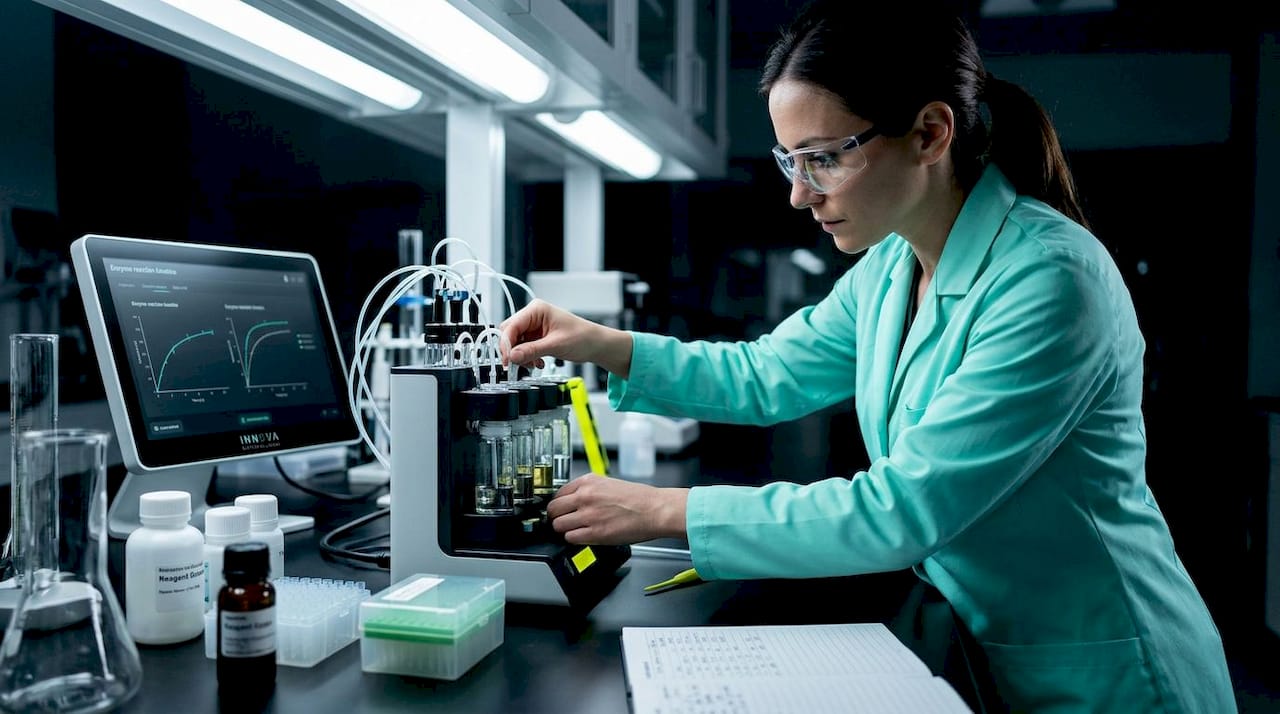
Phage-assisted continuous evolution (PACE) applied to the tryptophan halogenase RebH produced the variant RebHEvo4, carrying 12 mutations that collectively transformed a poorly soluble, low-activity enzyme into a biomanufacturing-grade catalyst. The 37-fold increase in 7-chlorotryptophan production and titers of 2.7 g/L in bioreactors represent a step change, not an incremental gain.
PACE works by coupling enzyme activity to phage propagation through a biosensor circuit. In the RebH case, an aminoacyl-tRNA synthetase-based biosensor linked halogenation activity to gene expression in real time, maintaining continuous selection pressure across thousands of generations without manual intervention. The tight genotype-phenotype coupling is what makes PACE faster than conventional directed evolution: there is no discrete round structure, so beneficial mutations accumulate continuously.
The practical implication for halogenated natural product synthesis is significant. Halogenated compounds are precursors to a range of antimicrobials and bioactive peptides, and enzymatic halogenation is far cleaner than chemical routes. RebHEvo4 makes that enzymatic route commercially viable for the first time.
3. Generative AI design of TrpB variants
Generative sequence models represent a genuinely different paradigm for enzyme engineering. Rather than starting from a known scaffold and mutating it, models like GenSLM generate novel sequences biased toward expression, stability, and catalytic competence in the target host. Applied to tryptophan synthase beta subunit (TrpB), this approach produced variants that outperformed PfTrpB-0B2, the benchmark set by years of intensive laboratory evolution at Caltech.
The standout variant, labeled "230," exceeded the industrial benchmark in tryptophan synthesis activity, maintained stability up to 75°C, and showed broader substrate promiscuity for noncanonical amino acid production. The entire design-to-test cycle took approximately one month. That timeline compares favorably to the multi-year campaigns typical of conventional directed evolution for equivalent performance gains.
Generative AI design also reduces screening burden by biasing sequences toward favorable expression in E. coli, meaning fewer variants fail at the expression stage before catalytic testing even begins. For researchers running high-throughput campaigns, this upstream filtering translates directly into cost and time savings.
Pro Tip: When using generative models for enzyme design, validate thermostability predictions experimentally at an early stage. Models trained on sequence data alone can underestimate the contribution of loop dynamics to thermal inactivation.
4. Mechanism-guided engineering of esterase Aes72 for polyurethane degradation
Polyurethane (PU) is one of the most recalcitrant synthetic polymers, and enzymatic depolymerization has long been limited by low catalytic efficiency. The engineering of esterase Aes72 addressed this directly by identifying the nucleophilic attack as the rate-determining step through a combination of crystal structure determination at 1.80 Å resolution and QM/MM simulations.
The double mutant F276A/L141I, designed by targeting that specific mechanistic bottleneck, achieved approximately 2-fold improvement in catalytic efficiency for polyether-based PU materials. That may sound modest, but in the context of polymer degradation, where baseline activity is already low, a 2-fold gain at the rate-determining step has outsized effects on overall throughput. Mechanism-guided engineering also drastically reduces the mutation search space compared to blind saturation mutagenesis, which is particularly valuable when structural data is available.
This case is a model for how structural biology and computational chemistry should inform enzyme remodeling for sustainable biocatalysis. The approach is transferable to other recalcitrant polymer-degrading enzymes, including PET hydrolases and lignin peroxidases.
5. Engineering cytochrome P450 P450stri as a peroxygenase
Cytochrome P450 enzymes are prized for regioselective C-H activation, but their dependence on expensive NAD(P)H cofactors and redox partner proteins limits industrial use. Engineering P450stri into a peroxygenase variant, M1, solved this by enabling H2O2 as the sole oxidant while maintaining regioselectivity for steroid hydroxylation.
The variant M1 tolerates H2O2 concentrations up to 300 mM, a level that inactivates most natural peroxygenases. The engineering strategy used a two-dimensional "Round Flask" approach, simultaneously optimizing activity and selectivity through semi-rational mutagenesis guided by structural analysis. Semi-preparative scale-up was demonstrated, confirming that the performance gains translate beyond the microtiter plate.
Regioselective steroid hydroxylation is a high-value transformation in pharmaceutical manufacturing. Steroidal drug intermediates that require specific hydroxylation patterns are currently produced through multi-step chemical routes or with whole-cell biocatalysts that introduce selectivity problems. A robust, cofactor-independent peroxygenase addresses both issues simultaneously.
6. How advanced techniques drive enzyme engineering breakthroughs
The five cases above each succeeded because the engineering strategy matched the specific bottleneck of the target enzyme. This is the central lesson across all successful enzyme engineering cases.
- PACE suits enzymes where solubility, activity, or substrate scope needs to improve simultaneously, and where a biosensor can be designed to link the desired function to phage propagation. It is not appropriate when the selection circuit is difficult to construct or when the target activity has no convenient readout.
- Generative AI suits cases where sequence diversity is the primary need and where expression in a standard host like E. coli is the bottleneck. It accelerates initial hit identification but does not replace mechanistic characterization of the best variants.
- QM/MM-guided mutagenesis suits cases where structural data is available and the rate-determining step is identifiable. It is the most resource-efficient strategy when the mechanistic picture is clear.
- Semi-rational design with structural guidance suits P450s and other complex metalloenzymes where active site geometry determines both activity and selectivity, and where combinatorial libraries would be too large to screen exhaustively.
- Multi-enzyme cascade design is not an alternative to the above strategies. It is a layer of process engineering that must be applied on top of individual enzyme optimization to achieve pharmaceutical-grade manufacturing outcomes.
Pro Tip: Before committing to a directed evolution campaign, run a short QM/MM analysis or molecular dynamics simulation on your enzyme of interest. Identifying the rate-determining step first can reduce your library size by an order of magnitude.
7. Industrial applications and impact of these achievements
The practical outputs from these achievements in enzyme engineering span pharmaceutical manufacturing, green chemistry, and polymer recycling.
- Pharmaceutical synthesis: Merck's enlicitide route demonstrates that biocatalytic manufacturing of macrocyclic peptides is now feasible at commercial scale, reducing chemical waste and improving yield simultaneously.
- Halogenated compound production: RebHEvo4 enables enzymatic synthesis of halogenated tryptophan derivatives at 2.7 g/L titers, making enzymatic routes competitive with chemical halogenation for antimicrobial precursor production.
- Noncanonical amino acid synthesis: AI-designed TrpB variants with broad substrate promiscuity accelerate the production of building blocks for peptide therapeutics and bioconjugates, compressing development timelines from years to weeks.
- Polymer recycling: Aes72 F276A/L141I provides a proof-of-concept for enzymatic PU depolymerization, supporting bio-based recycling of a polymer class that currently has no scalable enzymatic degradation route.
- Steroid drug intermediates: P450stri M1 offers a cofactor-independent route to regioselectively hydroxylated steroids, reducing the cost and complexity of producing pharmaceutical intermediates that currently require multi-step chemical synthesis.
The aggregate picture is that enzyme engineering is no longer confined to optimizing commodity enzymes for bulk chemical production. It now operates at the frontier of pharmaceutical manufacturing and sustainable materials processing, where the performance requirements are far more demanding and the value per kilogram of product is far higher.
8. Comparing strategies and lessons for practitioners
The table below summarizes the key trade-offs across the engineering strategies represented in these case studies.
| Strategy | Best fit | Key advantage | Primary limitation |
|---|---|---|---|
| PACE (continuous evolution) | Solubility, activity, multi-property improvement | Continuous selection, no manual rounds | Requires designable biosensor circuit |
| Generative AI (GenSLM) | Sequence diversity, expression optimization | Fast hit identification, reduced screening | Needs experimental mechanistic follow-up |
| QM/MM-guided mutagenesis | Known rate-determining step, structural data available | Minimal mutation search space | Requires high-quality structural data |
| Semi-rational P450 design | Metalloenzymes, regioselectivity tuning | Simultaneous activity and selectivity gains | Active site complexity limits prediction accuracy |
| Multi-enzyme cascade | Complex molecule synthesis | Enables reactions impossible with single enzymes | Process integration adds engineering overhead |
Protein stability engineering is a cross-cutting concern across all five strategies. Variants with improved activity but reduced thermostability rarely survive scale-up, which is why the TrpB "230" variant's stability to 75°C was as important a result as its catalytic performance. Practitioners should build stability assays into the earliest screening stages rather than treating them as a downstream validation step.
The most consistent predictor of success across these cases is mechanistic specificity. Every successful campaign targeted a defined molecular bottleneck rather than applying broad mutagenesis and hoping for improvement. That principle holds whether the tool is a phage, a language model, or a QM/MM simulation.
Key takeaways
Enzyme engineering succeeds when the strategy is matched precisely to the molecular bottleneck, whether that bottleneck is solubility, cofactor dependence, regioselectivity, or catalytic rate.
| Point | Details |
|---|---|
| Match strategy to bottleneck | PACE, AI design, and QM/MM each address different enzyme limitations; selecting the wrong tool wastes resources. |
| Cascade design is process engineering | Multi-enzyme systems like Merck's enlicitide route require coordinated process design, not just individual enzyme optimization. |
| AI compresses timelines | Generative models like GenSLM deliver benchmark-beating variants in weeks, reducing the need for multi-year evolution campaigns. |
| Mechanistic data reduces search space | QM/MM-guided targeting of the rate-determining step cut the mutation search space for Aes72 and yielded a 2-fold efficiency gain. |
| Stability must be screened early | Thermostability at 75°C was a defining criterion for TrpB "230"; variants that fail stability at scale are not commercially viable. |
What I've learned watching enzyme engineering mature
I've tracked enzyme engineering projects across pharmaceutical, industrial, and environmental applications for long enough to notice a pattern that the published literature rarely states directly. The projects that fail are almost never stopped by catalytic chemistry. They fail at the interface between molecular performance and process reality.
The Merck enlicitide case is instructive precisely because it did not stop at demonstrating that individual enzymes could perform each step. The team engineered the cascade, the purification, and the scale-up in parallel. That level of integration is still uncommon, and it is the reason most biocatalytic routes that look promising at the bench never reach manufacturing.
The rise of generative AI in enzyme design is genuinely exciting, but I am cautious about one trend I see in how it is being applied. Researchers sometimes treat AI-generated variants as finished products rather than starting points. The TrpB "230" variant is impressive, but its value came from rigorous experimental characterization after generation, not from the model output alone. AI accelerates the front end of discovery. It does not replace the mechanistic work that determines whether a variant is actually useful.
The area I expect to produce the most significant breakthroughs in the next three years is the intersection of continuous evolution and structural characterization. PACE generates variants rapidly, but the mechanistic understanding of why those variants work is often incomplete. Coupling PACE outputs to cryo-EM or X-ray crystallography in near-real time would close that gap and make continuous evolution far more predictable. That combination does not yet exist at scale, but the component technologies are all mature enough to make it feasible.
— Hooman
Explore enzyme engineering and peptide design at Innovabiotech
Innovabiotech applies the same principles behind these case studies to client projects spanning enzyme optimization, computational protein design, and peptide engineering. The team uses generative AI, structure-guided mutagenesis, and multi-enzyme process design to address specific molecular bottlenecks rather than running generic screening campaigns. If your project involves a biocatalyst with a defined performance gap, whether in activity, stability, or substrate scope, Innovabiotech's enzyme engineering services and peptide design capabilities are built to address it with the precision these case studies demonstrate. Contact the team to discuss your project requirements.
FAQ
What defines a successful enzyme engineering outcome?
Enzyme engineering success is defined by measurable improvement in at least one performance parameter, including catalytic activity, thermostability, substrate scope, or industrial scalability, validated at a relevant production scale.
How does PACE differ from conventional directed evolution?
PACE uses continuous phage propagation linked to a biosensor circuit to maintain uninterrupted selection pressure, eliminating the discrete round structure of conventional directed evolution and accelerating mutation accumulation by orders of magnitude.
Can generative AI replace laboratory-directed evolution?
Generative AI compresses the front end of discovery by delivering stable, active variants in weeks rather than years, but experimental characterization remains necessary to confirm mechanistic performance and industrial viability.
What makes multi-enzyme cascades superior for pharmaceutical synthesis?
Multi-enzyme cascades enable complex transformations, such as macrocyclization in Merck's enlicitide route, that no single enzyme can perform, and they reduce the total number of chemical steps required for pharmaceutical-grade synthesis.
How does QM/MM simulation improve enzyme engineering efficiency?
QM/MM simulation identifies the rate-determining step at atomic resolution, allowing engineers to target mutations precisely at the mechanistic bottleneck rather than screening large combinatorial libraries with uncertain outcomes.