

If your R&D team needs a confidential, pharma-grade pipeline for microbiome diversity analysis, contract it out rather than build it internally. Innova Biotech Solutions delivers validated shotgun metagenomics and 16S pipelines, alpha and beta diversity metrics, functional profiling, and integrated untargeted metabolomics reporting under NDA, with containerized, version-controlled code and full raw and processed data exports.
Three things separate a pharma-ready engagement from an academic-style workflow:
- Confidential intake and secure file transfer from day one, not bolted on after a data breach scare
- Reproducible pipelines built with Docker or Singularity and tracked in Git, so every result can be regenerated and audited
- Functional metabolomics integration (MZmine, GNPS, FBMN, ChemProp/ChemProp2) that links taxa shifts to actual drug biotransformations, not just abundance tables
One study found that 27 of 36 assayed drugs, or 75%, were metabolized by five tested probiotic strains, which is the scale of risk a taxonomy-only report will never surface. Request a scoped quote with your sample counts and desired omics layers to see what a real project timeline looks like.
Key Takeaways
A confidential, contracted microbiome diversity analysis workflow works because it pairs reproducible sequencing pipelines with functional metabolomics to reveal drug metabolism risks that taxonomy alone misses.
| Point | Details |
|---|---|
| Functional data beats taxonomy alone | Enzyme and pathway calling from shotgun metagenomics and metabolomics identifies real drug metabolism risk, not just species lists. |
| Metabolomics integration confirms mechanism | MZmine, FBMN via GNPS, and ChemProp-style scoring link taxa shifts to specific biotransformations with statistical confidence. |
| Timeline scales with omics layers | Pilots run 4 to 6 weeks; full multi-omics or time-series studies can run 12 to 24 or more weeks. |
| Security and reproducibility are non-optional | NDA, encrypted transfers, containerized pipelines, and Git-based version control should be contract requirements, not add-ons. |
| Innovabiotech delivers the full contracted workflow | Innovabiotech runs confidential sample intake through integrated multi-omics reporting with pharma-ready, auditable deliverables. |
Table of Contents
- What Does a Microbiome Diversity Analysis Workflow Deliver?
- What Are the Steps in a Microbiome Analysis Pipeline?
- How Does Functional Metabolomics Reveal Drug Metabolism Risk?
- How Are Microbiome Analysis Projects Scoped and Priced?
- What Do You Need to Prepare Before Onboarding?
- What Quality and Security Controls Should You Require?
- How Should a Vendor Communicate During the Project?
- What Happens After the Analysis Is Delivered?
- Why Move Microbiome Screening Earlier in Discovery?
- How Innovabiotech Runs a Confidential Microbiome Project
- Sources
- FAQ
What Does a Microbiome Diversity Analysis Workflow Deliver?
A contracted workflow has to produce artifacts your internal teams can act on immediately, not a slide deck. Innovabiotech structures deliverables around three tiers: raw analytical outputs, interpretive models, and reproducibility packages.
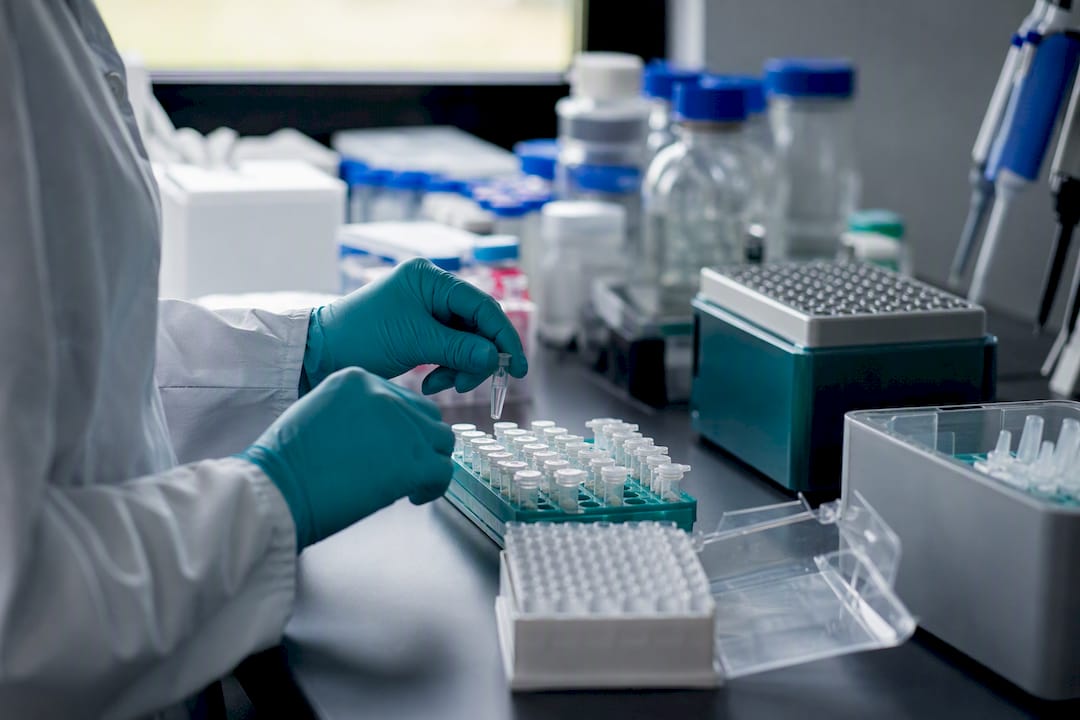
The base tier covers raw data QC reports, processed feature tables, taxonomic profiles at multiple ranks, and alpha and beta diversity tables with accompanying plots. Functional pathway tables drawn from KEGG, eggNOG, or MetaCyc annotations sit alongside metabolomics feature tables with putative or confirmed compound annotations.
The interpretive tier is where the real value shows up for drug discovery teams: predictive models linking specific taxa or functional pathways to drug metabolism risk, a prioritized list of candidate biotransformations, and mechanistic hypotheses your medicinal chemistry team can test.
Reproducibility deliverables matter just as much for a regulated pipeline:
- Containerized pipelines (Docker or Singularity images) so the exact software environment is portable
- Version-controlled analysis code with a documented commit history
- Workflow provenance records tying every output file back to its input and parameters
- Standard file formats: FASTQ, BAM, feature tables, mzML, mzTab, and RMarkdown or HTML reports
Before signing, confirm the contract's data return policy, intellectual property assignment, and archival storage terms. A vendor that hesitates on any of these three is not built for pharma work.
What Are the Steps in a Microbiome Analysis Pipeline?
A microbiome diversity analysis workflow runs through a fixed sequence, and knowing the order helps you map vendor scope against your internal timeline expectations.
- Sample intake and metadata validation. Every sample gets checked against a metadata schema before sequencing begins, catching mismatched IDs or missing collection details early.
- Sample QC. FASTQ quality checks for sequencing data, mzML quality checks for metabolomics runs. Low-quality reads or poorly ionized spectra get flagged before they contaminate downstream results.
- Preprocessing. Host DNA removal, adapter trimming, and either denoising (for amplicon data) or assembly (for shotgun metagenomics) happen here.
- Taxonomic profiling. Shotgun or targeted 16S approaches assign taxonomy, with metagenome-assembled genome (MAG) recovery and quality assessment where strain-level resolution matters.
- Functional characterization. Gene and pathway calling, metatranscriptomics mapping when activity data is needed, and specific annotation of enzymes tied to drug metabolism.
- Metabolomics integration. Untargeted LC-MS/MS data gets processed in MZmine, organized through feature-based molecular networking (FBMN) via GNPS, then scored with a ChemProp or ChemProp2-style approach to infer directional biotransformations across time-series samples. Repository searches, FASST or equivalent, contextualize unannotated features against public spectral libraries.
- Provenance and validation. The full workflow runs inside containers, passes unit tests, and includes sample swap checks and negative controls, closing out with a written reproducibility report.
That functional metabolomics integration in step six is what distinguishes a drug-discovery-grade workflow from a general ecology survey, and it deserves its own explanation.
How Does Functional Metabolomics Reveal Drug Metabolism Risk?
Taxonomy tells you who is present. It does not tell you what they are doing to your compound. That gap is exactly where a lead you thought was clean turns up with a microbially generated metabolite six months into a toxicology study.
The analytic pattern behind Innovabiotech's approach starts with time-series or endpoint incubations, often using synthetic community (SynCom) designs, followed by untargeted LC-MS/MS. Feature detection runs through MZmine, features get organized into molecular networks via FBMN on GNPS, and a ChemProp2-style scoring system applies time-series correlation analysis with empirical false discovery rate control to flag directional transformations. Applied to a panel of 50 drugs, this approach has prioritized dozens of putative transformations and mapped multi-step metabolic cascades, according to a 2026 study on time-series molecular networking.
When you pair sequencing with time-resolved metabolomics, you stop guessing whether a taxon shift matters. You can trace a specific metabolite's appearance to a specific community change and build a testable hypothesis around it, rather than a correlation you have to explain away later.
Repository contextualization strengthens the case further. In one large-scale application, 1,063 of 1,202 queried features returned at least one match in public spectral datasets, which means:
- Putative metabolites can be cross-checked against independent studies before you commit wet-lab resources
- Cascade-level transformation maps identify which taxa or enzymes are worth validating first
- Prioritized candidate lists replace a raw hit table with a ranked set of biotransformations
How Are Microbiome Analysis Projects Scoped and Priced?
Pricing on a contracted microbiome workflow tracks four main drivers, and knowing them ahead of your RFP saves a round of back-and-forth with procurement.
- Sample throughput. More samples means more sequencing lanes and more compute time, and that scales cost close to linearly.
- Number of omics layers. A single 16S run costs far less than a project stacking 16S, shotgun metagenomics, metatranscriptomics, and untargeted metabolomics together.
- Study design complexity. Time-series designs, strain-resolved MAG recovery, or bespoke modeling (including PBPK integration) all add analyst hours beyond the standard pipeline.
- Validation requirements. In vitro follow-up assays or wet-lab confirmation of predicted biotransformations extend both timeline and budget.
Typical schedules break into three bands: a pilot project runs 4 to 6 weeks, a standard multi-omics engagement runs 8 to 16 weeks, and a deep time-series functional metabolomics study can run 12 to 24 or more weeks. Sample prep and sequencing consume the first third of calendar time in almost every case, with metabolomics integration and modeling absorbing the rest.
Three engagement structures cover most projects:
- Fixed-scope, single deliverable project
- Phased pilot followed by a scale-up contract
- Ongoing retainer for continuous analytics and regulatory support
Your statement of work should specify sample numbers, the metadata schema, privacy and IP terms, and acceptance criteria before a contract gets signed.
What Do You Need to Prepare Before Onboarding?
A fast, low-risk vendor handoff depends on a few things being ready before sample shipment. Missing metadata is the single biggest cause of onboarding delay.
- Sample matrix, storage conditions, freeze/thaw history, and the collection kit and lot number
- Internal and external controls included with the shipment
- Preferred file formats, a manifest file, and a secure transfer method such as SFTP or an encrypted cloud bucket
- Unique sample IDs following a consistent labeling standard
- Experimental design details: negative and positive controls, timepoints, replicate counts, and any donor pooling strategy
- A signed NDA, data use agreement, IP terms, and consent documentation if the material is human-derived
Get these squared away before intake and the first pipeline run typically starts within days, not weeks.
What Quality and Security Controls Should You Require?
A pharma-grade vendor should be able to answer questions about auditability and data handling without hesitation. If they can't, that's a disqualifying signal on its own.
Quality controls should include sample-level QC, spike-in standards from primary antibodies and research reagents, negative controls, and replicate concordance metrics, with clearly stated criteria for what counts as a QC failure. Reproducibility rests on containerized pipelines, Git-based workflow versioning, unit tests, and archived run artifacts you can pull for an audit years later.
Ask any vendor to show you their SOPs for sample handling and their audit trail for a past project before you sign. A written answer beats a verbal assurance every time.
Security expectations for this kind of work include:
- A signed NDA before any sample or metadata changes hands
- HIPAA-aware handling procedures when the material touches human-derived data
- Encrypted data transfers and at-rest encryption, with role-based access controls and logged audit trails
- A stated data retention and destruction policy
Prior pharma or biotech project experience and references from confidential engagements are the fastest way to separate a serious vendor from one still building its process.
How Should a Vendor Communicate During the Project?
Communication cadence is one of the most overlooked line items in a bioinformatics contract, and it's usually the first thing that breaks down on a poorly run project. A confidential microbiome analysis engagement should specify update frequency in the statement of work, not leave it as an assumption.
Innovabiotech structures reporting around milestone checkpoints tied to pipeline stages: intake confirmation, QC completion, taxonomic and functional profiling results, and final integrated reporting. Between those milestones, a single named project lead should be your point of contact, not a rotating support queue. That matters more than it sounds. Microbiome projects generate ambiguous intermediate results constantly (a taxon that shows up in one replicate but not another, a metabolite feature that doesn't match any repository entry), and those ambiguities need a scientist who understands your project's context, not a generic help desk.
Weekly or biweekly status updates work for most standard multi-omics projects, while a deep time-series functional metabolomics study often warrants updates timed to major analytical phases instead of a fixed calendar. Either way, your contract should specify:
- Named technical lead and backup contact
- Update cadence (weekly, biweekly, or milestone-based)
- Format of interim reports (raw QC summary, preliminary diversity plots, or full written updates)
- Escalation path for unexpected findings that might affect your project's direction
A vendor that pushes back on documenting this in writing is telling you something about how the rest of the engagement will run.
What Happens After the Analysis Is Delivered?
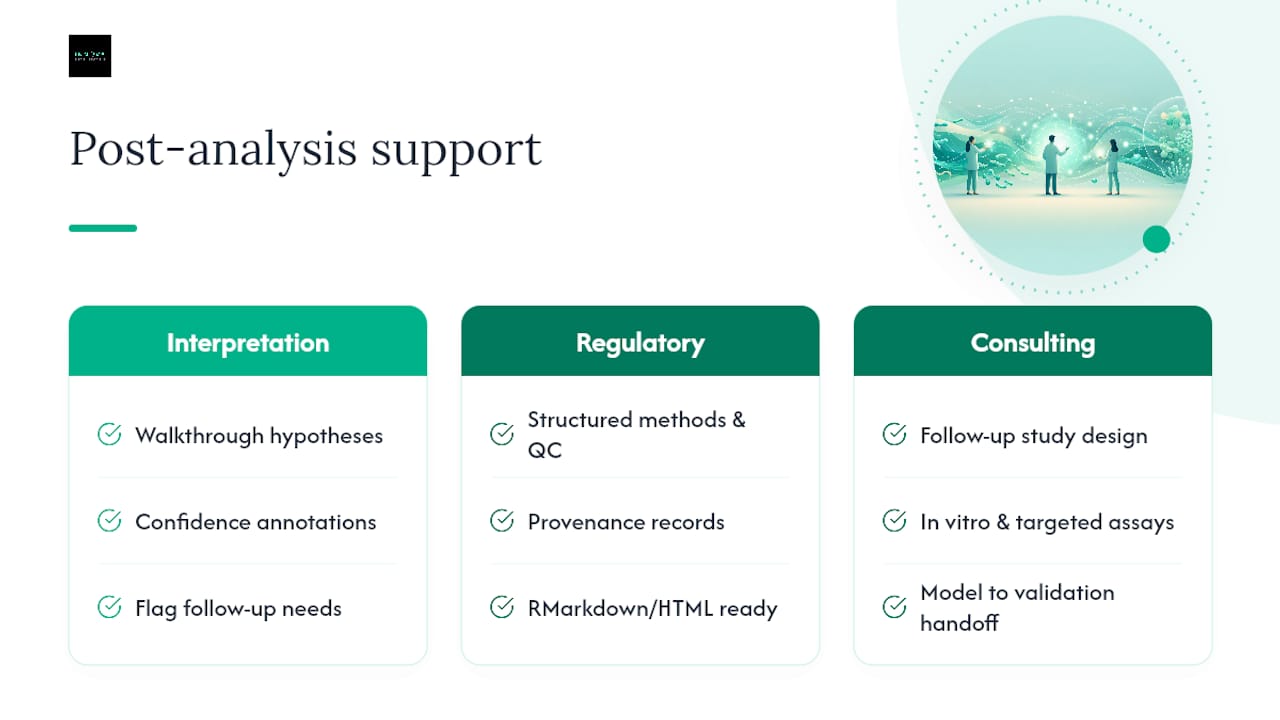
The final report is rarely the end of the engagement, and treating it as such wastes the most valuable part of a contracted workflow: the domain expertise that produced it. Interpretation support closes the gap between a data table and a decision your team can act on.
A capable partner sits down with your scientists to walk through prioritized biotransformations, explain the confidence level behind each mechanistic hypothesis, and flag which findings warrant in vitro follow-up versus which are speculative. That conversation matters especially when functional metabolomics has surfaced a compound-taxon interaction nobody anticipated during lead selection.
Regulatory submission support is the other half of post-analysis work. Reports need to be structured so methods, QC criteria, and provenance records hold up under regulatory review, whether that's an IND-enabling package or a broader safety dossier. That means the RMarkdown or HTML reports generated during the project should already carry the documentation rigor a regulatory affairs team expects, not require a second pass to reformat.
Consulting support can extend further into follow-up study design: helping decide whether a flagged biotransformation warrants an in vitro fermentation screen, a targeted metabolomics assay, or direct wet-lab validation. Innovabiotech's cross-disciplinary work on projects like cancer cell drug sensitivity prediction shows the kind of predictive-modeling-to-validation handoff that carries over directly into microbiome-linked risk assessment.
Why Move Microbiome Screening Earlier in Discovery?
Waiting until late-stage toxicology to check microbiome-mediated metabolism is how teams get blindsided. With 75% of assayed drugs shown to be metabolized by common probiotic strains, that risk is common, not rare. A pilot functional metabolomics screen during hit-to-lead can reprioritize candidates before real capital gets committed, catching a problematic biotransformation while switching leads still costs a lab week instead of a clinical hold.
How Innovabiotech Runs a Confidential Microbiome Project
Innovabiotech runs microbiome diversity analysis as a contracted, confidential engagement from sample intake through final integrated report, not a self-serve tool you have to learn. You get containerized pipelines, version-controlled code, and pharma-ready deliverables built for regulatory scrutiny, backed by the same computational rigor behind our protein engineering and enzyme optimization work.
If your team already knows its sample counts and target omics layers, that's enough to start a scoped proposal. Send us your sample numbers, whether you need 16S, shotgun, metatranscriptomics, or untargeted metabolomics (or some combination), and your timeline constraints. We'll return a cost estimate and can structure a pilot proof-of-concept if you want to validate the approach before committing to a full multi-omics study. For teams also working peptide or protein design in parallel, our peptide design services page covers where those workflows intersect. Reach out to start the NDA and scoping conversation.
Sources
- Integrating metabolomics, bionics, and culturomics to study probiotics-driven drug metabolism (Frontiers, 2023)
- ChemProp2 time-series molecular networking and functional metabolomics workflow (2026 DOI)
- Functional metabolomics framework linking SynCom incubations and time-series molecular networking (PubMed entry, 2026)
These sources shaped the functional metabolomics sequence and the sequencing-metabolomics integration steps described above.
FAQ
What Is Included in a Microbiome Diversity Analysis Workflow?
A contracted workflow typically includes sample QC, taxonomic profiling, alpha and beta diversity metrics, functional pathway annotation, and metabolomics integration, delivered with containerized code and raw and processed data exports.
How Long Does a Contracted Microbiome Project Take?
Pilot projects run 4 to 6 weeks, standard multi-omics engagements run 8 to 16 weeks, and deep time-series functional metabolomics studies can extend to 12 to 24 or more weeks.
Can Microbiome Analysis Predict Drug Metabolism Risk?
Yes. Integrated functional metabolomics workflows using MZmine, FBMN, and ChemProp-style scoring can link specific taxa or pathways to drug biotransformations, since 75% of assayed drugs were metabolized by tested probiotic strains in one study.
Does Innovabiotech Handle Confidential Microbiome Projects?
Yes. Innovabiotech runs microbiome diversity analysis under NDA with encrypted data transfers, containerized pipelines, and version-controlled code built for pharma and biotech confidentiality requirements.
What Sample Types Are Accepted for Analysis?
Accepted inputs include 16S amplicon data, shotgun metagenomics, metatranscriptomics, and untargeted metabolomics samples, along with required metadata on storage conditions and collection methods.