
TL;DR:
- Tailored bioinformatics services provide custom analyses aligned with specific biological questions and data types.
- A well-defined scoping phase ensures accurate deliverables, reducing wasted resources and incorrect interpretations.
Tailored bioinformatics services are custom computational analyses and pipelines designed to match the specific biological questions, data types, and research goals of each project. Unlike generic off-the-shelf solutions, these services align every analytical step with your experimental design, regulatory requirements, and downstream deliverables. Innovabiotech, based in San Francisco, California, builds these custom workflows for biotech companies and researchers working in drug discovery, protein engineering, enzyme optimization, and de novo peptide design. The difference between a generic pipeline and a truly custom one shows up in reproducibility, turnaround time, and the quality of biological insight you extract.
What types of tailored bioinformatics services are available?
Custom bioinformatics analysis spans a wide range of service categories, each matched to a specific research application. The four most common categories are metagenomics, whole-exome sequencing (WES), transcriptomics, and structural bioinformatics services.

Metagenomics profiles microbial communities from environmental or clinical samples. It is the method of choice for microbiome research and infectious disease studies. Whole-exome sequencing analysis targets protein-coding regions of the genome and is the fastest service to deliver. Turnaround times for WES run 1–2 days, while complex transcriptomics projects require 14–21 days. That gap reflects the difference in computational depth, not just data volume.
Transcriptomics maps gene expression across conditions and is central to biomarker discovery and target identification in drug discovery pipelines. Structural bioinformatics services focus on protein structure prediction, molecular docking, and computational modeling. These are the backbone of protein engineering workflows, where you need to understand how a protein folds and interacts before committing to wet-lab synthesis.
Personalized genomics services and custom pipeline development round out the offering. Personalized genomics applies population-level variant data to individual patient profiles, which is the foundation of precision medicine research.
| Service type | Typical turnaround | Primary application |
|---|---|---|
| Whole-exome sequencing | 1–2 days | Variant calling, rare disease |
| Metagenomics profiling | 3–5 days | Microbiome, infectious disease |
| Transcriptomics | 14–21 days | Biomarker discovery, DEG analysis |
| Structural bioinformatics | Project-specific | Protein engineering, docking |
| Custom pipeline development | Project-specific | Any high-throughput workflow |
- Match the service type to your biological question first, then scope the timeline.
- Structural bioinformatics and transcriptomics rarely fit a fixed-price model. Expect project-specific quotes.
- Personalized genomics services require population reference databases. Confirm your provider has access before scoping.
Pro Tip: Request a sample deliverable or report template before signing a service agreement. The format of the output tells you more about a provider's rigor than any sales conversation.
How does the engagement lifecycle for bespoke bioinformatics projects unfold?
A well-run bioinformatics project follows four defined phases. Skipping or compressing any phase is the most common cause of failed analyses and wasted sequencing budgets.
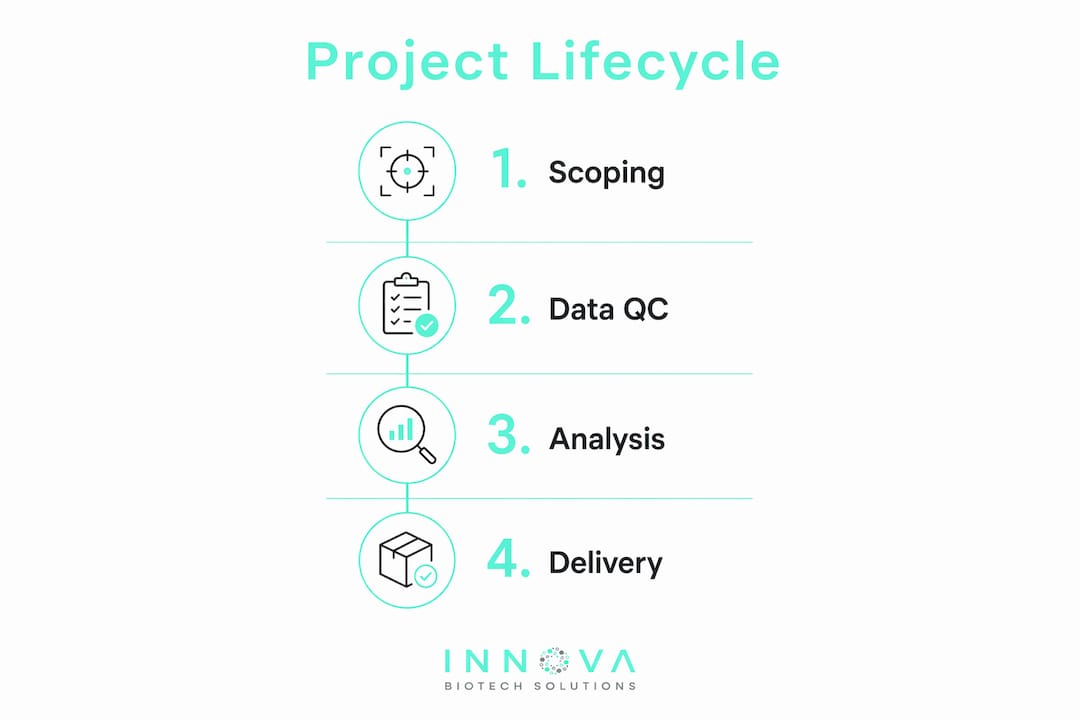
Phase 1: Scoping and consultation. Defining deliverables before computation begins is the single most important step in any bioinformatics engagement. This phase aligns your biological question with the right analytical approach, data format requirements, and statistical framework. Providers who skip this step produce technically correct outputs that answer the wrong question.
Phase 2: Secure data transfer and quality control. Raw sequencing data arrives with quality issues. Adapter contamination, low-quality base calls, and batch effects are standard problems. A rigorous QC step using tools like FastQC, Trimmomatic, or MultiQC catches these before they corrupt downstream results. Effective engagement includes secure data transfer protocols and documented QC checkpoints.
Phase 3: Iterative analysis with feedback. Analysis is not a one-pass process. Interim results go back to the research team for biological interpretation. This loop catches parameter errors, identifies unexpected findings, and keeps the analysis aligned with evolving experimental context.
Phase 4: Final delivery of reports and pipelines. The final deliverable includes processed data, statistical outputs, visualizations, and the documented pipeline itself. A reproducible pipeline is as valuable as the results it generates. You need to re-run it on new data without rebuilding it from scratch.
- Write your biological question as a single sentence before the first meeting.
- List every data type you will provide and every output you need.
- Ask for a QC report before full analysis begins.
- Schedule at least one interim review before final delivery.
- Confirm the pipeline is version-controlled and documented.
Pro Tip: The most expensive mistake in bioinformatics is starting computation before the experimental design is locked. One ambiguous variable in your metadata can invalidate an entire transcriptomics run.
What production-grade standards define high-quality bioinformatics pipelines?
Production-grade bioinformatics pipelines are not just scripts that run. They are engineered systems built for reproducibility, auditability, and scale. Pipeline engineering reduces turnaround time by 60–80% compared to manual systems through parallelization and automated failure recovery. That improvement compounds across every project you run.
The technology stack matters. Workflow orchestration tools like Nextflow, WDL, and Snakemake enable reproducible, scalable pipelines that run consistently across computing environments. Each tool has a different syntax and ecosystem, but all three enforce dependency tracking and parallel execution. Nextflow is the most widely adopted in clinical genomics; WDL is the standard for Broad Institute workflows; Snakemake is common in academic settings.
A production-grade pipeline must include containerized environments (Docker or Singularity), parameterized configurations, automated QC gates, observability dashboards, and full audit logging. Without these components, a pipeline that works today may fail silently on new data tomorrow. Regulatory submissions require audit trails. Clinical volumes require auto-scaling compute. Both requirements demand engineering discipline from the start.
Reproducibility and scalability for clinical volumes are the two factors that separate a research pipeline from one you can trust in a drug development context. A pipeline that works on 10 samples but breaks at 1,000 is not production-grade. It is a prototype.
Critical requirements for any production-grade bioinformatics pipeline:
- Containerization with Docker or Singularity for environment consistency
- Version control for all scripts, parameters, and reference files
- Automated QC gates at every major processing step
- Observability dashboards for real-time monitoring of pipeline health
- Audit-ready documentation for regulatory submissions
- Failure recovery and retry logic for compute interruptions
- Parameterized configurations that separate code from data paths
How do custom bioinformatics solutions drive drug discovery and protein engineering?
Custom bioinformatics analysis accelerates target identification and biomarker discovery by cutting through the noise in large genomic and proteomic datasets. A generic pipeline applies the same filters to every dataset. A tailored pipeline applies filters calibrated to your disease area, sample type, and statistical power. The result is fewer false positives and faster progression to wet-lab validation.
Protein engineering depends on computational modeling before any synthesis happens. Structural bioinformatics services generate predicted protein structures, binding site maps, and variant effect scores that guide which sequences are worth synthesizing. This is where protein engineering applications in drug discovery become concrete. You use computational output to rank candidates, not to replace experimental work, but to make experimental work more targeted.
Personalized genomics services connect population-level variant data to individual patient profiles. In precision medicine research, this means identifying which patients are likely to respond to a given therapy based on their genomic background. The analytical pipeline for this work is not generic. It requires custom variant annotation databases, population stratification controls, and disease-specific filtering criteria.
Enzyme optimization follows the same logic. Computational modeling of enzyme kinetics and active site geometry identifies which mutations are likely to improve catalytic efficiency. Wet-lab teams then synthesize and test a ranked shortlist rather than a random library. That focus reduces synthesis costs and accelerates the optimization cycle.
Pro Tip: Align your computational design goals with your experimental assay readout before analysis begins. A protein engineering pipeline optimized for binding affinity produces different candidate rankings than one optimized for thermostability. Both are valid. Only one matches your assay.
Key takeaways
Tailored bioinformatics services deliver research value only when the pipeline, the biological question, and the experimental design are aligned from the first consultation.
| Point | Details |
|---|---|
| Match service to question | Choose metagenomics, transcriptomics, or structural services based on your biological question, not convenience. |
| Define deliverables first | Scoping deliverables before computation prevents costly data misinterpretation and wasted sequencing runs. |
| Require production-grade pipelines | Containerization, automated QC, and audit logging separate research-grade scripts from reliable production systems. |
| Use orchestration tools | Nextflow, WDL, and Snakemake enforce reproducibility and parallel execution across computing environments. |
| Align computation with experiment | Computational protein or enzyme design must match the specific assay readout your wet-lab team will use. |
What I've learned about choosing bioinformatics service providers
The biggest mistake I see biotech teams make is treating bioinformatics as a service you order after the experiment is done. You send over the FASTQ files, wait for a report, and then try to interpret results that were never designed to answer your actual question. That approach wastes sequencing budget and delays programs by months.
The providers worth working with push back during scoping. They ask what your assay looks like, what your sample size is, and what statistical threshold you need to reach a go or no-go decision. That friction in the early conversation is a sign of scientific rigor, not a sales obstacle.
I also think researchers underestimate how much the pipeline architecture matters for long-term projects. A pipeline built without version control or containerization becomes a liability the moment the analyst who built it leaves the project. You cannot reproduce your own results. That is a serious problem for regulatory submissions and for any collaboration that requires data sharing.
Flexible engagement models matter more than most teams realize. A provider who can start with a pilot analysis on a small dataset, deliver interim results, and then scale to full production is far more valuable than one who requires a full project commitment upfront. That flexibility reflects confidence in their own methods.
The initial consultation phase is where the real value of a good provider shows up. If they can articulate your biological question back to you more clearly than you stated it, you have found a partner worth investing in.
— Hooman
Innovabiotech's custom bioinformatics solutions for biotech research
Innovabiotech works directly with biotech companies and researchers from initial scoping through final delivery, covering virtual screening, hit-to-lead optimization, protein engineering, enzyme optimization, and de novo peptide design.
Every project starts with a consultation to align the computational approach with your experimental design and regulatory requirements. Innovabiotech builds custom peptide design pipelines calibrated to your sequence constraints and assay readout, and delivers protein design and computational modeling services for drug discovery workflows that require structural precision. If your project involves enzyme engineering or high-throughput screening, the team builds production-grade pipelines with automated QC and full audit documentation. Reach out to discuss your project scope and get a tailored analysis plan built around your specific research goals.
FAQ
What are tailored bioinformatics services?
Tailored bioinformatics services are custom computational analyses and pipelines built to match the specific biological questions, data types, and research goals of a given project. They differ from generic solutions by aligning every analytical parameter with your experimental design and downstream deliverables.
How do I choose the right bioinformatics service for my project?
Start by writing your biological question as a single sentence, then match it to the service category: metagenomics for microbial communities, transcriptomics for gene expression, or structural bioinformatics for protein modeling. Turnaround times range from 1–2 days for whole-exome sequencing to 14–21 days for complex transcriptomics, so timeline requirements should factor into your choice.
What makes a bioinformatics pipeline production-grade?
A production-grade pipeline includes containerized environments, automated QC gates, version-controlled scripts, and audit-ready documentation. These components are required for regulatory submissions and for reliable performance at clinical data volumes.
How does custom bioinformatics analysis support drug discovery?
Custom analysis accelerates target identification and biomarker discovery by applying filters calibrated to your disease area and sample type. This reduces false positives and speeds progression to wet-lab validation, as detailed in bioinformatics for drug discovery research.
Why does the scoping phase matter so much in bioinformatics projects?
Defining deliverables before computation begins prevents data misinterpretation and keeps the analysis aligned with your actual research question. Ambiguous metadata or an undefined statistical threshold at the start can invalidate an entire sequencing run.