
If you run a B2B bioinformatics platform, an ELN or LIMS product, or any research data service that touches sponsor or partner data, pursue SOC 2. Start with a scoped readiness assessment and decide early whether you need a Type I report or can go straight for Type II, since most enterprise pharma buyers will eventually require the latter. SOC 2 reports carry weight because a licensed, independent CPA firm attests to them, not a vendor's own marketing claims.
TL;DR:
- Most biotech vendors can achieve SOC 2 Type I within two months, but reaching Type II typically requires an additional four months of operational monitoring.
- Focusing scope narrowly on essential criteria like Security and only adding Processing Integrity or Privacy if necessary can significantly reduce audit complexity and cost.
- Auditors will demand tangible artifacts such as access logs, change records, encryption configurations, and evidence of ongoing monitoring, not just policy documents.
- Over-scoping and poor preparation can extend the process and inflate costs, so a structured readiness assessment and internal pre-audits are highly recommended.
- SOC 2 primarily verifies operational controls for vendor confidence and is not a legal requirement, but it often overlaps with HIPAA and GxP compliance efforts in biotech.
Table of Contents
- What SOC 2 Is and Who Actually Issues the Report
- Mapping the Trust Services Criteria to Your ELN, LIMS, and Sequencing Pipeline
- SOC 2 vs. HIPAA vs. GxP: Do You Need One Framework or Three?
- How Long SOC 2 Actually Takes and What Drives the Cost
- What Auditors Actually Ask to See
- A Six-Month Readiness Program You Can Hand to Your Team
- Picking the Right Auditor and Passing the Interview
- How Innovabiotech Handles Data Security in Project Delivery
- SOC 2 as a Growth Lever, Not a Compliance Chore
- Get Help Preparing Your Research Workflows for Due Diligence
- Where to Read More
- Sources
- FAQ
What SOC 2 Is and Who Actually Issues the Report
SOC 2 is an attestation framework built by the American Institute of Certified Public Accountants (AICPA), and it exists specifically to give buyers evidence that a vendor's internal controls actually protect the data it handles. Unlike ISO certifications, which are issued by accredited registrars, a SOC 2 report can only be issued by a licensed CPA firm performing an independent audit. That distinction matters when a pharma procurement team asks who signed off on your report.
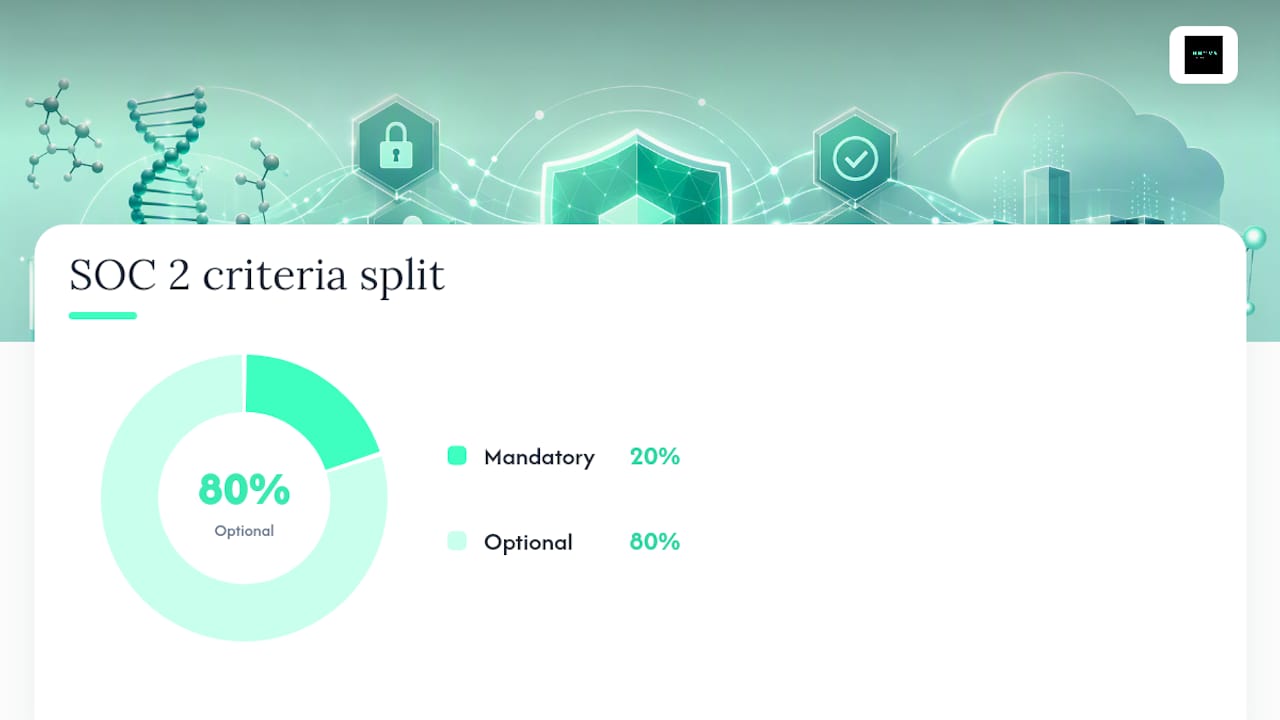
The audit evaluates a company against the five Trust Services Criteria (TSC): Security, Availability, Processing Integrity, Confidentiality, and Privacy. Security is the only mandatory criterion in every SOC 2 engagement, and it covers the baseline protections most people associate with cybersecurity: access controls, firewalls, intrusion detection, and incident response. Availability, Confidentiality, Processing Integrity, and Privacy are added based on what a company actually does and what its customers care about, according to Secureframe's breakdown of the Trust Services Criteria.
The two report types answer different questions:
- Type I evaluates whether your controls are designed correctly at a single point in time. Think of it as a snapshot: auditors review your policies and system configurations and confirm they meet the criteria on paper.
- Type II evaluates whether those controls actually operated effectively over a period of time, typically three to twelve months. Auditors pull samples of real evidence, log access reviews, incident tickets, and change records, to confirm the controls worked in practice, not just in a policy document.
Most enterprise pharma and biotech buyers treat Type I as a stepping stone and require Type II before signing a contract, because Type II proves sustained discipline rather than a one-time cleanup. A SOC 2 Type II report often functions as the default procurement filter for vendors selling into large pharma organizations, and companies without one can get quietly disqualified before a sales conversation even starts.
Mapping the Trust Services Criteria to Your ELN, LIMS, and Sequencing Pipeline
Auditors don't care about SOC 2 in the abstract. They want to see the five criteria applied to the specific systems your company runs, and for biotech that usually means an electronic lab notebook (ELN), a laboratory information management system (LIMS), cloud storage for raw sequencing files, and whatever pipeline turns that raw data into results a scientist or sponsor can act on.
Here's how each criterion typically shows up in a biotech environment:
- Security (mandatory): single sign-on and multifactor authentication on your ELN and LIMS, role-based permissions so a bench scientist can't access financial systems, and endpoint protection on lab workstations.
- Availability: documented disaster recovery and backup procedures for lab systems, so a cloud outage doesn't stall an active experiment or delete unrecovered sequencing runs.
- Confidentiality: encryption at rest and in transit for genomic and proprietary compound data, plus access partitioning so one client's project data never touches another's, especially critical if you run multi-tenant infrastructure.
- Processing Integrity: validation that your bioinformatics pipeline produces accurate, reproducible, and traceable outputs, particularly when those outputs feed into a regulated decision or a sponsor's go/no-go call.
- Privacy: applies when you handle personally identifiable information tied to human subjects, such as patient identifiers in a clinical genomics workflow.
Processing Integrity deserves special attention because it's the criterion biotech teams most often underestimate. When your pipeline output touches a clinical or regulated decision, published guidelines on validating next-generation sequencing (NGS) bioinformatics pipelines are the right reference point, not an internal QA checklist improvised for the audit. That guidance emphasizes reproducibility, traceability, and documented personnel training as the core pillars of a defensible validation record, according to peer-reviewed validation standards for NGS oncology panels, a standard echoed in parallel guidance published through Europe PMC.
Pro Tip: Don't build Processing Integrity evidence from scratch. If your pipeline already follows CAP/AMP validation practices for clinical-grade sequencing, that documentation usually satisfies most of what a SOC 2 auditor asks for, since you're just formalizing controls you should already have.
Privacy is the criterion most biotech companies can skip, and skipping it correctly is a skill. If your platform never touches identifiable patient data, an auditor will typically agree Privacy is out of scope. Scoping too broadly wastes audit hours and remediation budget on criteria your buyers never asked about. Secureframe's guidance on Trust Services Criteria explicitly cautions against over-scoping Processing Integrity or Privacy when the underlying business doesn't require it, and that advice holds especially true for early-stage biotech vendors trying to conserve runway.
SOC 2 vs. HIPAA vs. GxP: Do You Need One Framework or Three?
These three frameworks answer three different questions, and confusing them wastes time and money.
- SOC 2 answers whether your organization's security controls are trustworthy enough for a business partner to share data with you. It's an operational and vendor-assurance framework, not a healthcare or clinical-data regulation.
- HIPAA answers whether you're legally permitted to handle protected health information (PHI) in the United States. If your platform stores or processes PHI, HIPAA isn't optional; it's a legal requirement enforced by the Department of Health and Human Services, and SOC 2 does not substitute for it.
- GxP and 21 CFR Part 11 answer whether your lab systems and pipeline outputs meet FDA expectations for data integrity, traceability, and validated processes when those outputs support a regulated product or clinical decision.
A simple decision flow keeps these straight: if you handle PHI, you need HIPAA compliance regardless of anything else. If you operate validated lab systems or pipelines whose outputs feed regulated decisions, you need GxP validation. If enterprise buyers or sponsors are asking for third-party attestation of your security posture before they'll sign a contract, that's when SOC 2 enters the picture, often alongside the other two rather than instead of them.
The practical upside is that these frameworks overlap more than most teams realize. Access control logs, audit trails, and encryption configurations built for SOC 2 can often be reused, with some adaptation, to support HIPAA's technical safeguards and GxP's audit-trail requirements. Sector-specific mapping resources show that SOC 2 evidence can be reused across HIPAA, GxP, and ISO 27001, cutting total audit effort when the frameworks are coordinated rather than run as separate, siloed projects. That said, SOC 2 is a security foundation, not a substitute for GxP validation. Biotech teams should treat SOC 2 as vendor and operational assurance and keep a separate, validated evidence trail for anything tied to a regulated product output, like a clinical sequencing result headed toward an FDA submission. For a deeper look at where SOC 2 and HIPAA diverge on cloud infrastructure specifically, Innovabiotech's HIPAA compliant cloud providers guide breaks down the technical differences vendors get wrong most often.
How Long SOC 2 Actually Takes and What Drives the Cost
Founders consistently underestimate the calendar. A realistic path runs through three phases: readiness, Type I, and the Type II observation window.
Specialist consultancies working with biotech and pharma clients report that companies using an accelerated readiness process can typically reach a Type I report in about two months, followed by roughly four more months of observation before qualifying for Type II, according to ISpectra's biotechnology SOC 2 guidance. That's a six-month minimum runway from a standing start, and companies with messy access controls or no formal change management process should plan for longer.
Cost is driven less by the audit fee itself and more by three variables:
- Scope: adding Processing Integrity or Privacy criteria you don't strictly need adds real audit hours and remediation work.
- Automation tooling: evidence-collection platforms integrate directly with cloud infrastructure to pull logs and configuration data automatically, replacing manual screenshot collection.
- Remediation work: fixing gaps discovered during readiness, like missing MFA enforcement or undocumented incident response procedures, usually consumes more engineering time than the audit itself.
Three tactics shorten the path meaningfully. First, scope narrowly to what your actual buyers require rather than chasing every criterion preemptively. Second, run policy drafting in parallel with technical remediation instead of sequentially. Third, bring in a consultant who has specifically taken life sciences companies through this before; a generalist auditor unfamiliar with LIMS or sequencing infrastructure will ask the wrong questions and slow everything down. Narrow scoping paired with automation platforms has been shown to meaningfully cut engineer time spent on evidence collection, which matters when your engineering team is also shipping product.
What Auditors Actually Ask to See
Auditors don't accept a policy document as proof a control works. They want artifacts, timestamped, specific, and tied to real systems.
Access control evidence is usually the first thing requested: SSO configuration exports, MFA enforcement logs, documented role definitions mapping who can access what, and quarterly privileged access reviews showing someone actually checked whether ex-employees still had system access. If a former lab technician's credentials were still active six weeks after termination, that's a finding, and auditors will ask for the review record that should have caught it.
Change management and pipeline validation evidence comes next, especially for companies whose bioinformatics pipeline output touches a regulated decision. Auditors want change tickets showing what was modified, approval records showing who signed off, code review logs, and version tags tracing which pipeline version produced which result. This is where Processing Integrity work and standard software engineering discipline overlap almost completely.
Logging and monitoring artifacts need to demonstrate that your systems don't just generate logs, they preserve them immutably and someone actually reviews them. That means SIEM alert configurations, sample audit trails walking through a sequence-processing job from raw file to final report, and evidence that alerts triggered real human review rather than sitting unread in a dashboard.
Data protection artifacts cover encryption configurations for data at rest and in transit, backup verification reports proving restores actually work (not just that backups ran), and documented data retention and disposal procedures. For biotech companies retaining genomic data under sponsor contracts, disposal proof matters as much as encryption, since contracts often specify exactly when and how data must be destroyed.
Vendor management artifacts round out the list: signed vendor contracts with security clauses, SOC 2 reports from your own subservice organizations (your cloud provider, your bioinformatics SaaS vendors), and a documented workflow for what happens when a vendor's own report reveals a gap. Innovabiotech's security and confidentiality practices reflect this same principle: every layer of a data workflow, from access management to storage, needs its own evidence trail, not just a top-level policy statement.
Pro Tip: Keep a running evidence folder from day one of readiness, organized by control family, not by audit period. When Type II observation starts, you'll already have a structure instead of scrambling to reconstruct six months of history the week before fieldwork begins.
A Six-Month Readiness Program You Can Hand to Your Team
Most biotech companies benefit from a structured, sequenced program rather than an unstructured scramble toward an audit date.
- Month 0 to 1: Scope and kickoff. Define exactly which services, systems, and Trust Services Criteria are in scope. This is where you decide whether Confidentiality or Availability join Security, and whether Processing Integrity applies to your pipeline outputs.
- Month 1 to 2: Inventory and policy foundation. Build a complete asset inventory (every system, every data store), stand up a risk register, and draft your core policies: access control, incident response, and change management. Skipping the risk register is the single most common shortcut that comes back to bite companies during fieldwork.
- Month 2 to 3: Automation and evidence infrastructure. Deploy an evidence-collection platform, configure centralized logging, and integrate your cloud provider's native logs (AWS CloudTrail, Azure Monitor, or equivalent) so evidence accumulates automatically instead of manually.
- Month 3 to 4: Internal audit and remediation. Run your own internal control tests before the CPA firm does. This is where you find the stale access permissions and undocumented approval steps while you still have time to fix them quietly.
- Month 4 to 5: Type I audit. The CPA firm reviews your control design at a fixed point in time and issues the Type I report, which many buyers will accept as an interim signal of progress.
- Month 5 to 6 and beyond: Type II observation window. The clock starts on a three to twelve month period during which auditors will sample real operational evidence. Treat this window as ongoing operations, not a project with an end date, because "rolling annual" recertification means you'll go through this same observation cycle every year going forward.
Sequencing project management around this timeline matters more than most teams expect; Innovabiotech's guide to pharma bioinformatics project management covers how to structure delivery workflows so security evidence accumulates as a byproduct of normal operations rather than a separate burden.
Picking the Right Auditor and Passing the Interview
Not every CPA firm that issues SOC 2 reports understands what a LIMS is or why a genomic pipeline's version history matters. Choosing an auditor with real life sciences or technology-vendor experience saves months of back-and-forth explaining basic infrastructure.
Look for a firm that can speak fluently about sample-based testing for engineering teams, understands log retention expectations for regulated data, and has audited at least one other company running validated pipelines or clinical-adjacent data. Ask directly how many biotech or pharma-adjacent clients they've audited; a vague answer is itself useful information.
During fieldwork, expect questions about sample sizes (how many access reviews, how many change tickets they'll pull to test), log retention periods, and specifically how you validate pipeline outputs before they reach a client or sponsor. Auditors commonly probe whether your documented process matches what actually happened, not just whether a policy exists.
The most common failure mode isn't a missing control. It's a documented policy that doesn't match observed practice: a change management policy that says every deployment needs two approvals, but the evidence shows several deployments with only one. Preempt this by running your internal audit against your own policies before the CPA does, and fix mismatches rather than rewriting policies to lower the bar. Innovabiotech's biotech vendor selection checklist covers similar due-diligence questions from the buyer's side, which is worth reading if you want to anticipate what your own prospective customers will ask.
How Innovabiotech Handles Data Security in Project Delivery
Security in bioinformatics work isn't an add-on service, it's built into how a project moves from initial consultation to final deliverable. Some bioinformatics companies structure client engagements, whether virtual screening, protein engineering, or peptide design, around controlled data handling and transparent communication at every stage, so partners are kept informed about their proprietary compound or sequence data during the project.
Strong collaboration in bioinformatics depends on partners trusting that sensitive project data stays confidential and traceable from the first consultation through to final delivery.
That means clear data-handling protocols on every engagement and documentation practices designed so that if a partner's own compliance team later asks for evidence of how their data was handled, that record already exists rather than needing to be reconstructed after the fact. Teams evaluating vendor readiness for their own procurement due diligence are welcome to raise those questions directly during an initial consultation.
SOC 2 as a Growth Lever, Not a Compliance Chore
The conventional framing treats SOC 2 as a defensive cost center, something you endure because enterprise buyers demand it. That framing misses the actual value. SOC 2 reduces procurement friction in a way few other investments can match at an early-stage biotech company's size: it replaces months of back-and-forth security questionnaires with a single document a buyer's legal and security teams already trust.
The pragmatic move isn't chasing every Trust Services Criterion out of the gate. Scope narrowly to what your first few enterprise contracts actually require, usually Security plus one or two additional criteria, close those deals, then broaden scope as your buyer base grows more sophisticated. Companies that try to build a maximal, defensive SOC 2 posture before they have a single enterprise contract in hand often waste budget on criteria no buyer ever asks about. Let buyer demand drive scope, not fear of an audit you haven't even scheduled yet.
— Hooman
Get Help Preparing Your Research Workflows for Due Diligence
Passing SOC 2 requires an independent CPA's attestation, not a vendor's promise, and Innovabiotech doesn't issue that report. What Innovabiotech does bring is project delivery built around the same discipline SOC 2 auditors look for: controlled data handling on every engagement, from virtual screening and hit-to-lead work to protein engineering projects involving proprietary sequences.
If your team is preparing for a partner's due diligence review, or you're running a computational project where confidentiality and traceable documentation matter as much as the science itself, that's exactly the kind of engagement Innovabiotech is built around. Every project starts with a consultation where data handling expectations get set explicitly, not assumed. If you're evaluating vendors for a project that needs both scientific rigor and documented security practices, reach out to Innovabiotech to talk through your specific requirements before you commit to a partner.
Where to Read More
For readers who want the primary sources behind the guidance above, Secureframe's Trust Services Criteria reference is the clearest plain-language breakdown of what SOC 2 actually audits. ISpectra's SOC 2 certification guide for biotechnology covers sector-specific timelines and tooling in more depth than most general compliance guides. For the science side of Processing Integrity, the PubMed-published validation guidelines for NGS oncology panels remain the standard reference for pipeline validation. And the NetNXT life sciences case study is worth reading for a concrete look at what operational improvement actually looks like after Type II implementation.
Sources
- Secureframe — SOC 2 Trust Services Criteria
- ISpectra — SOC 2 Certification for Biotechnology
- Guidelines for validation of NGS-based oncology panels — PubMed (2017)
- NetNXT — SOC 2 Type 2 Compliance for Life Sciences, Healthcare & Biotech (Case Study)
FAQ
Is SOC 2 Legally Required for Biotech Companies?
No. SOC 2 is not a legal or regulatory requirement in the way HIPAA or FDA regulations are. It's a voluntary attestation that enterprise buyers and pharma sponsors increasingly require as a condition of doing business, which makes it a commercial necessity even though no law mandates it.
Which Biotech Companies Typically Pursue SOC 2 Compliance?
B2B bioinformatics platforms, ELN and LIMS providers, and data-hosting or analytics services that handle partner or sponsor data are the companies most likely to need it. A SOC 2 Type II report often serves as the default procurement filter for vendors trying to sell into large pharmaceutical organizations.
Is SOC 2 Hard to Achieve for a Small Biotech Startup?
It's demanding but manageable with the right scope. Specialist guidance suggests companies using an accelerated readiness process can reach Type I in about two months, with Type II following after a roughly four-month observation window, assuming access controls and change management are already reasonably organized.
How Do I Choose the Right Auditor for a Biotech SOC 2 Report?
Prioritize a CPA firm with direct experience auditing technology vendors or life sciences companies, since they'll understand LIMS, sequencing pipelines, and validated data workflows without a lengthy education process. Ask how many biotech-adjacent clients they've audited and what evidence they typically sample from pipeline validation records.
Does Innovabiotech Offer SOC 2 Certification Services?
No. SOC 2 attestation can only be issued by an independent licensed CPA firm. Innovabiotech supports secure project delivery and documentation practices that help biotech teams prepare for partner due diligence, but the audit itself sits with a certified public accounting firm.