
Yes: contract bioinformatics can be HIPAA compliant for U.S. sponsors, but only when a signed BAA, demonstrable technical safeguards, and active sponsor oversight are all in place before the first dataset moves. Before you sign anything, request proof of encryption, audit logging, an incident response plan, and a business associate agreement covering the exact scope of work. If a vendor can't produce those four items on request, keep looking. The checklist and technical controls below spell out what "proof" actually looks like.
TL;DR:
- Vendors handling protected health or sponsor data must sign a detailed business associate agreement covering scope, breach response, and audit rights before data transfer begins.
- Technical safeguards like encryption, role-based access, and immutable logs are essential, and vendors should demonstrate these measures rather than just state policies.
- Contract models influence oversight: FTE-based setups allow closer control, while project-based models demand stronger audit rights and transparent subprocessor lists.
- Data lifecycle management, including mapping data flows, preserving provenance, and defining retention terms, is critical for ongoing compliance.
- Red flags include refusal to sign a BAA, vague security claims, and uncooperative attitude toward sharing audit or subprocessor details.
Table of Contents
- What HIPAA Compliant Bioinformatics Actually Means Here
- Core HIPAA Obligations Sponsors and Vendors Must Enforce
- How Service Models Change HIPAA Risk and Oversight
- Technical Controls Worth Verifying Before You Sign
- Managing Data Through the Life of the Project
- A Practical Checklist for Vendor Diligence
- How Innovabiotech Approaches HIPAA-Aware Contract Work
- Start a HIPAA-Ready Bioinformatics Project With Innovabiotech
- Sources
- FAQ
What HIPAA Compliant Bioinformatics Actually Means Here
"HIPAA compliant bioinformatics" gets used two different ways online, and mixing them up wastes procurement time. This article covers contract bioinformatics and computational drug discovery services: virtual screening, hit to lead optimization, protein and peptide design, and enzyme engineering delivered by an outside vendor to a biotech or pharma sponsor. It does not cover clinical EMR systems or genomic PHI storage pipelines built for hospitals and health systems. That's a different buyer, a different regulatory posture, and largely a different vendor market.
For sponsors, the relevant question isn't "does our software store PHI." It's "does our vendor's team, systems, and contract terms protect sensitive research data, IP, and any patient-linked information that flows through a project." Typical engagements under this definition include:
- Structure-based and ligand-based virtual screening campaigns
- Hit-to-lead and lead optimization support using computational drug discovery techniques like docking and de novo generation
- Protein engineering, chimeric protein modeling, and enzyme stability optimization
- De novo peptide design tied to a sponsor's confidential target program
Core HIPAA Obligations Sponsors and Vendors Must Enforce
Bioinformatics vendors count as business associates the moment they touch protected health information or sponsor data governed by a covered entity's obligations. That triggers concrete, checkable requirements, not vague promises about "taking security seriously."
- Business associate agreement. The BAA must name the specific services covered, define permitted uses of data, spell out breach notification timelines, and grant the sponsor audit rights. Whoever signs on the vendor side needs actual authority to bind the company, not a project manager signing informally.
- Administrative safeguards. Written security policies, documented workforce training, role segregation between analysts and administrators, and a formal process for granting and revoking system access when staff join or leave a project.
- Technical safeguards. Encryption in transit and at rest, multifactor authentication for any account touching sensitive data, role-based access control, and audit logs that record who accessed what and when.
- Physical safeguards. If the vendor runs on a third-party cloud or colocation provider, the responsibility split needs to be explicit in writing. Data center physical security is usually the cloud provider's job; access provisioning and monitoring remain the vendor's.
None of this is exotic. It's the same baseline any covered entity's own IT department follows. The difference is that a sponsor has to verify it in a vendor they don't control day to day.
How Service Models Change HIPAA Risk and Oversight
The contracting model a sponsor picks changes who touches the data and how much direct oversight is realistic, and each model calls for different contract language.
An FTE-based model puts dedicated staff on the sponsor's program, often working inside sponsor-approved systems or with scoped access to sponsor infrastructure. This gives more day-to-day control, but sponsors still need to require background checks, formal onboarding, and system access limited to the current project.
A unit or project-based model typically runs on the vendor's own systems and infrastructure. That means the sponsor needs stronger audit rights written into the contract, a clear list of subprocessors the vendor relies on, and security service-level agreements that specify response times for security questions or incidents.
A hybrid model blends both, and outsourcing guidance for emerging biotech points out this often means a dedicated lead paired with unitized deliverables handled on shared infrastructure. Hybrid arrangements need an explicit responsibility matrix so nobody assumes the other side owns a control that neither party actually implemented.
Whichever model you pick, request these contract elements up front:
- A signed BAA scoped to the actual statement of work
- A current subprocessor list, updated when it changes
- Written audit rights, not just a verbal assurance
- Change-notification requirements before infrastructure or subprocessors shift
Technical Controls Worth Verifying Before You Sign
Security claims are cheap. Ask vendors to show, not just tell, how each of these is implemented.
- Network and compute isolation. Data should live in a private, segmented environment. No public-facing storage buckets or open endpoints holding PHI or sensitive research data, ever.
- Encryption. TLS for anything moving between systems, AES-256 or an equivalent standard for data at rest, and key management through a dedicated KMS or HSM rather than keys stored alongside the data they protect.
- Identity and access management. Least-privilege access, role-based permissions, short-lived credentials instead of static passwords, and mandatory MFA for anyone with privileged or administrative access.
- Logging and monitoring. Immutable audit trails, SIEM integration where the scale justifies it, retention windows that match the sponsor's own policy, and tamper-evident storage for the logs themselves.
- Data handling. Use of limited datasets or pseudonymization wherever full identifiers aren't necessary, with a documented process for any re-identification step and who is authorized to perform it.
- DevSecOps hygiene. Signed container images, routine vulnerability scanning, and change control gates in the CI/CD pipeline rather than ad hoc deployment.
Pro Tip: Ask for a screenshot or export of the audit log format itself, not just a description. A vendor that has real logging can produce a sample in minutes; one that's improvising cannot.
Sponsors evaluating vendors that lean on AI-driven design platforms should also confirm the platform separates model outputs from raw sponsor data, since generative screening tools can otherwise blur that line.
Managing Data Through the Life of the Project
Compliance doesn't end once the contract is signed. It has to hold up through the entire lifecycle of a project, from the first file transfer to final deletion.
- Map data flows before work starts. Document exactly where PHI or limited datasets will be stored, processed, and backed up, and who has access at each stage. Doing this after the fact almost always surfaces gaps.
- Preserve provenance. Consent flags, permitted-use restrictions, and a record of every transformation or derivation applied to the data need to travel with it, not get lost in a spreadsheet somewhere.
- Set retention and disposal terms explicitly. Define how long data is kept, whether archives are encrypted, and what "secure deletion" actually means in verifiable terms, not just a checkbox in a policy document.
- Build incident response into the contract. Specify breach notification timelines, forensic access rights if something goes wrong, and whether the vendor runs periodic tabletop exercises to test its own response plan.
Project management resources on governance for pharma bioinformatics engagements cover how these lifecycle terms typically get built into a statement of work rather than left as an afterthought.
A Practical Checklist for Vendor Diligence
Use this during RFPs, not after the contract is signed. A short conversation here saves months of cleanup later.
- Will you sign a BAA scoped to this specific project? (If the answer is hesitant, that's disqualifying.)
- Can you provide SOC 2, HITRUST, or ISO 27001 evidence, or a comparable third-party audit?
- Show me your encryption and key management setup, not just a policy statement.
- Who has access to our data, and how is that access logged and reviewed?
- What's your subprocessor list, and how do you notify us of changes?
- Walk me through your last security incident, real or simulated, and how you responded.
Red flags worth walking away from: refusal to sign a BAA, vague answers about audit evidence that can't be produced on request, and unwillingness to share a subprocessor list. None of those are negotiable details.
How Innovabiotech Approaches HIPAA-Aware Contract Work
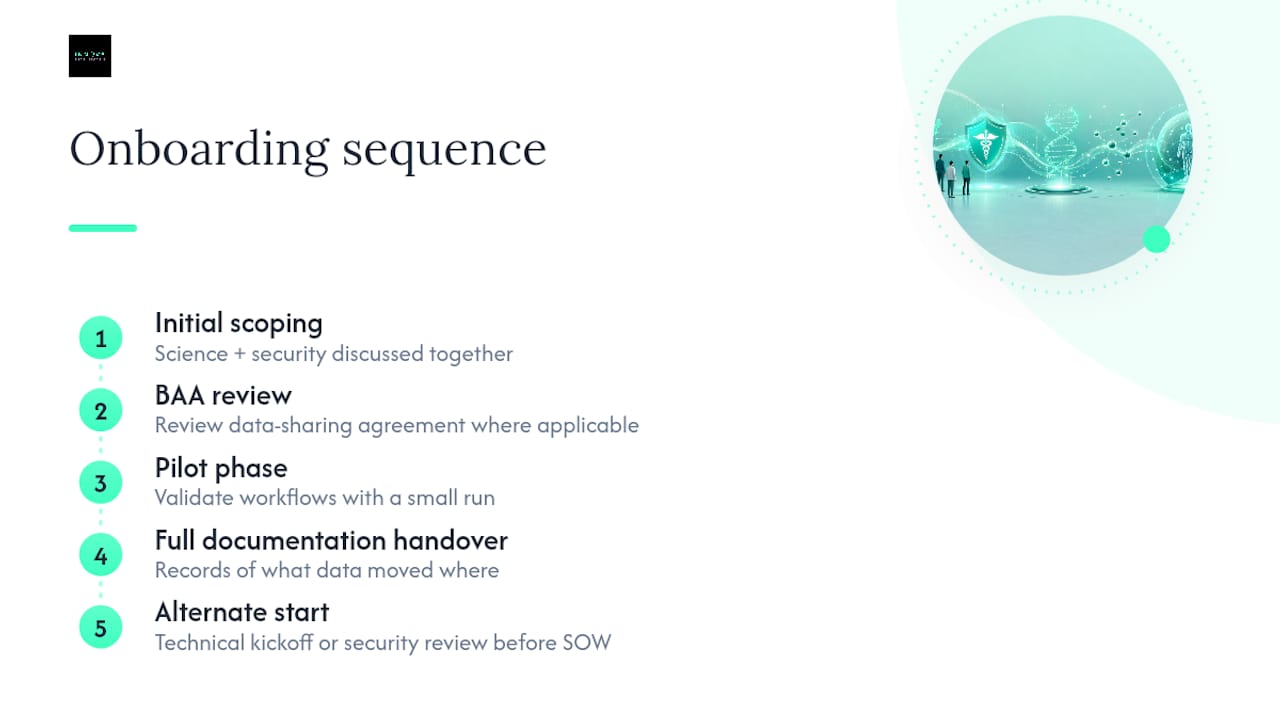
Innovabiotech scopes every engagement, whether it's virtual screening, protein engineering, or enzyme optimization, with a security conversation happening alongside the science conversation, not after it. Onboarding typically runs through initial scoping, BAA review where applicable, a pilot phase to validate workflows, and full documentation handover at project close. That sequencing exists so sponsors know exactly what data moved where, and why, before committing to a larger program.
Sponsors evaluating a first engagement are welcome to start with a technical kickoff or security review rather than jumping straight to a full statement of work.
— Hooman
Start a HIPAA-Ready Bioinformatics Project With Innovabiotech
Innovabiotech is built for sponsors who need contract bioinformatics without spending months vetting a vendor's security posture from scratch. Because scoping and BAA review happen at the start of every engagement rather than as an afterthought, you get a clearer path to a signed agreement and a pilot phase before committing to a full program.
Whether you need virtual screening, hit-to-lead optimization, or de novo peptide design handled under documented security controls, the fastest way to see how Innovabiotech scopes a project is to start the conversation directly. Visit the Innova Biotech overview page to request a technical kickoff and BAA review for your next program.
Sources
- Computational drug discovery and related techniques (PMC3880464)
- Selecting the right outsourcing model for emerging biotech (ContractPharma)
FAQ
Does a bioinformatics vendor need to sign a BAA?
Yes, if the vendor handles protected health information or data covered by a sponsor's HIPAA obligations, a signed business associate agreement scoped to the specific project is required before work begins.
What's the difference between FTE and unit-based bioinformatics contracts for compliance purposes?
FTE-based contracts put dedicated staff under closer sponsor oversight, while unit or project-based contracts typically run on the vendor's own systems and require stronger contractual audit rights and subprocessor transparency.
What encryption standard should a HIPAA-aware bioinformatics vendor use?
Vendors should use TLS for data in transit and AES-256 or an equivalent standard for data at rest, managed through a dedicated key management system rather than keys stored with the data.
Can AI-driven virtual screening platforms still be HIPAA compliant?
Yes, provided the platform separates model outputs from raw sponsor data, logs every transformation, and includes chemist-in-the-loop review to catch issues before results leave the secure environment.
What's a red flag when vetting a contract bioinformatics vendor?
Refusal to sign a BAA, vague or unverifiable security audit claims, and unwillingness to share a subprocessor list are all signs to keep looking elsewhere.