
Pharma bioinformatics project management sits at the intersection of computational biology, regulatory compliance, and drug development operations. It is not simply running a bioinformatics pipeline on schedule. It means governing every data decision, team handoff, and validation checkpoint across a regulated clinical lifecycle. For biotechnology companies working under GxP frameworks and ICH GCP E6(R3) requirements, the discipline determines whether a program advances or stalls at a regulatory gate.
The core objectives are clear:
- Maintain regulatory adherence across all project phases, from target identification through clinical submission
- Integrate cross-functional teams spanning R&D, clinical operations, data science, and regulatory affairs
- Apply risk-based decision-making with documented rationale at every stage
- Preserve full data traceability and lifecycle integrity for audit readiness
- Coordinate vendor and CRO oversight with proactive, documented controls
Innovabiotech was built specifically to deliver on these objectives for biotech clients who need more than generic project coordination.
Table of Contents
- How regulatory compliance shapes pharma bioinformatics project management
- What a bioinformatics project management system actually does
- Best practices for managing pharma bioinformatics projects
- How Innovabiotech approaches pharma bioinformatics project management
- Innovabiotech delivers what pharma bioinformatics projects actually need
- Key Takeaways
- FAQ
How regulatory compliance shapes pharma bioinformatics project management
GxP compliance covers Good Manufacturing Practice, Good Clinical Practice, and Good Laboratory Practice. All three apply simultaneously across a typical pharma bioinformatics project, and none can be treated as someone else's responsibility.
The FDA's 21 CFR Part 11 framework governs electronic records and signatures used throughout bioinformatics workflows. Validation of every software system that generates, modifies, or stores regulated data is mandatory, not optional. Patient privacy requirements layer on top of this, demanding that genomic and clinical datasets are handled under strict access controls and documented data governance policies.
Under ICH GCP E6(R3), sponsors carry documented oversight responsibility for all outsourced bioinformatics activities. That means active, evidenced control of CROs and data vendors, not a signed contract and periodic check-ins. Risk-based management throughout the clinical lifecycle requires sponsors to demonstrate proportionate oversight and informed decision-making at every phase gate.
Personnel competency is another non-negotiable. Staff handling bioinformatics project data must hold documented training records aligned to their specific roles, and those records must survive an inspection.
- GxP integration across manufacturing, clinical, and laboratory phases from project inception
- 21 CFR Part 11 validation for all electronic records and bioinformatics software
- Documented sponsor oversight of outsourced bioinformatics per ICH GCP E6(R3)
- Patient privacy and data security controls on genomic and clinical datasets
- Role-specific training records for all bioinformatics project personnel
- Quality assurance checkpoints embedded at each project phase gate
- Change control documentation for any modification to validated systems or protocols
Pro Tip: Embed 21 CFR Part 11 validation requirements at the system architecture stage, before a single line of code runs in production. Retrofitting compliance after build is exponentially more expensive and frequently triggers audit findings.
What a bioinformatics project management system actually does
Bioinformatics project management systems integrate four functional areas: workflow management, data management, user result tracking, and audit-ready reporting. Each area must connect to the others, because a gap between workflow execution and audit reporting is exactly where regulatory deficiencies appear.
Cross-functional integration is the operational backbone. R&D, clinical operations, manufacturing, regulatory affairs, and data science teams all generate outputs that feed into each other. Without a shared governance layer, handoffs create version conflicts, undocumented decisions, and traceability gaps.
Data lifecycle management covers automated versioning, secure off-site backups, and electronic laboratory notebooks (ELNs) that document every computational step. Reproducibility under GxP depends on this. An analysis that cannot be reconstructed from documented inputs is not a GxP-compliant analysis.
"Project management in bioinformatics core services can be demanding as we can get a wide variety of projects in all shapes and sizes. As managers, it is our responsibility to lay a clear organization of the project by setting the right scope, manage communication with our users and multiple teams, and make sure the right resources are assigned to the project." — EBI Managing a Bioinformatics Core Facility
Standardization and interoperability matter because bioinformatics tools rarely come from a single vendor. A well-governed system enforces data format standards and software interface protocols so outputs from one pipeline feed cleanly into the next. This is where bioinformatics workflow management moves from a technical concern to a compliance concern.
Pro Tip: Use a Kanban-style tracking board linked to your ELN so task status and computational decisions stay synchronized. When an auditor asks why a parameter changed mid-analysis, the answer should be one click away, not a three-day search through email threads.
- Workflow management connecting experimental design to data output
- Data management with automated versioning and secure backup protocols
- User result tracking with audit trails for every analytical decision
- Audit-ready reporting accessible to internal QA and external inspectors
- ELNs documenting computational steps for full reproducibility
- Standardized data formats enabling interoperability across tools and platforms
- Centralized communication logs replacing fragmented email chains
Best practices for managing pharma bioinformatics projects
Project governance works best when it is woven into daily decision-making rather than reserved for milestone reviews. Pharma project governance embedded as active decision architecture means every go/no-go call carries documented scientific and regulatory rationale. That documentation is what separates a defensible program from one that collapses under inspection.

Bioinformatics data pipelines must be treated as critical path. A delayed genomic analysis does not just slow down the data science team. It delays clinical operations, regulatory submissions, and ultimately patient access. Prioritizing pipeline throughput is prioritizing the program.
Flexible management frameworks outperform rigid pre-defined models in pharma bioinformatics because project scope varies dramatically. A hit-to-lead optimization study has different data volumes, team structures, and regulatory checkpoints than a de novo peptide design program. One-size-fits-all project templates create friction rather than efficiency.
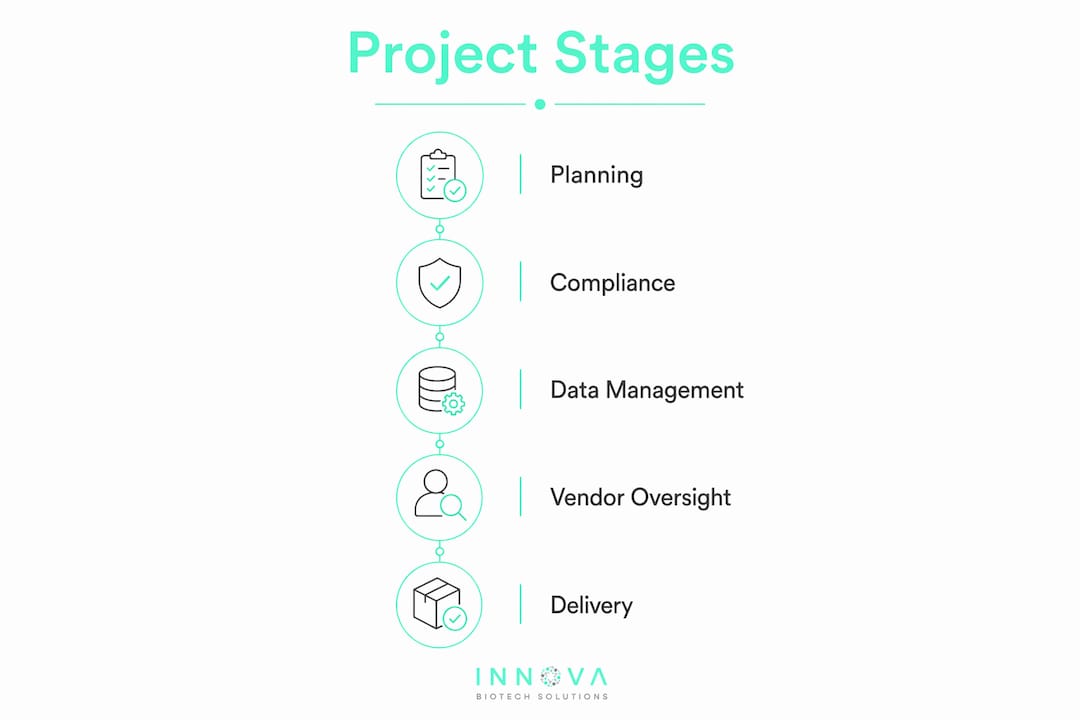
Vendor and CRO oversight requires active shepherding of genomic data flow, not passive contract administration. ICH GCP E6(R3) vendor oversight standards require sponsors to evidence proportionate control, which means KPI dashboards, regular performance reviews, and documented escalation paths.
AI-powered project management tools have been reported to significantly reduce project completion time by automating status monitoring and flagging pipeline risks before they escalate.
Key success factors:
- Embed governance into daily decisions, not quarterly reviews
- Treat bioinformatics pipelines as critical path in every project plan
- Use flexible, customizable frameworks adapted to each project's scope
- Maintain KPI dashboards tracking compliance milestones and vendor performance
- Document every change, scope adjustment, and risk decision in real time
- Build escalation protocols into vendor contracts from project kickoff
- Apply model-informed go/no-go decision frameworks at each phase gate
How Innovabiotech approaches pharma bioinformatics project management
Innovabiotech, based in San Francisco, California, was founded to address a specific gap: biotech companies needed bioinformatics services that came with genuine project governance, not just computational output. The team integrates regulatory compliance, scientific rigor, and structured pharmaceutical project oversight into every engagement from initial consultation through final delivery.
Their service model covers virtual screening, high-throughput drug discovery, hit-to-lead optimization, protein engineering, enzyme optimization, and de novo peptide design. Each service operates within a project management framework tailored to the client's regulatory environment and scientific objectives.
"At Innova Biotech Solutions, we believe strong communication is essential to successful collaboration. We keep our clients informed and supported throughout the entire process, providing clear updates, technical guidance, and responsive service at every step." — Innova Biotech Solutions
Client communication is not a support function at Innovabiotech. It is a core project management mechanism. Transparent updates, documented decision points, and responsive technical guidance keep clients aligned with project status and regulatory requirements simultaneously.
The team applies data-driven go/no-go decision frameworks and embeds compliance checkpoints at the design stage rather than treating them as audit preparation. For biotech clients navigating complex regulatory environments, that approach reduces the risk of late-stage findings that derail timelines.
- Tailored project management frameworks matched to each client's regulatory and scientific context
- Integration of GxP compliance into project architecture from day one
- Client communication protocols that double as project governance documentation
- Flexible scaling across discovery, optimization, and clinical-stage bioinformatics projects
- Expertise in bioinformatics services for drug discovery spanning computational biology and peptide design
Innovabiotech delivers what pharma bioinformatics projects actually need
Most biotech teams know what they need to accomplish. The harder problem is executing it within a regulatory framework that penalizes undocumented decisions and rewards audit-ready traceability. Innovabiotech provides the bioinformatics expertise and the project governance structure to do both at once.
For teams working on peptide design, protein engineering, or enzyme optimization, Innovabiotech delivers customized computational biology services with compliance built in, not bolted on afterward. Every project includes clear milestones, documented decision points, and direct communication with the scientific team handling your work. Contact Innovabiotech to discuss your project requirements and get a clear picture of what managed bioinformatics execution looks like for your program.
Key Takeaways
Effective pharma bioinformatics project management requires GxP compliance, risk-based governance, and flexible frameworks integrated from project design through final regulatory submission.
| Point | Details |
|---|---|
| GxP compliance is non-negotiable | 21 CFR Part 11 validation and GxP integration must be embedded at the system design stage, not added at audit time. |
| Pipelines are critical path | Bioinformatics data pipelines directly affect clinical timelines; delays in analysis translate to delays in submission. |
| Flexible frameworks outperform rigid templates | Project scope in pharma bioinformatics varies too much for one-size-fits-all models; customizable frameworks are required. |
| AI tools cut completion time | AI-powered project management tools have demonstrated up to a 60% reduction in project completion time. |
| Innovabiotech integrates both | Innovabiotech delivers tailored bioinformatics services with compliance-first project governance built into every engagement. |
FAQ
What is pharma bioinformatics project management?
It is the discipline of governing bioinformatics workflows within pharmaceutical drug development under regulatory frameworks like GxP and ICH GCP E6(R3), covering data traceability, cross-functional coordination, and compliance documentation.
Why does ICH GCP E6(R3) matter for bioinformatics projects?
ICH GCP E6(R3) requires sponsors to maintain documented, risk-based oversight of all outsourced bioinformatics activities, including active management of CROs and data vendors throughout the clinical lifecycle.
What KPIs should teams track in pharma bioinformatics projects?
Key metrics include pipeline throughput against critical path milestones, vendor performance against contracted deliverables, compliance checkpoint completion rates, and audit-finding rates per phase.
How does Innovabiotech support pharma bioinformatics project management?
Innovabiotech provides customized bioinformatics services, including peptide design, protein engineering, and enzyme optimization, with GxP-aligned project governance, transparent client communication, and compliance embedded from project inception.
What is the biggest risk in pharma bioinformatics project management?
Treating regulatory compliance as a post-hoc audit activity rather than a design-stage requirement. Late-stage findings in validated systems or undocumented analytical decisions are the most common causes of clinical program delays.