

Structural bioinformatics is defined as the discipline that merges three-dimensional molecular structure data with computational analysis to drive target identification, hit discovery, and lead optimization in pharmaceutical research. The role of structural bioinformatics in pharma has expanded dramatically through 2024 and 2025, with protein structure prediction advances transforming how researchers approach target validation and pharmacomics. Techniques spanning X-ray crystallography, cryo-EM, NMR spectroscopy, molecular docking, molecular dynamics, and generative AI now form an interconnected pipeline that takes a protein target from atomic coordinates to a ranked list of drug candidates. For pharmaceutical researchers and drug developers, understanding how these tools integrate is no longer optional. It is the foundation of competitive drug discovery.
What role does structural bioinformatics play in pharma drug discovery?
Structure-based drug design, the recognized industry term for the applied practice of structural bioinformatics in pharma, uses atomic-resolution protein structures to guide every stage of the discovery pipeline. Target identification relies on structural data to confirm that a binding site is druggable before any chemistry investment begins. Hit discovery uses that same structural information to screen compound libraries computationally, filtering millions of candidates down to a tractable set for synthesis. Lead optimization then refines those candidates by modeling how small structural changes to a molecule affect binding affinity, selectivity, and ADMET properties.
The importance of bioinformatics in pharma becomes concrete when you consider scale. Modern pipelines screen up to 10^9 compounds via virtual screening using docking, molecular dynamics, and free-energy calculations. No wet-lab operation can match that throughput. The computational layer does not replace experimental biology; it concentrates experimental resources on the candidates most likely to succeed, which directly reduces the cost and timeline of early-stage R&D.

What experimental techniques supply structural data for bioinformatics workflows?
The quality of any computational analysis depends entirely on the quality of the structural input. Three experimental methods dominate the field, and their outputs are not interchangeable.
| Method | Output type | Key strength | Key limitation |
|---|---|---|---|
| X-ray crystallography | Static high-resolution structure | Atomic precision, widely deposited in PDB | Single conformational snapshot; crystal packing artifacts |
| Cryo-EM | Multiple conformational states, large complexes | Captures flexibility; no crystallization needed | Lower resolution at smaller molecular weights |
| NMR spectroscopy | Solution-state structure and dynamics | Captures motion and disorder in solution | Labeling constraints; size limit ~50 kDa |
X-ray crystallography remains the most common source of PDB entries used in pharma docking campaigns because of its resolution and reproducibility. Cryo-EM has become the method of choice for membrane proteins and large multi-subunit complexes that resist crystallization, and its ability to capture multiple conformational states makes it directly useful for ensemble docking workflows. NMR spectroscopy adds a layer that neither of the other methods provides: real-time dynamic information about how a binding site breathes and flexes in solution.
Structural inputs determine whether static or ensemble conformations are available, and that choice propagates through every downstream computational step. A docking campaign built on a single X-ray structure of a flexible kinase will produce different, and often less reliable, results than one built on a cryo-EM-derived conformational ensemble of the same target.
Pro Tip: Before selecting a PDB structure for a docking campaign, filter by resolution, binding site completeness, and whether the structure represents the active or inactive conformation relevant to your therapeutic hypothesis. A 1.8 Å structure of the wrong conformational state is less useful than a 2.5 Å structure of the right one.
How do computational methods accelerate drug discovery and lead optimization?
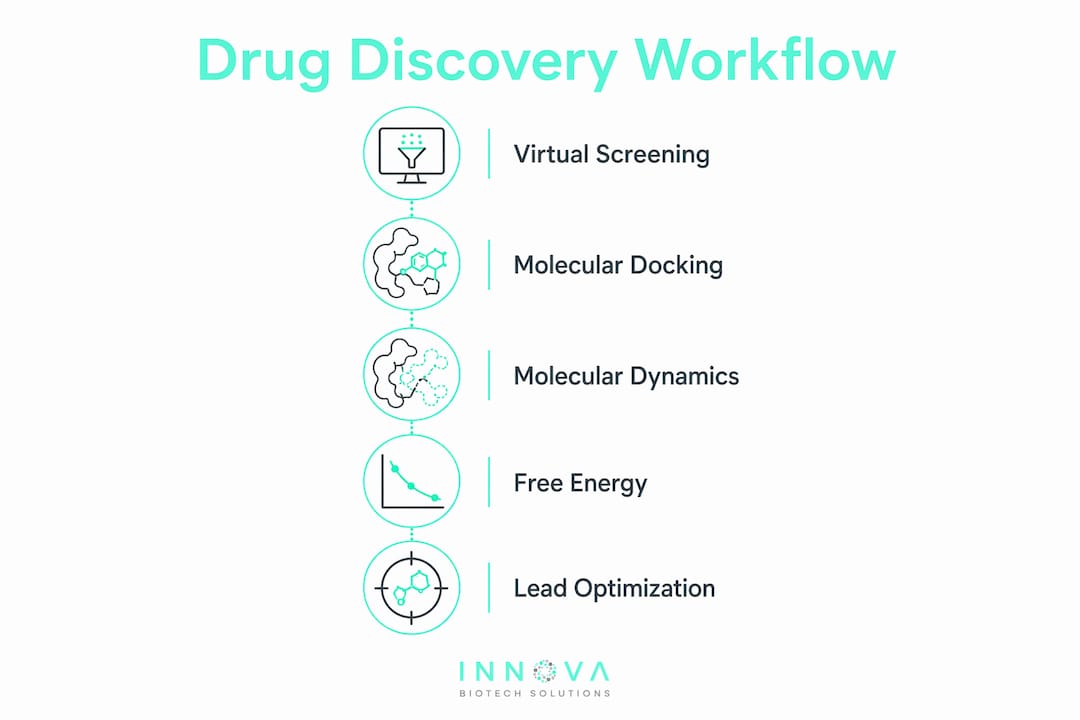
Computational methods in structural bioinformatics translate experimental structure data into ranked compound lists through a sequence of increasingly rigorous calculations. The workflow typically proceeds in four stages.
-
Virtual screening with molecular docking. Docking programs score how well each compound in a library fits the binding pocket geometry and chemistry. The challenge is receptor flexibility: a single static receptor structure misses conformations that certain chemotypes prefer. Ensemble docking addresses this by running docking against 10 to 20 receptor conformations derived from MD trajectories or cryo-EM maps, then aggregating scores across states.
-
Molecular dynamics validation. Top-ranked docking poses are subjected to MD simulations to assess whether the predicted binding mode is stable over nanosecond timescales. RMSD and RMSF analysis of the ligand and binding site residues, combined with interaction persistence metrics, separates genuinely stable poses from artifacts of the scoring function. Ensemble docking combined with MD trajectory validation improves hit reliability for flexible protein targets compared to docking-only approaches.
-
MM-GBSA rescoring. MM-GBSA post-processing estimates binding free energy from 50 to 200 frames of equilibrated MD trajectories, producing a more physically rigorous ranking than docking scores alone. Comparisons should be made within a compound series rather than across chemically diverse scaffolds, and entropic contributions must be explicitly reported.
-
ADMET filtering. Compounds that survive the binding affinity filter are passed through ADMET prediction models to flag liabilities in absorption, distribution, metabolism, excretion, and toxicity before any synthesis decision is made.
This integrated workflow, combining virtual screening campaigns with MD and free-energy calculations, is what separates production-grade pharma pipelines from exploratory academic scripts.
Pro Tip: Standardize your docking protocols, including protonation state assignment, grid box dimensions, and scoring function parameters, across all campaigns. Protocol drift between projects is one of the most common sources of irreproducible ranking results in pharma computational teams.
What is the impact of generative AI on structure-based drug design?
Generative AI in structure-based drug design does something traditional virtual screening cannot: it creates novel molecules rather than selecting from a pre-existing library. Target-aware generative models exploit the 3D geometry and chemistry of binding pockets to design compounds optimized for both shape complementarity and pharmacophoric fit from the outset.
The practical applications for pharma drug developers fall into three categories:
- De novo hit generation. Diffusion models and graph-based generative networks produce candidate molecules conditioned on binding pocket coordinates, generating chemotypes that may not exist in any commercial compound library. This directly addresses the problem of chemical novelty in hit campaigns against well-validated but historically undruggable targets.
- Lead optimization via fragment addition and scaffold hopping. Reinforcement learning frameworks iteratively modify a lead scaffold by adding fragments, replacing ring systems, or growing into unexplored sub-pockets, with each modification scored against the target structure and ADMET predictors simultaneously.
- Expanding chemical space for ADMET optimization. Generative models can be conditioned on both binding affinity and ADMET property targets, producing compounds that satisfy multiple objectives in a single design cycle rather than requiring sequential rounds of medicinal chemistry.
The dependency on reliable structural data is the central limitation. A generative model conditioned on a low-quality or conformationally irrelevant structure will design molecules optimized for the wrong binding site geometry. The benefits of structural bioinformatics in this context are only as strong as the experimental data feeding the model.
What are the practical challenges of integrating structural bioinformatics in pharma workflows?
Operational success with structural bioinformatics in pharma R&D depends on decisions that are rarely discussed in methods papers but consistently determine whether a project delivers actionable leads.
- PDB structure selection. Selecting the best PDB structure based on binding site quality and conformational relevance is the single most impactful decision in any docking campaign. Structures with incomplete binding sites, low resolution, or non-physiological crystal contacts introduce systematic errors that no downstream method can correct.
- Conformational ensemble representation. Single static structures are inadequate for flexible targets. Generating conformational ensembles from MD trajectories or clustering cryo-EM maps captures the range of binding-competent states and reduces the risk of missing chemotypes that prefer alternative conformations.
- Experimental validation. In silico scoring and rankings are hypotheses, not results. Orthogonal biophysical assays, including SPR, ITC, and cellular target engagement assays, remain the only way to confirm that a computationally predicted binder is a real one.
- Auditable, reproducible pipelines. Production-ready workflows with QC gates and version-controlled analysis scripts are a regulatory expectation in pharma, not a best practice. Every parameter choice, structure selection decision, and filtering threshold must be documented and reproducible.
- Scoring function bias. Docking scoring functions are trained on known binders and systematically underperform on novel chemotypes or allosteric sites. Awareness of these biases, combined with diverse scoring function consensus, reduces the rate of false positives reaching synthesis.
How is structural bioinformatics applied in real pharmaceutical drug discovery projects?
A 2026 study targeting PBP2A, the primary resistance determinant in methicillin-resistant Staphylococcus aureus (MRSA), demonstrates how these methods integrate in practice. The team used ensemble docking across 20 receptor conformations derived from MD trajectories of PBP2A, screening 40 compounds and refining the list to 3 lead candidates with binding affinities ranging from a mean of approximately -7.17 kcal/mol to a best of -9.42 kcal/mol. This represents a direct application of the role of computational biology in pharma: using conformational sampling to identify inhibitors that a single-structure docking campaign would have missed.
Deep generative molecular design conditioned on dynamic protein states was layered on top of the docking results to propose novel scaffolds for the identified binding modes. MM-GBSA rescoring of MD trajectories then re-ranked the candidates by binding free energy, separating genuine leads from docking artifacts. Orthogonal experimental validation confirmed compound efficacy and binding, closing the loop between computational prediction and wet-lab reality.
The benefits of structural bioinformatics in this case were concrete: improved hit rate, chemical novelty beyond existing antibiotic scaffolds, and a ranked candidate list with mechanistic rationale for each compound. For teams working on peptide-based therapeutics, peptide binding affinity prediction using MM-GBSA and related approaches provides a complementary path to lead prioritization.
Pro Tip: When reporting ensemble docking results to medicinal chemistry partners, include interaction persistence data from MD simulations alongside docking scores. A compound that maintains a key hydrogen bond to a catalytic residue in 80% of MD frames is a far stronger lead than one with a better docking score but unstable binding pose.
Key takeaways
Structural bioinformatics drives pharmaceutical drug discovery by converting atomic-resolution protein structures into ranked, experimentally validated compound candidates through integrated computational workflows.
| Point | Details |
|---|---|
| Structural input quality is decisive | PDB structure selection by resolution, conformation, and binding site quality determines the reliability of all downstream docking and MD results. |
| Ensemble methods outperform single structures | Docking across 10 to 20 receptor conformations combined with MD validation improves hit reliability for flexible targets. |
| Generative AI expands chemical novelty | Target-aware generative models design compounds beyond existing libraries, but require high-quality structural inputs to function correctly. |
| Computational rankings are hypotheses | MM-GBSA and docking scores guide prioritization; orthogonal biophysical assays confirm binding and efficacy before synthesis investment. |
| Auditable pipelines are a regulatory requirement | Production-grade pharma workflows demand version-controlled, reproducible analysis with documented QC gates at every stage. |
Why the field is moving faster than most pharma teams realize
I have watched structural bioinformatics shift from a specialist support function to a core decision-making tool in drug discovery programs, and the pace of that shift has accelerated sharply in the last two years. The integration of AlphaFold-derived structures into docking campaigns, the maturation of diffusion-based generative models, and the availability of cloud-scale HPC for virtual screening have collectively compressed what used to be a 12-month hit identification cycle into weeks for well-resourced teams.
What concerns me is the gap between teams that have built production-grade, auditable workflows and those still running exploratory scripts. The computational methods work. The bottleneck is workflow engineering: reproducible pipelines, documented parameter choices, and integration with experimental validation gates. Pharma teams that treat bioinformatics as a one-off analysis service rather than a continuous, version-controlled R&D function are leaving lead quality and regulatory defensibility on the table.
The promise of AI-driven molecule design is real, but it is also fragile. A generative model fed a low-quality or conformationally irrelevant structure will produce chemically interesting molecules that bind the wrong pocket geometry. The discipline of structural bioinformatics, meaning the careful selection of experimental inputs, the honest reporting of scoring function limitations, and the insistence on orthogonal validation, is what separates productive AI-assisted drug discovery from expensive noise. Pharma researchers who invest in that discipline now will have a compounding advantage over teams that treat AI as a shortcut around rigorous structural analysis.
— Hooman
How Innovabiotech supports your structural bioinformatics-driven projects
Innovabiotech, based in San Francisco and founded in 2024, builds the kind of integrated structural bioinformatics workflows described throughout this article for pharmaceutical and biotech clients who need production-grade results, not exploratory analyses.
Our team delivers peptide design and optimization services that combine experimental structural inputs with ensemble docking, MD-based rescoring, and generative design to accelerate hit identification and lead optimization. We also provide protein engineering and computational modeling services for clients targeting complex or flexible protein systems where single-structure approaches fall short. Every project is delivered with documented, reproducible pipelines and clear communication at each stage. If you are building a drug discovery program that depends on structural bioinformatics, explore how Innovabiotech can support your specific project goals at innovabiotech.com.
FAQ
What is structural bioinformatics in the context of pharma?
Structural bioinformatics in pharma is the application of computational methods to three-dimensional molecular structure data, including protein-ligand complexes, to support target identification, virtual screening, and lead optimization in drug discovery programs.
How does molecular docking differ from generative AI in drug design?
Molecular docking scores pre-existing compounds against a protein binding site, while target-aware generative AI designs novel molecules conditioned on the 3D geometry of that site, expanding chemical space beyond any existing compound library.
Why is conformational ensemble docking preferred over single-structure docking?
Single static structures miss binding-competent conformations of flexible targets. Ensemble docking across multiple receptor states, combined with MD validation, produces more reliable hit lists and reduces the rate of false positives reaching synthesis.
What role does MM-GBSA play in lead prioritization?
MM-GBSA estimates binding free energy from multiple frames of equilibrated MD trajectories, providing a more physically rigorous ranking than docking scores alone. It works best when comparing compounds within the same chemical series rather than across diverse scaffolds. Learn more about applying MM-GBSA for binding affinity in peptide-based lead optimization.
How do peptide biomarkers connect to structural bioinformatics workflows?
Peptide biomarkers in drug discovery provide experimental binding and activity data that can be used to validate and calibrate computational models, closing the loop between structural predictions and measurable biological outcomes.
Recommended
- Biotechnology Advancements: Innovations at Innova Biotech Solutions
- Peptide Secondary Structure: What Researchers Need to Know
- Peptide Binding Affinity Prediction: A Practical Guide
- Innova Biotech Solutions: Expert Peptide Design and Optimization Services.bioinformatics validation, custom peptides, peptide design services