

TL;DR:
- Validating virtual screening involves combining computational benchmarking with experimental orthogonal assays to reliably identify true binders and prioritize leads.
- Each validation step, from pose reproduction to pipeline enrichment, must be assessed individually to prevent overestimated performance and false positives.
Validating virtual screening results is the process of confirming that computational predictions reliably identify true binders and correctly prioritize leads for experimental follow-up. Without rigorous validation, a docking workflow can appear to perform well on paper while failing completely in the lab. The field has moved well beyond checking root-mean-square deviation (RMSD) alone. Modern best practices now combine computational benchmarking with experimental orthogonal assays to build genuine confidence in hit lists. This article covers the full validation stack: from self-docking sanity checks and ROC-AUC benchmarking to jump dilution kinetics and pipeline-level enrichment analysis.
What does validating virtual screening results actually require?
Virtual screening validation is the systematic process of testing whether a docking or scoring workflow discriminates true binders from non-binders across realistic compound libraries. The term covers two distinct but complementary tasks: pose validation (does the method reproduce known binding geometries?) and hit discovery validation (does the method rank actives above decoys in a realistic screening scenario?). Conflating the two is one of the most common errors in drug discovery workflows.

Pose reproduction and hit discovery quality are different validation tasks, and skipping decoy and enrichment tests risks selecting compounds that fail realistic screening scenarios. A workflow can achieve sub-2 Å RMSD on a co-crystallized ligand and still produce a hit list dominated by false positives when applied to a diverse library. That distinction matters enormously when you are about to commit synthesis resources to 20 or 30 compounds.
The standard industry term for this combined approach is prospective and retrospective validation. Retrospective validation uses known actives and decoys to measure performance before a real screen. Prospective validation tests whether computationally predicted hits are confirmed by experiment. Both layers are necessary, and neither alone is sufficient for a trustworthy workflow.
Key computational approaches to validating virtual screening workflows
Computational validation starts with self-docking: re-docking a co-crystallized ligand back into its own binding site and measuring RMSD against the experimental pose. RMSD below ~2 Å indicates pose recovery but does not guarantee screening robustness across different proteins or ligands. Think of self-docking as a sanity check, not a performance certificate.
Cross-docking extends this by docking a ligand into receptor conformations derived from other ligand-bound structures. This tests whether the scoring function generalizes across conformational flexibility, which is the actual condition during a virtual screen. Cross-docking and decoy benchmark tests using ROC-AUC and enrichment factors provide stronger validation by assessing discrimination between binders and non-binders. An ROC-AUC above 0.7 is a widely used acceptance threshold, though targets with shallow binding sites often require higher cutoffs to be meaningful.
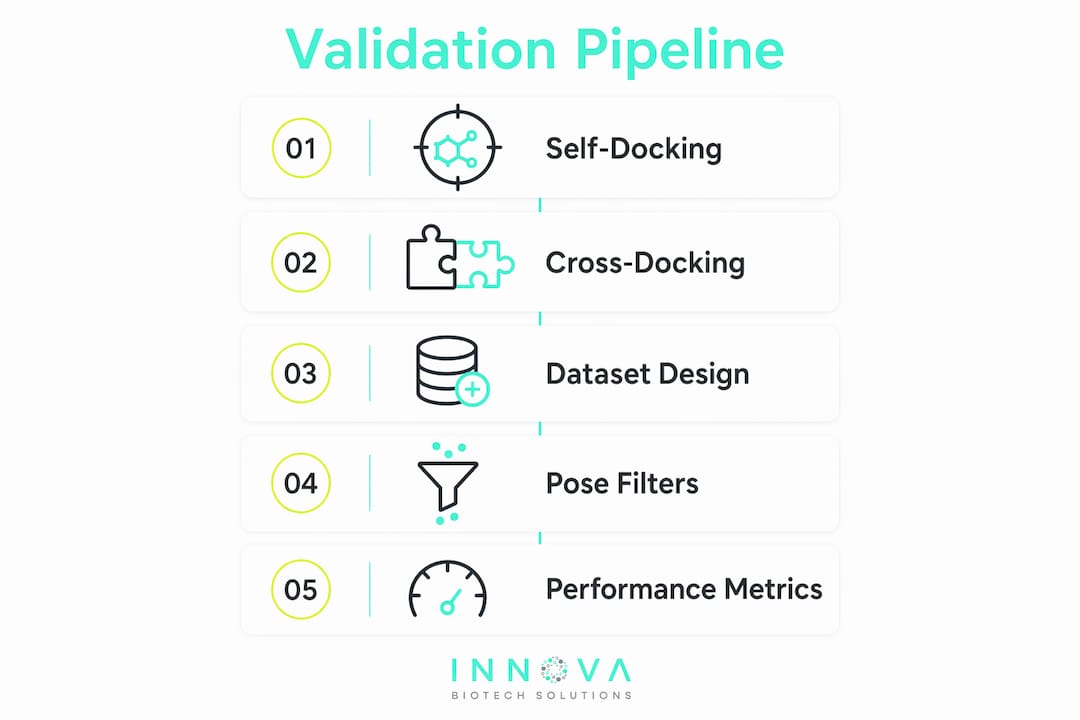
Dataset design is where many validation efforts quietly fail. Leakage-resistant dataset splits that prevent overlap of pocket or ligand scaffolds between training and test sets are required to avoid overestimating performance. If your decoy set shares scaffold families with your actives, enrichment metrics will look artificially strong. This is especially problematic for machine learning rescoring models, where memorization of training patterns can masquerade as generalization.
Geometric plausibility filters add another layer of quality control. Stringent pose convergence and binding-site proximity filters can improve enrichment performance dramatically, with reported enrichment factors reaching EF 62 and 93.5% enrichment in well-designed workflows. These filters remove poses that pass scoring thresholds but violate basic geometric or interaction criteria, such as ligands partially outside the binding pocket or missing key hydrogen bond contacts.
| Validation method | Primary metric | Typical acceptance criteria |
|---|---|---|
| Self-docking | RMSD vs. crystal pose | < 2 Å for pose recovery |
| Cross-docking | RMSD across receptor conformations | < 2.5 Å across multiple structures |
| Decoy benchmarking | ROC-AUC, Enrichment Factor (EF1%) | AUC > 0.7; EF1% > 5 |
| Geometry filters | Pose convergence, pocket proximity | > 80% poses within binding site |
| ML rescoring | Leakage-resistant AUC | Scaffold-split AUC > 0.65 |
Pro Tip: When building your decoy set, use DUD-E or DEKOIS 2.0 as starting points, but always verify that decoys are physicochemically matched to your actives. Unmatched decoys inflate enrichment metrics and give a false sense of workflow quality.
How do orthogonal assays confirm virtual screening hits?
Experimental confirmation is the stage where computational predictions meet biological reality. Orthogonal biochemical assays using different detection methods confirm hit activity, reduce false positives, and deliver quantitative metrics like IC50 for lead prioritization. The logic is straightforward: if two assays with fundamentally different detection mechanisms both confirm activity, the probability of a false positive drops sharply.
A standard orthogonal confirmation workflow for virtual screening hits typically includes:
- Primary biochemical assay (e.g., fluorescence polarization or HTRF) to establish initial activity at a fixed concentration
- Counter-screen using a different detection format (e.g., TR-FRET or enzymatic readout) to rule out assay interference artifacts
- Dose-response IC50 measurement to rank potency across confirmed hits and prioritize compounds for structural follow-up
- Selectivity profiling against closely related targets to assess specificity early in the hit-to-lead process
Kinetic parameters add a dimension that equilibrium IC50 values cannot capture. The Jump Dilution Assay measures drug-target residence time, providing a kinetic parameter that predicts pharmacodynamic durability beyond equilibrium potency. A compound with a long residence time can maintain target occupancy well after plasma concentrations drop, which translates directly to dosing interval and therapeutic window decisions. Integrating residence time data early in lead optimization prevents the common mistake of advancing potent but kinetically fragile compounds.
Pro Tip: Plan your orthogonal assay panel before you run the virtual screen, not after. Reagent availability, assay format compatibility, and throughput requirements all affect which hits you can actually confirm. Discovering mid-campaign that your primary assay format is incompatible with your counter-screen costs weeks.
For reliable research results, reagent quality and assay consistency across plates are non-negotiable. Variability in protein batch quality or DMSO tolerance between assay formats is a common source of discordant orthogonal results that gets misattributed to compound behavior.
How should you validate each step of a virtual screening pipeline?
Multi-stage virtual screening pipelines typically include docking, rescoring, physicochemical filtering, and clustering before a final hit list is produced. Assuming the pipeline works end-to-end without testing each stage individually is a structural mistake. Incremental validation of each pipeline step is necessary, assessing enrichment improvements at every stage rather than assuming end-to-end effectiveness.
The practical challenge is generating enough negative data to make enrichment metrics statistically meaningful at each stage. Generating large negative datasets computationally by ligand randomization and isomer generation enables rigorous pipeline-wide validation without additional experiments. This approach produces matched negatives that are structurally plausible but biologically inactive, which is far more demanding than using random drug-like molecules as decoys.
| Pipeline stage | What to measure | Why it matters |
|---|---|---|
| Initial docking | EF1%, ROC-AUC vs. decoy set | Establishes baseline discrimination |
| Rescoring | Delta EF vs. docking alone | Confirms rescoring adds real value |
| Physicochemical filtering | Hit rate change, scaffold diversity | Checks that filters don't remove actives |
| Clustering | Coverage of known active chemotypes | Validates chemical diversity of final list |
| Final hit list | Experimental confirmation rate | Measures real-world predictive accuracy |
Pipeline validations should document intermediate outputs and evaluate enrichment improvements incrementally. This analysis uncovers which pipeline steps add true value and which add noise. A rescoring step that improves EF1% from 8 to 12 is worth keeping. One that improves it from 8 to 8.2 while adding two hours of compute time is not.
Pro Tip: Run your pipeline on a held-out benchmark set before applying it to your actual screening library. If enrichment metrics on the benchmark match your development set, you have reasonable confidence the pipeline generalizes. If they diverge significantly, investigate dataset leakage before proceeding.
Best practices for troubleshooting virtual screening validation failures
Validation failures are informative. They tell you exactly where your workflow breaks down, which is more useful than a pipeline that appears to work but produces unreliable hit lists. The most common failure modes and their fixes follow a recognizable pattern.
- Over-reliance on RMSD. RMSD below 2 Å confirms pose recovery for the co-crystallized ligand but says nothing about how the method handles chemically diverse compounds. Always pair RMSD checks with decoy benchmarking using ROC-AUC and enrichment factors.
- Dataset leakage. Scaffold or pocket overlap between training and test sets inflates performance metrics. Use scaffold-based splits and verify that no active in your test set shares a Murcko scaffold with a training active.
- Weak decoy sets. Decoys that are physicochemically dissimilar to actives make discrimination trivially easy. Use property-matched decoys from DUD-E or generate them computationally using isomer and randomization methods.
- Missing geometry checks. Poses that pass scoring thresholds but violate binding-site geometry inflate false positive rates. Apply binding-site proximity and pose convergence filters before finalizing any hit list.
- Opaque reporting. Validation details are frequently omitted from publications and internal reports, making it impossible to reproduce or build on the work. Report RMSD values, decoy set composition, ROC-AUC, EF metrics, and dataset split methodology as standard.
AlphaFold3-like pose generators show strong initial screening capabilities, but performance drops for more challenging datasets. This reinforces the need for comprehensive validation beyond standard benchmark sets, particularly when applying AI-driven docking to target classes outside the training distribution. The structural bioinformatics tools available in 2026 are genuinely powerful, but they require the same rigorous validation framework as classical docking methods. For context on how structural bioinformatics shapes modern validation benchmarking, the underlying principles of structure prediction quality directly affect how you interpret pose-level metrics.
Key takeaways
Validating virtual screening results requires combining computational benchmarking, leakage-resistant dataset design, and experimental orthogonal assays to build genuine confidence in hit lists before committing synthesis resources.
| Point | Details |
|---|---|
| RMSD is a starting point, not a conclusion | Pair self-docking RMSD with ROC-AUC and enrichment factor benchmarking for meaningful validation. |
| Orthogonal assays reduce false positives | Use two assays with different detection mechanisms plus IC50 dose-response to confirm hits quantitatively. |
| Kinetics matter beyond IC50 | Jump dilution assays measure residence time, which predicts pharmacodynamic durability in lead optimization. |
| Validate each pipeline step separately | Measure enrichment improvements at every stage; do not assume end-to-end performance without evidence. |
| Dataset leakage is a hidden bias | Use scaffold-based splits to prevent overlap between training and test sets and avoid inflated metrics. |
Why I think the field still underestimates validation depth
Most virtual screening papers I review report self-docking RMSD and call it validated. That practice was defensible a decade ago when the toolbox was limited. It is not defensible now. The 2026 generation of docking tools, including AI-driven pose generators, produces impressive numbers on standard benchmarks precisely because those benchmarks are well-represented in training data. The moment you apply these tools to a novel target class or a chemically unusual ligand series, performance can drop sharply without any warning signal from RMSD alone.
What I have seen work consistently is treating validation as a pipeline design problem rather than a reporting checkbox. That means building your decoy set before you build your docking protocol, running cross-docking across multiple receptor conformations from the start, and planning your orthogonal assay panel in parallel with your computational workflow. The teams that do this spend more time upfront but recover it many times over by not advancing false positives into expensive synthesis campaigns.
The integration of kinetic parameters like residence time into early hit characterization is the most underused practice I encounter. IC50 tells you about equilibrium affinity. Residence time tells you whether that affinity will translate into sustained target engagement in a cellular or in vivo context. For peptide binding affinity predictions specifically, this distinction is critical because peptides often show kinetic profiles that diverge significantly from their equilibrium potency rankings.
The community is moving toward more transparent, deployment-realistic validation, and that shift is overdue. Reporting ROC-AUC, EF metrics, dataset split methodology, and orthogonal confirmation rates as standard should become the norm, not the exception.
— Hooman
How Innovabiotech supports your virtual screening validation workflow
Innovabiotech combines deep computational expertise with practical drug discovery experience to help research teams build validation workflows that hold up under real screening conditions. Whether you need rigorous decoy benchmarking for a novel target, cross-docking validation across receptor conformations, or a complete hit-to-lead pipeline with integrated orthogonal assay planning, Innovabiotech's bioinformatics team delivers solutions tailored to your specific project requirements.

For teams working on peptide and protein targets, Innovabiotech's peptide design and optimization services integrate directly with virtual screening validation workflows, covering binding affinity prediction, structural modeling, and experimental confirmation planning. From initial consultation through final hit list delivery, every stage is handled with scientific rigor and full transparency. Contact Innovabiotech to discuss a customized validation strategy for your next drug discovery campaign.
FAQ
What is the difference between pose validation and hit discovery validation?
Pose validation checks whether a docking method reproduces known binding geometries using RMSD metrics. Hit discovery validation assesses whether the method ranks true binders above decoys in a realistic screening scenario using ROC-AUC and enrichment factors. Both are required for a trustworthy workflow.
Why is RMSD alone insufficient for virtual screening validation?
RMSD below 2 Å confirms pose recovery for a co-crystallized ligand but provides no information about how the method performs across diverse compound libraries. A workflow can achieve excellent RMSD scores and still produce hit lists dominated by false positives when applied to a real screen.
What are orthogonal assays and why are they used for hit confirmation?
Orthogonal assays use two or more detection mechanisms to confirm compound activity independently. This approach reduces false positives caused by assay interference and delivers quantitative potency metrics like IC50 for lead prioritization, making them standard practice in post-virtual screening hit validation.
How do you prevent dataset leakage in virtual screening benchmarking?
Use scaffold-based dataset splits that prevent Murcko scaffold overlap between training and test sets. Verify that no active in your test set shares structural features with training actives, and use property-matched decoys to avoid artificially inflated enrichment metrics.
What is the jump dilution assay and when should it be used?
The jump dilution assay measures drug-target residence time, a kinetic parameter that predicts how long a compound maintains target engagement after free drug concentration drops. It should be applied to confirmed hits during lead optimization to identify compounds with pharmacodynamically durable binding profiles.