
Computational drug design, formally known as computer-aided drug design (CADD) and its AI-driven extension (AIDD), delivers three measurable advantages for R&D teams: shorter hit-finding timelines, lower cost per validated lead, and higher-quality candidates entering the wet-lab queue. A 2023 Nature review documents the tectonic shift toward large-scale virtual screening enabled by abundant structural data and on-demand computing. Hasselgren and Oprea (2024) in Annual Reviews identify multi-property optimization as the defining industry trend, with ADMET and synthetic feasibility now evaluated alongside potency from the earliest pipeline stages.
The core benefits in brief:
- Speed: Virtual screening filters millions of compounds in days, not months.
- Cost efficiency: Prioritizing candidates before synthesis cuts per-hit screening costs substantially.
- Hit quality: Multi-property optimization (ADMET, synthetic feasibility) reduces late-stage attrition.
- Chemical space access: Generative AIDD models propose novel chemotypes beyond known ligand series.
Key Takeaways
Computational drug design delivers its greatest value when multi-property optimization, rigorous data vetting, and iterative wet-lab feedback are built into the workflow from the first pilot.
| Point | Details |
|---|---|
| Speed and cost advantage | Virtual screening compresses hit identification from months to weeks and reduces synthesis costs by prioritizing candidates before the bench. |
| Multi-property optimization | Evaluating ADMET and synthetic feasibility alongside potency from day one reduces late-stage attrition, per Hasselgren and Oprea (2024). |
| Wet-lab symbiosis required | Computational predictions filter and rank candidates; wet-lab confirmation remains mandatory for every validated hit. |
| Data quality is the constraint | Overfit or biased training data produces misleading candidates; vet ground-truth data before synthesis, as documented in the PMC reproducibility review. |
| Innovabiotech pilot path | Innovabiotech offers scoped pilot engagements covering data audit, virtual screening, and synthesis-ready hit delivery with defined SOW milestones. |
Table of Contents
- What CADD and AIDD actually mean for your pipeline
- 8 concrete benefits of computational drug design
- How computational predictions and wet-lab validation work together
- Where in the pipeline CADD and AIDD add the most value
- What realistic ROI looks like: timelines and benchmarks
- When computational design can mislead you
- Build vs. buy: how to scope your first pilot
- The shift CADD and AIDD are actually driving
- Innovabiotech accelerates your first validated hit
- Sources
- FAQ
What CADD and AIDD actually mean for your pipeline
CADD (computer-aided drug design) uses physics-based and rule-based methods, including structure-based docking, ligand-based QSAR, and molecular dynamics simulations, to model how small molecules interact with biological targets. AIDD (AI-driven drug design) is an enhanced iteration of CADD: it adds machine learning for property prediction, deep learning for protein folding, and generative models for de novo molecular design. The RSC Medicinal Chemistry perspective frames AIDD as expanding chemical space beyond known ligands and accelerating both target identification and HTS workflows.
The practical distinction matters for project scoping. CADD excels at targeted, physics-grounded refinement: binding pose prediction, free-energy perturbation, and selectivity modeling against structurally characterized targets. AIDD is the better choice when you need novel chemotypes, want to explore vast virtual libraries, or are working on a target with limited prior ligand data. Most productive pipelines use both, with computational protein design informing target selection before any docking run begins.
8 concrete benefits of computational drug design
1. Faster hit identification through virtual screening
Virtual screening evaluates millions to billions of compounds against a target in a fraction of the time required for physical HTS. The MDPI Molecules review documents case studies where docking and ADMET filtering yielded validated hit compounds with a fraction of the wet-lab effort. For a kinase program, that can mean narrowing a 10-million-compound library to 200 prioritized candidates before a single assay plate is prepared.
2. Lower cost per validated hit
Physical HTS at scale runs into millions of dollars per campaign. Computational pre-filtering shifts the cost curve: you synthesize and test fewer compounds, and the ones you do test are more likely to pass. The Springer 2025 review notes that improved ML and expanded chemical libraries are making this cost advantage more pronounced, particularly for programs targeting proteins with limited structural precedent.
3. Multi-property optimization from day one
This is where modern AIDD earns its keep. Rather than optimizing potency and fixing ADMET problems later, multi-property optimization simultaneously scores candidates on activity, metabolic stability, solubility, permeability, and synthetic accessibility. Hasselgren and Oprea (2024) identify this as the industry's most consequential near-term trend because it catches the trade-offs that kill leads in phase I before a single milligram is synthesized.
4. Access to previously undruggable targets
Protein-protein interactions, intrinsically disordered proteins, and allosteric sites on large enzymes were largely inaccessible to traditional small-molecule discovery. The Springer review highlights how advances in ML, compute, and chemical library design are enabling work on these targets, opening therapeutic areas that were closed five years ago.
5. Expanded and novel chemical space
Generative AIDD models propose structures that no medicinal chemist would draw from scratch, including macrocycles, stapled peptides, and non-obvious scaffolds with favorable drug-like properties. This is distinct from classical CADD, which searches within defined libraries. De novo peptide design is a direct application: generative models propose sequences optimized for target affinity and proteolytic stability simultaneously.
6. Earlier ADMET triage
Predicting absorption, distribution, metabolism, excretion, and toxicity in silico before synthesis is one of the highest-ROI applications in the pipeline. A candidate flagged for CYP3A4 inhibition or hERG liability at the virtual screening stage costs nothing to remove; the same flag at IND-enabling studies costs months and significant budget. The MDPI computational algorithms review emphasizes that this filtering role, raising the success rate of subsequent experiments, is where computational methods deliver their clearest value.
7. Synthetic-route planning and feasibility scoring
Generative models increasingly output not just structures but synthetic routes, flagging compounds that are theoretically active but practically unsynthesizable. Scoring synthetic accessibility early prevents the common failure mode of advancing a beautiful virtual hit that no chemistry team can make in reasonable time.
8. Democratized access for smaller R&D teams
Open-source tools, public structural databases (PDB, ChEMBL), and cloud compute have lowered the barrier significantly. A PMC review on democratization documents how smaller R&D groups now access discovery workflows previously confined to large pharma, and bioinformatics-driven discovery is increasingly viable for biotech teams without dedicated computational departments.
How computational predictions and wet-lab validation work together
The most productive framing is not "computational versus experimental" but "computational first, experimental where it counts." Computational methods filter and prioritize candidates so wet-lab work tests the most promising leads, not the broadest possible set. The MDPI algorithms review is explicit: algorithms are best used to raise the success rate of subsequent experiments, not replace them.
A practical iterative workflow looks like this: the computational team generates a docked and ADMET-filtered hit list; the chemistry team synthesizes the top 20–50 compounds; assay results feed back into the model as new training data; the next virtual screen is more accurate. Each cycle tightens the model. The key is that both teams agree on the feedback format before the first synthesis run, not after.
Pro Tip: Before synthesis, vet your ground-truth training data manually. The Nature review notes that virtual screening efficiency depends more on smart library preparation and property filtering than raw compute. A modular, synthon-based library built from purchasable fragments outperforms an exhaustive gigascale search on a poorly curated set.
Where in the pipeline CADD and AIDD add the most value
The highest-ROI entry points, in rough pipeline order:
- Target identification and prioritization: Protein structure prediction (AlphaFold-informed) and binding-site analysis narrow the target list before any chemistry begins.
- Virtual HTS: Replace or augment physical HTS with docking-based pre-filtering; deliverable is a ranked, ADMET-annotated hit list.
- Hit-to-lead optimization: Iterative CADD/AIDD cycles refine potency, selectivity, and drug-like properties; deliverable is a lead series with predicted SAR.
- ADMET screening: In silico ADMET flags metabolic liabilities and toxicity risks before synthesis; deliverable is a flagged candidate list with predicted failure modes.
- Synthetic-route planning: Retrosynthetic AI tools score feasibility; deliverable is a ranked synthesis plan for each lead.
The area where computational investment has limited impact today is late-stage clinical efficacy prediction. Without large, high-quality clinical datasets tied to molecular features, models cannot reliably predict phase II/III outcomes. Set expectations accordingly when scoping a pilot.
What realistic ROI looks like: timelines and benchmarks
The honest answer is that ROI varies by program type, data quality, and target class. The table below reflects ranges reported in peer-reviewed reviews rather than vendor marketing.
| Pipeline stage | Typical baseline (traditional) | Computational impact reported |
|---|---|---|
| Hit identification (HTS) | 6 months | Reduced to weeks for virtual screen campaigns |
| Lead optimization cycles | 12 months | Iterative CADD cycles compress SAR exploration |
| ADMET failure rate | High at lead nomination | Earlier flagging reduces late-stage attrition |
| Cost per validated hit | High (physical HTS) | Lower when synthesis is preceded by virtual triage |
Key figure: The MDPI Molecules review documents that virtual screening combined with ADMET filtering consistently yields validated hits with substantially reduced experimental effort compared to unguided physical screening.
Metrics worth tracking in a pilot: hits-per-screen rate, predicted versus observed ADMET failure rate, time-to-first-validated-hit, and cost-per-validated-hit. Establish baselines from your last physical HTS campaign before the pilot starts, or the comparison is meaningless.
When computational design can mislead you
Computational models are powerful but fragile. Poor training data or overfit models will produce misleading candidates, and the PMC reproducibility review documents this as a genuine concern: advanced AI models can overfit to biased public datasets, generating hits that look excellent in silico and fail immediately in the assay.
Common failure modes: dataset bias toward well-characterized targets (kinases, GPCRs) that inflates apparent model performance on novel targets; lack of negative examples in training sets; docking scores that correlate poorly with binding affinity for flexible or allosteric sites; and synthetic feasibility scores that miss protecting-group chemistry or stereochemical complexity.
Red flags during vendor selection or internal pilots:
- No independent validation set separate from training data
- Model performance reported only on benchmark datasets, not on your target class
- No wet-lab confirmation data in the case studies provided
- Inability to explain which molecular features drive a prediction
On the regulatory side, the FDA accepts computational data as supporting evidence, not standalone proof of efficacy or safety. Computational predictions should be documented with their validation methodology and presented alongside experimental data in IND submissions.
Build vs. buy: how to scope your first pilot
Choose build when you have proprietary assay data, dedicated computational staff, and a long-term need for full IP control. Choose buy when you need speed, domain expertise, and lower upfront risk on a defined program.
Vendor-selection checklist:
- Data access and quality: does the vendor use your proprietary data, public data, or both? Who owns model weights trained on your compounds?
- Model explainability: can the vendor show which features drive each prediction?
- Validation case studies: are there wet-lab-confirmed results in your target class?
- IP handling: clear contractual language on compound confidentiality and model ownership
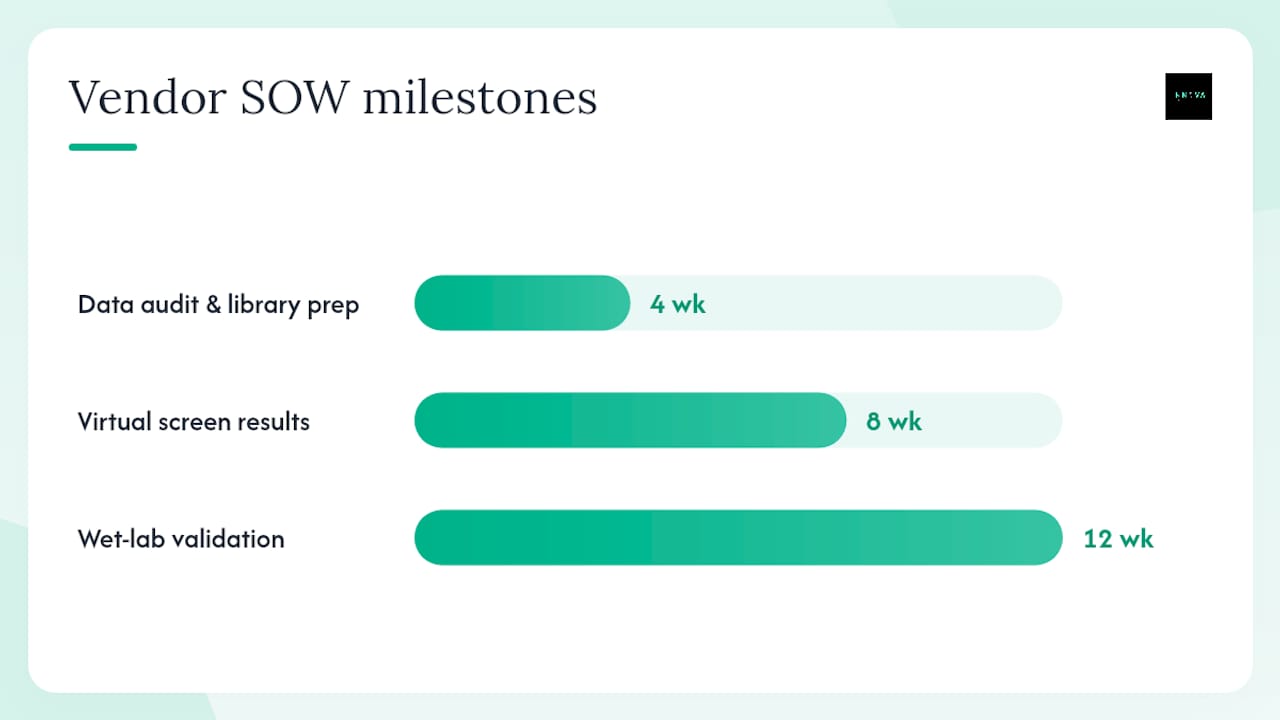
- SOW milestones: defined deliverables at 4 weeks (data audit, library prep), 8 weeks (virtual screen results), and 12 weeks (wet-lab validation of top hits)
- Reproducibility: can the vendor reproduce results on a held-out test set you provide?
| Dimension | Build in-house | Engage a service partner |
|---|---|---|
| Upfront cost | High (talent, compute, licenses) | Lower (project-scoped fees) |
| Speed to first pilot | Slow (3–12 months setup) | Fast (weeks to first deliverable) |
| IP control | Full | Contractually defined |
| Domain expertise | Depends on hiring | Immediate access |
| Scalability | High long-term | Project-dependent |
ML-enabled drug design pilots benefit from a clear SOW that specifies the target, input data format, deliverable format, and validation assay before work begins.
The shift CADD and AIDD are actually driving
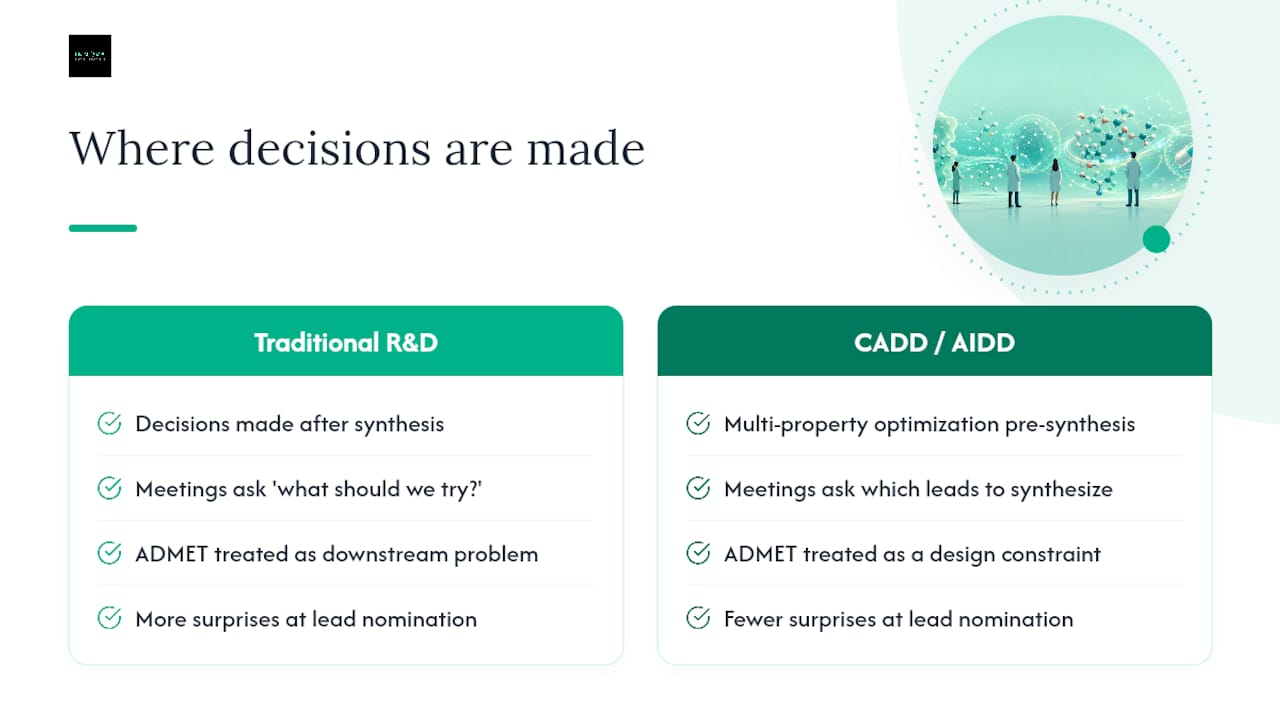
The most underestimated benefit of computational drug design is not speed or cost. It is the shift in where decisions get made. When multi-property optimization runs before synthesis, the chemistry team stops debating which analog to make next and starts evaluating a ranked, scored candidate list with predicted failure modes already attached. That changes the conversation in the project meeting from "what should we try?" to "which of these predicted leads do we trust enough to synthesize first?"
The RSC perspective frames AIDD as expanding the decision space, not just accelerating it. That framing is right, but it undersells the organizational implication: teams that adopt multi-property optimization early stop treating ADMET as a downstream problem and start treating it as a design constraint. Programs that make that shift tend to reach lead nomination with fewer surprises.
The caveat worth stating plainly: none of this works without data discipline. The reproducibility concerns documented in the PMC review are real, and they are almost always traceable to training data that was never properly vetted. The computational output is only as trustworthy as the assay data that trained the model.
Innovabiotech accelerates your first validated hit
Faster time-to-first-validated-hit is the concrete payoff Innovabiotech delivers: a focused service partner that runs the full computational workflow, from data audit through virtual screening to wet-lab-ready candidate lists, without the 6–12 month setup cost of building an internal team.
A typical pilot engagement covers a data audit and library preparation in weeks 1–4, a structure-based or ligand-based virtual screen with ADMET filtering in weeks 5–8, and delivery of a ranked, synthesis-ready hit list with predicted failure modes. For programs involving novel peptide therapeutics, Innovabiotech's peptide design and optimization services apply generative design and stability modeling to produce candidates optimized for both target affinity and proteolytic resistance. For biologics-focused programs, protein design and computational modeling services cover chimeric protein design and structure-based engineering. Contact Innovabiotech to scope a pilot with defined milestones and a clear IP agreement before work begins.
Sources
- Computational approaches streamlining drug discovery | Nature
- Recent advances from computer-aided drug design to artificial intelligence drug design - RSC Medicinal Chemistry
- Hasselgren and Oprea (2024) — Annual Reviews
- Advancing drug discovery: the role of computer-aided design and development in modern pharmaceuticals | Springer
- Role of Computer-Aided Drug Design in Drug Development | MDPI Molecules
- PMC article on democratization of drug discovery (PMC10819513)
FAQ
What are the main benefits of computational drug design?
The primary benefits are faster hit identification through virtual screening, lower cost per validated lead, earlier ADMET triage, and access to larger and more novel chemical space than physical HTS allows.
How does CADD differ from AIDD?
CADD uses physics-based and rule-based methods such as docking and molecular dynamics; AIDD extends this with machine learning for property prediction and generative models for de novo molecular design, as described in the RSC Medicinal Chemistry 2024 perspective.
Does computational drug design replace wet-lab experiments?
No. Computational methods filter and prioritize candidates to raise the success rate of subsequent experiments; wet-lab validation remains mandatory for every hit, per the MDPI algorithms review.
What is multi-property optimization in drug discovery?
Multi-property optimization evaluates potency, ADMET properties, and synthetic feasibility simultaneously rather than sequentially, catching trade-offs that typically kill leads in phase I before any synthesis occurs.
Can a small biotech team use computational drug design?
Yes. Open-source tools and cloud compute have lowered the barrier substantially, and service partners like Innovabiotech offer scoped pilot engagements that give smaller teams immediate access to virtual screening and hit-to-lead optimization without building an internal computational department.