
TL;DR:
- Bioinformatics accelerates drug discovery by replacing random screening with prediction-driven molecular design. It shortens timelines, cuts costs, and improves candidate quality before laboratory testing begins.
Bioinformatics is defined as the application of computational tools and biological data to replace trial-and-error drug discovery with rational, prediction-driven pipelines. Traditional drug discovery takes over 10 years from target identification to clinical approval. That timeline collapses when machine learning models, multi-omics data integration, and virtual screening replace manual compound testing. The shift is not incremental. It represents a fundamental change in how pharmaceutical researchers identify targets, filter candidates, and predict clinical outcomes before a single molecule is synthesized.
Why bioinformatics accelerates drug discovery: rational design over random screening
The core reason bioinformatics accelerates drug discovery is that it replaces random compound screening with rational molecular design. Instead of testing thousands of compounds in a wet lab, researchers use computational models to predict which molecules will bind a target, avoid toxicity, and survive metabolic processing. That prediction happens before synthesis, which eliminates dead ends early.
Virtual screening combined with ML can evaluate billions of compounds in a fraction of the time required by traditional assays. The cost reduction is substantial. Wet-lab screening at scale requires reagents, equipment, and labor that computational methods simply do not. Researchers redirect those resources toward validating the highest-confidence candidates.
Target identification benefits equally. Genomic and proteomic datasets reveal disease-associated proteins that classical biochemistry would take years to characterize. Bioinformatics pipelines cross-reference gene expression data, protein interaction networks, and clinical phenotypes to rank targets by biological relevance. The result is a shorter list of high-quality targets entering the design phase.
Deep learning models like transformers and generative architectures identify emergent biological patterns that conventional assays cannot detect. These models learn from millions of known drug-target interactions and generate novel molecular hypotheses. That capability extends the chemical space researchers can explore without proportionally increasing experimental workload.
- Virtual screening filters billions of compounds by predicted binding affinity before synthesis.
- Molecular docking models the three-dimensional interaction between a candidate and its protein target.
- ADMET prediction (absorption, distribution, metabolism, excretion, toxicity) flags pharmacokinetic liabilities computationally.
- Multi-omics integration combines genomics, transcriptomics, and proteomics to rank targets by disease relevance.
- Generative ML models produce novel drug-like molecules beyond existing chemical libraries.
Pro Tip: When building a virtual screening pipeline, apply ADMET filters before docking, not after. Removing metabolically unstable compounds early reduces docking runtime and keeps your candidate list focused on viable chemistry.
What computational tools and data integration techniques speed up candidate screening?
Computational candidate screening works at a scale that no wet-lab operation can match. A virtual screening workflow can process chemical libraries containing hundreds of millions to billions of compounds in days. The key is combining fast docking algorithms with ML-based scoring functions that rank candidates by predicted binding quality.

AlphaFold-predicted protein structures have expanded the pool of druggable targets significantly. Many disease-relevant proteins previously lacked experimental crystal structures, making docking impossible. AlphaFold fills that gap. However, practitioners must filter predictions by pLDDT confidence scores to avoid running docking simulations on structurally unreliable regions. Low-confidence regions produce misleading binding poses and waste computational resources.
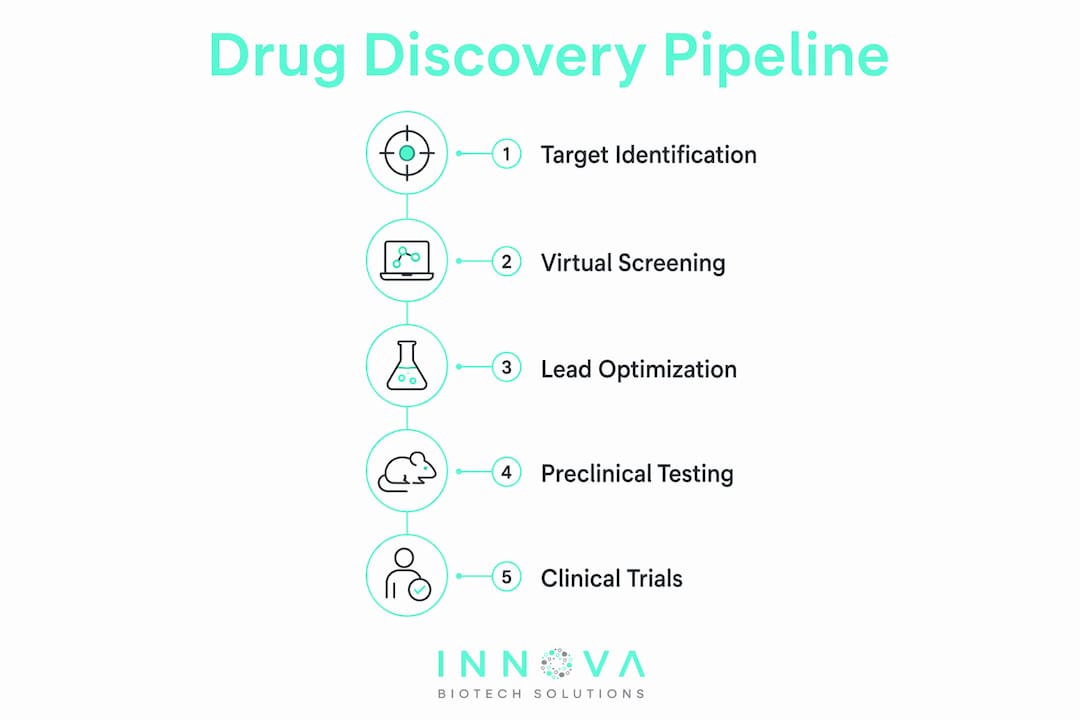
Machine learning-driven de novo compound generation extends screening beyond existing libraries. Deep learning architectures generate chemically stable, bioactive molecules that no catalog contains. This matters for targets where known chemical series have failed. Generative models explore novel scaffolds while maintaining drug-like properties such as solubility, molecular weight, and synthetic accessibility.
Peptide and protein engineering workflows benefit from the same computational infrastructure. Sequence-based models predict how amino acid substitutions affect binding affinity, thermal stability, and immunogenicity. Researchers can screen thousands of peptide variants computationally before committing to solid-phase synthesis. Innovabiotech applies these methods in its peptide design services, combining sequence prediction with structural modeling to deliver optimized lead candidates.
Multi-omics data integration adds biological context that pure chemical screening lacks. Combining genomic variants, protein expression profiles, and metabolomic signatures identifies which targets are genuinely active in disease tissue versus healthy controls. That distinction prevents researchers from pursuing targets that look relevant in cell lines but fail in patient-derived samples.
Pro Tip: Use scaffold-aware dataset splitting when training any ML model on drug-target affinity data. Random splits allow chemically similar compounds to appear in both training and test sets, inflating performance metrics and masking generalization failures.
What are the challenges in applying bioinformatics for drug discovery?
Bioinformatics does not eliminate failure. It shifts where failures occur and, when applied carefully, reduces their frequency. The most damaging pitfall is data leakage in model training. Scaffold-aware data splitting prevents models from memorizing chemical structures rather than learning generalizable affinity patterns. Without it, a model reports excellent validation metrics but performs poorly on genuinely novel compounds.
Correlation versus causation is a second critical challenge. Many computational target identification methods rank proteins by statistical association with disease phenotypes. Association is not causation. A protein that correlates with tumor progression may be a passenger event, not a driver. Causal inference methods, including causal knowledge graphs and sensitivity analyses, distinguish true biological drivers from correlated markers. Teams that skip this step pursue targets that look compelling computationally but fail in functional validation.
The following practices reduce these risks in a production bioinformatics pipeline:
- Audit datasets for leakage before training any predictive model. Check for structural overlap between training and test sets using Tanimoto similarity thresholds.
- Apply causal inference frameworks to target ranking outputs. Mendelian randomization and causal graph analysis add mechanistic evidence beyond correlation.
- Validate computationally prioritized targets in orthogonal experimental assays before committing to lead optimization. In silico predictions are hypotheses, not conclusions.
- Maintain an iterative feedback loop between computational predictions and wet-lab results. Experimental data should continuously retrain and recalibrate models.
- Document model assumptions explicitly. Every predictive model carries assumptions about training data distribution, feature representation, and biological context. Undocumented assumptions propagate silently into downstream decisions.
Interpreting vast biological datasets, rather than simply accumulating them, remains the central bottleneck. Data acquisition has become cheap. Extracting reliable biological meaning from that data has not. Teams that invest in interpretability tools and causal analysis consistently outperform those that treat model outputs as ground truth.
How is bioinformatics transforming the drug discovery pipeline in practice?
The practical impact of bioinformatics on drug development pipelines is measurable across timelines, costs, and therapeutic precision. Computational predictions inform prioritization before resource-intensive synthesis and testing begin, which cuts early-stage failure rates. Fewer failed compounds entering wet-lab validation means lower overall program costs.
Cancer drug discovery illustrates this transformation clearly. Oncology targets are numerous, and many share structural homology that makes selectivity difficult. Bioinformatics pipelines cross-reference somatic mutation data, gene expression atlases, and protein interaction networks to identify which targets are genuinely driver mutations in specific tumor subtypes. That specificity reduces off-target toxicity in subsequent lead optimization.
Precision medicine depends on this kind of stratification. Platforms combining genomics, proteomics, and clinical data enable stratified clinical trial design. Researchers can define patient subgroups likely to respond to a given mechanism before Phase II enrollment begins. That reduces trial size, cost, and the risk of a statistically null result masking a real effect in a subpopulation.
Translational research gains from bioinformatics integration as well. Biomarker identification, patient stratification, and companion diagnostic development all rely on the same multi-omics infrastructure used in target discovery. Innovabiotech's computational protein design approach connects early target identification directly to protein engineering workflows, shortening the path from discovery to a testable therapeutic candidate.
- Bioinformatics reduces early-stage costs by eliminating low-confidence candidates before synthesis.
- Multi-omics integration supports biomarker discovery and patient stratification for clinical trials.
- Computational ADMET modeling cuts late-stage attrition by flagging toxicity liabilities early.
- Generative ML models produce novel scaffolds for targets where existing chemical series have failed.
- Iterative computational-experimental feedback loops continuously improve model accuracy across a program's lifetime.
Key Takeaways
Bioinformatics accelerates drug discovery by replacing random screening with computational prediction, cutting timelines, reducing costs, and improving candidate quality before any molecule enters a wet lab.
| Point | Details |
|---|---|
| Virtual screening at scale | Computational pipelines evaluate billions of compounds rapidly, cutting early discovery costs. |
| Rational target identification | Multi-omics and causal inference methods rank targets by biological relevance, not just correlation. |
| Data quality controls | Scaffold-aware splitting and pLDDT filtering prevent misleading model performance and docking errors. |
| Iterative feedback loops | Experimental results must continuously recalibrate computational models to maintain prediction reliability. |
| Precision medicine integration | Combining genomics, proteomics, and clinical metadata enables stratified trial design and personalized therapeutics. |
The computational turn I think most teams are still underestimating
After working across multiple drug discovery programs, the pattern I see most often is this: teams adopt virtual screening and call it a bioinformatics strategy. They run docking, generate a hit list, and hand it to chemistry. That is not a bioinformatics pipeline. That is a single computational step dressed up as a workflow.
The real acceleration comes from closing the loop. Experimental results from wet-lab validation need to feed back into the computational models. Every confirmed hit, every unexpected failure, and every off-target interaction is a data point that should retrain your scoring functions and recalibrate your target hypotheses. Teams that treat computation and experiment as sequential stages rather than a continuous cycle leave most of the efficiency gains on the table.
The second thing I would push back on is the assumption that more data automatically means better predictions. The bottleneck is interpretation, not acquisition. I have seen programs with enormous multi-omics datasets produce worse target hypotheses than smaller programs with disciplined causal analysis. Data volume without interpretive rigor produces confident-looking noise.
The teams making the most progress in 2026 are those combining multi-omics and AI with genuine mechanistic understanding of the biology. Generative models and AlphaFold structures are powerful. They are also easy to misuse. The researchers who treat computational outputs as hypotheses requiring experimental confirmation, rather than answers requiring only formatting, are the ones moving programs forward efficiently.
— Hooman
Innovabiotech's computational services for drug discovery teams
Innovabiotech works with biotech and pharmaceutical researchers who need more than off-the-shelf computational tools. The team applies protein engineering and computational modeling to design and optimize therapeutic proteins with defined binding, stability, and selectivity profiles. Every project runs from initial consultation through delivery with full scientific transparency.
For teams working on peptide-based therapeutics, Innovabiotech's peptide design and optimization services combine sequence-level prediction with structural modeling to accelerate lead development. The enzyme solutions practice extends the same computational rigor to enzyme engineering for drug synthesis and metabolic pathway design. If your program needs a tailored bioinformatics workflow rather than a generic platform, Innovabiotech builds it around your specific targets and data.
FAQ
What is bioinformatics in drug discovery?
Bioinformatics in drug discovery is the use of computational tools, biological databases, and statistical models to identify drug targets, screen compounds, and predict molecular behavior before experimental testing. It replaces or reduces labor-intensive wet-lab screening with data-driven prioritization.
How does virtual screening reduce drug discovery timelines?
Virtual screening evaluates billions of chemical compounds computationally against a target structure, filtering candidates by predicted binding affinity and ADMET properties before synthesis. This eliminates low-quality compounds early, compressing the timeline from hit identification to lead optimization.
What role does machine learning play in bioinformatics drug development?
Machine learning models trained on drug-target interaction data predict binding affinity, toxicity, and pharmacokinetics for novel compounds. Generative architectures also design new molecules with desired properties, extending discovery beyond existing chemical libraries.
Why is data leakage a problem in bioinformatics models?
Data leakage occurs when chemically similar compounds appear in both training and test sets, causing models to memorize structures rather than learn generalizable patterns. Scaffold-aware dataset splitting prevents this and produces more reliable predictions on genuinely novel candidates.
How does multi-omics integration improve target identification?
Multi-omics integration combines genomic, proteomic, and transcriptomic data to identify targets that are active in disease tissue and causally linked to disease mechanisms. This reduces the risk of pursuing targets that appear relevant in cell-line data but fail in patient-derived validation.