
A repeatable bioinformatics collaboration framework rests on three pillars: a defined management structure with clear roles, documented communication protocols, and shared technical standards that guarantee reproducible pipelines. Innovabiotech implements exactly this structure for drug-discovery and protein-engineering engagements, from virtual screening through hit-to-lead optimization. Before your first technical meeting, do three things:
- Sign a collaboration agreement that covers IP ownership, data governance, and authorship rules
- Stand up version-controlled repositories and containerized runtimes (Docker or Apptainer)
- Schedule a governance kickoff with all named role-holders present
Then assign a project lead, select a pilot dataset representative of your target assay, and run a four-week pilot with defined acceptance criteria before committing to full-scale production.
Table of Contents
- What does a bioinformatics collaboration framework actually require?
- How do you design and roll out the framework step by step?
- Which technical standards keep collaborative pipelines reproducible?
- What contracts and compliance items must you settle before work begins?
- How do you operationalize the framework with cadence and KPIs?
- What pitfalls derail collaborations and how do you prevent them?
- How do you evaluate a bioinformatics service provider?
- How does Innovabiotech implement this framework in practice?
- Key Takeaways
- What the governance conversation usually misses
- Innovabiotech's services for your next collaboration
- Useful sources
- FAQ
What does a bioinformatics collaboration framework actually require?
Successful bioinformatics collaborations rest on three core pillars: governance and roles, communication protocols, and technical reproducibility standards. Each one fails without the other two.
Governance and roles. Without a RACI matrix agreed before work begins, decisions stall and ownership disputes surface mid-project. The table below maps the five roles every drug-discovery or protein-engineering engagement needs.
| Role | Responsible | Accountable | Consulted | Informed |
|---|---|---|---|---|
| Sponsor | Approves budget and scope changes | ✓ | Legal, Procurement | All |
| Program Lead | Manages milestones and escalations | ✓ | Sponsor | All |
| Data Steward | Enforces DPA/MTA compliance | ✓ | Legal | Program Lead |
| Bioinformatician | Builds and validates pipelines | ✓ | Lab Lead | Program Lead |
| Lab Lead | Provides wet-lab data and context | ✓ | Bioinformatician | Sponsor |
Communication protocols. A bi-weekly analytics sync aligned with interim experimental data reduces rework when upstream assay results shift. Pair that with a shared project-management workspace (Jira, Asana, or equivalent) and a weekly written status update so nothing lives only in someone's inbox.

Technical reproducibility standards. Every analysis must run identically on any compute environment. That means containerized execution, Git-based code review, and documented SOPs for data submission and pipeline updates. Projects like Bioconductor and ELIXIR demonstrate that documented contribution rules reduce wasted effort across diverse contributors.
Pro Tip: Set explicit decision thresholds in your governance charter: any change affecting timeline or budget by more than 10% requires sponsor sign-off within 48 hours. Without a threshold, every minor scope question escalates unnecessarily.
How do you design and roll out the framework step by step?
Five phases cover the full lifecycle from scoping to production.
Phase 1: Discovery and scoping. Produce a one-page scope document that names the target molecule class, data types, computational objectives, and success criteria. Identify every stakeholder who will touch the data.
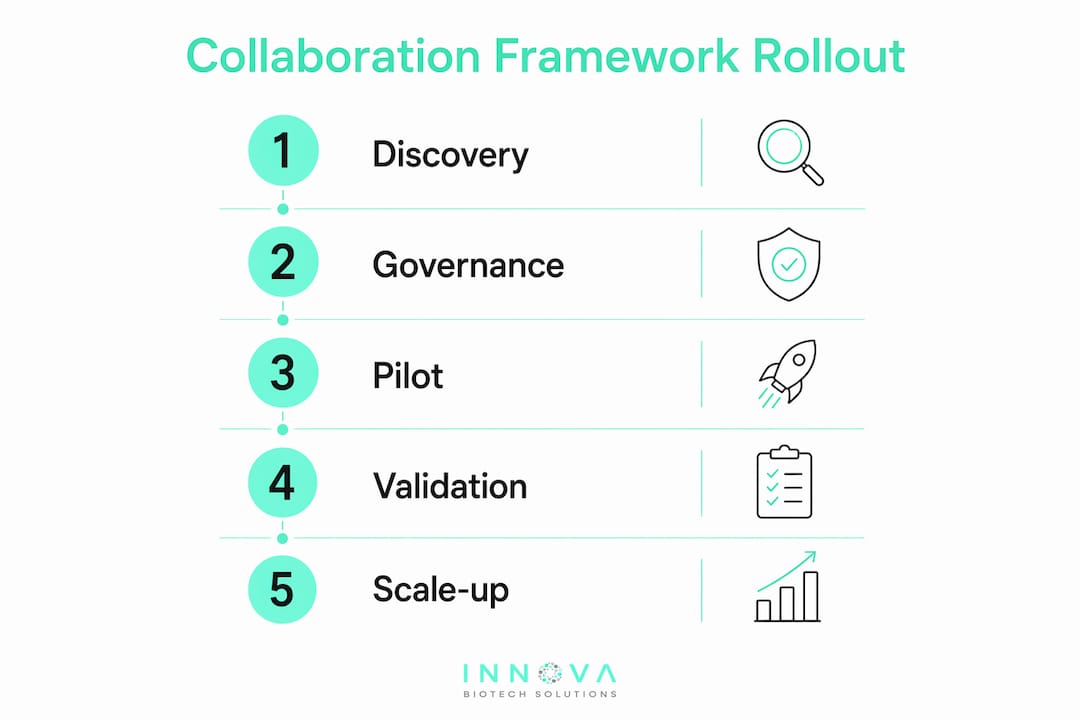
Phase 2: Contract and governance setup. Execute the MTA, DPA, and IP agreement before any data moves. Assign all RACI roles. Documenting roles, decision authority, and IP ownership in a collaboration agreement prior to project start is the single most reliable way to prevent stalled progress in multi-party projects.
Phase 3: Pilot implementation. Run a four-week pilot on a representative dataset. Deliverables: a containerized pipeline bundle, a reproducibility checklist, and a validated results report. Acceptance criteria should include at least one independent re-run producing identical outputs.
Phase 4: Validation and handoff. Review pilot outputs against acceptance criteria in a structured demo. Produce an SOP stub the client team can extend. For pharma bioinformatics project management, this handoff meeting is where scope for Phase 5 gets formally agreed.
Phase 5: Scale-up. Transition to full production cadence, expand the pipeline to additional targets or data modalities, and activate the KPI dashboard.
Which technical standards keep collaborative pipelines reproducible?
The minimum technical stack for a multi-organization bioinformatics collaboration is not negotiable. Collaborative development environments and Git-based hosting are the practical backbone for distributed teams.
- Containerized runtimes: Docker or Apptainer for every analysis step; no bare-metal execution in shared environments
- Workflow managers: Nextflow or Snakemake to encode pipeline logic, handle job scheduling, and produce auditable run logs; the nf-core community demonstrates how Nextflow enables portable, modular pipelines across institutions
- Version control: Git for all code, configuration, and pipeline definitions; pull-request-based review before any change merges to main
- CI/CD: Automated tests triggered on every commit; a pipeline that cannot pass its own test suite does not ship
- Artifact registries: OCI-compliant container registries (Docker Hub, GitHub Container Registry, or a private registry) plus a workflow metadata store for run provenance
Architecturally, containers wrap each tool, the workflow manager orchestrates execution order and data flow, and CI/CD validates the whole chain on every change. Approaches like BioClaw's multi-channel orchestration show that embedding executable workflows into persistent group workspaces preserves conversational context and produces re-executable artifacts for audits. For large biological dataset analysis, ephemeral compute environments prevent state contamination between runs.
What contracts and compliance items must you settle before work begins?
Legal and governance items decided late are the most common source of collaboration breakdowns. The IUA research integrity framework recommends setting out roles, responsibilities, governance, and data-management expectations in a collaborative research agreement before any work starts.
Contractual checklist:
- MTA (Material Transfer Agreement): covers biological materials, derivatives, and permitted uses
- DPA (Data Processing Agreement): defines data controller/processor roles, retention limits, and breach notification timelines
- IP ownership and licensing: specify who owns jointly developed methods versus client-specific data and results
- Authorship and attribution: agree publication order and acknowledgment rules before the first manuscript draft
- Change-control process: document how scope changes are proposed, reviewed, and approved
- Dispute escalation path: name a neutral escalation contact and a resolution timeline
For U.S.-based projects involving clinical or regulated data, de-identification standards and limited-dataset provisions under HIPAA apply. Consult qualified legal counsel for your specific data category; this article is general guidance, not legal advice.
Pro Tip: Structure IP carve-outs so that general computational methods developed during the engagement remain licensable by the service provider, while all client-specific results and derived datasets are assigned exclusively to the client. This protects both parties without blocking future method reuse.
How do you operationalize the framework with cadence and KPIs?
Iterative touchpoints outperform a single final-deliverable model. A practical governance cadence looks like this: a monthly governance board for budget and scope decisions, a bi-weekly technical steering call for pipeline and data issues, a weekly analytics sync for active analysis work, and a milestone stakeholder demo at the end of each phase.
| KPI | Target | Measurement method |
|---|---|---|
| Reproducibility rate | all deliverables re-ran identically | Independent re-execution log |
| Mean time to reproduce | Under 2 hours per analysis | CI/CD run timestamps |
| Deliverables passing validation | — | Acceptance-criteria checklist |
| Change-request turnaround | Under 5 business days | Project-management tracker |
For bioinformatics in drug discovery, resourcing options break into three patterns: in-house team augmented by a specialist vendor for specific pipeline work; a retainer engagement for ongoing analytics support across multiple programs; or a fixed-scope project for a defined deliverable such as a validated virtual screening pipeline.
What pitfalls derail collaborations and how do you prevent them?
Most collaboration failures trace back to a small set of avoidable mistakes.
- Undefined roles: Mitigate with the RACI table signed before kickoff; revisit it at every phase transition
- Irreproducible pipelines: Require a containerized re-run as a mandatory acceptance criterion; no exceptions
- Noisy wet-lab to informatics handoffs: Document a formal handoff protocol specifying data format, QC thresholds, and the named contact who confirms receipt
- Scope creep: Use the change-control process from the contract; every new request gets a written impact assessment before it enters the backlog
- Unclear IP terms: Resolve carve-outs at contract stage, not after results exist
Change management is the piece most teams underinvest in. Designate a change champion on each side of the collaboration, run a half-day onboarding session on the SOPs and tooling, and schedule a 30-day retrospective after the pilot to surface friction before it compounds.
How do you evaluate a bioinformatics service provider?
Use these five dimensions and the scorecard below when running an RFP for drug-discovery or protein-engineering bioinformatics work.
| Evaluation dimension | Weight | Questions to ask | Red flags |
|---|---|---|---|
| Scientific domain expertise | 30% | Which target classes have you worked on? Show a pipeline for a similar project. | Generic answers; no named assay types |
| Pipeline reproducibility | — | Can you demonstrate a containerized re-run? Do you use CI/CD? | No containers; manual execution steps |
| Data security practices | — | How do you handle client data at rest and in transit? What is your breach protocol? | No DPA template; vague encryption claims |
| Governance and contract readiness | — | Do you have standard MTA/DPA templates? How do you handle IP carve-outs? | No standard agreements; IP terms undefined |
| Communication cadence | 10% | What is your standard reporting frequency? Who is the named technical contact? | Reporting only at project end |
For a deeper look at what to expect from tailored bioinformatics services, review engagement models and deliverable examples before finalizing your RFP criteria.
How does Innovabiotech implement this framework in practice?
A representative Innovabiotech engagement begins with a biopharma client targeting a protein-engineering or hit-to-lead optimization objective. The pilot phase typically runs four weeks and produces the following:
- A containerized, version-controlled pipeline bundle with full run provenance
- A validated results report with reproducibility logs from an independent re-run
- A scope document and RACI matrix signed by all named stakeholders
- An SOP stub covering data submission, pipeline execution, and change-control steps
- A peptide design or protein-engineering analysis package with annotated outputs
After pilot validation, Innovabiotech transitions to a production engagement under a project-based or retainer contract, with bi-weekly technical syncs and monthly governance reviews.
Key Takeaways
A repeatable bioinformatics collaboration framework requires governance, reproducible pipelines, and legal agreements in place before the first dataset moves.
| Point | Details |
|---|---|
| Sign agreements first | Execute MTA, DPA, and IP terms before any data is transferred or analysis begins. |
| Stand up reproducible pipelines | Use Docker/Apptainer, Git, and Nextflow or Snakemake as the minimum technical stack. |
| Run a four-week pilot | Validate acceptance criteria with an independent re-run before committing to full production. |
| Measure with KPIs | Track reproducibility rate, validation pass rate, and change-request turnaround from day one. |
| Evaluate partners rigorously | Use the five-dimension scorecard; weight scientific expertise and pipeline reproducibility highest. |
What the governance conversation usually misses
Most teams spend their pre-project energy on tool selection and almost none on decision thresholds and IP carve-outs. That imbalance is where collaborations quietly break down. A bioinformatician waiting three weeks for a scope-change approval is not a pipeline problem; it is a governance problem that no container runtime will fix.
The other underappreciated factor is the wet-lab to informatics handoff. In drug-discovery projects, the quality of the data handed to the computational team determines the ceiling on what the analysis can produce. A formal handoff protocol with named QC thresholds is not bureaucracy; it is the fastest way to reduce rework cycles.
Finally, training is not a one-time onboarding event. The SOPs and tooling will evolve, and the people using them need structured touchpoints to stay current. A 30-day retrospective after the pilot and a quarterly SOP review are low-cost investments that prevent the framework from drifting into informal workarounds six months in.
Innovabiotech's services for your next collaboration
Biopharma and biotech teams that need a partner who arrives with the governance templates, containerized pipelines, and domain expertise already in place will find Innovabiotech a faster path to a validated pilot than building the infrastructure from scratch internally.
Innovabiotech's project-based and retainer engagements cover protein engineering and chimeric protein design, enzyme optimization, and de novo peptide design, each delivered with documented SOPs, reproducibility logs, and a RACI matrix from day one. Every engagement starts with a scoping call where roles, IP terms, and acceptance criteria are agreed before any analysis runs. To request a pilot or speak with a technical lead, contact Innovabiotech directly at innovabiotech.com.
Useful sources
| Source | What to use it for |
|---|---|
| PLOS Computational Biology: Building a Bioinformatics Community | SOPs, contribution rules, governance structure, and community-building best practices |
| IUA Research Integrity Framework | Template language for MTA/DPA, authorship agreements, and pre-project governance setup |
| Tools and Collaborative Environments for Bioinformatics Research (PMC) | CDE taxonomy and awareness features for selecting collaboration tooling |
| Nextflow and nf-core (Wellcome Sanger Institute) | Workflow manager selection and portable, reproducible pipeline design |
| BioClaw Technical Document | Containerized, chat-native execution patterns for preserving conversational context and audit trails |
These sources are directly applicable when drafting MTA/DPA language, selecting workflow tooling, and writing SOPs. For U.S.-regulated data, cross-reference the IUA framework with HIPAA de-identification guidance from the HHS Office for Civil Rights.
FAQ
What are the three pillars of a bioinformatics collaboration framework?
The three pillars are a defined management structure with RACI roles, documented communication protocols with a regular meeting cadence, and shared technical standards covering containerization, version control, and reproducible pipelines.
When should IP and data agreements be signed?
Before any data is transferred or analysis begins. The IUA research integrity framework recommends executing IP ownership, DPA, and MTA terms in a collaboration agreement prior to project start to prevent disputes later.
What is the minimum technical stack for reproducible bioinformatics pipelines?
Docker or Apptainer for containerized runtimes, Git for version control, Nextflow or Snakemake as the workflow manager, and automated CI/CD tests that validate every pipeline change before it merges.
How do you measure collaboration success?
Track important KPIs including reproducibility rate aiming for all deliverables re-ran identically, timely reproduction of analyses, high initial validation pass rates, and prompt turnaround of change requests.
How does Innovabiotech structure a pilot engagement?
Innovabiotech runs a four-week pilot that delivers a containerized pipeline bundle, validated results with reproducibility logs, a signed RACI matrix, and an SOP stub, then transitions to a project-based or retainer production contract after pilot acceptance.