
TL;DR:
- Chimeric protein design services engineer fusion proteins by combining domains from multiple sources to create new biological functions. They utilize computational modeling, AI-driven tools, and experimental validation to develop effective constructs for drug discovery and structural biology. The most successful workflows generate large candidate libraries, apply dual-filter ranking, and validate function through lab assays to enhance enzyme engineering and therapeutic applications.
Chimeric protein design services are expert-driven processes that construct fusion proteins by combining functional domains from two or more source proteins to generate novel biological activities. These services sit at the intersection of structural biology, recombinant protein engineering, and AI-driven computation, making them central to modern drug discovery and therapeutic development. Researchers use them to build proteins that no single natural sequence could produce, from multifunctional enzymes to receptor constructs that resist crystallization in their native form. Innovabiotech delivers these capabilities through computational modeling, domain selection, and iterative experimental validation tailored to each project's specific biological target.
What are chimeric protein design services and their core methodologies?
Chimeric protein engineering begins with selecting compatible functional domains from structurally characterized source proteins. The goal is to fuse those domains into a single construct that retains, and ideally improves, the activity of each parent. This requires assessing sequence alignment, structural compatibility, and the biochemical environment each domain expects to operate in.

Domain selection is the first critical decision. Researchers must identify which regions of each source protein carry the desired function and whether those regions can tolerate the physical proximity of a foreign domain. Preserving conserved residues in domain fusion is critical for maintaining ligand recognition and functional integrity in chimeric receptors, with structure-guided substitutions focusing on loops, hydrophilicity, and glycosylation sites for stability.
Linker engineering connects the selected domains without disrupting either one. AI-guided linker optimization reduces steric clashes and preserves enzymatic activity in chimeric enzymes, mitigating activity loss in multi-domain fusion constructs. A poorly chosen linker can physically block an active site or force a domain into an unproductive conformation, killing function before the protein ever reaches an assay.
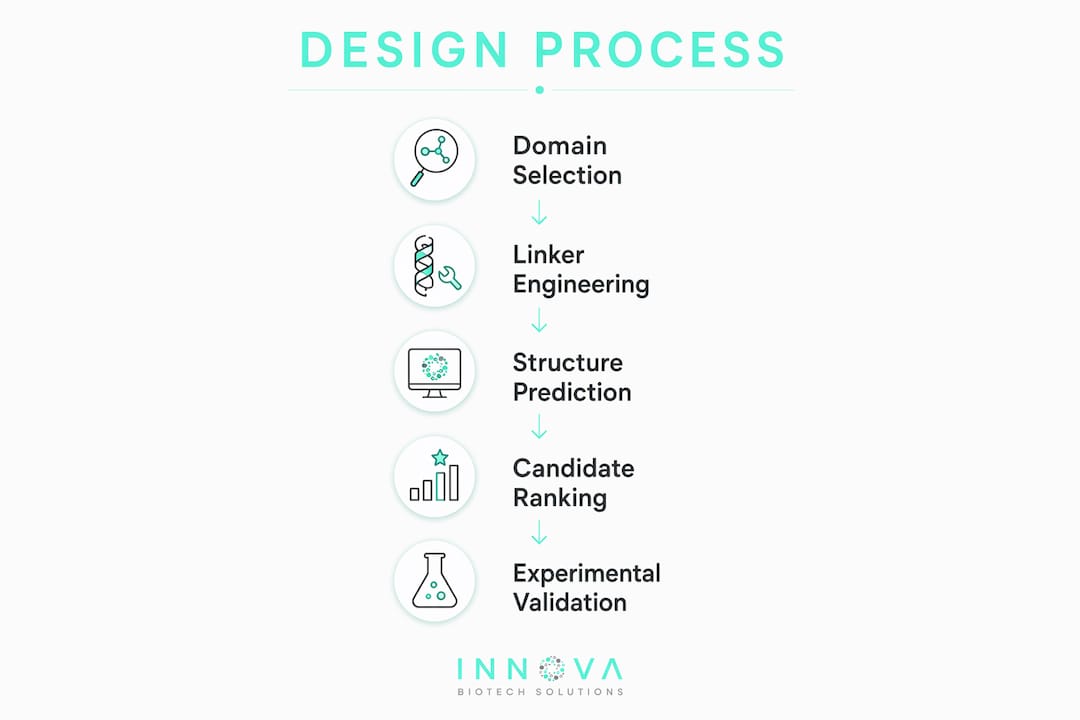
Computational tools including AlphaFold2 and Uni-fold now provide high-confidence structural predictions for candidate constructs before any wet-lab synthesis occurs. AI-assisted protein design tools have transformed rational engineering workflows from trial-and-error into hypothesis-driven, high-throughput operations. Diffusion-based platforms extend this further by generating thousands of candidate sequences in a single run.
Pro Tip: Run sequence alignment across all candidate source domains before committing to a fusion architecture. Incompatible secondary structure elements at the junction point are the most common cause of insoluble expression products.
Key methodological steps in a full chimeric protein design workflow include:
- Structural domain fusion: Map active sites and binding interfaces from crystal structures or AlphaFold2 models before designing the junction.
- AI-driven candidate generation: Use diffusion-based platforms to produce large candidate libraries rather than designing single constructs manually.
- Linker optimization: Test flexible (Gly-Ser) and rigid (alpha-helical) linker sequences computationally before synthesis.
- Recombinant expression planning: Select expression hosts, codon optimization strategies, and purification tags early to avoid downstream bottlenecks.
- Dual-filter validation: Apply both physics-based scoring and confidence models to rank candidates before committing to experimental synthesis.
How do these services enhance enzyme engineering and drug discovery?
The most concrete proof of chimeric protein design's value comes from enzyme engineering. A chimeric single-molecule enzyme combining TPase, GTase, and MTase catalytic domains simplifies mRNA capping workflows and reduces production cost compared to traditional multi-enzyme systems. That kind of all-in-one construct is only achievable through deliberate domain fusion and AI-aided linker design.
Catalytic performance in these constructs reaches near-commercial benchmarks. AI-aided chimeric enzyme design achieves TPase activity of 96.76%±1.63%, GTase activity of 100.69%±2.95%, and MTase activity of 77.87% relative to commercial enzyme standards. Those figures mean a single recombinant construct can replace three separate commercial enzymes in an mRNA vaccine manufacturing line.
| Catalytic Domain | Activity vs. Commercial Standard |
|---|---|
| TPase (triphosphatase) | 96.76% ± 1.63% |
| GTase (guanylyltransferase) | 100.69% ± 2.95% |
| MTase (methyltransferase) | 77.87% |
Structural biology applications show a different dimension of value. Chimeric receptor constructs help overcome expression and crystallization challenges for complex membrane proteins like nicotinic acetylcholine receptors (nAChRs). Domain substitution and epitope tagging aid structural investigation and functional validation for targets that resist standard expression systems. This approach has opened structural access to receptor families that were previously intractable.
Drug discovery workflows benefit directly from these capabilities. When a target receptor cannot be expressed in sufficient quantity or purity for high-throughput screening, a chimeric construct that substitutes problematic transmembrane or extracellular segments can restore tractability. Researchers gain access to real-world enzyme engineering outcomes that demonstrate how chimeric designs cut both timelines and reagent costs.
Pro Tip: When designing chimeric constructs for structural studies, prioritize chimeric partners with high-resolution crystal structures already deposited in the Protein Data Bank. Known crystal contacts from the partner protein often transfer to the chimeric construct, improving crystallization success rates.
The benefits of integrated all-in-one constructs over traditional multi-enzyme systems include:
- Reduced reaction setup complexity and fewer purification steps per assay
- Lower batch-to-batch variability from a single expression run
- Simplified quality control with one protein rather than three
- Easier scale-up for manufacturing contexts where enzyme stoichiometry matters
What best practices should researchers follow when using chimeric protein design services?
The single most underappreciated practice in chimeric protein engineering is generating enough candidate designs. Generating 10,000 or more candidate designs maximizes the probability of identifying high-affinity binders in therapeutic applications. Researchers who design five or ten constructs manually and then wonder why none work are skipping the combinatorial search that makes modern design tractable.
A structured best-practice workflow looks like this:
- Generate a large candidate library. Use diffusion-based or other AI-driven platforms to produce at minimum several thousand candidate sequences before applying any filter.
- Apply dual-filter ranking. Dual-filter scoring systems combining AlphaFold2 confidence scores and specialized structural models separate stable in silico predictions from likely lab failures. This step alone eliminates the majority of candidates that would waste synthesis budget.
- Prioritize linker validation. Test linker sequences computationally for steric clashes before ordering gene synthesis. AI-aided linker design is pivotal because improper linkers reduce catalytic activity and downstream product yields in chimeric fusion enzymes.
- Run functional assays before scale-up. Functional validation combining ligand-binding assays, chromatography, surface plasmon resonance, and cellular expression systems is mandatory to confirm utility beyond computational models.
- Iterate based on experimental data. Treat the first round of synthesis as a learning experiment. Feed expression and activity data back into the computational model to refine the next design cycle.
The most common pitfall is treating a high AlphaFold2 confidence score as a guarantee of experimental success. Confidence scores reflect structural plausibility, not biological function. A construct can fold correctly and still fail to bind its target if the binding interface geometry differs from the native protein by even a few angstroms.
Domain incompatibility is the second major failure mode. Two domains that function perfectly in isolation can interfere with each other when fused, particularly if both require large conformational changes during their catalytic cycles. Screening for this computationally, before synthesis, is far cheaper than discovering it at the purification stage.
Pro Tip: Always include a negative control construct with a scrambled linker sequence in your first expression batch. It costs one additional synthesis reaction and immediately tells you whether activity differences between candidates are linker-dependent or domain-dependent.
What are emerging trends in chimeric protein engineering?
Next-generation AI models are accelerating de novo protein binder design at a pace that was not achievable even two years ago. Diffusion-based platforms now report experimentally validated hit rates between 17% and 82%, depending on target complexity and library size. That range reflects how much target tractability still matters, but the upper bound represents a genuine step change from earlier rational design approaches.
Expanding application domains are reshaping what chimeric protein design services are asked to deliver:
- Synthetic biology: Chimeric enzymes with non-natural domain combinations are enabling biosynthetic pathways that do not exist in any organism.
- Microbial biosensors: Fusing ligand-binding domains from mammalian receptors onto bacterial scaffold proteins creates biosensors with mammalian-level selectivity in microbial hosts.
- Cross-viral family engineering: Combining domains from related viral proteins, as demonstrated in mRNA capping enzyme work, creates constructs with broader substrate tolerance than any single viral enzyme.
- Multi-domain therapeutic proteins: Bispecific and trispecific formats that combine targeting, effector, and half-life extension domains into a single chain are moving from academic proof-of-concept into clinical development pipelines.
High-throughput screening integration is the operational trend that makes these applications practical. Automated liquid handling, miniaturized assay formats, and cloud-based data analysis now allow research teams to screen thousands of chimeric variants in the time it previously took to characterize dozens. The bottleneck has shifted from synthesis to data interpretation.
Regulatory and scale-up challenges remain real. A chimeric construct that performs well at microgram scale in a research lab faces a different set of demands when produced at gram scale for clinical trials. Expression host selection, glycosylation patterns, and aggregation propensity all behave differently at scale. Teams that address these variables during the design phase, rather than after lead identification, save months of development time.
Key Takeaways
Chimeric protein design services deliver the highest research value when AI-driven candidate generation, dual-filter ranking, and rigorous experimental validation are combined into a single integrated workflow.
| Point | Details |
|---|---|
| Generate large design libraries | Produce 10,000 or more candidate designs to maximize the probability of identifying functional hits. |
| Apply dual-filter ranking | Combine AlphaFold2 confidence scores with physics-based models to eliminate likely lab failures before synthesis. |
| Prioritize linker engineering | AI-guided linker design prevents steric clashes that destroy catalytic activity in multi-domain fusions. |
| Validate experimentally | Use ligand-binding assays, surface plasmon resonance, and cellular expression to confirm function beyond computational predictions. |
| Plan for scale-up early | Address expression host, glycosylation, and aggregation variables during design to avoid costly late-stage failures. |
Why I think most research teams underuse chimeric protein design
The field has a credibility problem that has nothing to do with the science. Researchers who have been burned by overconfident computational predictions often swing to the opposite extreme and distrust AI-driven design entirely. That is the wrong lesson to take.
What I have seen work consistently is treating computational design as a filter, not an oracle. The AI does not tell you which construct will succeed. It tells you which constructs are worth the cost of finding out. That reframe changes how you allocate synthesis budget and how you interpret negative results.
The teams that get the most out of chimeric protein design services are the ones that commit to iteration. They synthesize a first batch, run functional assays, feed the data back into the model, and design a second batch that is smarter than the first. One round of design rarely produces a clinical candidate. Three or four rounds, each informed by real experimental data, routinely do.
Partnering with a specialized service provider like Innovabiotech matters more than most researchers expect. The computational infrastructure, the domain expertise in protein engineering, and the project management discipline to move from design to validated hit without losing months to miscommunication are not things most academic or early-stage biotech teams have in-house. The science is hard enough without rebuilding that infrastructure from scratch.
The future of this field belongs to teams that treat chimeric protein design as a systematic, data-driven process rather than a creative exercise. The proteins that matter most clinically will come from workflows that combine AI prediction, structural biology, and disciplined experimental validation in a tight feedback loop.
— Hooman
Innovabiotech's protein design services for your research
Innovabiotech brings together computational modeling, recombinant protein engineering, and experimental validation expertise under one roof for biotech and pharmaceutical research teams. Every project starts with a detailed consultation to map your target, your expression constraints, and your downstream application before a single design decision is made.
Innovabiotech's chimeric protein design capabilities cover the full workflow from domain selection and AI-driven candidate generation through expression optimization and functional characterization. For teams working on enzyme-based applications, the enzyme engineering solutions service extends these capabilities into catalytic optimization and scale-up planning. Custom peptide design and bioinformatics validation are also available for projects where smaller constructs complement larger protein engineering efforts. Contact Innovabiotech to discuss your project requirements and timelines.
FAQ
What are chimeric protein design services?
Chimeric protein design services are specialized biotech offerings that engineer fusion proteins by combining functional domains from multiple source proteins to create constructs with novel or enhanced biological activities. These services use computational modeling, AI-driven design platforms, and experimental validation to deliver research-ready protein constructs.
How many candidate designs should I generate for a chimeric protein project?
Generating 10,000 or more candidate designs is the recommended starting point for therapeutic applications, as larger libraries significantly increase the probability of identifying high-affinity binders before experimental screening begins.
What is a dual-filter ranking system in protein design?
A dual-filter ranking system combines AlphaFold2 confidence scores with physics-based structural models to rank candidate chimeric designs. This approach separates constructs that are stable in silico from those likely to fail in the lab, reducing wasted synthesis costs.
How does chimeric protein design improve enzyme engineering?
Chimeric enzyme design integrates multiple catalytic domains into a single construct, as demonstrated by all-in-one mRNA capping enzymes that achieve near-commercial TPase, GTase, and MTase activities. This approach simplifies workflows, reduces reagent costs, and improves batch consistency compared to multi-enzyme systems.
What validation methods confirm chimeric protein function?
Functional validation requires a combination of ligand-binding assays, size-exclusion chromatography, surface plasmon resonance, and cellular expression systems to confirm that a chimeric construct performs as predicted beyond computational models.
Recommended
- Protein engineering, Chimeric Protein Design Services, computational modeling
- Innova Biotech Solutions: Expert Peptide Design and Optimization Services.bioinformatics validation, custom peptides, peptide design services
- Examples of De Novo Protein Design: 2026 Research Guide
- Protein Engineering for Therapeutics: A 2026 Guide