
Yes, de novo D-peptide design works now, not just in theory. Modern pipelines pair mirror-image transformations with generative flow models or physics-based redesign to generate testable D-peptide binders against ordinary L-proteins. The canonical route: generate and filter candidates computationally, synthesize a prioritized shortlist, run folding and binding assays, then iterate. Tools like D-Flow, Rosetta hotspot grafting, and OSPREY-based DexDesign already anchor working versions of this pipeline.
TL;DR:
- Generative approaches like D-Flow produce D-peptides by mirroring the target in silico and typically generate thousands of candidates before filtering.
- Physics-based methods such as Rosetta hotspot grafting and DexDesign focus on structural accuracy, requiring high-resolution target structures and more computational time.
- Most successful pipelines combine both strategies, using generative models for diversity and physics-based filters for reliable, interpretable designs.
- Synthesis and validation involve solid-phase peptide synthesis, circular dichroism for folding confirmation, and orthogonal binding assays to confirm genuine target interactions.
- Typical first-round binders show KD values around 10 µM, with sub-micromolar affinities achieved after structural validation and iterative optimization.
Table of Contents
- What Computational Approaches Exist for D-Peptide Design?
- How Do Generative Models Like D-Flow Design D-Peptides?
- How Does Rosetta Hotspot Grafting Design D-Peptides?
- What Is the Practical Workflow for D-Peptide Scaffold Selection?
- How Do You Synthesize and Validate D-Peptide Candidates?
- What KD and Assay Results Indicate a Real Hit?
- What Are the Biggest Limitations in D-Peptide Design Today?
- What Is a Go/No-Go Checklist for D-Peptide Programs?
- Who's Behind This Guide and What Innovabiotech Brings to D-Peptide Projects
- Where Is D-Peptide Design Research Headed?
- How Innovabiotech Supports Your D-Peptide Design Program
- Sources
- FAQ
What Computational Approaches Exist for D-Peptide Design?
Three families of methods dominate the field, and picking the wrong one for your target wastes months.
Generative machine learning models, including flow-matching and diffusion architectures, learn sequence-structure relationships from L-protein data and then generate D-peptide candidates through mirror-image conditioning. D-Flow is the clearest example: it produces D-peptide binders against native L-targets without ever synthesizing a D-enantiomeric version of the target protein, which used to be the biggest bottleneck in mirror-image phage display.
Physics-based redesign takes the opposite philosophy. Instead of learning statistical patterns, it applies deterministic search over rotamers, energy functions, and scaffold libraries. Rosetta hotspot grafting and DexDesign (built on the OSPREY framework) fall here. These methods trade generative breadth for interpretability. Every mutation has a physical rationale you can trace back to a specific interaction.
Hybrid workflows combine both. Generative models cast a wide net across sequence space; physics-based filters then screen for genuinely designable, foldable, and chirality-consistent structures. Teams that pair ML generation with physics-based post-filtering report better downstream validation success than either approach alone, largely because the physics layer catches artifacts the generative model has no way to know are wrong.
Your choice depends on what you know about the target:
- Epitope-conditioned binder design (you know the hotspot residues on your target and want a peptide that mimics a known interaction) favors Rosetta-style hotspot grafting or DexDesign's MASTER scaffold search.
- De novo binder discovery (you have a target structure but no known interacting peptide) favors generative approaches like D-Flow, which can explore sequence space without a template.
- Scaffold redesign (you have an existing peptide binder in L-space and want a stable D-mirror) is the natural fit for mirror-inversion pipelines regardless of which generation engine you use downstream.
Compute needs vary sharply. Generative models need GPU inference time but modest wall-clock hours per batch. Physics-based search, especially exhaustive rotamer sampling in OSPREY, can run for days on a single target depending on scaffold library size. Budget accordingly, and expect physics-based methods to output tens of ranked designs where generative pipelines might output thousands of raw candidates before filtering.
How Do Generative Models Like D-Flow Design D-Peptides?
The trick underlying nearly every generative D-peptide method is a mirror-image transformation, often written as a Ψ operation, applied before or after generation. Structural databases are built almost entirely from L-proteins, so a model trained directly on D-peptide data would starve for examples. Instead, the target protein (which stays in native L-form) gets algorithmically mirrored in silico, the model generates a binder in that mirrored coordinate frame using ordinary L-trained weights, and the resulting peptide gets flipped back to D-configuration. The math does the enantiomer-swapping that used to require an actual D-synthesized target protein for mirror-image phage display.

D-Flow implements this with flow-matching, a generative technique related to diffusion models that learns to transport random noise toward realistic peptide structures step by step. Some newer frameworks go further and inject axial chirality-aware features directly into the model architecture rather than relying purely on coordinate mirroring. The PepMirror framework uses this approach and reports a 10-mer D-binder against CD38 with a measured KD around 10 µM from a wet-lab validated campaign, a useful benchmark for what "success" looks like on a first-pass generative hit.
Statistic to know: a KD near 10 µM from an initial generative campaign counts as a legitimate hit worth optimizing, not a finished lead. Expect most raw generative outputs to fail one or more downstream filters before reaching synthesis.
After generation, candidates go through several filtering passes before anyone touches a synthesizer:
- Geometric filters reject peptides with implausible backbone torsions or clashing side chains.
- Energy scoring ranks candidates by predicted binding energy, usually via a physics-based scoring function layered on top of the ML output.
- Chirality consistency checks confirm the mirrored coordinates translated correctly and no residue accidentally reverted to L-configuration.
- Synthetic feasibility screens flag sequences with problematic motifs (excessive hydrophobicity, aggregation-prone stretches) that will cause solid-phase synthesis headaches.
Because structural databases skew so heavily toward L-proteins, chirality-aware model features or mirror-image transformations are what let these pipelines generalize at all. Without one of those two tricks, a generative model has effectively never seen a D-peptide and has no basis for producing one.
How Does Rosetta Hotspot Grafting Design D-Peptides?
Physics-based design earns its keep on precision. When you know exactly which residues on your target matter, deterministic search beats generative sampling for control over the outcome.
The Rosetta hotspot-centric workflow starts by identifying hotspot residues, the small cluster of side chains that account for most of the binding energy in a known interaction, often from an existing antibody-antigen or protein-protein complex. Those hotspots get computationally mirrored into D-space, and the algorithm then searches for scaffolds capable of presenting equivalent side-chain geometry in the D-configuration. This is how the team behind that paper designed D-peptide binders against influenza hemagglutinin, a large, structurally demanding target, without ever needing to synthesize a D-enantiomeric hemagglutinin for mirror-image phage display. The design was validated by synthesis, folding, binding assays, and an X-ray co-crystal structure confirming the predicted binding mode.
DexDesign, built on the OSPREY framework, runs a related but distinct process. It uses MASTER (Method of Accelerated Search for Tertiary Ensemble Representatives) to search structural databases for scaffolds that geometrically match a mirrored template, then applies K*-based mutational scanning, an algorithm that estimates binding constants across combinatorial sequence space with a provable search guarantee, to optimize the sequence on that scaffold.
The trade-offs run in predictable directions:
- Advantage: every mutation traces back to an interpretable physical cause, which makes iteration and troubleshooting far easier than debugging a generative model's black box.
- Advantage: K*-based search in OSPREY provides provable bounds, meaning you know the algorithm actually explored the relevant sequence space rather than sampling a fraction of it.
- Limitation: both methods depend on high-resolution structural input, an existing complex or a well-resolved target structure. Without that, there's no hotspot to graft onto and no scaffold search to run.
- Limitation: search runtimes scale with scaffold library size and rotamer count, which can make exhaustive searches slow on larger targets.
Generative and physics-based methods aren't really competitors. Generative models broaden scaffold diversity while physics-based redesign supplies the interpretable, provable search that catches what generation alone would miss.
What Is the Practical Workflow for D-Peptide Scaffold Selection?
A working pipeline looks like this, in order:
- Define the target and epitope. Pull the highest-resolution structure available (crystal or cryo-EM) and pin down the hotspot residues or binding surface you're designing against. Vague epitope definitions produce vague designs.
- Set scaffold constraints. Favor peptide lengths of roughly 35 amino acids or fewer. Longer all-D sequences get progressively harder to synthesize cleanly via solid-phase peptide synthesis, and folding predictions get less reliable as chain length grows.
- Run hotspot grafting or generative sampling. For physics-based routes, this means rotamer sampling around the hotspot followed by redocking to confirm geometric compatibility, then inverse rotamer generation to identify scaffold positions that can support the grafted side chains.
- Expand the library. Generate variants around your top hits, small sequence perturbations, alternate scaffold backbones, so you have a real distribution to filter rather than a handful of one-off guesses.
- Filter and triage. Apply energy score thresholds to rank binding potential, run chirality checks to catch coordinate errors, and screen for synthetic feasibility (aggregation risk, problematic residue runs) before anything reaches the bench.
- Prioritize a synthesis shortlist. Most groups take somewhere between 10 and 30 top-ranked candidates into wet-lab work, balancing computational confidence against synthesis cost.
Innovabiotech's computational peptide screening work follows a similar filtering logic before candidates ever reach synthesis, whatever the generation engine behind them.
How Do You Synthesize and Validate D-Peptide Candidates?
Getting a computational hit into a test tube is where a lot of promising designs quietly die.
Solid-phase peptide synthesis (SPPS) for all-D sequences uses the same Fmoc or Boc chemistry as standard L-peptide synthesis, but difficult sequences (long hydrophobic stretches, beta-sheet-prone segments) tend to aggregate on resin regardless of chirality. C-terminal amidation is worth defaulting to for most D-peptide candidates. It improves proteolytic stability further and better mimics the C-terminus of many natural peptide ligands.
Once synthesized, folding needs confirmation before you spend assay time on a peptide that never adopted its intended structure:
- Use solubility aids (mild detergents, adjusted buffer pH) for hydrophobic sequences that resist aqueous folding.
- Run circular dichroism (CD) spectroscopy early. Computational folding predictions routinely overestimate the stability of non-native folds, so confirming secondary structure by CD before committing to binding assays saves real time.
- Compare CD spectra against the intended secondary structure motif (helix, strand, or defined loop) rather than assuming a clean signal means success.
For binding, run a primary assay and at least one orthogonal method:
- Surface plasmon resonance (SPR) for real-time kinetic binding data.
- Microscale thermophoresis (MST) as a solution-based orthogonal check that doesn't require surface immobilization.
- Fluorescence polarization for higher-throughput initial screening across larger candidate sets.
Always include a scrambled-sequence or non-binding D-peptide control alongside your target protein alone, without either you can't tell whether a signal reflects genuine binding or an assay artifact.
Pro Tip: Run CD spectroscopy before your first binding assay, not after. A peptide that never folds correctly will still sometimes show a false binding signal in SPR or MST, and you won't know why until you've wasted a full assay cycle chasing it.
What KD and Assay Results Indicate a Real Hit?
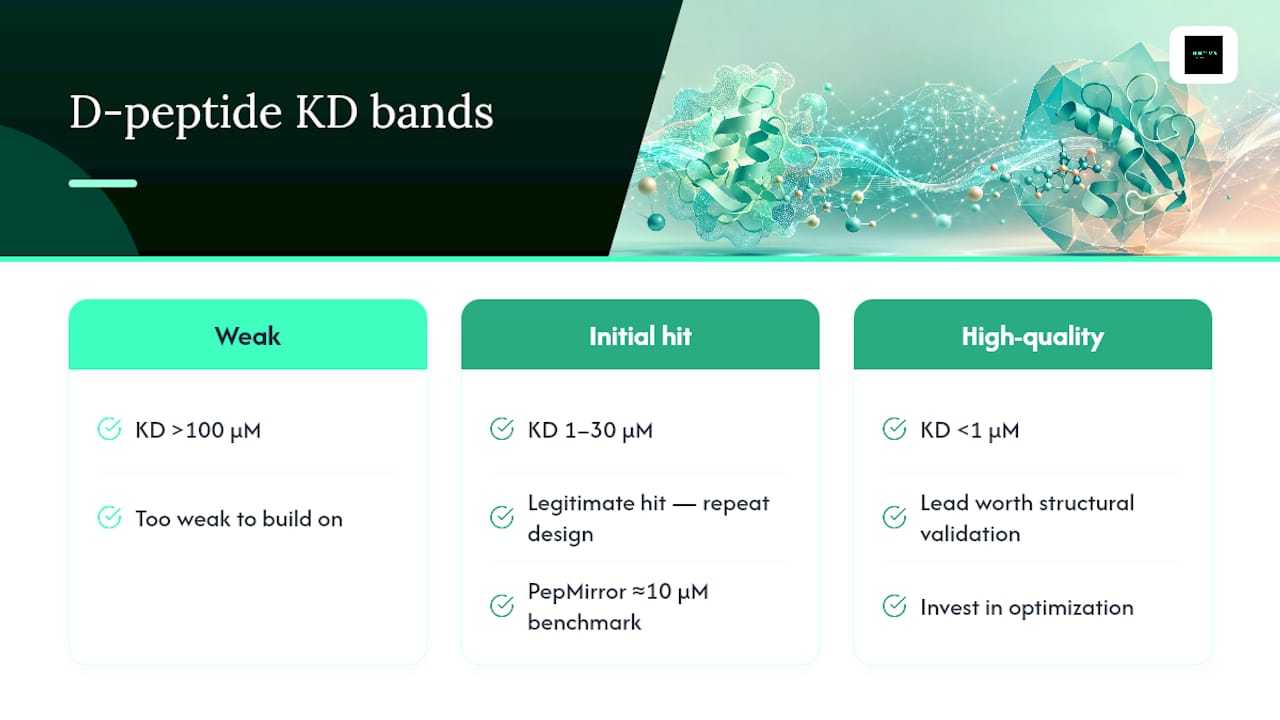
Affinity numbers only mean something in context, and D-peptide campaigns tend to cluster into three rough bands.
A dissociation constant (KD) above 100 µM is generally too weak to build on. Something in the 1 to 30 µM range counts as a legitimate initial hit worth a second design round, in line with the roughly 10 µM result PepMirror reported for an early D-binder campaign against CD38. Sub 1 µM binding marks a high-quality lead worth investing in structural validation and optimization.
Statistic to know: a first-round hit rate anywhere in the low single digits (a handful of confirmed binders out of dozens of synthesized candidates) is normal for de novo D-peptide campaigns, not a sign the pipeline failed.
Orthogonal confirmation matters more here than in most peptide work, because D-peptide binding data is thinner across the field and there are fewer historical benchmarks to sanity-check an unusual result against. Competition assays (does a known ligand displace your peptide?) and cell-based functional assays where relevant both help rule out artifacts that a single binding assay can miss.
Structural validation, ideally a co-crystal structure or cryo-EM map, is the gate before committing to expensive affinity maturation. It confirms your peptide binds where and how you designed it to, not just that it binds somewhere. The influenza hemagglutinin D-peptide work validated exactly this way, with an X-ray co-crystal structure confirming the intended binding mode before further optimization proceeded. Skipping this step to save time is one of the more common ways teams end up optimizing the wrong interaction for months.
What Are the Biggest Limitations in D-Peptide Design Today?
Retro-inverso (RI) peptides, sequences with reversed backbone direction and inverted chirality meant to mimic a parent L-peptide's side-chain presentation, remain a common source of false confidence. Reversing the backbone does not guarantee the same 3D fold, and documented cases show RI designs failing to reproduce native binding despite looking correct on paper. Treat RI as a hypothesis to test experimentally, not a shortcut around design work.
Dataset scarcity is the deeper structural problem. Nearly every high-resolution structure in public databases is an L-protein, which is exactly why mirror-image transformations and chirality-aware model features exist in the first place, they're workarounds for a training-data gap that isn't closing anytime soon.
Protease resistance, the main selling point of D-peptides, doesn't automatically solve delivery. A D-peptide that survives serum proteases can still fail on oral bioavailability, membrane permeability, or renal clearance. Common mitigation strategies include:
- Cyclization to reduce conformational flexibility and improve membrane permeability.
- PEGylation or lipidation to extend serum half-life.
- Conjugation to cell-penetrating peptide sequences for intracellular targets.
- Careful C-terminal and N-terminal capping to block exopeptidase activity that D-configuration alone doesn't fully block.
None of these are exotic. They're standard peptide drug development tools applied to a D-backbone, and skipping them because "it's already protease resistant" is a common and avoidable mistake.
What Is a Go/No-Go Checklist for D-Peptide Programs?
A usable pipeline needs decision gates, not just steps. Here's a compact version:
- Define target and generate candidates. Run your chosen generative and/or physics-based pipeline against a well-resolved target structure. No-go if resolution is too poor to define hotspots confidently.
- Filter computationally. Apply energy, chirality, and synthetic feasibility filters. Go criterion: candidates scoring within the top percentile of your energy function AND passing chirality consistency checks.
- Synthesize a shortlist. Typically 10 to 30 candidates, prioritized by computational score and chemical tractability.
- Run primary assays. SPR or MST for binding, CD for folding confirmation. No-go if CD shows no defined secondary structure matching the design intent.
- Confirm with an orthogonal assay. Go criterion: KD below 30 µM on at least one orthogonal method, ideally sub 1 µM for immediate lead status.
- Structural validation. Pursue co-crystal or cryo-EM confirmation before committing to affinity maturation resources.
- Iterate or advance. Feed structural and binding data back into the design model or physics-based scan for a second optimization round.
Pro Tip: Parallelize steps 3 and 4 across your whole shortlist rather than validating one candidate at a time. D-peptide synthesis turnaround is usually the rate-limiting step, so batch it.
Expect roughly 4 to 8 weeks from finalized design to primary assay results for a batch of 10 to 30 peptides, depending on synthesis complexity and assay throughput, and budget a second iteration round as the default outcome rather than the exception.
Who's Behind This Guide and What Innovabiotech Brings to D-Peptide Projects
This guide draws on the current published literature in computational D-peptide design, mirror-image transformation methods, and wet-lab validation practices used across academic and industry groups working in this space.
Innovabiotech provides custom bioinformatics and computational biology services for biotech and pharma teams, including de novo peptide design, protein engineering, and structure-based screening. Projects typically start with a target and objective, move through computational candidate generation and filtering, and continue through validation support, mirroring the pipeline described throughout this guide. Specific case outcomes and performance data for individual engagements are available on request during a scoping conversation.
Where Is D-Peptide Design Research Headed?
The biggest open need is better integration between generative and physics-based methods, most groups still run them as separate stages rather than a truly unified search. More D-protein structural data would help every model in this space generalize better, since the field is still leaning on mirror-image workarounds rather than native training data.
Watch for growth in immune-evasive binder design (D-peptides that resist both proteolysis and immune recognition), diagnostic applications where stability matters more than potency, and enzyme-instructed self-assembling D-peptide systems for drug delivery. Academic groups developing new algorithms and industry teams running high-throughput validation are a natural pairing here. Neither side has the full toolkit alone.
How Innovabiotech Supports Your D-Peptide Design Program
Running a D-peptide program in-house means assembling generative modeling expertise, physics-based design capability, and wet-lab validation capacity, three skill sets that rarely live under one roof. Innovabiotech's peptide design service exists specifically to close that gap: computational hotspot grafting and generative candidate generation paired with structured guidance through synthesis and binding validation, without the overhead of building that stack internally.
A typical engagement starts with a scoping call covering your target structure, known epitope or hotspot data if available, and your priorities (affinity threshold, timeline, synthesis budget). Teams with a resolved target structure and a defined biological question move the fastest through initial design. If your project also touches broader protein engineering questions, Innovabiotech's protein design services cover that adjacent scope under the same engagement model.
If you're weighing whether to build this pipeline internally or bring in support for a defined project, reach out to Innovabiotech to scope your D-peptide target and get a project timeline back.
Sources
For deeper technical grounding, read the PNAS paper on de novo D-peptide design against influenza hemagglutinin for the hotspot-grafting workflow and its X-ray validation. The D-Flow preprint and PepMirror framework cover generative and cross-chirality approaches in detail. The DexDesign/OSPREY paper explains MASTER scaffold search and K*-based scanning, and the PMC review on D-peptide technology offers broader context on synthesis and mirror-image history.
- D-Flow: Multi-modality Flow Matching for D-peptide Design
- De novo design of D-peptide ligands: Application to influenza virus hemagglutinin
- DexDesign: an OSPREY-based algorithm for designing de novo D-peptide inhibitors
FAQ
What Is a D-Peptide?
A D-peptide is a peptide built entirely from D-amino acids, the mirror-image enantiomers of the L-amino acids found in natural proteins, which makes them resistant to most endogenous proteases and generally less immunogenic than standard L-peptides.
Which Amino Acid Is D-Configuration?
D-configuration refers to the mirror-image spatial arrangement around an amino acid's alpha carbon, opposite to the L-configuration used in nearly all natural proteins; any standard amino acids can theoretically exist in D-form, and D-peptide design uses the D-enantiomer of the relevant residues throughout the sequence.
How Do You Determine a Peptide's Structure?
Structure gets confirmed through a combination of methods: CD spectroscopy for secondary structure (helix, sheet, or disordered), X-ray crystallography or cryo-EM for atomic-resolution detail, and computational prediction tools for early-stage hypotheses that still need experimental confirmation before you trust them.
What Makes D-Peptides Better Than L-Peptides for Drug Design?
D-peptides resist degradation by the proteases that break down natural L-peptides in serum and tissue, which extends half-life, and they tend to trigger a weaker immune response, though delivery and bioavailability still require the same engineering attention as any peptide therapeutic.
Can Existing L-Peptide Design Tools Be Used for D-Peptide Design?
Not directly. Because virtually all training data and structural databases are L-protein based, D-peptide design requires either a mirror-image transformation step or a chirality-aware model architecture, both of which computational workflows incorporate when building D-peptide candidates.