
Generative AI in drug discovery does something fundamentally different from traditional virtual screening: it proposes novel molecules and protein sequences optimized for specified properties and target geometry rather than searching a fixed library. The core model families driving this shift are diffusion models, transformer-based chemical language models (CLMs), graph neural networks (GNNs), variational autoencoders (VAEs), generative adversarial networks (GANs), and reinforcement learning (RL) agents including GFlowNets. Practical applications already in active use include de novo small-molecule hit generation from scratch, pocket-conditioned 3D structure design against a known binding site, and antibody or peptide sequence generation tuned for affinity and stability. Every output from these models still requires a validation chain: in silico scoring, synthetic accessibility filtering, and ultimately in vitro confirmation before any compound earns further investment.
- De novo hit generation: models sample novel scaffolds from learned chemical distributions, not from enumerated compound collections
- Pocket-conditioned 3D design: diffusion models place atoms directly into a protein binding pocket, respecting geometric constraints
- Peptide and antibody sequence generation: transformer and GNN models propose sequences optimized for binding, stability, and manufacturability
- Validation chain: in silico scoring → synthetic accessibility check → in vitro assay → iterative refinement
Table of Contents
- How does generative AI differ from traditional virtual screening?
- What model families power generative drug design?
- Why does molecular representation determine model performance?
- What are the primary R&D applications of generative AI in drug discovery?
- Which datasets and benchmarks should your team actually use?
- How do you choose the right approach for your project?
- How Innovabiotech operationalizes generative AI for clients
- What research frontiers will reshape generative drug design next?
- Key Takeaways
- The gap between generative AI's promise and what actually moves a project forward
- Generative AI drug design services from Innovabiotech
- Useful sources
- FAQ
How does generative AI differ from traditional virtual screening?
Traditional high-throughput screening and virtual docking work by evaluating compounds that already exist, whether in a physical collection or an enumerated virtual library. Generative AI flips that logic: the model learns a probability distribution over chemical or protein space and samples new structures from it, conditioned on whatever objectives you specify — binding affinity, solubility, metabolic stability, or all three at once. According to Drug Discovery News, generative models propose entirely novel molecular structures optimized for properties and 3D binding from the outset, a capability that high-throughput screening cannot replicate.
The practical implication is access to a vastly larger search space. Estimates of drug-like chemical space routinely cite figures in the range of 10^60 compounds, a number no physical library or enumerated virtual collection can approach. Generative models navigate that space by learning what "good" looks like from training data and extrapolating beyond it. The corresponding risk is that the model can propose structures that score well computationally but are chemically unrealistic or impossible to synthesize, which is why synthesizability constraints must be built into the generation process rather than applied only afterward.
| Dimension | Traditional virtual screening | Generative AI design |
|---|---|---|
| Search space | Fixed library (physical or enumerated) | Learned distribution over chemical/protein space |
| Novelty | Limited to known scaffolds | Can propose entirely new scaffolds |
| Optimization | Post-hoc filtering of candidates | Multi-objective optimization during generation |
| Throughput | Millions of docking evaluations | Thousands of high-quality, pre-filtered proposals |
| Synthesizability | Assumed (library compounds exist) | Must be explicitly enforced |
| Data requirement | Moderate (docking scores) | High (labeled activity, structure, ADMET data) |
Key figure: PMC reviews of generative AI in drug discovery consistently note that de novo methods explore chemical space beyond physical libraries but face synthesizability and development bottlenecks as the primary practical constraint — not model performance.
What model families power generative drug design?
The choice of model family is a practical decision, not a theoretical one. Each architecture has a natural fit with specific task types, data formats, and validation requirements.
- Diffusion models: Progressively denoise random noise into structured molecular geometries. They excel at generating 3D structures directly for pocket-conditioned design, because the denoising process can be conditioned on the binding-site geometry at every step. DiffSBDD and DiffDock are representative examples.
Downstream scoring models — ADMET predictors, docking engines like AutoDock Vina or Glide, and synthetic accessibility scorers like SAScore or SCScore — are almost always used in combination with generators rather than in isolation.
Pro Tip: Use 3D-aware geometric models (diffusion, equivariant GNNs) when a known crystal or cryo-EM structure of the target is available and binding geometry drives activity. Fall back to SMILES-based transformers for broad chemical-space exploration when no structure is available or when throughput matters more than geometric precision — they are faster to train and easier to fine-tune on small proprietary datasets.
Why does molecular representation determine model performance?
The format you use to represent a molecule or protein is not a neutral encoding choice. It directly constrains what the model can learn, what errors it makes, and what validation steps you need afterward.
| Representation | Format | Strengths | Weaknesses for generative work |
|---|---|---|---|
| SMILES | Linear string | Compact, widely supported, large training corpora | Invalid strings common; no explicit 3D geometry |
| SELFIES | String (grammar-constrained) | syntactic validity by construction | Less intuitive; smaller corpora |
| Molecular graph | Nodes + edges | Captures topology; GNN-native | No 3D information; stereochemistry needs explicit encoding |
| 3D Cartesian coordinates | Atom positions in Å | Full geometric fidelity; binding-relevant | High dimensionality; requires conformer generation |
| Voxel grid | 3D density grid | Captures pocket shape directly | Memory-intensive; resolution limits |
| Amino-acid sequence | 1-letter code string | Large protein databases; transformer-native | No structural context without folding step |
| Structural embedding | Learned vector (ESM, AlphaFold) | Encodes both sequence and structure implicitly | Requires pretrained foundation model |
SMILES is efficient for large-scale pretraining and works well when you have millions of labeled compounds. It fails when the task requires geometric reasoning: a SMILES string carries no information about how a molecule sits in a pocket, so a model trained only on SMILES cannot learn binding-geometry preferences directly. SELFIES solves the validity problem by using a grammar that guarantees every string decodes to a chemically valid molecule, which matters when you are generating millions of candidates and cannot afford to waste compute on invalid outputs.
For proteins, the shift toward foundation models has been significant. Sequence embeddings from ESM-2 or structural embeddings derived from AlphaFold2 representations encode evolutionary and structural context that a raw one-hot amino-acid encoding cannot capture. This is especially relevant for computational protein design tasks where the goal is to engineer a sequence that folds into a target structure with desired function.
What are the primary R&D applications of generative AI in drug discovery?
The applications span the full discovery pipeline, from first-in-class hit identification to late-stage lead refinement.
- Peptide and antibody sequence design: Transformer and GNN models propose sequences optimized for binding, stability, and developability. Protein engineering for therapeutics increasingly relies on these methods for biologic hit identification.
In practice, generators are rarely run in isolation. A typical pipeline couples a generative model with a docking engine, an ADMET predictor, and a synthesizability filter. The generator proposes a batch of candidates; the scoring stack ranks and prunes them; the top-ranked subset goes to synthesis and assay. The assay results then feed back into the next training cycle.
From the field: Puja Sapra at AstraZeneca describes the modern AI adoption model as a "build-measure-learn" loop where generative models narrow candidates and labs test a prioritized set, shortening cycle times and enabling pursuit of targets previously considered undruggable — made possible by coupling generative design with rich, multimodal training data. MIT Technology Review
Which datasets and benchmarks should your team actually use?
Benchmarks and their gaps
GuacaMol and MOSES are the two most widely cited small-molecule generative benchmarks. GuacaMol tests goal-directed optimization across a suite of property objectives; MOSES evaluates distribution-learning quality on a filtered drug-like subset of ZINC. Both are useful for comparing models on standardized tasks, but neither tests synthesizability in a wet-lab sense, and neither captures multi-target or ADMET-constrained optimization well. Structure-based benchmarks (CrossDocked2020 for pocket-conditioned generation) are more relevant for 3D design tasks but require careful train/test splitting to avoid data leakage from PDB.
How do you choose the right approach for your project?
The decision is faster when you frame it around three questions before looking at any model.
Decision checklist:
- Is a high-resolution target structure available (X-ray, cryo-EM, or reliable homology model)? If yes, pocket-conditioned 3D generation (diffusion) is the natural starting point. If no, use SMILES-based CLMs or GNNs with ligand-based constraints.
- Is the target a small molecule, peptide, or protein/antibody? Small molecules: CLMs, VAEs, GNNs, diffusion. Peptides: transformer sequence models, GNNs. Proteins/antibodies: protein language models (ESM-2-based), structure-conditioned diffusion.
- How much labeled activity data do you have? Fewer than 1,000 data points: prioritize transfer learning from pretrained models and active learning. More than 10,000: fine-tuning or training from scratch becomes feasible.
- What is your synthesis capacity? If you can synthesize only 20–30 compounds per cycle, your scoring and filtering pipeline must be tight. If you have access to high-throughput synthesis, you can afford broader generation.
Red flags to stop a project early:
- No synthesis plan for generated candidates before ordering
- Missing negative controls in the training dataset
- Scoring function not validated against experimental data for the target class
- Benchmark claims based only on GuacaMol/MOSES without held-out experimental validation
- No versioning of models or datasets between iterations
Minimal pilot template: Select one well-characterized target with at least 500 labeled actives. Fine-tune a public CLM (ChemBERTa or similar) on that data. Generate candidates, filter based on synthesizability and predicted activity, confirm retrosynthetic routes for the top selections, synthesize and assay a prioritized subset. Success criteria should be defined clearly based on biochemical assay outcomes and synthetic feasibility. If that bar is not met, diagnose whether the failure is in data quality, model fit, or scoring before scaling.
How Innovabiotech operationalizes generative AI for clients
A generative AI project at Innovabiotech follows a structured sequence that maps directly onto the workflow above, with explicit checkpoints at each stage.
Sample project outline:
- Objective: De novo peptide hit generation against a validated target with a known binding pocket
- Data inputs: Client-provided activity data (SPR or biochemical IC50), supplemented with ChEMBL actives for the target family and PDB structures for the binding site
- Models used: Pocket-conditioned diffusion for 3D hit generation; transformer CLM fine-tuned on peptide sequences for sequence-space exploration; GNN-based ADMET predictor for multi-objective scoring
- In silico filters: SAScore below 4, predicted solubility above 50 µM, no predicted hERG liability, docking score below target-specific threshold
- Synthesis and assay plan: Top 30 candidates submitted to retrosynthesis; top 20 with confirmed routes synthesized; primary binding assay followed by selectivity panel
- Iteration cadence: 6–8 week cycles; assay results fed back into fine-tuning dataset after each cycle
Operational best practices Innovabiotech applies:
- Synthesizability is evaluated during generation, not after, using integrated SAScore and retrosynthesis checks
- Every model version and dataset version is logged with a unique identifier tied to the candidate batch it produced
- Client teams receive structured updates at each stage gate, with clear go/no-go criteria agreed upon before synthesis begins
- Negative controls and confirmed inactives are included in every training dataset to prevent the model from learning only the positive half of the activity landscape
Innovabiotech is a San Francisco-based biotechnology company founded in 2024, offering tailored bioinformatics and scientific solutions. The company provides customized services in virtual screening, hit-to-lead optimization, protein engineering, enzyme optimization, de novo peptide design, and chimeric protein modeling, each tailored to the specific needs of the project. Strong communication and transparency throughout client collaborations are central to how Innovabiotech works, with clear technical updates and responsive service at every project stage.
The DRAGONFLY model framework is one example of how Innovabiotech approaches model selection and evaluation for molecular design projects, combining geometric deep learning with multi-objective scoring to prioritize candidates that are both active and synthesizable.
What research frontiers will reshape generative drug design next?
-
Autonomous experimentation and self-driving labs: World Economic Forum reporting highlights that fully realizing AI's timeline gains requires coupling generative models with robotic synthesis and high-throughput assay automation. Self-driving labs close the build-measure-learn loop without human bottlenecks at the synthesis and assay steps.
-
Explainable AI (XAI) for safety and regulatory use: — Frontiers in Bioinformatics frames explainability as an operational requirement for clinical translation, not an optional feature. Attention visualization, SHAP-based feature attribution, and concept-based explanations are being integrated into generative pipelines to support both internal trust and regulatory documentation.
Key Takeaways
Generative AI in drug design creates novel, property-optimized molecular candidates from learned distributions, but synthesizability, data quality, and closed-loop validation determine whether those candidates reach the bench.
| Point | Details |
|---|---|
| Match model to task | Use pocket-conditioned diffusion for 3D structure-based design; use transformer CLMs for broad SMILES-space exploration and low-data fine-tuning. |
| Enforce synthesizability early | Apply SAScore, SCScore, and retrosynthesis checks during generation, not as a post-hoc filter, to avoid wasting synthesis resources. |
| Validate in a closed loop | Feed in vitro assay results back into model retraining each cycle; a single generation pass without experimental feedback rarely produces development-ready candidates. |
| Use realistic benchmarks | GuacaMol and MOSES scores are not predictive of bench success; always evaluate on held-out experimental data for your specific target class. |
| Data quality is the rate limiter | Curated, balanced datasets with confirmed inactives outperform larger, noisier corpora for fine-tuning generative models on specific targets. |
| Innovabiotech as a project partner | Innovabiotech provides end-to-end generative AI services including de novo peptide design, protein engineering, and hit-to-lead optimization with built-in synthesizability checks and closed-loop iteration. |
The gap between generative AI's promise and what actually moves a project forward
The conversation around generative AI in drug discovery tends to focus on model architecture. Which family is newest, which benchmark score is highest, which paper just dropped on bioRxiv. That framing misses where projects actually succeed or fail.
The teams making real progress are not necessarily running the most sophisticated models. They are the ones who invested in data curation before touching a model, who built synthesizability constraints into the generation step rather than discovering the problem at the synthesis quote stage, and who treat the first generation cycle as a diagnostic rather than a deliverable. The build-measure-learn loop only works if the "measure" step produces reliable signal, and that requires wet-lab infrastructure and assay quality that no model can substitute for.
There is also a cultural dimension that rarely appears in technical reviews. Generative AI asks medicinal chemists to evaluate candidates they did not design, using scoring functions they did not build, against criteria that may conflict with their intuitions. Getting that collaboration right, where the chemist's structural intuition and the model's combinatorial reach reinforce each other rather than compete, is the actual implementation challenge. The teams that solve it treat the model as a hypothesis generator and the chemist as the hypothesis evaluator, not the other way around.
For R&D teams starting now: pick one well-characterized target, run a tight pilot with explicit go/no-go criteria, and treat the first cycle's failures as the most valuable data you will collect.
Generative AI drug design services from Innovabiotech
Pharma and biotech teams that want to move from concept to synthesized candidates without building a generative AI infrastructure from scratch have a direct path through Innovabiotech. The San Francisco-based team handles the full project arc: target-specific data curation, model selection and fine-tuning, multi-objective in silico scoring, retrosynthesis feasibility checks, and structured reporting at each stage gate.
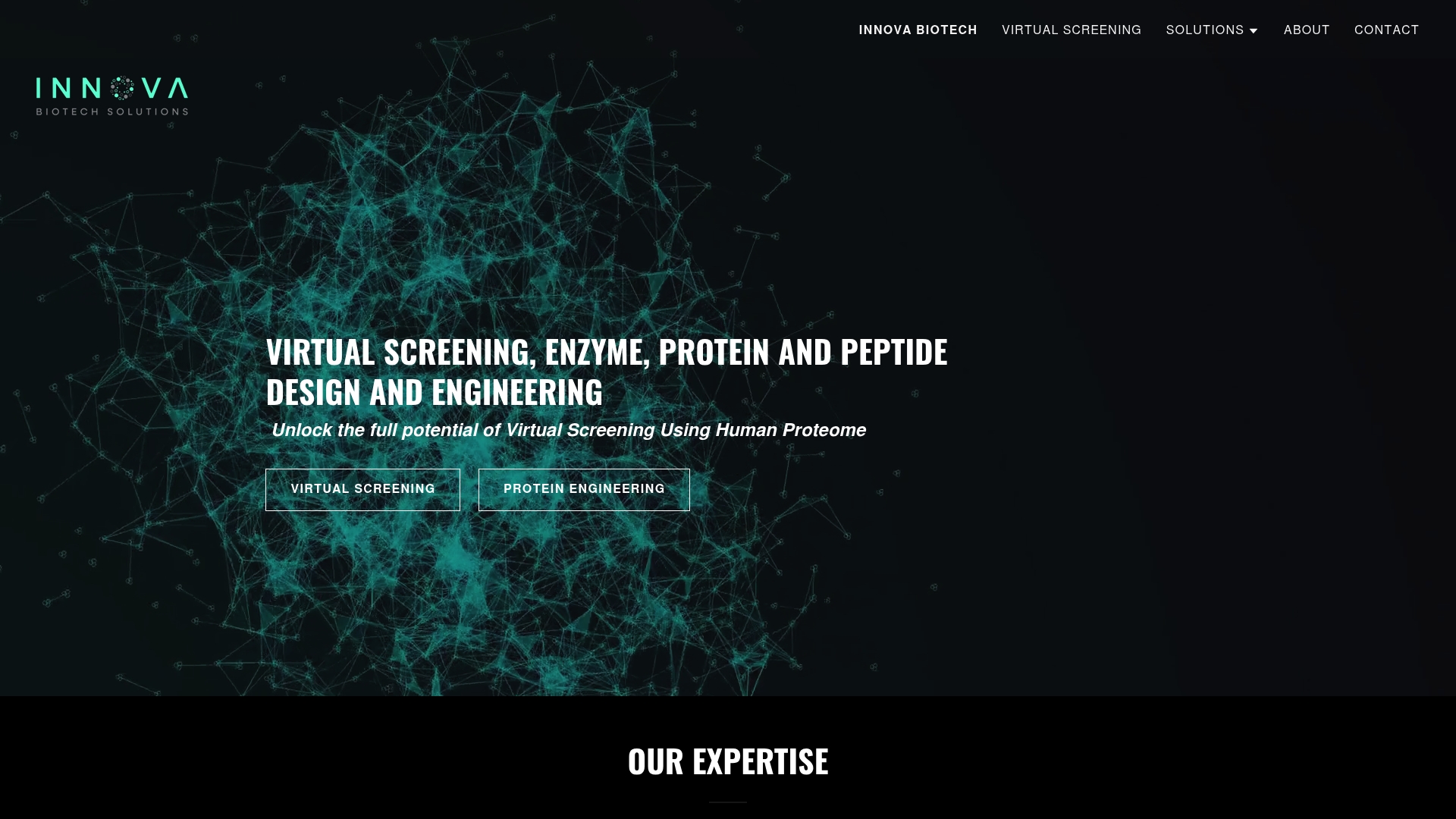
The services most relevant to generative AI projects include de novo peptide design and optimization, protein engineering and chimeric protein modeling, and enzyme optimization for biocatalyst discovery. Each engagement is scoped to the project's specific target, data availability, and synthesis capacity, with go/no-go criteria agreed upon before any compute or synthesis resources are committed.
To discuss a pilot scoping session or a technical whiteboard for your target, contact Innovabiotech directly at innovabiotech.com.
Useful sources
-
Generative artificial intelligence in drug discovery: basic framework, recent advances, challenges, and opportunities | PMC — Comprehensive taxonomy of de novo design approaches for small molecules and proteins; strong on datasets, benchmarks, and the synthesizability bottleneck.
-
Artificial intelligence in drug discovery from advanced molecular representation to pipeline applications | Frontiers in Pharmacology — Broad survey of AI applications across the pipeline; particularly useful for datasets, benchmark limitations, and data-quality warnings.
FAQ
What does generative AI actually do in drug discovery?
Generative AI proposes novel molecular or protein structures optimized for specified properties, rather than searching a fixed compound library. It learns a distribution over chemical or biological space and samples new candidates from it, conditioned on objectives like binding affinity, solubility, or ADMET profile.
Which generative model is best for small-molecule design?
There is no single best model. Diffusion models are strongest for pocket-conditioned 3D design when a target crystal structure is available; transformer CLMs are more practical for broad chemical-space exploration and fine-tuning on small proprietary datasets; GNNs are the standard for property prediction and graph-based optimization.
How do you validate generative AI outputs before synthesis?
Validation follows a sequential filter: check chemical validity and uniqueness, apply SAScore or SCScore for synthesizability, run docking and ADMET predictions against target-specific thresholds, then confirm retrosynthetic routes with tools like AiZynthFinder or ASKCOS before committing to synthesis.
What datasets should a team use to train or fine-tune a generative model?
ChEMBL is the standard for small-molecule activity data; ZINC provides synthesizability grounding; PDB supplies 3D protein structures for structure-based methods; UniProt covers protein sequences. Specialized corpora (SAbDab for antibodies, APD for peptides) are necessary for biologic design tasks.
Can Innovabiotech run a generative AI pilot for a specific target?
Yes. Innovabiotech provides end-to-end generative AI drug discovery services including de novo peptide design, protein engineering, and hit-to-lead optimization, with explicit go/no-go criteria and closed-loop iteration built into each project engagement.