
TL;DR:
- Enzyme specificity engineering involves modifying enzymes to improve substrate selectivity and reaction efficiency.
- AI and computational tools now enable rapid design, filtering, and validation, dramatically reducing development time.
Enzyme specificity engineering is the deliberate modification of enzymes to tailor their catalytic properties for selective substrate recognition and improved reaction efficiency. The field draws on three core protein engineering strategies: rational design, semi-rational mutagenesis, and AI-driven generative modeling. Each approach reshapes how enzymes recognize and process substrates, directly affecting selectivity, stability, and throughput. For biotech researchers working on enzyme optimization projects, understanding which method fits which problem is the most consequential decision in any design campaign.
What are the main strategies for enzyme specificity engineering?
Rational design, directed evolution, and semi-rational mutagenesis each address enzyme specificity from a different angle. Choosing the right one depends on how much structural data you have and how much experimental throughput you can sustain.
Rational design starts with a known enzyme structure and applies physical chemistry principles to predict which residue changes will alter substrate binding or transition-state stabilization. Three sub-approaches define this space:
- Backbone-first design: Generate a new protein scaffold, then identify sequences that fold into it. Tools like RFdiffusion handle backbone generation.
- Sequence-first design: Fix the backbone and use models like ProteinMPNN to identify sequences that stabilize the target fold.
- Function-first design: Define the catalytic geometry first, then build a scaffold around it. This is the most demanding approach but produces the most targeted selectivity changes.
Semi-rational mutagenesis combines structural knowledge with combinatorial library screening. Researchers identify a small set of residues near the active site, generate focused libraries, and screen for improved selectivity. This method reduces the search space compared to full directed evolution while retaining experimental flexibility.
Directed evolution applies iterative rounds of random mutagenesis and selection without requiring structural knowledge. It remains the most reliable method for improving activity under conditions where structural data is sparse, though it demands high-throughput screening infrastructure.

Pro Tip: Before committing to directed evolution, run a computational pre-screening pass using Rosetta ddg and AlphaFold2 pLDDT scores. Computational pre-screening can improve experimental success rates by 50–150%, meaning you test fewer candidates and find hits faster.
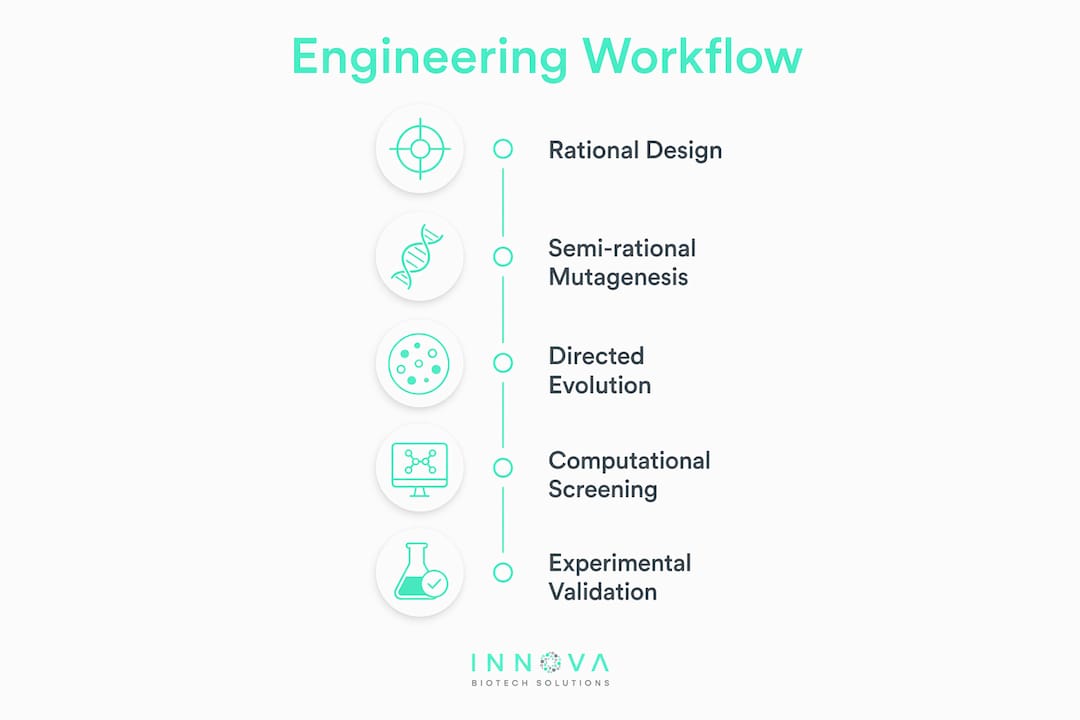
The most effective campaigns combine elements from all three strategies. Rational design narrows the sequence space, computational filters remove non-viable candidates, and experimental validation confirms function. This integrated workflow is now the standard for serious enzyme design programs.
How are AI and computational tools transforming enzyme design workflows?
AI has fundamentally changed the economics of enzyme specificity engineering. The shift is not just about speed. It is about the quality of candidates entering experimental screens.
AI-driven pipelines can complete the full cycle of enzyme design, gene synthesis, and experimental testing in as little as one month. That timeline would have required years using traditional iterative evolution. The practical implication is that researchers can now test multiple design hypotheses in parallel rather than sequentially.
The workflow that delivers this speed follows a clear sequence:
- Backbone generation: Use generative models like RFdiffusion to produce diverse enzyme scaffolds compatible with the target catalytic geometry.
- Sequence design: Apply ProteinMPNN or equivalent models to identify sequences that fold stably into each backbone.
- Computational filtering: Score candidates using Rosetta ddg, SASA, AlphaFold2 pLDDT, RMSD, PAE, and pTM metrics to eliminate structurally implausible variants.
- Experimental validation: Synthesize and test the top-ranked candidates. Screening a limited set of high-quality AI-predicted candidates can identify functional proteins without massive experimental libraries.
- Iterative refinement: Feed experimental results back into the computational model to guide the next design round.
One concrete example of this pipeline's power comes from AI-designed tryptophan synthases. Generative AI produced enzyme variants that rival or surpass laboratory-evolved enzymes, reducing the need for iterative directed evolution steps entirely.
Non-autoregressive generative models add another dimension to this workflow. These models permit in-place optimization of natural enzymes, improving specificity and stability without a full redesign. The cost and time savings compared to de novo engineering are substantial, making this approach attractive for projects where the starting enzyme already has most of the desired properties.
The critical insight is that AI does not replace experimental work. It concentrates experimental effort on candidates that are most likely to succeed, which is where the real efficiency gain lives.
What challenges arise when engineering enzyme specificity?
The most underappreciated challenge in modifying enzyme function is protein dynamics. Enzymes are not static structures. They sample multiple conformational states, and catalytic specificity often depends on which conformations are accessible during substrate binding.
Static structure-based design misses this entirely. Ensemble-based design strategies that generate backbones from multiple crystallographic conformations capture the dynamic range of the enzyme and outperform designs built on a single structure. This matters most for enzymes with flexible active sites or those that undergo induced-fit binding.
Several other pitfalls consistently derail enzyme specificity campaigns:
- Black-box AI reliance: Treating generative models as oracles without rational validation produces computationally plausible but functionally invalid variants. Physical principles and chemical intuition remain essential filters.
- Ignoring stability-specificity tradeoffs: Mutations that improve substrate selectivity often reduce thermostability. Design campaigns must track both properties simultaneously.
- Insufficient conformational sampling: Designs built on a single crystal structure miss the conformational ensemble the enzyme actually samples in solution.
- Overconfidence in computational scores: Rosetta ddg and pLDDT scores predict structural plausibility, not catalytic activity. Experimental validation cannot be skipped.
Pro Tip: When designing for a specific substrate, model the enzyme-substrate complex explicitly rather than the apo structure. Active site geometry in the presence of substrate often differs meaningfully from the unbound form, and designs based on the apo structure frequently miss key contact residues.
Experimental validation strategy also matters. Testing 10 well-chosen AI-filtered candidates outperforms testing 1,000 randomly mutated variants. The goal is not to maximize library size but to maximize the probability that each tested candidate is functional. Focusing on quality over quantity is the single most impactful change most research teams can make to their screening workflow.
What are real-world applications and recent successes?
Enzyme specificity engineering delivers measurable results across biomass processing, drug synthesis, and industrial catalysis. The case studies from 2025 and 2026 are particularly instructive because they show what integrated computational and experimental workflows actually produce.
The xylose isomerase mutant ASR285-M2 is one of the clearest demonstrations. Semi-rational engineering produced a variant with a 7.85-fold increase in catalytic activity toward D-glucose while maintaining native substrate specificity and doubling protein half-life. The mutant also achieved a 9-fold higher D-fructose yield in lignocellulosic hydrolysates, directly improving biomass valorization potential. That combination of enhanced activity, retained selectivity, and improved stability in a single engineering campaign is exactly what the field has been working toward.
AI-designed tryptophan synthases represent a different class of success. These enzymes were generated entirely through computational design and then validated experimentally. The results showed catalytic performance matching or exceeding laboratory-evolved variants, which confirms that AI-driven enzyme design has crossed from proof-of-concept into practical application.
Current and near-term application areas include:
- Biomass valorization: Engineering cellulases, xylanases, and isomerases for more efficient lignocellulose breakdown.
- Drug biocatalysis: Designing enzymes with tight substrate selectivity for pharmaceutical intermediate synthesis, where off-target reactions are costly.
- Sustainable industrial catalysis: Replacing chemical catalysts with engineered biocatalysts that operate under mild conditions and generate less waste.
- Therapeutic enzymes: Modifying enzyme function to reduce immunogenicity or improve tissue targeting for enzyme replacement therapies.
For researchers working on enzyme engineering case studies, the pattern across successful campaigns is consistent. The best results come from combining structural knowledge, computational filtering, and focused experimental validation rather than relying on any single method.
The directed evolution literature also shows that AI integration is accelerating even traditional evolution-based workflows. Computational pre-screening reduces the number of rounds needed, and generative models can propose starting points that are already closer to the fitness peak than random mutagenesis would reach.
Key Takeaways
Enzyme specificity engineering succeeds when computational filtering, ensemble-based structural modeling, and focused experimental validation work together rather than in isolation.
| Point | Details |
|---|---|
| Integrate methods, not just tools | Combine rational design, AI generation, and experimental validation for the best results. |
| Computational pre-screening pays off | Rosetta and AlphaFold2 filters improve experimental success rates by 50–150%, cutting wasted screening effort. |
| Dynamics matter for specificity | Ensemble-based backbone design captures conformational flexibility that static structures miss. |
| Quality beats quantity in screening | Testing a small set of high-quality AI-selected candidates outperforms large random libraries. |
| Real-world results validate the approach | The ASR285-M2 mutant achieved a 7.85-fold activity increase, proving integrated workflows deliver measurable gains. |
Where enzyme specificity engineering is actually headed
The conversation in the field has shifted. Five years ago, the debate was whether AI could contribute meaningfully to enzyme design. That debate is over. The real question now is how to integrate AI outputs with physical chemistry knowledge without losing interpretability.
My view is that the researchers making the most progress are the ones who treat AI models as hypothesis generators, not answer machines. RFdiffusion and ProteinMPNN produce excellent starting points. But the researchers who understand why a proposed sequence should work, and who can identify when a computationally attractive variant violates basic chemical principles, consistently outperform teams that run pipelines without that interpretive layer.
The ensemble-based design work is the development I find most compelling right now. Capturing protein dynamics through crystallographic ensembles rather than single structures is not a minor technical refinement. It changes which design solutions are even visible to the computational pipeline. Enzymes that look suboptimal on a static structure often perform well in solution because their conformational flexibility is part of the mechanism. Designs that ignore this will keep failing in ways that are hard to diagnose.
Non-autoregressive generative models for in-place optimization are the other trend worth watching. The ability to improve a natural enzyme's specificity without rebuilding it from scratch reduces both cost and risk. For most industrial applications, you do not need a de novo enzyme. You need a better version of one that already works. That framing should guide more research programs than it currently does.
The practical recommendation is straightforward. Build your workflow around the highest-quality candidates you can generate computationally, validate with physical chemistry reasoning before synthesis, and treat experimental results as data to feed back into the model. That cycle, run efficiently, is what separates teams that find hits from teams that generate libraries.
— Hooman
Innovabiotech's approach to enzyme specificity projects
Biotech researchers who need to move from design concept to validated enzyme candidate face a real bottleneck: the gap between computational output and experimental confirmation. Innovabiotech addresses that gap directly.
Innovabiotech's enzyme design services cover the full workflow, from in silico modeling and computational pre-screening through activity and stability optimization. The team applies integrated pipelines that combine generative AI with rational design principles, producing candidates that are both computationally sound and mechanistically interpretable. For researchers who need protein engineering support beyond standard directed evolution, Innovabiotech offers customized solutions built around your specific substrate targets and performance requirements. Contact the team to discuss your enzyme specificity project.
FAQ
What is enzyme specificity engineering?
Enzyme specificity engineering is the targeted modification of an enzyme's active site or surrounding structure to alter which substrates it binds and converts. The goal is to improve selective catalytic activity for a defined reaction while minimizing off-target activity.
How does rational design differ from directed evolution?
Rational design uses structural and chemical knowledge to predict which specific mutations will improve specificity, while directed evolution applies iterative random mutagenesis and screening without requiring structural data. Rational design is faster when structural information is available; directed evolution is more reliable when it is not.
What role does AlphaFold2 play in enzyme design?
AlphaFold2 provides structural predictions and quality metrics including pLDDT, PAE, and pTM that serve as computational filters in enzyme design workflows. These metrics help researchers eliminate structurally implausible candidates before committing to experimental synthesis.
Can AI-designed enzymes outperform naturally evolved ones?
Yes. AI-designed tryptophan synthases have demonstrated catalytic performance that rivals or surpasses laboratory-evolved enzymes, and the design-to-test cycle completed in as little as one month.
What is semi-rational mutagenesis?
Semi-rational mutagenesis targets a small set of structurally informed residue positions for combinatorial library generation, combining the precision of rational design with the exploratory power of experimental screening. The ASR285-M2 xylose isomerase mutant, which achieved a 7.85-fold activity increase, was produced using this approach.