
MM/GBSA rescoring reliably improves relative ranking for congeneric hit lists and focused virtual screens, provided you apply careful parameter choices and report clear uncertainty estimates. It corrects some of docking's crudest scoring errors by adding real physics, an implicit solvent model, and, ideally, ensemble averaging over molecular dynamics snapshots. Treat the output as a ranking tool, not a binding-constant predictor. Without an entropy term, every score is an enthalpy approximation, and that distinction should shape how you present results to a project team.
TL;DR:
- Rescoring with MM/GBSA is most effective for congeneric series where docking poses are reliable and poses look chemically sensible, with at least some short MD equilibration.
- The choice of the solute dielectric constant and GB model heavily influences the results; typical values range from 1 for nonpolar pockets to 4 for charged or polar sites, with OBC variants preferred.
- Ensemble-average rescoring across 50 to 200 MD snapshots significantly improves correlation with experimental data compared to single-structure evaluations, especially for flexible ligands.
- Most results omit entropy calculations due to high computational cost and noise, so reported scores are better viewed as relative enthalpy estimates rather than full free energies.
- Parameter consistency and validation, including ligand parameterization and convergence checks, are critical to avoid common mistakes and ensure reproducibility of MM/GBSA outcomes.
Table of Contents
- What Is MM/GBSA and How Does It Estimate Binding Affinity?
- When Should You Rescore Docking Hits With MM/GBSA?
- How to Run MM/GBSA Rescoring Step by Step
- Which Parameters Change Your MM/GBSA Results the Most?
- Do Advanced MM/GBSA Techniques Improve Accuracy Further?
- What Are the Most Common MM/GBSA Mistakes?
- Which Tools Support Reproducible MM/GBSA Calculations?
- How Does a Client-Facing MM/GBSA Project Actually Run?
- When Should You Trust MM/GBSA and When Should You Escalate?
- How Innovabiotech Supports MM/GBSA-Enabled Virtual Screening
- Sources
- FAQ
What Is MM/GBSA and How Does It Estimate Binding Affinity?
MM/GBSA sits in the middle ground between a fast, empirical docking score and a slow, rigorous alchemical calculation like free energy perturbation. It takes docked poses or MD trajectories and computes a more physically grounded estimate of binding free energy by summing several distinct energy terms, then uses that composite score to reorder your hit list. Researchers have leaned on it for years precisely because it recovers some of the physical detail that docking scoring functions strip away for speed, without the multi-day compute budget FEP demands.
The total score usually breaks down into four pieces:
- ΔE_MM: the molecular mechanics energy, covering bond, angle, torsion, electrostatic, and van der Waals terms calculated directly from the force field.
- ΔG_GB: the polar solvation free energy, estimated using a Generalized Born implicit solvent model rather than explicit water molecules.
- ΔG_SA: the nonpolar solvation contribution, typically estimated from solvent-accessible surface area.
- −TΔS: the conformational entropy penalty, which many workflows omit entirely because it is expensive and noisy to calculate.
This structure makes MM/GBSA modular. You can swap in a different GB model, adjust the dielectric treatment, or add entropy corrections without rebuilding the whole calculation. A comprehensive review of MM/PBSA and MM/GBSA methods points out that this flexibility is also the method's biggest liability: two labs running "MM/GBSA" on the same system can get meaningfully different numbers depending on GB variant, dielectric constants, and whether entropy was included.
Compared to a pure docking score, MM/GBSA gains accuracy by simulating actual molecular motion, even if only over a short trajectory. Compared to FEP, it sacrifices rigor for speed by replacing explicit alchemical transformations with a single (or ensemble) snapshot approximation. That trade-off is exactly why it has become the default rescoring layer between the two.
The choice of GB model matters more than most people expect going in. Generalized Born approximations like the Onufriev/OBC variants (commonly invoked through the igb flag in AMBER-family tools) are the most widely benchmarked, and switching between them can shift both absolute scores and, occasionally, relative rankings on charged or highly polar binding sites.
When Should You Rescore Docking Hits With MM/GBSA?
Rescoring adds the most value in a specific, recognizable situation: a congeneric series or focused hit-list where docking has already done a reasonable job placing poses, but the scoring function can't distinguish which analog binds tighter. MM/GBSA analysis shines here because the systematic errors in the docking score tend to cancel out when comparing chemically similar ligands against the same target conformation.
The conditions that predict a useful outcome share three traits:
- The ligands share a common scaffold or binding mode, so relative comparisons are meaningful.
- Docking poses look chemically sensible on visual inspection, not just numerically favorable.
- You have compute budget for at least a short MD equilibration per pose, not just a single minimization.
Rescoring is far less likely to help when your hit list spans wildly diverse chemotypes with different predicted binding modes, or when the underlying docking poses are themselves unreliable. Feeding MM/GBSA a bad pose just produces a more expensive bad number. One study on model cavity binding sites found that MM/GBSA rescoring rescued a majority of docking false negatives in a prospective test, correctly identifying 23 of 33 predicted binders, but it also introduced new false positives and failed outright on systems requiring large receptor rearrangements. That is the realistic ceiling: real improvement, not perfection.
The compute trade-off deserves an honest accounting before you commit a project to it. A single-structure MM/GBSA run on a minimized pose can complete in minutes per ligand. Ensemble-average rescoring across dozens of MD snapshots multiplies that cost by roughly the number of frames you sample, plus the equilibration time upfront. For a screening set of a few hundred compounds, that difference is the gap between an afternoon job and a multi-day cluster reservation. Reserve ensemble rescoring for the shortlist stage, after docking and single-structure MM/GBSA have already trimmed the field.
How to Run MM/GBSA Rescoring Step by Step
A reproducible MM/GBSA pipeline follows a fairly fixed sequence, and skipping steps is where most published inconsistencies come from.
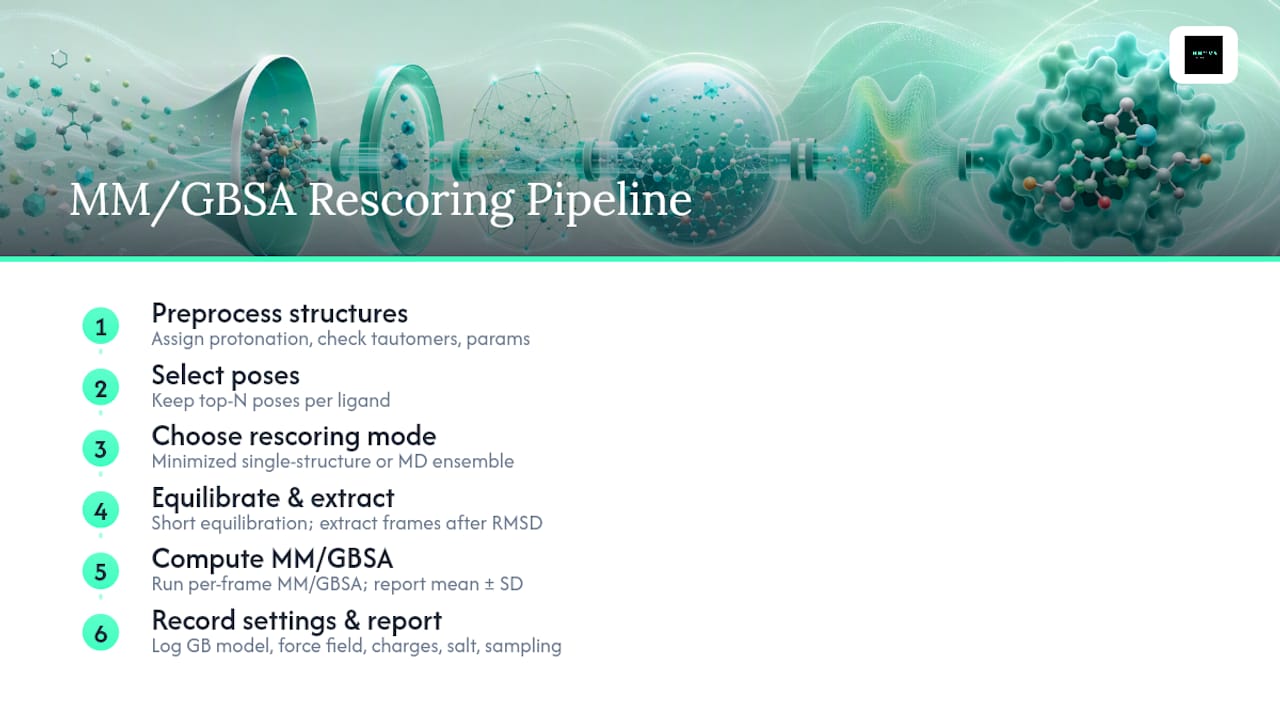
1. Preprocess structures before anything touches a simulation. Assign correct protonation states for both the receptor and ligand at your target pH, check for tautomer ambiguity on the ligand, and confirm ligand parameters are actually complete rather than auto-generated with default placeholders. A ligand missing partial charges or with an unrecognized functional group will silently produce garbage energies that look plausible.
2. Select poses from your docking output. Take the top-N poses per ligand rather than only the single best-scored pose, especially for flexible or non-specific binders. The literature on ensemble rescoring specifically flags keeping multiple top poses as important when the binding mode is uncertain, since collapsing to one pose too early can lock in a docking error.
3. Decide between minimized single-structure and full MD-based rescoring. A minimized structure answers "does this pose look stable," while short MD equilibration followed by production sampling answers "how does this pose actually behave." For a first-pass triage of hundreds of compounds, single-structure MM/GBSA is often good enough. For a shortlist of a few dozen finalists, ensemble-average MM/GBSA over MD snapshots is worth the extra time.
4. Run equilibration, then production, then extract frames. A short equilibration (tens to low hundreds of picoseconds, system-dependent) lets the complex relax before you start collecting data. Extract evenly spaced frames from the production run after the trajectory's RMSD has plateaued, rather than from the very start.
5. Run the MM/GBSA calculation per frame and average. Feed each extracted snapshot through the MM/GBSA calculation with fixed settings, then report the ensemble mean and standard deviation rather than a single number.
6. Record every setting that could change the answer. That means the GB model and its igb number, the force field version, the ligand charge method, salt concentration, and the frame sampling interval. A reproducibility checklist built around exactly these fields is what separates a defensible MM/GBSA rescoring analysis from a black-box number nobody can reproduce six months later.
7. Report results with component decomposition. Break the total score into its ΔE_MM, ΔG_GB, and ΔG_SA pieces when presenting to a project team, not just the summed total. That breakdown often reveals why one analog scores better, which matters more to a medicinal chemist than the number itself.
Pro Tip: Always report ΔTOTAL as mean ± standard deviation across frames, never as a bare number. A ranking built on ΔG = −8.2 kcal/mol with no error bar looks precise and is often meaningless once you see the frame-to-frame spread.
Which Parameters Change Your MM/GBSA Results the Most?
A handful of settings drive most of the variance you'll see between two "identical" MM/GBSA setups, and getting them wrong is the most common reason rescoring results don't reproduce.
Solute dielectric constant. This is the single highest-leverage knob in the whole calculation. Assessments across many test systems confirm that MM/GBSA performance is sensitive to the solute dielectric you choose, and there's no universal correct value. A default of 1 works reasonably for nonpolar, well-packed binding pockets. For binding sites with buried charges, extensive hydrogen-bond networks, or metal coordination, a higher interior dielectric in the range of 2 to 4 is often more sensible because it partially compensates for the rigid force field's inability to model electronic polarization.
GB model choice. Onufriev/OBC-style GB variants dominate published rescoring studies for good reason: they consistently outperform older GB models on solvation energy accuracy without a major speed penalty. Implementation notes from the rescoring literature repeatedly point back to these OBC variants and their corresponding igb settings as the practical default worth starting from.
Ligand parameterization. GAFF combined with AM1-BCC charges is the standard combination for small-molecule ligands, but it isn't foolproof. Checkpoints worth running before you trust any result:
- Confirm the ligand's total charge matches the intended protonation state.
- Check for unusually high force-field penalty scores on any atom type, which flag a poor parameter match.
- Verify bond and angle parameters weren't silently substituted with generic fallback values.
Number of snapshots. Statistical stability matters more than raw frame count. Practical guidance from published MM-GBSA tutorials recommends a moderate number of evenly spaced frames typically recommended(https://structbiotools.com/mm-gbsa-tutorial/) drawn from an equilibrated production trajectory, and the marginal benefit of pushing past 500 frames is usually small relative to the added compute cost. Extract frames after the RMSD trace has plateaued, not from the equilibration phase.
Typical reported runtimes back this up directly: a moderate protein-ligand system analyzed across roughly 200 frames finishes in about 10 to 30 minutes on a modern CPU, which is fast enough to make ensemble averaging routine for a shortlist-sized hit list rather than a luxury reserved for a handful of compounds.
Entropy inclusion. Adding a normal-mode entropy correction can, in principle, bring MM/GBSA closer to a true binding free energy. In practice, normal-mode entropy calculations are computationally expensive, numerically noisy across similar ligands, and frequently contribute more variance than signal for congeneric series where the entropy penalty is roughly constant across analogs. Most rescoring pipelines for virtual screening skip it and label results as relative enthalpy comparisons instead, which is the more honest framing anyway.
Do Advanced MM/GBSA Techniques Improve Accuracy Further?
Ensemble-average MM/GBSA is the advanced technique with the strongest published evidence behind it, and it should be your first upgrade before reaching for anything more exotic. A published rescoring study on antithrombin ligand binding found that switching from single-structure to ensemble-average MM/GBSA improved the correlation with experimental data significantly, from a low to a much higher R2 value. That's not a marginal gain; it's the difference between a scoring model with almost no predictive value and one you can actually make decisions on.
The recommended workflow mirrors the pipeline above: run short MD on each candidate pose, extract 50 to 200 frames after equilibration, compute MM/GBSA per frame, and average. The gain comes specifically from sampling conformational fluctuations that a single static structure can't capture, especially for flexible ligands or binding sites with mobile loops.
Beyond ensemble averaging, three extensions come up regularly in the literature, each with real trade-offs:
- Nwat-MMGBSA (explicit water inclusion): adds a shell of explicit water molecules around the binding site instead of relying purely on implicit solvation. This helps most when a binding pocket has a tightly bound, structurally important water molecule that a GB model can't represent. Selecting which waters to keep requires either crystallographic evidence or careful analysis of water occupancy during MD, and getting it wrong adds noise rather than accuracy.
- QM/MM-GBSA hybrids: replace the molecular mechanics description of the ligand, or sometimes key active-site residues, with a quantum mechanical calculation. Worth considering for metalloenzymes, covalent inhibitors, or systems with significant charge transfer that a classical force field handles poorly. The reproducibility cost is real: QM/MM results are sensitive to basis set, functional choice, and QM region boundary in ways that are hard to standardize across a screening campaign.
- Multiple-pose ensemble rescoring: rather than committing to one docked pose per ligand, carry several forward through MD and rescore all of them, keeping the best or averaging across poses. This is the direct extension of the pose-selection advice from the pipeline section, applied at scale.
None of these extensions are free. Each one adds setup complexity, computational cost, or both. The practical test before adopting any of them on a live project: run the extension on a small validation set of 10 to 20 ligands with known experimental affinities first, and confirm the correlation actually improves before scaling to your full hit list. Skipping that validation step is how teams end up trusting an expensive calculation that performs no better than the simple version.
What Are the Most Common MM/GBSA Mistakes?
Most MM/GBSA misinterpretation traces back to a handful of repeatable mistakes, and every one of them is avoidable with a short checklist before you circulate results.
- Treating scores as binding constants. An MM/GBSA score without an entropy term is an enthalpy-like approximation, not a free energy you can convert to a Kd. Label every reported number as "relative ranking score" unless entropy was explicitly included and validated.
- Ignoring ligand parameterization warnings. A flagged penalty score on an unusual functional group means the force field is guessing. Reparametrize or drop that ligand rather than trusting a suspicious outlier ranking.
- Reporting a single number with no uncertainty. Standard deviation across frames tells you whether a ranking is real or noise. Two ligands separated by 0.5 kcal/mol with a 2 kcal/mol standard deviation are statistically indistinguishable, not ranked.
- Skipping convergence checks. Compare results from independent MD repeats or non-overlapping frame subsets. If the ranking flips between repeats, the calculation hasn't converged and the answer isn't trustworthy yet.
Translating outputs into project decisions works best as a simple triage rule: use MM/GBSA rankings to prioritize which compounds get synthesized or tested first, not to make a final go/no-go call on a single compound. The method is built for relative comparison within a series, and stretching it past that role is where most credibility problems start.
Pro Tip: Before trusting any MM/GBSA ranking, run the same calculation twice with different random seeds or starting frames. If the rank order survives that stress test, it's real. If it doesn't, you're looking at numerical noise dressed up as a result.
Which Tools Support Reproducible MM/GBSA Calculations?
The tool ecosystem for MM/GBSA rescoring splits cleanly along the two dominant molecular dynamics engines, and picking the right one mostly comes down to which simulation infrastructure your team already runs.
For GROMACS-based workflows, gmx_MMPBSA has become the standard implementation, built to interface directly with GROMACS trajectories while reusing AMBER-derived force field logic for the energy calculations. For teams already inside the AMBER ecosystem, the native MMPBSA.py toolset (often referred to informally through its Prime MMGBSA-style workflow analogs in commercial packages) handles the same job natively.
Parameterization utilities matter just as much as the rescoring engine itself:
- Antechamber, distributed with AmberTools, handles GAFF parameter assignment and AM1-BCC charge generation for small-molecule ligands.
- CGenFF serves the equivalent role for CHARMM-based force field workflows, with its own web server for parameter generation.
A common pitfall with both: default settings sometimes assign generic fallback parameters to unusual functional groups without an obvious warning. Always cross-check unusual atoms or ring systems against the parameter log rather than assuming a clean run means clean parameters.
Runtime budgeting is worth doing before you commit a cluster reservation to a large batch. A moderate-sized protein-ligand complex processed across roughly 200 frames typically completes in 10 to 30 minutes on a modern CPU, which scales roughly linearly with your hit-list size and frame count. For a screening set of several hundred compounds at 100 frames each, that's a multi-hour to overnight job on a single workstation, and a straightforward parallelization candidate across a compute cluster.
Readers building the docking stage that feeds into this pipeline will find practical checks for producing docking poses suitable for rescoring useful groundwork before running any of the above.
How Does a Client-Facing MM/GBSA Project Actually Run?
A typical MM/GBSA-enabled virtual screening engagement follows a consistent shape once a target and hit list are defined. It starts with a consultation to pin down the chemical series, the target structure quality, and how many compounds need ranking. Docking generates initial poses, which are then curated by a computational chemist to remove chemically implausible binding modes before any rescoring begins. Ensemble-average MM/GBSA runs on the surviving poses, sampling MD snapshots per candidate rather than relying on a single minimized structure.
Deliverables from that kind of engagement typically include a ranked hit list reporting ΔTOTAL as mean ± standard deviation per compound, a per-residue energy decomposition highlighting which contacts drive the strongest predicted binders, and a reproducibility note specifying the GB model, force field, and frame count used. That last piece matters more than clients often expect going in. It's what lets an internal team defend the ranking to a review committee six months later without having to rerun the whole analysis from scratch.
When Should You Trust MM/GBSA and When Should You Escalate?
MM/GBSA earns its place in a screening pipeline as a triage tool, not a final verdict. A workable rule of thumb: if two compounds differ by less than roughly one standard deviation in ensemble-averaged ΔTOTAL, treat their ranking as a tie and let other criteria such as synthetic accessibility, selectivity, and known liabilities break it. Anything ranking in the top tier with a clean convergence check earns a spot on the experimental confirmation list. Anything with a flagged ligand parameter or a wide frame-to-frame spread gets a second look before it goes anywhere.
Escalating to FEP or another alchemical method makes sense specifically when a project has narrowed to a handful of close analogs where the synthesis cost of guessing wrong is high, and where MM/GBSA's ranking is ambiguous within its own error bars. That's a genuinely different calculation, not a fancier version of the same one, and it should be reserved for decisions where the extra rigor changes what gets made in the lab.
Having reviewed how computational teams apply these methods across drug discovery programs, the pattern that stands out is how often labs skip the validation step: running a small known-affinity set through their exact pipeline before trusting it on a live screen. That single check catches more bad rescoring decisions than any parameter tweak discussed above.
— Hooman
How Innovabiotech Supports MM/GBSA-Enabled Virtual Screening
Contracted engagements for MM/GBSA-enabled virtual screening and hit-to-lead computational work can provide ranked, defensible hit lists without requiring clients to build out MD infrastructure in-house.

A typical engagement covers docking pose curation, ensemble-average rescoring across MD snapshots, and a full reporting package: ranked hits with ΔTOTAL mean ± standard deviation, per-residue decomposition showing which contacts drive each score, and a reproducibility note listing every parameter choice. For peptide-ligand systems specifically, that same rescoring logic extends into Innovabiotech's peptide design services, where affinity optimization runs alongside sequence design rather than as a separate downstream step. Teams working on modified proteins or engineered binding domains can route the same computational scrutiny through the protein design services page, where structural modeling and rescoring inform the same decision: which candidate actually deserves synthesis. If a hit list has grown past what an internal pipeline can rescore with confidence, consulting a specialized service provider for project scoping and quotes on specific screening systems may be beneficial.
FAQ
What Is the MM/GBSA Method Used For?
MM/GBSA is used to rescore docking hit lists, refining the ranking of candidate ligands by combining molecular mechanics energies with implicit solvent terms for a more physically grounded estimate than a standard docking score.
How Do MM/PBSA and MM/GBSA Estimate Ligand Binding Affinities?
Both methods sum molecular mechanics energy, solvation free energy, and a surface area term across one or more structures, with MM/PBSA using a Poisson-Boltzmann solvent model and MM/GBSA using the faster Generalized Born approximation. MM/PBSA often gives better absolute energies while MM/GBSA runs faster and is generally preferred for ranking large hit lists.
What Do Scoring Functions Do in Molecular Docking?
Docking scoring functions rapidly estimate binding favorability for thousands to millions of poses, prioritizing speed over physical accuracy. MM/GBSA rescoring is typically applied afterward, to a much shorter list of top-ranked poses, to add back some of the physical detail the docking score sacrificed for speed.
Does MM/GBSA Rescoring Account for Entropy?
Most standard MM/GBSA rescoring workflows omit conformational entropy because it is computationally expensive and often noisy for congeneric series, which means reported scores approximate enthalpy rather than full binding free energy. Always confirm and state whether entropy was included before comparing scores across studies.
How Many MD Frames Are Needed for Reliable MM/GBSA Rescoring?
Most published guidance recommends a moderate number of evenly spaced frames typically recommended(https://structbiotools.com/mm-gbsa-tutorial/) taken from an equilibrated production trajectory, with diminishing returns past roughly 500 frames relative to the added compute cost.