

TL;DR:
- Computational protein modeling predicts structures and conformational ensembles from sequence data and experimental constraints.
- AI-driven methods like AlphaFold3 generate realistic structural populations guided by experimental data, enhancing dynamic understanding.
Computational protein modeling is the process of predicting and simulating three-dimensional protein structures and conformational ensembles from sequence data and experimental constraints. The field spans comparative modeling, de novo structure prediction, and AI-driven ensemble generation, with tools like AlphaFold3 now integrating NMR restraints, cryo-EM maps, and electron density data to produce physically realistic structural populations. Industry standards such as the Protein Data Bank (PDB) anchor these workflows by supplying validated receptor structures. Structural bioinformatics has moved decisively beyond single static models. Researchers now treat protein structures as dynamic ensembles, and that shift is reshaping both basic science and drug discovery.
What are the main computational techniques in protein modeling?
Computational protein modeling divides into three broad methodological families: comparative modeling, de novo prediction, and AI-driven generative approaches. Each targets a different region of the accuracy-versus-novelty spectrum.

Comparative modeling (also called homology modeling) builds a target structure by threading its sequence onto a known template from the PDB. The method is fast and reliable when sequence identity exceeds roughly 30%, but it fails for proteins with no close structural homologs.
De novo prediction constructs structures from physical energy functions without a template. Methods like Rosetta use fragment assembly and Monte Carlo sampling to search conformational space. The approach is computationally expensive but covers sequence space that homology modeling cannot reach.
AI-driven ensemble modeling represents the current frontier. AlphaFold3 generates conformational ensembles guided by experimental likelihood gradients from electron density, NMR data, and cryo-EM maps. That guidance steers diffusion-based sampling toward structures consistent with physical measurements rather than just sequence statistics. The result is a set of structures that reflects true biological heterogeneity, not a single lowest-energy conformation.
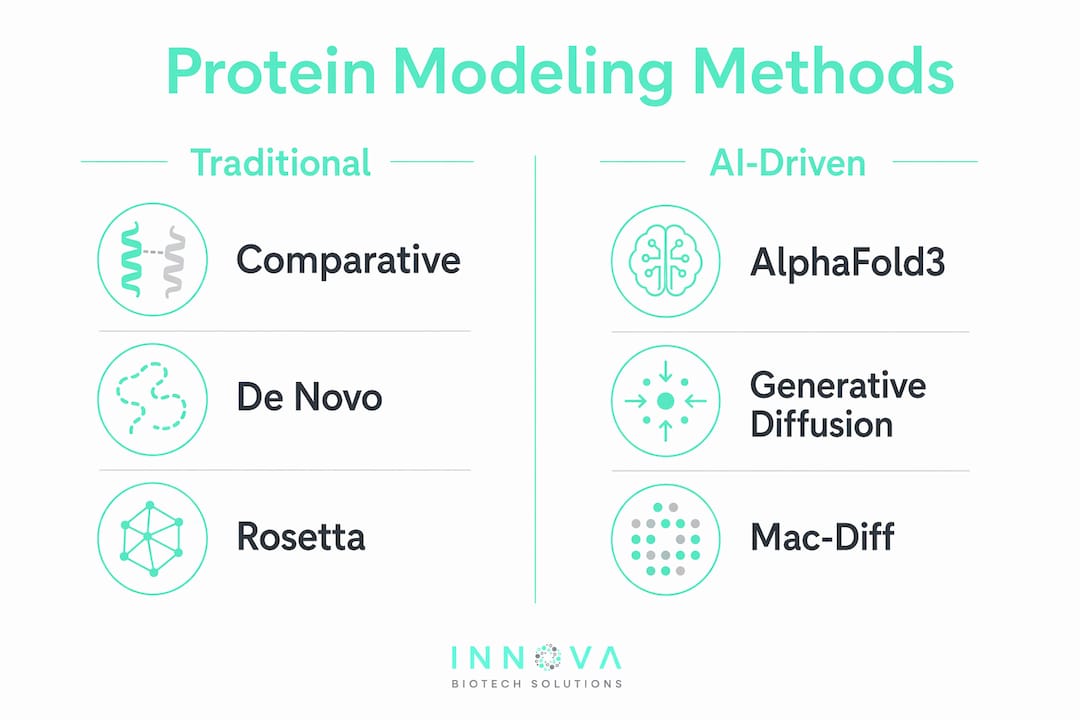
A parallel advance comes from generative diffusion models. Mac-Diff uses protein language models and locality-aware modal alignment attention (LAMA-attention) to generate diverse, realistic conformational ensembles directly from sequence. LAMA-attention enforces local sequence-to-structure correspondence during denoising, which captures allosteric conformations that conventional cross-attention misses.
Protein language models also underpin scalable de novo design by uncovering evolutionary sequence-structure grammars that physics-based force fields cannot represent. This makes them especially valuable for designing proteins with no natural homologs.
Key refinement steps apply across all three families:
- Force field relaxation removes steric clashes introduced during model building.
- Ensemble pruning removes redundant or physically implausible conformers using energy-based or clustering criteria.
- Protonation and tautomer assignment at the target pH corrects ionization states before downstream docking or dynamics.
Pro Tip: Run at least three independent sampling trajectories and compare ensemble diversity metrics before selecting a representative structure. A single trajectory often undersamples the accessible conformational space.
How are protein modeling techniques integrated into drug discovery?
Modern drug discovery workflows use computational triage as a multi-stage funnel. Each stage filters a large chemical space down to a manageable set of candidates for experimental validation.
- Receptor preparation. Retrieve a high-quality structure from the PDB. Assign protonation states, resolve missing loops with comparative or AI-based modeling, and place crystallographic waters that mediate key contacts.
- High-throughput docking. Screen millions of ligands against the prepared receptor using a rapid docking engine. Score poses by estimated binding affinity and discard obvious mismatches early.
- Molecular dynamics (MD) simulation. Run nanosecond-to-microsecond MD on top-ranked poses to assess stability. Unstable poses that drift from the binding site within tens of nanoseconds rarely translate to active compounds.
- Free-energy estimation. Apply free-energy perturbation (FEP) or MM-GBSA calculations to rank the surviving candidates by predicted binding free energy.
- Pharmacophore modeling. Extract the geometric and chemical features of active poses to build a pharmacophore query. Use the query for scaffold hopping and to prioritize new library subsets.
- ADMET filtering. Apply rule-based filters, including Lipinski's Rule of Five, to flag compounds with poor oral bioavailability or likely toxicity before synthesis.
- Biophysical validation. Test prioritized compounds with SPR, ITC, or fluorescence-based assays. Feed binding data back into the model to refine the receptor structure and scoring function.
Iterative coupling of docking, MD, and biophysical assays is the practice that separates effective computational triage from simple virtual screening. Each experimental cycle corrects model errors and improves the accuracy of the next computational round.
Understanding why protein structure matters in this context is not academic. A receptor model with incorrect protonation or a missing allosteric pocket will consistently rank the wrong compounds, wasting synthesis resources.
Pro Tip: Prepare multiple receptor conformations from an MD ensemble rather than a single crystal structure. Docking against a conformational ensemble reduces false negatives caused by induced-fit effects.
What challenges exist in capturing protein conformational dynamics?
The central challenge in structural bioinformatics is that proteins are not static objects. A single lowest-energy structure, however accurate, misrepresents the biological reality of a protein that samples multiple conformations at physiological temperature.
AI-predicted structures should be treated as sequence-conditioned priors that require experimental validation to capture true biological flexibility. Treating an AlphaFold output as ground truth leads to missed allosteric sites and incorrect binding predictions for flexible targets.
Integrating multiple experimental modalities addresses this limitation directly. The table below summarizes how each data type contributes to ensemble generation.
| Experimental modality | Information provided | Role in ensemble modeling |
|---|---|---|
| NMR restraints | Distance and dihedral constraints | Guides sampling toward solution-state conformations |
| Cryo-EM maps | Electron density at near-atomic resolution | Anchors global fold and domain orientations |
| X-ray crystallography | High-resolution electron density | Validates static reference structure |
| HDX-MS | Solvent accessibility and dynamics | Identifies flexible regions for ensemble weighting |
Gradient-based guidance during diffusion sampling incorporates experimental likelihoods directly into the structure generation process. This means the model does not just predict a structure and then check it against data. It steers sampling in real time using data as a constraint.
LAMA-attention outperforms conventional cross-attention for this task because it enforces locality. Each residue's structural prediction draws primarily from its sequence neighborhood rather than from distant positions that may share no physical contact. That locality constraint produces more realistic backbone geometries for disordered regions and loop segments.
Additional challenges researchers encounter:
- Metastable state prediction. Allosteric proteins occupy multiple energy minima. Standard MD rarely samples transitions between them on accessible timescales. Enhanced sampling methods such as replica exchange or metadynamics are required.
- Quantum chemistry trade-offs. Quantum mechanical (QM) calculations capture electronic effects in metal-containing active sites but are computationally prohibitive for full proteins. QM/MM partitioning restricts QM treatment to the active site while using molecular mechanics for the remainder.
- Modality misalignment. Combining sequence embeddings from a protein language model with 3D structural coordinates requires careful alignment. Misalignment between the two representations degrades both ensemble diversity and physical plausibility.
Researchers working on protein stability prediction face these same ensemble challenges when validating AI-generated models against experimental thermodynamic data.
How should researchers choose the right modeling approach?
Method selection in in silico protein analysis depends on four factors: system size, required resolution, available experimental data, and the downstream application.
- Use comparative modeling when a template with greater than 30% sequence identity exists and you need a fast, reliable starting structure for docking or MD.
- Use de novo prediction or AI ensemble modeling for novel folds, intrinsically disordered regions, or when conformational diversity is the research question.
- Use molecular mechanics force fields for large systems (greater than 10,000 atoms) where speed matters. AMBER, CHARMM, and OPLS-AA each have validated parameter sets for proteins and common small molecules.
- Use QM or QM/MM methods when the active site contains metal ions, radical intermediates, or covalent bond formation that classical force fields cannot represent.
- Integrate experimental data at every stage where it is available. Even sparse NMR chemical shift data improves ensemble quality measurably compared to sequence-only predictions.
Balancing molecular mechanics for speed and quantum chemistry for precision is not a one-time decision. Revisit it as the project moves from initial hit identification to lead optimization, where higher accuracy justifies greater computational cost.
Closed-loop systems that connect generative AI frameworks with robotic platforms represent the next step in experimental design. These systems use real-time assay data to update the generative model, which then proposes the next round of compounds or conditions without human intervention between cycles.
For practical guidance on domain selection in protein design, the same principles apply: match the computational method to the biological question, not to the tool you are most familiar with.
Pro Tip: Validate your receptor preparation protocol on a known ligand before running a large docking campaign. If the known binder does not reproduce its crystal pose within 2 Å RMSD, the receptor is not ready for screening.
Key Takeaways
Computational protein modeling produces its best results when AI-generated structural priors are validated against experimental data and refined through iterative computational-experimental cycles.
| Point | Details |
|---|---|
| AI structures are priors, not ground truth | Treat AlphaFold3 outputs as starting points requiring NMR, cryo-EM, or X-ray validation. |
| Ensemble modeling over single structures | Capture conformational diversity with diffusion-based methods like Mac-Diff or experiment-guided AlphaFold3. |
| Iterative triage drives drug discovery | Couple docking, MD, and biophysical assays in feedback loops to improve hit quality each cycle. |
| Match method to system and goal | Use molecular mechanics for speed at scale; apply QM/MM only where electronic effects are critical. |
| Experimental integration is non-negotiable | Gradient-based guidance from NMR and cryo-EM data measurably improves ensemble accuracy over sequence-only prediction. |
What I've learned from watching the field shift to ensemble thinking
The most consequential change in structural bioinformatics over the past two years is not AlphaFold3 itself. It is the community's growing acceptance that a single predicted structure is a hypothesis, not an answer.
I have watched research teams invest months in docking campaigns against a beautifully resolved crystal structure, only to find that the protein's biologically relevant conformation was never captured in that crystal form. The binding site they were targeting did not exist in the active state. Ensemble modeling would have surfaced that problem in the first week.
The practical implication is uncomfortable for labs with limited computational budgets: you cannot skip experimental validation of your receptor model. NMR chemical shifts, HDX-MS protection patterns, or even a second crystal form from a different space group will tell you things that sequence-based prediction cannot. The cost of that validation is always lower than the cost of optimizing against the wrong structure.
I am also skeptical of the framing that generative AI has "solved" protein structure prediction. What it has done is dramatically lower the cost of generating a credible starting hypothesis. The hard work of understanding which conformation matters for your specific biological question still requires experimental judgment. Closed-loop platforms that integrate generative models with robotic assay systems are the right direction, but they amplify good experimental design. They do not replace it.
The researchers I see getting the most out of these tools treat computation and experiment as a single workflow, not as sequential handoffs. That integration is the actual advance, and it is available to any lab willing to build the feedback loop.
— Hooman
Innovabiotech's computational protein modeling and design services
Innovabiotech, based in San Francisco, California, applies the methods described throughout this article to client projects in protein engineering, virtual screening, and de novo peptide design.

The team at Innovabiotech works directly with researchers from initial consultation through project delivery, covering everything from receptor preparation and ensemble generation to hit-to-lead optimization. Their protein design services address the full modeling workflow, including AI-driven structure prediction, conformational ensemble analysis, and experimental integration. For researchers focused on therapeutic peptides, Innovabiotech's peptide design and optimization services apply bioinformatics validation and binding affinity prediction to accelerate candidate selection. Every project is handled with direct scientific communication and full transparency at each stage.
FAQ
What is computational protein modeling?
Computational protein modeling is the use of algorithms and physical models to predict and simulate the three-dimensional structure and conformational dynamics of proteins from sequence data and experimental constraints. Methods range from comparative modeling to AI-driven diffusion approaches like AlphaFold3.
How does AlphaFold3 differ from earlier structure prediction tools?
AlphaFold3 generates conformational ensembles guided by experimental data such as NMR restraints and cryo-EM maps, rather than predicting a single static structure. This makes it far more useful for studying dynamic proteins and allosteric mechanisms.
What is protein-ligand docking and when is it used?
Protein-ligand docking computationally predicts how a small molecule binds to a receptor by sampling binding poses and scoring them by estimated affinity. It is used in early drug discovery to screen large compound libraries against a target before synthesis.
When should researchers use quantum chemistry instead of molecular mechanics?
Quantum chemistry methods are necessary when the system involves metal coordination, covalent bond formation, or radical intermediates that classical force fields cannot model accurately. For most large-scale protein simulations, molecular mechanics force fields like AMBER or CHARMM provide sufficient accuracy at a fraction of the computational cost.
What is Mac-Diff and why does it matter for ensemble modeling?
Mac-Diff is a conditional diffusion model that uses protein language model embeddings and LAMA-attention to generate diverse, physically realistic protein conformational ensembles from sequence alone. It captures allosteric and metastable states that single-structure prediction methods miss entirely.