
Use a validated, target-specific workflow that pairs careful structure preparation, calibrated docking, consensus rescoring, and targeted molecular dynamics (MD) to produce reliable poses and defensible prospective hits. Skip any of those steps and your enrichment factors will tell you so.
Before running a single docking job, work through this checklist:
- Prepare your target structure: fix missing atoms, assign protonation states and tautomers, handle metals and cofactors, and decide which crystallographic waters to retain.
- Enumerate your ligand set: generate protonation states, tautomers, and stereoisomers before conformer sampling.
- Run a redocking control on a known co-crystal ligand and report RMSD. If you cannot reproduce the experimental pose within 2.0 Å, stop and fix the preparation before screening anything.
- Validate retrospectively on a benchmark such as CASF-2016 or PoseBusters and report enrichment factor (EF) and ROC/AUC.
- Choose your sampling and rescoring strategy based on throughput, receptor flexibility, and available GPU resources.
- Apply MD or alchemical free-energy calculations only to your top 100–500 ranked compounds.
Pro Tip: Run the redocking control and report both RMSD and EF before any prospective screen. Teams at Innovabiotech treat this as a non-negotiable acceptance gate before scaling to a full virtual screen.
Key Takeaways
Building reliable protein-ligand docking models requires a validated, target-specific workflow: prepare structures carefully, confirm RMSD < 2.0 Å on redocking, benchmark retrospectively on CASF-2016 or PoseBusters, and apply MD or FEP only to top-ranked compounds.
| Point | Details |
|---|---|
| Validate before screening | Redock a known ligand and confirm RMSD < 2.0 Å before running any prospective screen. |
| Benchmark with standard datasets | Use CASF-2016 and PoseBusters to report EF, ROC/AUC, and pose success rates. |
| Use hybrid ML + physics pipelines | Pair ML pose generation (DiffDock, Interformer) with physics-based rescoring for the most defensible results. |
| Document every parameter | Record software versions, random seeds, grid coordinates, and protonation states for full reproducibility. |
| Innovabiotech for managed pipelines | Innovabiotech delivers benchmarked docking protocols, prioritized hit lists, and reproducibility packages for pharma and biotech teams. |
Table of Contents
- When is protein-ligand docking the right tool for your project?
- Core concepts every practitioner must master
- Step-by-step workflow for building a docking model
- How do you choose the right docking tools and algorithms?
- How do you validate and benchmark a docking model?
- When should you integrate MD and free-energy methods?
- Common pitfalls that waste compute and produce false positives
- A modern ML-enabled pipeline you can reproduce
- How Innovabiotech implements this workflow for clients
- The direction of docking: AI models, interpretability, and what actually matters
- Innovabiotech's docking and virtual screening services for production-ready pipelines
- Sources
- FAQ
When is protein-ligand docking the right tool for your project?
Docking is appropriate when you have a defined binding site, a target structure of reasonable quality (X-ray or cryo-EM at ≤ 2.5 Å resolution, or a ColabFold/AlphaFold model you can validate), and at least a handful of known active ligands to use as redocking controls. It fits virtual screening, hypothesis-driven mechanism studies, and structure-based lead optimization.
Docking is the wrong primary tool when:
- Receptor dynamics dominate binding (large conformational changes on ligand binding): use MD-enhanced or induced-fit workflows instead.
- You already have experimental HTS data: ligand-based ML models will outperform structure-based docking on that chemical series.
- Your structure is low-resolution or homology-modeled without validation: docking errors compound on top of modeling errors.
- Cofactors or metals are absent from the model and cannot be reliably placed.
Core concepts every practitioner must master
Molecular docking has two separable problems: sampling (exploring the pose space) and scoring (ranking those poses by predicted binding energy). Getting both right is what separates a defensible screen from an expensive false-positive generator.
Sampling algorithms range from stochastic methods (Monte Carlo, simulated annealing) and systematic grid searches to genetic algorithms (AutoDock, GOLD) and, most recently, diffusion-based generative models (DiffDock, GeoDirDock). Sampling depth directly controls pose diversity; too shallow and you miss the native binding mode, too deep and runtime becomes prohibitive for large libraries.
Scoring functions fall into four families: force-field-based, empirical, knowledge-based, and ML-driven. Each has characteristic failure modes. Force-field functions penalize steric clashes well but struggle with entropy. Empirical functions are fast but overfit to their training sets. ML-driven scores improve ranking but can hallucinate plausible-looking poses for chemotypes outside their training distribution.
Binding-site identification starts with the experimental site when a co-crystal structure is available. For apo or predicted structures, pocket-detection tools (FPocket, SiteMap) identify candidate cavities. Allosteric sites require separate grid definitions and, often, MD-derived open conformations to expose the pocket. A standard grid box should extend at least 10 Å beyond the known or predicted ligand centroid in each dimension.
Receptor flexibility is where most programs fall short. Rigid-receptor docking is fast but systematically fails when the binding site reorganizes on ligand binding. Side-chain rotamer sampling (soft-docking) recovers some of that loss at modest cost. Full backbone flexibility requires induced-fit protocols or MD relaxation, both of which add significant compute time. The standard RMSD threshold for a successful top-1 pose is < 2.0 Å against the experimental structure.
- Rigid docking: fast, appropriate for well-characterized targets with rigid binding sites.
- Side-chain flexible docking: moderate cost, recovers most induced-fit cases where backbone moves < 1 Å.
- Full induced-fit / backbone-flexible docking: high cost, necessary for cryptic or allosteric sites.
Step-by-step workflow for building a docking model
Molecular docking in drug discovery requires explicit documentation of every preparation and parameterization choice. Here is the ordered workflow:
- Target preparation. Download the highest-resolution structure available. Fix missing loops (Modeller, Prime), add hydrogens, assign protonation states at physiological pH (Epik, Propka), place metals and cofactors, and retain waters within 5 Å of the binding site unless there is a specific reason to remove them.
- Ligand preparation. Enumerate protonation states and tautomers at the target pH, generate stereoisomers, and produce 3D conformers. Store the enumerated input file; it is part of your reproducibility record.
- Grid and search-space definition. Center the grid on the co-crystal ligand centroid or the predicted pocket center. Define separate grids for each candidate binding site if you are investigating allosteric mechanisms.
- Docking run configuration. Set sampling depth, choose rigid or flexible residues, and run replicates with different random seeds. For ML-based methods, sample at least 40 poses per ligand before filtering.
- Rescoring and pose filtering. Apply consensus scoring across at least two scoring functions. Filter by interaction plausibility: hydrogen-bond networks to known pharmacophore atoms, absence of buried charged groups without counterions, and hydrophobic contact quality.
- Validation. Redock the co-crystal ligand and report RMSD. Run a retrospective virtual screen against a benchmark set and report EF at 1% and 5%, ROC/AUC, and BEDROC. Document all parameter values.
- Lead refinement. Run short restrained MD (10–50 ns) on top-ranked compounds to relax docked poses. Apply MM-GBSA for mid-tier rescoring, and alchemical free-energy perturbation (FEP) or thermodynamic integration (TI) for final lead ranking.
Pro Tip: Keep an explicit parameter record for every run: software version, random seeds, sampling lengths, receptor protonation state, and grid coordinates. Without it, you cannot reproduce your own results six months later, let alone satisfy a regulatory or corporate review.
How do you choose the right docking tools and algorithms?
The decision comes down to four axes: throughput, pose accuracy, receptor flexibility handling, and available compute.
Classical programs remain the workhorses for accessible, large-scale screening. AutoDock Vina and its GPU-accelerated variant AutoDock-GPU deliver fast, open-source screening with well-characterized performance. Glide (Schrödinger) adds extra-precision (XP) scoring and induced-fit extensions suited to high-precision lead optimization. GOLD (CCDC) uses a genetic algorithm with configurable fitness functions and handles covalent docking well.
ML-driven and generative models are where the field is moving fastest. Interformer is an interaction-aware deep-learning model that improves pose accuracy and produces interpretable hydrogen-bond and hydrophobic contact outputs, making it useful for affinity prediction as well as pose generation. CarsiDock pre-trained on approximately 9 million predicted protein-ligand complexes and shows improved docking accuracy and early recognition in retrospective screens. DiffDock frames docking as a generative diffusion problem and is fast, though it benefits from domain-informed guidance: GeoDirDock demonstrates that guiding diffusion with geodesic paths and domain knowledge measurably improves pose realism. DockFormer adapts the AlphaFold2 pair-transformer architecture to enable fully flexible docking with an eight-layer model that is smaller and faster than comparable architectures while remaining competitive on pose and affinity benchmarks.
Hybrid strategies get the best of both worlds: use ML models for rapid pose generation across a large library, then apply physics-based rescoring or short MD relaxation to the top 100–500 hits. ColabFold feeds predicted structures into this pipeline when no experimental structure is available.

Before committing to any tool for a full-scale screen, run a small pilot: redock known actives, compute RMSD and EF, and compare at least two programs on your specific target. No tool wins universally.
How do you validate and benchmark a docking model?
Validation is what separates a publishable screen from an internal hypothesis. The Annual Reviews docking paper is direct: target-specific validation is required to avoid high false-positive rates in large-scale screens.
- Redocking. Remove the co-crystal ligand, re-dock it, and measure RMSD to the experimental pose. Top-1 RMSD < 2.0 Å is the standard success criterion.
- Cross-docking. Dock ligands from one complex into another structure of the same target to test robustness across conformational states.
- Retrospective virtual screening. Mix known actives with property-matched decoys (DUD-E, DEKOIS2) and compute EF at 1% and 5%, ROC/AUC, and BEDROC. An EF at 1% above 5 is a reasonable signal for a well-calibrated model.
- Benchmark datasets. Use CASF-2016 for pose and ranking benchmarks, PoseBusters for physically plausible pose assessment, and PLINDER for interaction-level analysis. Interaction-aware models like Interformer report improved top-1 rates on PoseBusters splits.
- Reporting. Publish your parameter table: software version, grid coordinates, sampling settings, random seeds, and the full benchmark results. Reproducibility is not optional.
Pro Tip: Design your decoy set carefully. Property-matched decoys (molecular weight, logP, rotatable bonds) prevent artificial enrichment from physicochemical bias rather than genuine binding selectivity.
When should you integrate MD and free-energy methods?
MD and alchemical free-energy calculations are not first-pass tools. Apply them after docking has already filtered your library to a manageable set.
- Short restrained MD (10–50 ns): relax docked poses, identify unstable binding modes, and expose receptor flexibility missed by rigid docking. Use GROMACS or AMBER for this step.
- MM-GBSA: mid-tier rescoring for top 100–500 compounds. Faster than FEP, more physically grounded than raw docking scores, but sensitive to force-field parameters and solvation model.
- Alchemical FEP/TI: reserve for final lead ranking within a congeneric series (typically 10–30 compounds). AMBER and GROMACS both support production-grade FEP workflows.
- Ensemble docking: when your target has multiple known conformations (apo, holo, MD snapshots), dock against the ensemble and take the best-scoring pose per compound. This partially compensates for backbone flexibility without full induced-fit cost.
The practical rule: apply MD rescoring to no more than the top 500 compounds from a docking run to keep cost proportional to the information gain.
Common pitfalls that waste compute and produce false positives
Most failed screens trace back to a small set of avoidable mistakes.
- Skipping protonation and tautomer enumeration. A ligand docked in the wrong protonation state will score poorly or, worse, score well in a physically impossible pose.
- Ignoring metals and cofactors. A zinc-binding site docked without the zinc ion will produce nonsense poses for zinc-chelating scaffolds.
- Single scoring function reliance. No scoring function is universally reliable. Consensus scoring across two or three functions reduces false positives without proportional compute cost.
- No redocking control. If you cannot reproduce the co-crystal pose, the model is not ready for prospective use.
- Data leakage in benchmarks. Training-set overlap between your actives and the ML model's training data inflates retrospective metrics. Use time-split or scaffold-split validation sets.
- Undocumented parameters. Random seeds, sampling depths, and software versions must be recorded. Results that cannot be reproduced are not results.
Pre-release QC gate: before committing compounds to synthesis, confirm RMSD < 2.0 Å on redocking, EF at 1% above your pre-set threshold, interaction plausibility review for all top-ranked poses, and a complete parameter record.
A modern ML-enabled pipeline you can reproduce
A practical folding-docking-affinity pipeline maps directly onto the workflow above:
- ColabFold (folding): generate or refine the target structure when no experimental structure is available. Validate the model quality before docking.
- DiffDock or Interformer (pose generation): sample 40+ poses per ligand. Guided diffusion with domain knowledge (GeoDirDock) improves pose realism over blind diffusion.
- Consensus rescoring (physics + ML): apply a force-field-based score alongside the ML model's interaction-aware output. Retain poses that pass both filters.
- GNN affinity predictor or GIGN: prioritize the filtered pose set by predicted binding affinity. The FDA framework shows this step can match docking-free state-of-the-art on kinase benchmarks.
- Short MD/MM-GBSA or alchemical FEP (top series): GROMACS or AMBER for the final 10–100 compounds.
Pro Tip: Using the structural noise generated during folding and docking as data augmentation for the affinity predictor has been reported to improve generalization to novel chemotypes. It is worth testing on your pilot set before scaling.
How Innovabiotech implements this workflow for clients
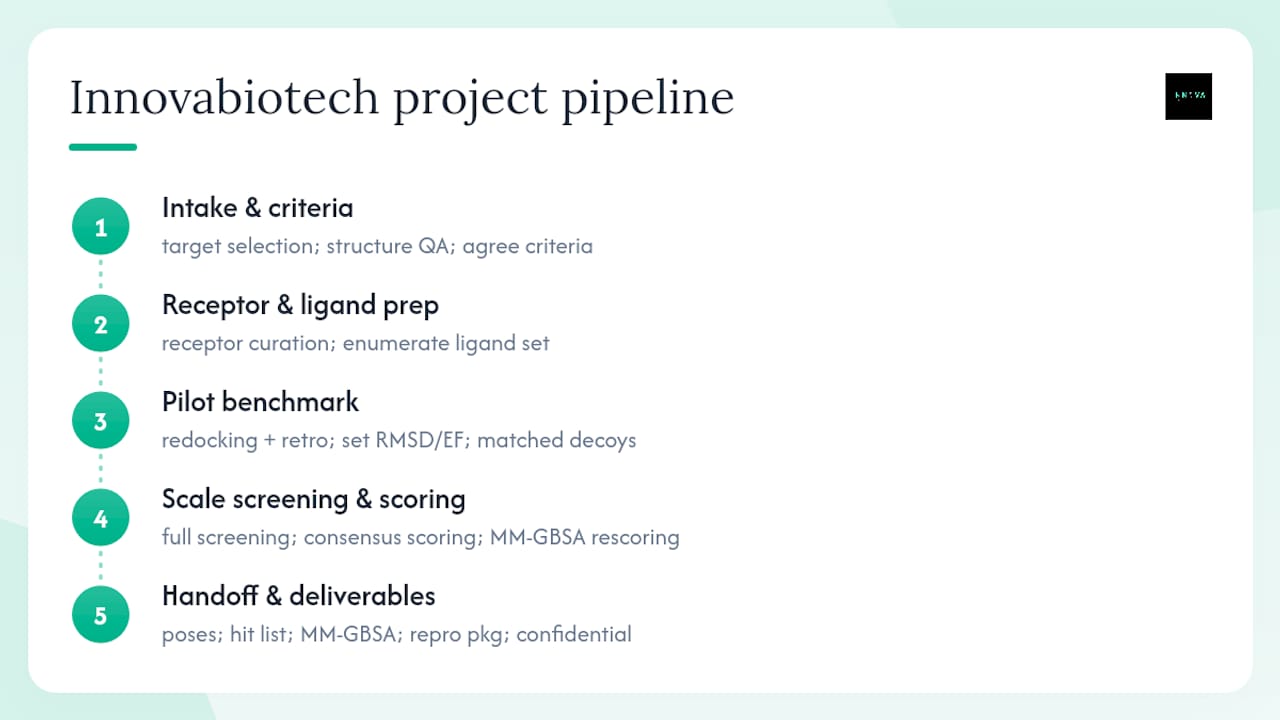
Innovabiotech's standard project pipeline starts with a structured intake: target selection, structure quality assessment, and agreement on acceptance criteria before any compute runs. The team then curates and prepares the receptor, enumerates the ligand set, and runs a calibrated pilot benchmark (redocking + retrospective VS) to establish the protocol's RMSD and EF thresholds for that specific target.
Every Innovabiotech project delivers a parameter record, a benchmark report with RMSD and EF values, a prioritized hit list with interaction-level annotations, and a recommended follow-up plan. Data security and confidentiality are built into the workflow from intake to handoff.
Deliverables for a typical virtual screening engagement include the docked pose files, a consensus-scored and interaction-filtered hit list, MM-GBSA rescoring results for top compounds, and a reproducibility package (software versions, seeds, grid files, enumerated ligand inputs). All project data remains confidential under a signed agreement.
Pro Tip: Innovabiotech selects pilot benchmark sets using property-matched decoys and a scaffold-split active set to prevent data leakage. Acceptance criteria are agreed with the client before scaling, so there are no surprises at the full-screen stage.
The direction of docking: AI models, interpretability, and what actually matters
The shift toward interaction-aware and diffusion-based models is real and the performance gains on benchmarks like PoseBusters are genuine. But benchmark performance and prospective utility are not the same thing. A model that achieves top-1 RMSD < 2.0 Å on a curated test set can still fail badly on a novel target with an unusual binding site geometry or a chemotype outside its training distribution.
The practical lesson is not to distrust AI-driven docking but to validate it the same way you would validate any other protocol: redock known ligands, run a retrospective screen, and check interaction plausibility before trusting the ranked list. Hybrid pipelines that pair ML pose generation with physics-based rescoring and targeted MD are the most defensible approach for most pharma projects right now. Speed and scale matter, but a fast wrong answer is worse than a slower right one.
Invest early in benchmark design and parameter documentation. Those records will accelerate every regulatory or corporate review that comes later.
Innovabiotech's docking and virtual screening services for production-ready pipelines
Teams that need a production-ready docking pipeline without building the infrastructure from scratch get a faster path through Innovabiotech's virtual screening and hit-to-lead services. The concrete advantage: a benchmarked, target-specific protocol with documented acceptance criteria, delivered in weeks rather than months of internal setup.
A pilot engagement includes receptor preparation, ligand enumeration, a calibrated docking run with redocking and retrospective VS validation, consensus rescoring, and a prioritized hit list with interaction annotations. For teams moving into lead optimization, protein design and computational modeling services extend the pipeline into induced-fit and protein engineering workflows. Every project runs under a confidential agreement with full data security.
To discuss a pilot project or get a scoped proposal, contact Innovabiotech at Innovabiotech.
Sources
Primary literature and benchmarks:
- The Art and Science of Molecular Docking | Annual Reviews
- Interformer: an interaction-aware model for protein-ligand docking and affinity prediction | Nature Communications
- CarsiDock: large-scale pre-training improves DL-guided docking accuracy | Chemical Science (RSC)
- Protein–ligand docking: fundamentals and applications | PubMed (chapter review)
- A Folding-Docking-Affinity framework for protein-ligand binding affinity prediction | Communications Chemistry (preview)
- DockFormer: Affinity prediction and flexible docking with pair transformer | PRX Life
Innovabiotech service pages:
FAQ
What RMSD threshold defines a successful docking pose?
A top-1 RMSD below 2.0 Å against the experimental co-crystal structure is the standard success criterion used across benchmarks including CASF-2016 and PoseBusters.
When should you use ML-driven docking instead of AutoDock Vina?
Use ML-driven models like Interformer or DiffDock when you need faster pose generation across large libraries or when interaction-level interpretability matters; fall back to AutoDock Vina or AutoDock-GPU for open-source, well-validated screening on targets with known rigid binding sites.
How do you handle receptor flexibility in docking?
For modest flexibility, side-chain rotamer sampling in programs like GOLD or Glide recovers most induced-fit cases. For larger conformational changes, use induced-fit protocols, ensemble docking across MD snapshots, or DockFormer's fully flexible architecture.
What benchmarks should you run before a prospective virtual screen?
Run redocking (RMSD < 2.0 Å), a retrospective virtual screen with EF at 1% and 5% and ROC/AUC reported, and physically plausible pose assessment using PoseBusters. CASF-2016 provides a standardized pose and ranking benchmark.
Can Innovabiotech run a benchmarked docking pilot before a full screen?
Yes. Innovabiotech's pilot engagements include receptor preparation, calibrated docking, redocking validation, retrospective VS metrics, and a prioritized hit list with interaction annotations, all delivered under a confidential agreement.