

Multi-omics integration is the analytical process of combining data from two or more molecular layers, such as genomics, transcriptomics, proteomics, metabolomics, and epigenomics, into a single model that links genotype to phenotype. For matched samples, joint methods like MOFA, SNF, or network-based fusion give you the strongest signal. For unmatched or heterogeneous cohorts, sequential or similarity-fusion approaches hold up better. This guide covers preprocessing, core algorithms, open-source pipelines, real case studies, and a practical checklist for picking your approach.
TL;DR:
- Matched samples benefit most from joint factorization methods like MOFA, while unmatched or heterogeneous cohorts require similarity fusion or meta-analytic approaches.
- Proper preprocessing, including platform-specific normalization, batch correction, and careful handling of missing data, is essential to prevent confounding technical artifacts with biological signals.
- Network-based integration tools such as SNF and WGCNA excel in patient stratification and module discovery, especially when sample sizes are moderate and biological interpretability is needed.
- Deep generative models like VAEs perform best with large datasets and are prone to overfitting in small cohorts, making hybrid strategies more reliable for most labs.
- Successful multi-omics analysis demands rigorous experimental design, detailed metadata documentation, and validation on independent cohorts to avoid overfitting and ensure reproducibility.
Table of Contents
- What Are the Main Types of Multi-Omics Integration?
- How Do You Preprocess Data Across Omics Layers?
- Which Computational Method Should You Use for Integration?
- What Tools and Pipelines Support Multi-Omics Workflows?
- What Have Multi-Omics Studies Found in Practice?
- Which Pitfalls Threaten Reproducibility in Multi-Omics Analysis?
- How Do You Choose an Integration Strategy Step by Step?
- How Does Innovabiotech Apply Multi-Omics Integration for Clients?
- How Do You Evaluate and Benchmark Integration Performance?
- How Should You Design an Experiment for Multi-Omics Studies?
- What the Field Gets Wrong About Multi-Omics Integration
- Where to Turn When You Need Multi-Omics Analysis Done Right
- Sources
- FAQ
What Are the Main Types of Multi-Omics Integration?
Every integration project starts with one question you can't skip: do your samples actually match across layers? That answer determines almost everything downstream, from which software you install to how you interpret the output.
Vertical (matched) integration applies when the same biological samples were profiled across multiple omics platforms, say, RNA-seq and mass spectrometry proteomics run on the same tumor biopsies. Because sample identities line up, you can model shared latent structure directly. This is the setting where factorization methods like MOFA perform best, since the mathematics assumes a common sample axis running through every data matrix.
Diagonal (unmatched) integration deals with the opposite problem: different samples, different patients, sometimes different cohorts, measured on different platforms with no shared identifiers. You can't align rows directly, so you align on shared features, correlated modules, or biological annotations instead. This is common when combining a public transcriptomic cohort with an internal proteomic dataset that was never designed to be paired.
Mosaic integration sits between the two. Some samples have all omics layers measured, others have only a subset, which is the norm in large biobank studies where budget constraints mean phosphoproteomics gets run on a subset of samples but RNA-seq gets run on all of them. Mosaic methods borrow information from the fully-profiled samples to fill gaps in the partially-profiled ones.
Spatial multi-omics adds a fourth dimension, physical location within tissue. Spatial transcriptomics paired with spatial proteomics preserves the tissue architecture, letting you ask not just what molecules are present but where, relative to a tumor margin or an immune infiltrate boundary.
The practical decision tree looks like this:
- If your samples are matched and you have a moderate sample size (dozens to low hundreds), start with a joint factorization or network fusion method.
- If your cohorts are unmatched or come from different studies, use meta-analytic or diagonal integration, and treat sample matching as the first quality gate, not an afterthought.
- If you have partial coverage across omics layers, mosaic-aware tools that explicitly model missingness will outperform methods that assume complete matrices.
- If tissue architecture matters to your biological question, budget extra time for spatial registration before you touch statistical integration at all.
A related distinction that trips up newcomers is the difference between early, intermediate, and late integration, sometimes called sequential vs. parallel integration. Early integration concatenates raw feature matrices before any modeling, which is simple but lets the highest-dimensional omics layer (usually transcriptomics or methylation) dominate the signal. Late integration runs separate models per omics layer and combines results afterward, which preserves each layer's individual signal but can miss cross-layer interactions. Intermediate integration, where MOFA and SNF both live, models the layers jointly while still respecting their distinct statistical properties. For most matched-sample studies, intermediate integration is the sweet spot between the two failure modes.
How Do You Preprocess Data Across Omics Layers?
Skipping preprocessing rigor is the single most common way an integrative multi-omics model ends up describing batch effects instead of biology. Specialists at EMBL-EBI point to inconsistent normalization across platforms as the top failure mode in integrative pipelines, and it's an easy trap because each omics layer has its own accepted conventions that don't transfer to the others.
Genomic data needs variant-quality filtering and depth thresholds before anything else. Transcriptomic count data typically gets a variance-stabilizing transform, DESeq2's VST or a similar log-based approach, since raw counts violate the assumptions of most downstream statistical models. Proteomics from mass spectrometry usually needs median or quantile normalization to correct for run-to-run intensity drift, and metabolomics often requires probabilistic quotient normalization to handle dilution effects in urine or serum samples. None of these steps are interchangeable. Applying an RNA-seq normalization method to proteomics intensities, or vice versa, is a common mistake that silently degrades an integration model's output.
Here's a working preprocessing sequence that holds up across most study designs:
- Run sample-level QC first: check read depth, protein identification counts, and metabolite detection rates, and drop or flag outlier samples before any cross-omics step.
- Filter low-information features within each omics layer separately, using platform-appropriate thresholds rather than one blanket cutoff.
- Normalize each layer using its own accepted method, and confirm with diagnostic plots (density plots, PCA) that the correction actually worked before moving on.
- Detect batch effects explicitly using PCA or hierarchical clustering colored by batch, processing date, or instrument, rather than assuming there aren't any.
- Correct detected batch effects with ComBat, or encode batch and other technical covariates directly into a limma design matrix if you're running downstream linear models.
- Handle missing values deliberately: for missing-completely-at-random data, k-nearest-neighbor or MOFA's built-in factor-based imputation both work; for structured missingness (an entire omics layer absent for a subset of samples), mosaic-aware methods that model the missingness pattern beat naive imputation.
- Record metadata for every sample, platform version, processing date, batch ID, and any known technical covariate, in a structured format (a simple TSV works, but a MultiAssayExperiment or Bioconductor SummarizedExperiment object keeps sample metadata bound to the data matrices themselves).
Pro Tip: Run your batch-effect diagnostic PCA before AND after correction, and save both plots. Reviewers and collaborators will ask how you know the correction worked, and "I ran ComBat" isn't an answer, but a side-by-side PCA showing batch clusters collapsing after correction is.
Missing-value imputation deserves its own caution. Any imputation method injects assumptions into your dataset, and those assumptions can manufacture correlations that weren't there biologically. If a large portion of a feature's values are missing, consider dropping the feature rather than imputing it, since the imputed values will start to dominate whatever signal you eventually extract.
Which Computational Method Should You Use for Integration?
No single algorithm family wins across every study design, and reviews of the field increasingly frame this as a menu of trade-offs rather than a hierarchy. A technical review of integration methods tracks a clear shift from classical statistical correlation methods toward machine learning-driven network analysis and deep generative models, but that shift doesn't make the older methods obsolete. It changes when you'd reach for them.
Correlation and statistics-based methods remain the right starting point for hypothesis generation. Canonical correlation analysis and its multi-omics extensions find linear relationships between two data matrices, which is useful for a first-pass check of whether two omics layers share any signal worth pursuing further. Their limitation is exactly what makes them fast: they assume linear relationships and struggle past two or three omics layers simultaneously.
Factorization approaches solve the scaling problem. MOFA and its successor MOFA2 decompose multiple matched omics matrices into a shared set of latent factors, essentially finding the small number of underlying biological axes of variation that explain patterns across every layer at once. Because MOFA models each omics layer's noise structure separately, it handles the very different statistical properties of, say, count-based RNA-seq data and continuous metabolomics intensities within a single unified framework. It's an unsupervised method, so it works well for exploratory studies where you don't yet have a predefined outcome to predict, and it requires matched samples to function as intended.
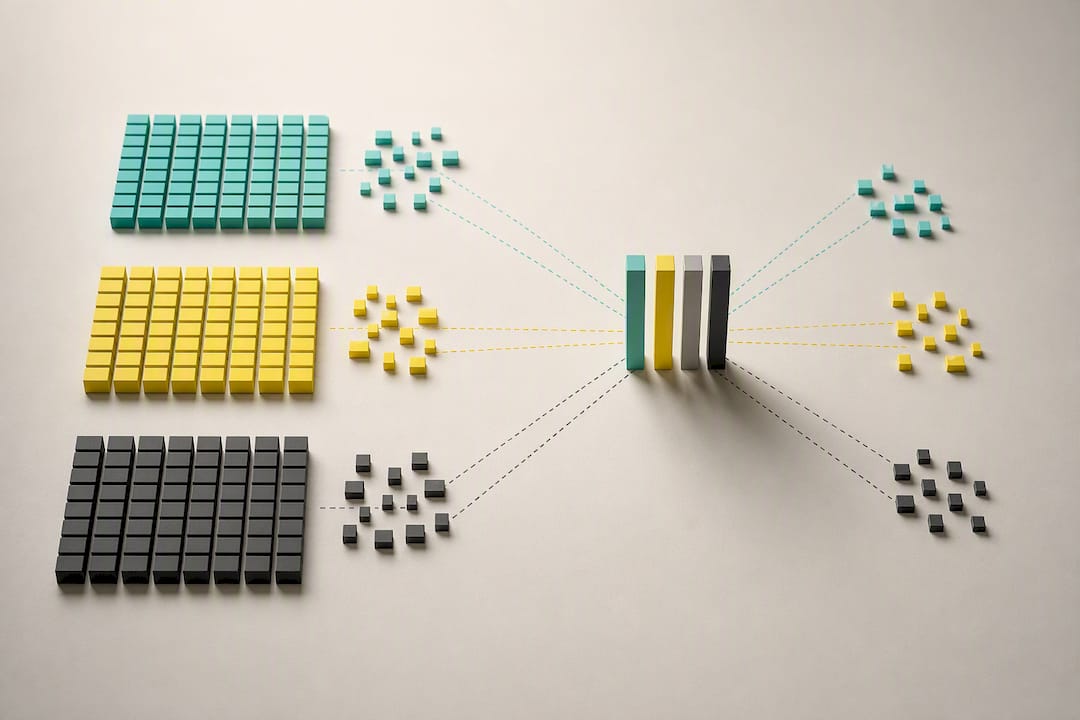
Similarity and network-based fusion takes a different mathematical route. Rather than finding shared latent axes, Similarity Network Fusion (SNF) builds a sample-similarity network within each omics layer, then iteratively fuses those networks into one integrated similarity graph. Reviews of network-based integration approaches point to SNF's particular strength in patient stratification, where the goal is to cluster patients into biologically meaningful subgroups even when the individual omics layers disagree on where the cluster boundaries fall. WGCNA takes a related but distinct approach, building co-expression or co-abundance modules within a single omics layer first, which then get correlated with other omics layers or with clinical traits. Network propagation methods extend this further by walking known biological networks (protein interaction maps, pathway databases) to spread signal from a few significant genes or proteins to their functional neighbors.
Machine learning and deep generative methods are where the field is moving fastest. Variational autoencoders (VAEs) learn compressed, non-linear representations of multi-omics data that can outperform linear factorization when the underlying biology genuinely involves non-linear interactions between layers, which is common in signaling networks and metabolic regulation. Multimodal deep learning architectures extend this to jointly model three or more omics layers with cross-layer attention mechanisms, and they're increasingly used for imputation and data augmentation in cohorts with structured missingness. The catch is real: these models need substantial clean training data, and reviews caution that without careful validation, deep generative approaches overfit small cohorts and produce imputed values that look plausible but don't hold up in independent validation sets.
A rough decision framework:
- Exploratory, matched, moderate sample size → MOFA or a comparable factorization method.
- Patient stratification with heterogeneous or partially matched data → SNF or another network-fusion approach.
- Module discovery within a single large omics dataset before cross-layer correlation → WGCNA.
- Large training cohorts (typically several hundred samples or more) with structured missingness or a clear non-linear hypothesis → VAE-based or multimodal deep learning.
- Any of the above, when sample sizes are small → hybrid or ensemble approaches that average multiple methods tend to be more robust than betting everything on one algorithm.
Small-sample deep learning is the single most common way researchers manufacture false confidence in a multi-omics result. A network-based or factorization method with a transparent, inspectable latent space will almost always generalize better than a deep model trained on 40 samples, even when the deep model's training loss looks better.
Hybrid and ensemble strategies are gaining ground precisely because no method family dominates every dataset. A common pattern: run MOFA to identify latent factors, then validate those factors' biological coherence using a network-propagation step against a curated pathway database, cross-checking the two independent methods against each other before reporting either result alone.
What Tools and Pipelines Support Multi-Omics Workflows?
A reproducible multi-omics pipeline generally moves through six stages: data import and harmonization, per-omics quality control, single-omics analysis (differential expression, differential abundance), cross-omics integration, network or pathway analysis, and reporting. Which tool handles which stage depends heavily on your data types and how much coding you want to do by hand.
OmNI (Omics Notebook Interactive) is an open-source, R-based modular framework built specifically for transcriptomics, proteomics, phosphoproteomics, and metabolomics integration. It uses an S-score integration method to combine differential signals across omics layers, then reconstructs a Prize-Collecting Steiner Forest (PCSF) network to highlight the most parsimonious connected subnetwork explaining your multi-omics changes. OmNI outputs interactive HTML reports and Cytoscape-compatible network files, which makes it a strong choice when your end goal is a shareable, explorable result rather than a static figure.
MUUMI takes a meta-analytic angle. It's an R package that unifies statistical meta-analysis with network-based integration, wrapping SNF functionality and adding module aggregation across multiple independent studies or omics types. MUUMI fits naturally when you're combining several published datasets that weren't designed together, exactly the diagonal-integration scenario where matched-sample methods like MOFA don't apply.
iSODA is a browser-based interactive platform implementing both MOFA and SNF under one interface, with on-the-fly normalization and imputation built in. Its value is accessibility: you don't need to write R or Python code to run a first-pass MOFA factorization or SNF clustering, which makes it useful for exploratory analysis, teaching, and quick sanity checks before committing to a heavier command-line pipeline.
MOFA/MOFA2 remains the reference implementation for factorization-based joint integration, distributed as both an R and a Python package with a shared underlying model, so teams that mix languages don't need to reimplement the math twice.
| Tool | Primary inputs | Core method | Output format | Best fit |
|---|---|---|---|---|
| OmNI | Transcriptomics, proteomics, phosphoproteomics, metabolomics | S-score integration, PCSF network | Interactive HTML, Cytoscape files | Matched-sample studies needing network context |
| MUUMI | Multi-study, multi-omics matrices | SNF wrappers, meta-analysis, module aggregation | R objects, network annotation files | Combining unmatched or multi-study cohorts |
| iSODA | Omics matrices via web upload | MOFA, SNF | Interactive browser visualizations | Exploratory analysis, teaching, quick checks |
| MOFA/MOFA2 | Matched multi-omics matrices | Latent factor analysis | Factor loadings, R/Python objects | Unsupervised joint dimensionality reduction |
In practice, most reproducible workflows combine Bioconductor packages (limma, DESeq2, MOFA2) for per-omics statistics with Python for downstream machine learning steps, stitched together inside a container. Docker or Singularity images pin exact package versions, which matters enormously in a field where an R package update can silently change a normalization default. For teams handling genuinely large cohorts, containerized pipelines also make it far easier to hand analysis off to shared compute infrastructure, a point covered in more depth in Innovabiotech's guide to large biological dataset analysis. Whatever pipeline you assemble, export intermediate results, normalized matrices, factor loadings, network files, in open formats (CSV, GraphML, or Cytoscape's native format) so a collaborator without your exact software stack can still verify your work.
What Have Multi-Omics Studies Found in Practice?
The clearest proof that integration adds value over single-omics analysis comes from cancer subtyping studies, where SNF-based patient clustering has repeatedly revealed molecular subgroups that neither transcriptomics nor proteomics alone would have separated cleanly. A review of multi-omics applications in complex disease confirms this pattern holds across several disease areas: integrated models surface disease signatures invisible to any single omics layer, precisely because the biological signal is distributed across layers rather than concentrated in one.
A representative workflow for biomarker discovery looks like this: run differential expression on transcriptomic data and differential abundance on proteomic data from the same matched cohort, then rank the overlapping and network-adjacent hits using a propagation step against a curated interaction database. Candidates that show consistent direction of change across both omics layers, and sit within a coherent network module, carry far more weight than a single-omics hit alone. This combined ranking is exactly the kind of output OmNI's PCSF network step is built to generate directly.
A few patterns show up repeatedly across published integrative studies:
- Cancer subtyping using SNF on matched genomic, transcriptomic, and clinical data has identified molecular subgroups with distinct prognosis that some single-layer clustering missed.
- Biomarker panels combining transcriptomic and proteomic signal, filtered through network centrality, tend to replicate better in independent cohorts than panels built from either omics layer alone.
- Drug-target prioritization pipelines increasingly layer multi-omics evidence (expression changes, protein abundance shifts, pathway enrichment) on top of genetic association data before committing to expensive downstream validation, a workflow explored further in Innovabiotech's piece on bioinformatics-accelerated drug discovery.
- Integrative pipelines are increasingly used to generate a testable hypothesis, a specific gene, protein, or pathway flagged as central to a network module, that then gets validated through targeted wet-lab experiments rather than accepted as a final answer.
That last point matters more than it might seem. An integrative multi-omics result is a hypothesis-generation engine, not a diagnostic conclusion. The translational gap between a network module flagged as significant and a clinically validated biomarker is substantial, and it typically requires an independent cohort, orthogonal experimental validation (a knockdown, a binding assay, a functional readout), and, for anything approaching clinical use, regulatory-grade reproducibility that a single exploratory analysis was never designed to provide.
Which Pitfalls Threaten Reproducibility in Multi-Omics Analysis?
Most multi-omics failures aren't algorithmic. They're structural problems baked in before the modeling step even starts, and they're hard to spot after the fact because the model still produces an output that looks reasonable.
Technical confounders are the top offender. Batch, processing date, and instrument run frequently correlate with biological variables of interest by accident, especially in studies where samples were collected over months or years. If your case samples were all processed in batch one and controls in batch two, no amount of downstream statistical sophistication will separate biology from batch. Detecting this requires deliberately checking whether your outcome variable correlates with any known technical covariate before you trust any integrated result.

Small-n large-p is the second recurring failure. Multi-omics datasets routinely have tens of thousands of features measured across dozens of samples, an inversion of the usual statistics assumption that observations outnumber variables. This makes overfitting almost automatic unless you actively guard against it: use dimensionality reduction before modeling, apply regularization, and always hold out a validation set, even a small one, rather than reporting performance on the same data the model was fit to.
Interpretability is where deep generative methods extract their cost. A VAE's latent dimensions rarely map cleanly onto biological concepts the way MOFA's factors or an SNF-derived cluster does, which makes it harder to explain a deep model's output to a wet-lab collaborator who needs to design a follow-up experiment. Incorporating biological priors, known pathways, curated interaction networks, into the model structure itself, rather than treating the model as a black box, is what actually improves interpretability without sacrificing predictive power. Innovabiotech's guide to network biology covers this trade-off from the pathway-analysis side in more depth.
Pro Tip: Before trusting any cross-omics correlation, run the same pipeline on a permuted (shuffled) version of your data. If the permuted data still produces a "significant" integrated signal, your pipeline has a technical artifact problem, not a biological finding.
Documentation discipline separates reproducible studies from irreproducible ones:
- Version-control every script, and pin exact package versions rather than relying on "latest" installs that will silently change behavior six months later.
- Containerize the full pipeline (Docker or Singularity) so a collaborator can rerun your exact environment.
- Record every parameter choice, normalization method, imputation threshold, number of latent factors, in a config file rather than buried in code comments.
- Report negative and null results alongside positive findings; a multi-omics field full of only positive results is a field that's overfitting in aggregate.
How Do You Choose an Integration Strategy Step by Step?
Picking an integration strategy is less about finding the "best" algorithm and more about matching method assumptions to what your data actually looks like.
- Define your research question and evaluation metric before touching any software. Are you clustering patients into subtypes, ranking biomarker candidates, or predicting an outcome? Each goal favors a different method family.
- Inventory your omics layers and confirm sample overlap. Fully matched samples open the door to MOFA and joint factorization. Partial or no overlap pushes you toward SNF, MUUMI-style meta-analysis, or mosaic-aware methods.
- Run the minimal preprocessing sequence (QC, platform-appropriate normalization, batch correction) before any integration step, and confirm it worked with diagnostic plots.
- Reserve a validation cohort or a held-out split from the start; never fit and validate on the same samples.
- Choose your primary method based on steps 1 to 3, and pair it with a second, independent method as a sanity check on biological coherence.
- Plan compute resources and containerization before you scale beyond a laptop, particularly for deep generative methods, which need meaningfully more compute than factorization or network approaches.
- Decide your data-sharing and reporting format up front (open matrices, network files, an HTML report) so reproducibility isn't an afterthought.
| Decision point | If yes | If no |
|---|---|---|
| Samples matched across omics layers? | Consider MOFA or joint factorization | Consider SNF, MUUMI, or mosaic methods |
| Sample size in the hundreds or more? | Deep generative methods become viable | Favor factorization or network methods |
| Need biological interpretability for wet-lab follow-up? | Prioritize network/pathway-aware methods | Deep models acceptable if validated carefully |
| Multiple independent studies to combine? | MUUMI-style meta-analysis fits | Single-cohort joint methods suffice |
How Does Innovabiotech Apply Multi-Omics Integration for Clients?
Innovabiotech builds custom bioinformatics pipelines for biotech and pharma teams working through exactly the challenges this guide covers: matching integration strategy to sample structure, controlling for batch effects before they contaminate a model, and turning a network module into a testable hit for downstream validation. That work regularly feeds into hit-to-lead optimization, protein engineering, and de novo peptide design once a target or biomarker signature has been prioritized. A fuller picture of typical deliverables and project scope is available in Innovabiotech's overview of multi-omics data analysis services.
Before reaching out, prospective clients should have on hand:
- A clear statement of the research question (subtyping, biomarker discovery, target prioritization) and how success will be measured.
- An inventory of available omics datasets, including sample overlap, platform types, and known batch or cohort structure.
- Any existing preprocessing or normalization already applied, to avoid duplicating or conflicting with prior work.
- A target timeline and whether downstream experimental validation (protein or peptide design, enzyme optimization) is anticipated as a next phase.
How Do You Evaluate and Benchmark Integration Performance?
Multi-omics methods don't get graded on a single universal metric, and pretending they do is a common mistake. For clustering-based methods like SNF, silhouette scores and concordance with known clinical subtypes (when ground truth exists) are the standard checks. For factorization methods like MOFA, the relevant benchmark is how much variance each latent factor explains per omics layer, alongside whether factors correlate meaningfully with known clinical or phenotypic variables rather than technical covariates.
For predictive tasks, cross-validated accuracy or area under the curve on a held-out cohort is non-negotiable, and it should be reported alongside performance on the training data so reviewers can spot overfitting immediately. Benchmarking deep generative models adds another layer: imputation accuracy should be tested by deliberately masking known values and checking reconstruction error, never by trusting imputed values that were never independently verifiable in the first place.
Cross-study benchmarking is where the field is still maturing. Because different multi-omics studies rarely share identical platforms, batches, or patient populations, a method that performs well on one dataset frequently underperforms on another without any change to the algorithm itself. The practical takeaway: report performance across at least two independent cohorts when claiming a method works, and treat single-cohort validation as preliminary, not conclusive.
How Should You Design an Experiment for Multi-Omics Studies?
Experimental design decisions made before data collection often matter more than any algorithm choice made afterward. Sample size planning needs to account for the small-n large-p problem directly. Power calculations designed for single-omics studies routinely underestimate what's needed once you're testing for consistent signal across multiple layers simultaneously.
Matching your cohort deliberately, same patients across omics layers wherever feasible, opens the door to the stronger joint methods (MOFA, SNF) rather than forcing you into diagonal integration by default. When full matching isn't feasible due to sample or budget constraints, plan for mosaic integration from the start rather than treating missing layers as a problem to solve later.
Randomizing sample processing order across batches, rather than processing all cases first and all controls second, prevents the single most common technical confounder in multi-omics studies. Building in technical replicates, even a small number, gives you an empirical estimate of platform noise that you can use to set realistic thresholds for what counts as biological signal versus measurement variability. And documenting the exact clinical and phenotypic metadata you'll need for downstream correlation, before samples are collected, avoids the common scramble to retroactively track down missing clinical annotations after the omics data is already generated.
What the Field Gets Wrong About Multi-Omics Integration
The conventional pitch for multi-omics integration treats more data layers as an automatic upgrade over single-omics analysis. It isn't. A poorly matched, poorly batch-corrected five-omics dataset produces a worse result than a clean, well-controlled two-omics dataset, and the field's growing enthusiasm for deep generative models has made this worse, not better, because a sophisticated model dressed up with impressive architecture diagrams can hide a preprocessing failure that a simple correlation plot would have caught in five minutes.
What actually separates a useful integrative analysis from a decorative one is unglamorous: rigorous batch correction, honest validation on held-out cohorts, and methods chosen because they fit the sample structure rather than because they're fashionable. SNF and MOFA aren't older or lesser options next to VAE-based approaches; they're often the correct tool, full stop, for the sample sizes most labs actually work with.
If there's one priority to take from this, it's sequencing: fix your preprocessing and confirm your sample matching before you touch an algorithm, not after. The method choice is the easy part. The discipline around it is what makes the result trustworthy enough for a wet-lab collaborator to act on.
— Hooman
Where to Turn When You Need Multi-Omics Analysis Done Right
Running matched-sample factorization, network fusion, and validation in-house takes specialized statistical infrastructure most academic labs and biotech teams don't have staffed full-time, and getting the preprocessing wrong wastes months before anyone notices. Innovabiotech runs these pipelines as a core service, not a side offering, which means batch correction, method selection, and network validation are handled by a team that builds them repeatedly rather than once per grant cycle.

If your project has already reached the point of prioritizing a target or biomarker candidate from omics data, Innovabiotech's protein engineering and computational design services pick up exactly where this guide leaves off, turning a network-flagged hit into a structurally validated design candidate. That's the natural next step for a hit-to-lead program, an enzyme optimization project, or a de novo peptide design effort built on integrated omics evidence. Reach out with your dataset structure and research question, and Innovabiotech's team will scope which integration strategy fits before any modeling work begins.
Sources
Reproducing or extending the methods covered here starts with a short set of primary sources. The OmNI framework paper and MUUMI package documentation both include open-source code repositories with working examples. The technical review of integration methods offers the most current survey of where deep generative approaches fit relative to classical statistics.
- A technical review of multi-omics data integration methods: from classical statistical to deep generative approaches
- Multi-omics Data Integration, Interpretation, and Its Application
- MUUMI: an R package for statistical and network-based meta-analysis for multi-omics data integration
- Review Integrating multi-omics data: Methods and applications in human complex diseases
FAQ
What Does Multi-Omics Mean?
Multi-omics refers to the combined analysis of two or more molecular data layers, such as genomics, transcriptomics, proteomics, and metabolomics, from the same biological system to build a more complete picture than any single layer provides.
What Is the Difference Between Omics and Multi-Omics?
A single omics study measures one molecular layer in isolation, such as transcriptomics alone, while multi-omics integrates two or more layers together to reveal cross-layer relationships that single-omics analysis can't detect on its own.
What Is an Example of a Multi-Omics Study?
A common example combines transcriptomic and proteomic data from matched cancer samples using SNF or MOFA to identify molecular subtypes with distinct clinical outcomes, a pattern documented across several complex disease areas.
Is Multi-Omics Bioinformatics?
Multi-omics integration relies heavily on bioinformatics, since it depends on computational methods, statistical models, and specialized software like MOFA, SNF, OmNI, and MUUMI to process and combine large, high-dimensional biological datasets. Innovabiotech treats it as a core computational biology service rather than a purely academic exercise, applying it directly to drug discovery and protein engineering projects.