

Outsourcing bioinformatics projects pays off the moment your team needs specialist expertise, extra compute, or an independent check on results faster than you can hire or build in-house, with access to multiple resources including primary antibodies, ELISA kits, and research reagents commonly used alongside bioinformatics analyses. That covers a lot of ground: a variant-calling pipeline that needs to scale past what your local cluster handles, a protein engineering problem outside your team's core skill set, or a regulatory deadline that won't wait for a new hire's ramp-up time.
A credible engagement should deliver three things almost immediately:
- Concrete deliverables — processed data, documented pipelines, and a written report, not a folder of unexplained files
- Reproducibility — someone on your team can rerun the analysis and get the same answer
- Knowledge transfer — your scientists understand what was done and why, not just what came out
Innova Biotech Solutions works from that same premise: outsourcing only creates value when it hands back something your team can verify, extend, and defend.
Key Takeaways
Outsourcing bioinformatics projects delivers measurable value when it provides specialist expertise, reproducible deliverables, and documented handover artifacts a client team can independently verify and extend.
| Point | Details |
|---|---|
| Outsource for specific gaps | Capacity surges, specialized algorithms, or deadlines are the clearest signals it's time to bring in outside expertise. |
| Avoid the file-dump trap | Insist on milestone reviews, methods documentation, and code access before any final payment. |
| Demand full handover artifacts | Container images, workflow files, test datasets, and README documentation let your team rerun the work independently. |
| Lock IP terms early | Pair an NDA with an explicit IP assignment clause so patent and publication rights stay with you. |
| Innova fits domain-specific projects | Innova Biotech Solutions structures engagements around drug discovery, protein engineering, and peptide design with milestone-based deliverables. |
Table of Contents
- What Makes Outsourcing Bioinformatics Projects a Smart Move?
- What Are the Common Pitfalls in Bioinformatics Outsourcing?
- How Do You Choose the Right Bioinformatics Outsourcing Provider?
- How Should You Scope and Price a Bioinformatics Project?
- What Data Security and IP Terms Should You Require?
- What Should a Proper Handover Include?
- How Innova Approaches Outsourced Bioinformatics Engagements
- Ready to Scope Your Bioinformatics Project?
- Sources
- FAQ
What Makes Outsourcing Bioinformatics Projects a Smart Move?
Outsourcing earns its cost when the problem is bigger than your bandwidth, not just bigger than your patience. The clearest signals fall into a few buckets, and most managers recognize at least one of them the moment they read the list.
- Capacity surge. A grant deadline or a data dump from a new sequencing run has buried your team, and hiring won't happen fast enough to matter.
- Specialized algorithms. Your in-house team is strong in transcriptomics but has never touched de novo peptide design or enzyme stability modeling.
- Publication or regulatory deadlines. A paper or submission needs analysis validated by someone outside the group that generated the hypothesis.
- One-off or bounded projects. A single reproducibility check, a pilot protein engineering study, or a proof-of-concept screen doesn't justify a full-time hire.
Typical use cases include variant calling at population scale, single-cell RNA-seq pipelines, bespoke structure-based modeling for hit-to-lead optimization, and independent audits of results your team already produced. Accessing specialized algorithms and HPC resources on demand is often the biggest reason teams outsource at all, since building that infrastructure internally can take months a project doesn't have, according to research on high-throughput computational demands.
Match the model to the need. A single stuck analysis calls for a short consulting engagement. Recurring, similar work across quarters fits a retainer. An embedded team makes sense only when the workload is sustained and central enough to your roadmap that you'd rather build permanent capacity than keep buying it.
What Are the Common Pitfalls in Bioinformatics Outsourcing?
Most outsourcing disappointments trace back to five recurring problems, and each one has a fix you can write directly into a contract.
- The file-dump problem. Some vendors hand over a results folder and disappear, leaving no explanation of parameters, thresholds, or decisions. Ask upfront: "Will you walk us through the pipeline on a call before sign-off?" Contract safeguard: require at least one milestone review meeting plus a written methods summary as deliverables, not extras.
- Software-first vendors posing as service providers. Some outfits sell you access to a locked platform instead of a customized analysis. Ask: "Can we see and modify the underlying code, or are we restricted to your interface?" Safeguard: specify code and container access in the deliverables list.
- Overbooked staff and ghost staffing. The scientist on the sales call isn't the one doing the work. Ask for CVs of the actual analysts assigned and their committed hours per week. Safeguard: name the assigned staff and their FTE percentage in the statement of work.
- Vendors who vanish after delivery. No support window means any bug discovered in month two is your problem alone. Ask: "What's covered after acceptance, and for how long?" Safeguard: a written support and data-retention clause, typically 30 to 90 days post-delivery.
- Domain mismatch. General data science firms sometimes rebrand as "bioinformatics" without biology-specific experience. Ask for case studies or publications in your specific domain, whether that's genomics, proteomics, or peptide design.
Pro Tip: Ask every prospective vendor for one past deliverable, redacted for confidentiality, that shows their documentation style. If they can't produce one, that tells you more than any sales call.
How Do You Choose the Right Bioinformatics Outsourcing Provider?
A strong RFP or vendor call should surface four categories of evidence before you sign anything.
- Deliverables to demand. Raw and processed data, full pipeline source code, containerized or workflow-managed environments, quality-control logs, and documentation written for a human, not just a machine.
- Contract essentials. A signed NDA, explicit IP assignment back to you, defined acceptance criteria, milestone-based payments tied to those criteria, and a clear liability and support window.
- Technical checks. Ask whether the team runs reproducibility tests, uses version control, writes unit tests, and follows established frameworks. Reference points like GATK's best-practice workflows for variant analysis or workflow managers such as Nextflow and CWL are reasonable things to expect a serious vendor to know cold.
- Organizational checks. References from comparable projects, relevant publications, and a documented approach to data security.
A few markers separate a serious partner from a risky one:
- They can name the open-source tools they'd use and explain why, not just that they use them
- They welcome a code review before final payment
- They ask you clarifying scientific questions, not just logistical ones
Vendors who lean on well-documented community resources like GenePattern, DAVID, and scikit-bio tend to produce more auditable work, since those tools come with established validation histories your team can check independently.
How Should You Scope and Price a Bioinformatics Project?
Translating a scientific goal into a scoped statement of work is where most outsourcing budgets go wrong, usually because the request stays vague until the invoice arrives.
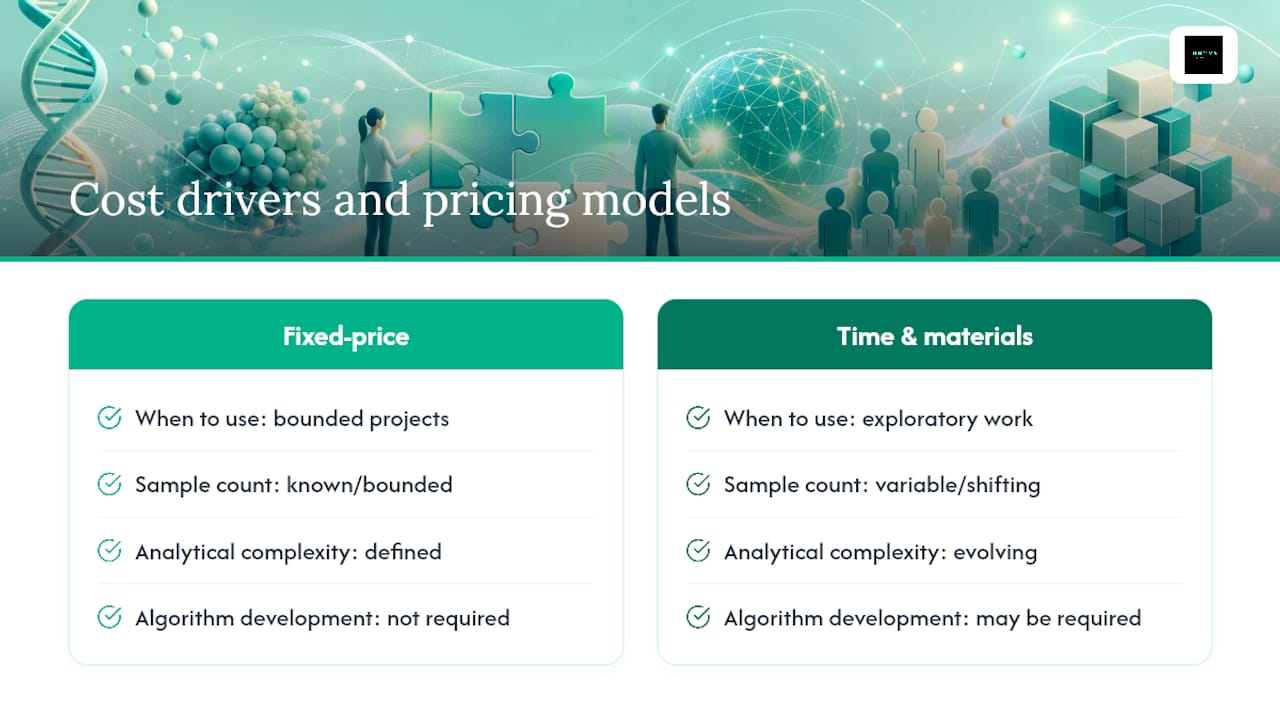
Three pricing shapes dominate the market. Fixed-price works for well-defined, bounded analyses, like running a validated variant-calling pipeline on a known sample set. Time and materials fits exploratory or open-ended work where the scope may shift, such as de novo peptide design with multiple design rounds. Milestone-based retainers suit ongoing relationships spanning several related projects across a quarter or year.
Cost drivers worth naming explicitly in your request for proposal:
- Sample count and sequencing read depth
- Analytical complexity, especially multi-omics integration or single-cell resolution work
- Whether the project requires new algorithm development versus applying established methods
- Regulatory documentation requirements, which add real time even when the science is straightforward
Timelines vary widely by scope. Routine sample processing on established pipelines often runs one to two weeks. Custom pipeline development, particularly for novel modeling tasks like enzyme optimization, can run four to twelve weeks depending on validation depth. End-to-end projects with regulatory deliverables commonly stretch three to six months.
Always request a contingency line, written acceptance tests tied to specific outputs, and a change-control clause defining how scope shifts get priced.
What Data Security and IP Terms Should You Require?
Every outsourcing contract needs a signed NDA and an explicit IP assignment clause stating that all resulting intellectual property, including patent and publication rights, belongs to you, not the vendor. This isn't a negotiable extra; it's the baseline that protects everything downstream, including your ability to publish or file first.
Technical controls to verify before data ever leaves your hands:
- Encryption at rest and in transit
- Role-based access limiting who at the vendor can touch your data
- Audit logging showing who accessed what and when
- Secure compute environments, whether HPC clusters or cloud VPCs with defined network isolation
Documentation matters as much as security. Ask for QC logs and versioned records compatible with frameworks like BioCompute if the work feeds a regulatory submission down the line. If any dataset touches human subject samples, confirm the vendor's de-identification practices align with your IRB approval terms before a single file transfers.
A well-drafted contract typically pairs an NDA with a separate IP assignment clause, since NDAs protect confidentiality but don't automatically transfer ownership of derivative work products, an oversight that causes disputes more often than outright data breaches.
What Should a Proper Handover Include?
A clean handover means your team can pick up the work without calling the vendor back for basic questions.
- Artifacts to demand: container images, workflow definitions (Nextflow, CWL, or Galaxy-compatible), raw and processed data, a test dataset with expected results, and a README covering setup and known limitations.
- Acceptance tests to run: reproduce the key figures or tables from the final report, execute the pipeline against the provided test set, and review actual run logs, not summary claims.
- Knowledge transfer: a live training session, full documentation handover, and a defined support window, typically 30 days minimum, for post-delivery questions.
How Innova Approaches Outsourced Bioinformatics Engagements
Founded in 2024 in San Francisco, Innova Biotech Solutions built its process around the exact gaps outlined above: reproducible pipelines, named points of contact, and deliverables built for handover rather than black-box output. A typical engagement moves through consultation, a scoped milestone plan, an interim review, and a final delivery package that includes source code, QC documentation, and a live walkthrough. Transparency isn't a marketing line here; it's the deliverable structure itself.

Ready to Scope Your Bioinformatics Project?
If your team is weighing outsourcing against building in-house capacity, Innova Biotech Solutions offers something most generalist vendors can't: domain-specific teams built around drug discovery, protein engineering, and peptide design, not general-purpose data science stretched to fit biology.
Whether your project involves structure-based virtual screening, enzyme stability optimization, or de novo peptide design, the engagement follows the same safeguards this article laid out: signed NDAs, milestone deliverables, and reproducible pipelines your team owns outright. If your project centers on structural or computational protein work, the protein design services page outlines how that engagement typically runs. For projects requiring peptide-specific expertise, the peptide design and optimization services page covers scope and deliverables in more depth. Reach out with your project's current stage and timeline, and request a scoped proposal before committing budget.
Sources
- High-throughput data and computational demands (PMC article)
- GATK documentation and best-practice workflows
- Brandeis research guides: bioinformatics analysis resources
FAQ
What Does It Cost to Outsource a Bioinformatics Project?
Costs depend heavily on sample count, analytical complexity, and whether new algorithm development is required; fixed-price models suit bounded projects, while time-and-materials pricing fits exploratory work with shifting scope.
How Long Does a Typical Outsourced Bioinformatics Project Take?
Routine sample processing on established pipelines often takes one to two weeks, custom pipeline development can run four to twelve weeks, and end-to-end projects with regulatory deliverables commonly take three to six months.
What Should Be Included in a Bioinformatics Outsourcing Contract?
A solid contract includes a signed NDA, explicit IP assignment back to the client, defined acceptance criteria, milestone-based payments, and a post-delivery support window.
Is Freelance Bioinformatics Work a Good Fit for Regulated Projects?
Individual freelancers can work well for bounded, exploratory analyses, but regulated or publication-grade work generally needs a provider with documented QC processes, reproducible pipelines, and case studies in your specific domain, something Innova Biotech Solutions builds into every engagement.
How Do You Know if a Vendor Actually Understands Bioinformatics?
Ask for domain-specific publications or case studies, request a redacted sample deliverable, and confirm they can explain their tool choices, whether that's GATK for variant calling or Galaxy for workflow management, rather than defaulting to generic data science methods.