
The strongest peptide cyclization strategies pair generative backbone sampling conditioned on pocket geometry with explicit cyclization topology modeling, side-chain packing, physics-based all-atom optimization, and property-guided sampling. That five-stage sequence, not any single algorithm, is what separates a computational pipeline that ships synthesizable candidates from one that ships pretty structures nobody can make.
Method classes like APCyc, MuCO, AfCycDesign, and CyclicChamp each anchor a piece of that workflow, and understanding which piece each one owns is the fastest way to write a proposal a vendor can't fudge. Before you sign anything, require these four deliverables:
- An ensemble of low-energy conformations, not a single "best" structure
- Annotated cyclization and linkage rationales tied to pocket geometry
- Per-candidate predictions across binding, permeability, and stability
- Confidence metrics and explicit synthesis-readiness flags
Pro Tip: If a vendor proposal shows only one final structure per target, that's the single clearest sign the pipeline skipped ensemble sampling. Ask for the distribution, not the winner.
Key Takeaways
The most reliable path to a drug-like cyclic peptide combines pocket-aware generative sampling, explicit cyclization modeling, physics-based refinement, and joint multi-property optimization in one pipeline.
| Point | Details |
|---|---|
| Require hybrid pipelines | Demand a sequence of generative sampling, cyclization modeling, and physics refinement, not one isolated method. |
| Cyclization must follow pocket geometry | Linkage site and chemistry should be inferred from the target pocket, not applied as a fixed heuristic. |
| Optimize properties jointly | Binding, permeability, protease resistance, solubility, and stability need posterior guidance, not sequential filtering. |
| Insist on ensembles, not single structures | Ask for low-energy conformer distributions plus confidence metrics before accepting any candidate list. |
| Innovabiotech runs this exact workflow | Innovabiotech delivers target-aware, multi-stage cyclic peptide design with annotated synthesis-handoff packages. |
Table of Contents
- Computational Strategy Families: What They Are and When to Use Each
- Design Constraints and Property Trade-Offs You Must Require in Proposals
- How to Commission a Computational Cyclization Project
- Benchmark Datasets and Metrics for Evaluating Computational Cyclization Methods
- Common Pitfalls and Limitations in Current Computational Cyclization Approaches
- Integration With Experimental Validation Workflows
- Case Studies: Where In Silico Cyclization Design Has Worked
- Software Tools and Platforms Commonly Used for Cyclic Peptide Design
- What Actually Matters When You Cut Through the Method Papers
- Innova Biotech Solutions: What We Deliver for Cyclic Peptide Design
- Sources
- FAQ
Computational Strategy Families: What They Are and When to Use Each
Every peptide cyclization method on the market today falls into one of five families, and each one trades speed for a different kind of rigor. Knowing which family your target actually needs keeps you from paying for physics-grade validation on a project that only required fast triage, or the reverse.
- Multi-stage frameworks (MuCO-style). These decouple the problem into backbone generation, side-chain packing, and physics-aware refinement run in sequence. MuCO uses this separation to sample structural diversity efficiently before handing candidates to force-field relaxation, and it consistently outperforms end-to-end deterministic models on stability and secondary-structure recovery. Practitioner teams often use a hierarchical K×M sampling scheme, generating many backbone and side-chain combinations in parallel before the expensive physics stage narrows the field.
- Target-aware generative frameworks (APCyc). APCyc extends the residue vocabulary itself to encode which residues participate in cyclization and what linkage chemistry connects them. It trains property surrogates directly into the latent space, so sampling gets steered toward binding, permeability, and stability simultaneously through posterior guidance rather than filtered after the fact.
- Diffusion and composable-constraint methods. Tools like CP-Composer and CpSDE decompose cyclization into discrete geometric constraints (bond type, distance) and condition a diffusion model on those constraints. This matters most when you're working a target with sparse training data, since the constraint decomposition allows something close to zero-shot generation instead of requiring a large labeled set.
- AlphaFold2-based redesign and hallucination (AfCycDesign). By modifying AlphaFold2's positional encoding to represent cyclic topology, AfCycDesign redesigns or hallucinates peptides in the 7–13 residue range with confidence scores (pLDDT, PAE) that are fast to compute and, per Nature's validation study, have held up against X-ray crystallography with sub angstrom RMSD in several cases.
- Physics-first pipelines (Rosetta/GenKIC, CyclicChamp). When a target calls for heterochiral residues, noncanonical side chains, or macrocycles in the 15 to 24 residue range, generative models trained mostly on canonical peptides start to struggle. CyclicChamp converts the ring closure into an error function solved through layered simulated annealing and genetic algorithms, then validates candidates with microsecond-scale molecular dynamics.
No single family wins every project. The right question for a vendor isn't "which method do you use," it's "which combination, in what order, and why."
Design Constraints and Property Trade-Offs You Must Require in Proposals
A cyclic peptide that binds tightly but gets chewed up by serum proteases in minutes is not a drug candidate, it's a data point. Every proposal you evaluate needs to show that six properties are being optimized as one joint objective: binding affinity, membrane permeability, protease resistance, aqueous solubility, metabolic stability, and immunogenicity risk.
The mechanism that ties all of this together is pocket-adaptive cyclization. Linkage site and linkage chemistry should be inferred from the geometry of the binding pocket itself, not bolted on afterward through a fixed head-to-tail or side-chain-bridge heuristic. Recent reviews are blunt about this: treating cyclization as a design variable that's decoupled from pocket shape is the single most common flaw in older pipelines, and it shows up downstream as candidates that look great in isolation and fail the moment you dock them.
The technical mechanism worth asking about by name is posterior guidance, sometimes called property-guided generation. It steers the sampling process toward multiple objectives at once by embedding property surrogates into the model's latent space, rather than generating candidates blind and filtering afterward. If your statement of work doesn't specify this, you're likely getting sequential optimization dressed up as multi-objective work.
Require these outputs before accepting any deliverable:
- Ensembles of low-energy conformations per candidate, not one static structure
- Property score distributions across all six properties above, not a pass/fail flag
- Confidence and uncertainty metrics attached to every prediction
- A synthetic-feasibility flag reviewed against real coupling chemistry constraints
Pro Tip: Ask the vendor to show you what happens when binding and permeability objectives conflict for a specific candidate. A team that can walk you through that trade-off in real time understands multi-objective optimization; a team that can't is probably running it sequentially.
How to Commission a Computational Cyclization Project
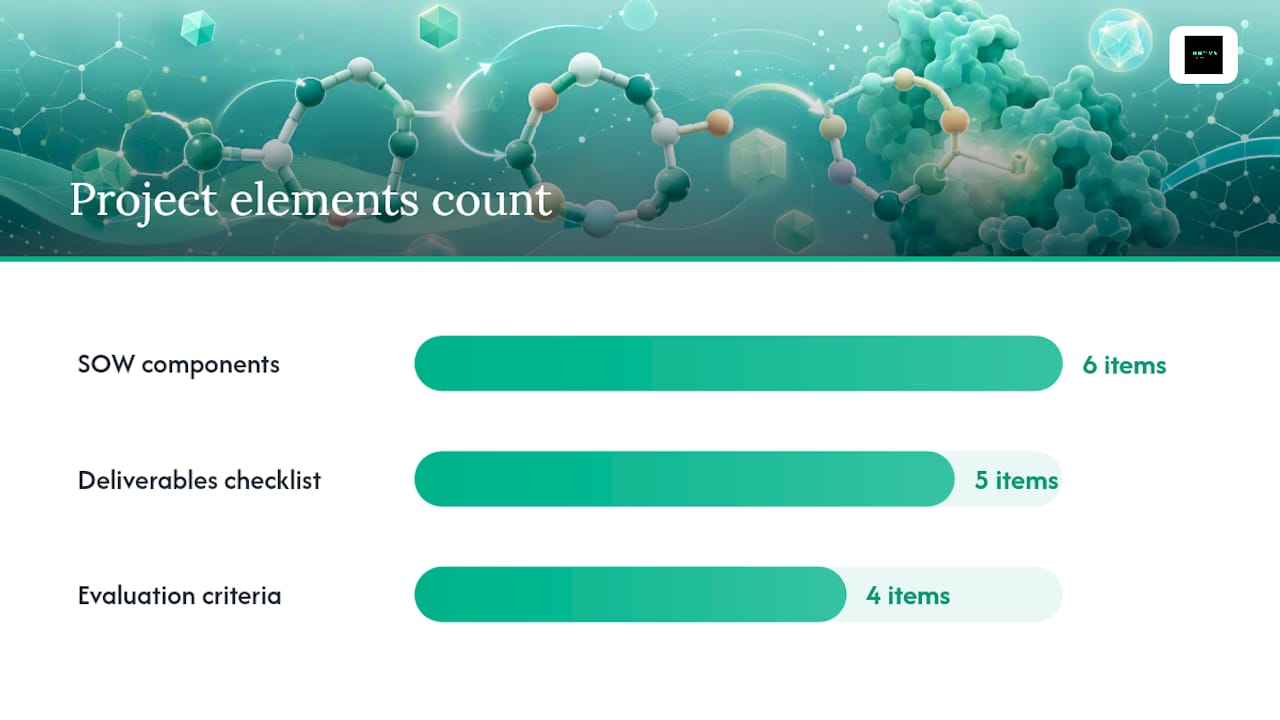
A statement of work for this kind of engagement needs six components spelled out before compute time starts: target structural data (crystal structure, cryo-EM map, or homology model), which cyclization strategies to explore, the property objectives ranked by priority, the number of prioritized candidates expected at handoff, the depth of molecular dynamics validation, and the format of synthesis handoff materials.
Your deliverables checklist should include:
- Coordinate ensembles for each prioritized candidate, not single conformers
- Annotated sequences with explicit linkage-site and linkage-type rationale
- Per-candidate property predictions with confidence scores attached
- Suggested synthetic routes or coupling-site notes flagged for feasibility
- An executable validation plan for the experimental team to run against
Timeline and cost scale with a few specific levers: sampling breadth (the K×M tree size mentioned earlier), how deep the physics refinement goes (single-point energy minimization versus multi-nanosecond MD), how many targets are in scope, and whether the vendor has access to parallel compute for the sampling stage. A project scoped for one target with shallow MD runs in days; ten targets with microsecond-scale replica-exchange validation runs in weeks.
When you sit down to evaluate proposals or interview a technical lead, score against four criteria: whether the cyclization rationale is genuinely target-adaptive rather than templated, whether the candidate set shows structural diversity and low-energy coverage rather than one dominant conformation, whether property trade-offs are balanced rather than optimized in sequence, and whether the handoff package is actually synthesis-ready.
Good interview questions expose the gaps fast: How do you infer cyclization sites from pocket geometry rather than defaulting to head-to-tail closure? Which force field and MD protocol do you run for refinement, Charmm36, Amber, something else? How do you quantify permeability predictions, and what's your confidence in that number for a novel scaffold? A team that answers with specifics, not platitudes, is the one worth your budget.
Benchmark Datasets and Metrics for Evaluating Computational Cyclization Methods
Vendors love to cite "state of the art" performance without saying against what. Ask specifically which benchmark set they validated on and which metrics they report, because the gap between methods often only shows up at that level of detail.
The metrics that actually separate strong pipelines from weak ones include structural diversity (how much conformational space the ensemble actually covers, not just how many structures it spits out), low-energy coverage (what fraction of sampled conformations fall within a reasonable energy window of the global minimum), secondary-structure recovery against known folds, and prediction confidence scores like pLDDT and PAE borrowed from the AlphaFold2 lineage. MuCO's validation work reports gains specifically on structural diversity and computational efficiency compared to end-to-end deterministic baselines, which is a useful reference point when a vendor claims their diffusion model is "better" without specifying better at what.
Cross-validation against experimentally solved structures matters more than any in-silico metric alone. AfCycDesign's designs have been checked against X-ray crystallography with sub angstrom RMSD in several published cases, and that kind of wet-lab confirmation is the gold standard a purely computational benchmark can't replace. If a vendor can't point to any experimental cross-validation of their method class, treat their confidence scores as provisional.
Common Pitfalls and Limitations in Current Computational Cyclization Approaches
The most expensive mistake in this space is accepting a single "best" structure instead of an ensemble with an energy distribution attached. A synthetic chemist needs to see the range of low-energy conformers and the sampling parameters behind them to pick a candidate that's actually robust to real-world flexibility, not just the one number a model happened to rank first.

A second recurring failure is treating cyclization chemistry as fixed rather than pocket-dependent. Pipelines trained mostly on canonical head-to-tail cyclic peptides tend to underperform on noncanonical or heterochiral chemistry, which is exactly where physics-first methods like CyclicChamp earn their keep. Data scarcity compounds this: many generative models are trained on datasets skewed toward smaller, well-characterized cyclic peptides, so predictions for larger macrocycles or unusual side-chain chemistry carry wider uncertainty than the confidence score alone suggests.
Sequential optimization masquerading as multi-objective work is a third trap. A model that optimizes binding affinity first and filters for permeability afterward will systematically miss candidates that trade a little of one for a lot of the other. Genuine joint optimization, the kind APCyc's posterior guidance is built for, catches those trade-offs during sampling instead of after.
Finally, computational confidence metrics like pLDDT are a proxy for structural certainty, not a guarantee of biological activity. Treat every predicted structure as a hypothesis until it's checked against orthogonal data.
Integration With Experimental Validation Workflows
Computational cyclization work only pays off when it hands cleanly to a bench team, and that handoff is where a lot of otherwise strong projects stall. The design package needs to arrive with enough detail that a synthesis chemist doesn't have to reverse-engineer the model's reasoning, annotated linkage rationale, suggested coupling sites, and a ranked candidate list with confidence scores attached to each property prediction.
Automated synthesis platforms paired with machine-learning feasibility predictors are increasingly part of this bridge. Integrated platforms combining ML prediction with automated synthesis can screen cyclization feasibility faster than manual bench work alone, which shortens the loop between a computational candidate list and a confirmed synthesizable set. That said, these platforms accelerate feasibility screening, they don't substitute for the design-stage rationale that explains why a given linkage was chosen in the first place.
For downstream biochemical characterization, teams often need reagents and assay kits lined up before candidates arrive, and partners like ABMIUM supply the antibodies and ELISA kits that experimental validation depends on once cyclic candidates reach the bench. Building that reagent sourcing into your timeline early, rather than after computational deliverables land, avoids a validation bottleneck that has nothing to do with the quality of the design work itself.
Case Studies: Where In Silico Cyclization Design Has Worked
The clearest published proof point for AF2-based redesign comes from AfCycDesign's own validation work: designs in the 7 to 13 residue range, generated through cyclic relative positional encoding, were solved by X-ray crystallography with structures matching the computational models within about 1.0 angstrom RMSD. That's a rare case where a purely in-silico design pipeline produced a structure that held up essentially unchanged once crystallized.
On the physics-first side, CyclicChamp's validation pushed into larger macrocycle territory, sampling backbones up to 24 residues and confirming candidate stability with microsecond-scale molecular dynamics and replica-exchange simulations. That's the size range where most generative models, trained mostly on smaller cyclic peptides, start to lose reliability, which makes the physics-based route the more defensible choice for larger or chemically unusual targets.
MuCO's benchmarking, meanwhile, demonstrates the practical value of decoupling the pipeline into stages, showing measurable gains in conformational diversity and computational efficiency over end-to-end deterministic baselines. Read together, these three results make a specific point: the "best" method genuinely depends on peptide size, chemistry, and how much experimental cross-validation the project can afford. A commissioning team that picks one method family and applies it universally is leaving performance on the table in at least one of those dimensions.
Software Tools and Platforms Commonly Used for Cyclic Peptide Design
The tooling landscape for this work splits cleanly into published method classes and the infrastructure that surrounds them. On the generative side, APCyc and MuCO represent the current published state of target-aware and multi-stage frameworks respectively, both released as peer-reviewed methods with accompanying preprints. AfCycDesign extends the AlphaFold2 codebase with cyclic positional encoding, making it accessible to any team already running AF2-based structure prediction infrastructure.
On the physics side, CyclicChamp, Rosetta with GenKIC extensions, and molecular dynamics engines running Charmm36 or Amber force fields handle the refinement and validation stage. Most serious practitioner teams don't pick one tool and stop there. Combining ML generative sampling with physics-based refinement is common precisely because each approach covers the other's blind spot: generative models sample diversity fast but can drift from physical realism, while physics engines refine accurately but sample slowly on their own.
For constraint-driven or data-scarce scenarios, diffusion-based tools like CP-Composer and CpSDE round out the toolkit by allowing zero-shot or constrained generation when a target lacks the training data a fully generative model needs. If you're evaluating a vendor's technical stack, the honest answer to "which tool do you use" should almost never be one name. It should be a sequence, with a stated reason for each stage.
What Actually Matters When You Cut Through the Method Papers
Most of what gets published in this field reads like a methods bake-off: which generative model samples more diverse backbones, which physics engine converges faster. That's useful for researchers building the next model. It's close to useless for an R&D team trying to decide who gets the contract.
The judgment this research actually supports is narrower and more practical: the pipeline architecture matters more than any single algorithm's benchmark score. A vendor running APCyc alone without physics refinement, or Rosetta alone without generative sampling breadth, is giving you half a solution dressed up as a complete one. The teams producing genuinely synthesis-ready candidates are the ones stitching multiple method classes together in a deliberate sequence, and treating cyclization chemistry as something inferred from the target, not chosen from a menu.
Where conventional advice falls short is in treating "which algorithm" as the decision that matters. It's not. The decision that matters is whether your vendor can defend, in plain language, why they chose a particular linkage site for your specific pocket. If a project has a budget for exactly one thing, put it toward ensemble sampling depth over algorithm sophistication. A shallow ensemble from a brilliant model beats a deep ensemble from a mediocre one far less often than people assume.
Innova Biotech Solutions: What We Deliver for Cyclic Peptide Design
Innovabiotech runs the exact hybrid pipeline this guide describes as the standard to require, not as an upsell. Our de novo peptide design work combines target-aware generative sampling, explicit cyclization topology modeling, and physics-based refinement so you get an ensemble of candidates with annotated linkage rationale, not a single structure and a hope.

A typical engagement starts with a consultation where we review your target structure and discuss which cyclization strategies fit the pocket geometry, followed by a confirmed statement of work covering property objectives and candidate count. From there, our team runs multi-stage modeling and property-guided sampling, then delivers coordinate ensembles, annotated designs, and synthesis-handoff materials your chemistry team can act on directly, with optional coordination for experimental validation if you need it. Related protein engineering and chimeric modeling support is available for projects that extend beyond peptide scaffolds alone, and background on why cyclic peptides outperform linear ones as drug candidates is worth a read if you're still building the internal case for this approach.
What you get working with us is a dedicated team that communicates clearly at every stage, keeps your target data confidential, and matches deliverable timing to your R&D milestones rather than a generic delivery schedule. If you have a target ready, start a peptide design consultation and bring your structural data, we'll scope the cyclization strategy from there.
Sources
- APCyc: Property-Informed Design of Cyclic Peptides via Automated Cyclization
- Cyclic peptide structure prediction and design using AlphaFold2
- Heuristic energy-based cyclic peptide design | PLOS Computational Biology
- Review: AI-driven strategies for cyclic peptide discovery
FAQ
What Is the Best Computational Strategy for Peptide Cyclization?
There's no single best method. The strongest results come from combining target-aware generative sampling (like APCyc) with multi-stage physics refinement (like MuCO or CyclicChamp) rather than relying on one algorithm alone.
How Long Does a Computational Cyclization Project Typically Take?
Timelines depend on sampling breadth, molecular dynamics depth, and the number of targets in scope, ranging from days for a single shallow-MD target to several weeks for multiple targets validated with microsecond-scale simulations.
What Deliverables Should I Require From a Cyclization Vendor?
Insist on ensembles of low-energy conformations, annotated linkage rationale, per-candidate property predictions with confidence scores, and synthesis-readiness flags, never a single unexplained structure.
Can Computational Methods Handle Noncanonical or Heterochiral Peptides?
Physics-first pipelines like CyclicChamp are generally more reliable for noncanonical residues and heterochiral chemistry than generative models trained mostly on canonical peptide data.
Does Innovabiotech Handle Both Design and Synthesis Handoff?
Innovabiotech delivers full design packages, coordinate ensembles, annotated designs, and synthesis-handoff materials, and can coordinate optional experimental validation support for teams that need it.