

TL;DR:
- Cyclic peptides are covalently closed polypeptides that offer better binding, stability, and target specificity than linear peptides. They resist enzymatic breakdown and enable oral delivery by combining structural rigidity with chemical modifications. These molecules are proven drugs across various diseases and are transforming how drug targets, especially large protein interfaces, are approached.
Cyclic peptides are defined as polypeptides with a covalently closed ring structure that delivers superior binding affinity, metabolic stability, and target specificity compared to linear peptides. Understanding what is cyclic peptide advantage matters because these molecules occupy a molecular weight range of approximately 500–3,000 Da, placing them squarely between small molecules and biologics. That position gives them the cell-penetrating potential of small molecules and the selectivity of antibodies. Over 40 cyclic peptides have already been approved as clinical therapeutics across infectious diseases, metabolic disorders, and autoimmune conditions, confirming that these molecules are not a theoretical promise. They are a proven drug class with expanding applications in protein engineering and targeted drug delivery.
What is cyclic peptide advantage in binding affinity and specificity?
Cyclic peptides achieve superior binding affinity through a thermodynamic mechanism that linear peptides cannot replicate. When a linear peptide binds a target protein, it loses conformational freedom and pays a significant entropy penalty. A cyclic peptide arrives at the binding site already constrained, so the entropy term in Gibbs free energy upon binding is reduced. That reduction translates directly into tighter binding and greater receptor selectivity.

Conformational rigidity also limits off-target interactions. A linear peptide can adopt multiple conformations, some of which fit unintended receptors. A cyclic peptide presents a fixed interaction surface, so the probability of engaging the wrong target drops substantially. This is why structural rigidity is consistently cited as the primary driver of reduced off-target effects in cyclic peptide drug candidates.
Protein-protein interactions (PPIs) are a particularly important application. PPIs involve large, flat binding interfaces that small molecules cannot cover and that flexible linear peptides cannot engage with enough force. Cyclic peptides lock into conformations that match these interfaces, making them effective modulators of targets previously considered inaccessible. Computational peptide screening methods now allow researchers to model these binding conformations before synthesis, reducing costly trial-and-error cycles.
Key factors that determine binding quality in cyclic peptides:
- Cyclization chemistry: head-to-tail amide bonds, disulfide bridges, and side-chain lactam formation each produce distinct conformational profiles.
- Ring size: smaller rings increase rigidity; larger rings allow more flexibility and can accommodate extended binding surfaces.
- Residue composition: incorporation of D-amino acids or N-methylated residues fine-tunes the binding geometry and protease resistance simultaneously.
- Solvent exposure: surface-exposed polar residues affect both target engagement and aqueous solubility.
Pro Tip: When designing a cyclic peptide for a PPI target, model the bound conformation of the linear precursor first. The cyclic version should pre-organize the residues that make direct contact with the protein surface, not simply close the termini.
How does cyclization improve metabolic stability and bioavailability?
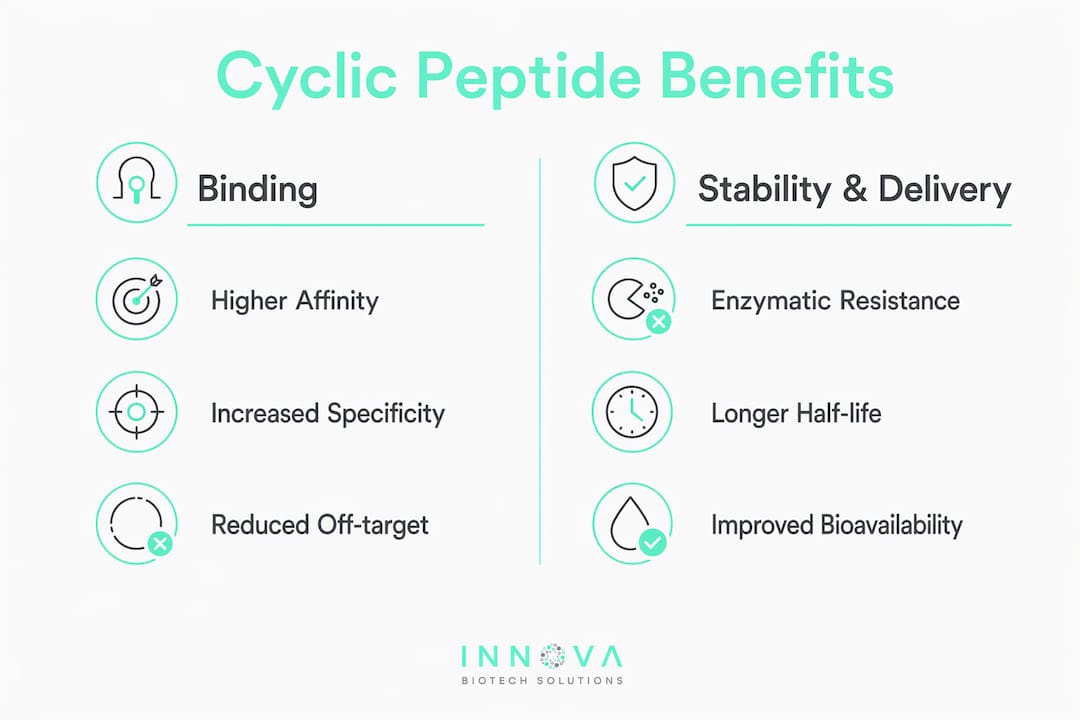
The absence of free amino and carboxyl termini is the structural reason cyclic peptides resist enzymatic degradation. Exopeptidases, which degrade linear peptides from their ends, have no entry point on a closed ring. This single structural fact extends cellular half-life substantially and reduces the dosing frequency required to maintain therapeutic plasma concentrations.
Extended half-life has direct clinical implications. Linear peptide drugs often require continuous infusion or frequent injection because they degrade within minutes in plasma. Cyclic peptides with improved metabolic stability can survive long enough to reach intracellular targets, opening therapeutic windows that injectable linear peptides cannot access.
Oral bioavailability is the frontier where cyclic peptides are making the most progress. The rigid cyclic architecture reduces the conformational flexibility that normally prevents peptides from crossing intestinal membranes. Oral delivery is now a growing trend in cyclic peptide therapeutics, supported by structural rigidity, metabolic stability, and chemical optimizations that mask polarity and improve membrane permeability.
| Property | Linear peptides | Cyclic peptides |
|---|---|---|
| Exopeptidase resistance | Low (exposed termini) | High (no free termini) |
| Plasma half-life | Short, often minutes | Extended, hours to days |
| Oral bioavailability | Generally poor | Achievable with modification |
| Conformational flexibility | High | Low to moderate |
| Binding selectivity | Variable | High due to fixed conformation |
Pro Tip: Cyclization alone rarely achieves oral bioavailability. Pair it with N-methylation of backbone amides or incorporation of unnatural amino acids to mask hydrogen bond donors and improve passive membrane permeability.
What are the key applications and uses of cyclic peptides in drug development?
The benefits of cyclic peptides translate into a wide range of clinical and research applications. The approved therapeutic catalog already spans multiple disease areas, and the pipeline is expanding rapidly as design tools improve.
-
Infectious diseases. Cyclic peptide antibiotics like vancomycin and polymyxins have been in clinical use for decades. Their cyclic structure enables them to disrupt bacterial cell walls or membranes with high specificity, and their resistance to degradation extends their activity in complex biological environments.
-
Autoimmune and inflammatory conditions. Cyclosporin A, a cyclic peptide immunosuppressant, remains a standard of care in organ transplantation. Its oral bioavailability, achieved through N-methylation and a lipophilic ring structure, demonstrated early that cyclic peptides could be orally dosed at therapeutic levels.
-
Metabolic disorders. Cyclic peptide analogs of somatostatin, such as octreotide, are used to manage acromegaly and neuroendocrine tumors. These analogs retain the bioactive conformation of the native hormone while resisting rapid degradation.
-
Intracellular protein-protein interactions. Cyclic peptides enable targeting of previously undruggable intracellular PPIs by locking into binding conformations inaccessible to small molecules. This is one of the most active areas of current drug discovery research.
-
Peptide-drug conjugates (PDCs). Cyclic peptides serve as modular scaffolds for PDCs, allowing targeted delivery of cytotoxic payloads with improved therapeutic indices compared to systemic administration. This application mirrors the logic of antibody-drug conjugates but at a fraction of the molecular weight.
-
Molecular probes and tool compounds. Researchers use cyclic peptides as conformationally defined probes to map binding sites on target proteins. Their fixed geometry makes them ideal for structure-activity relationship studies where conformational ambiguity would obscure the data.
The de novo peptide design approach is increasingly central to these applications. Rather than cyclizing an existing linear lead, researchers now build cyclic scaffolds from scratch around the target binding site geometry, producing candidates with better starting affinity and fewer optimization cycles.
What design considerations and challenges affect cyclic peptide performance?
Cyclization strategy is not a single choice. It is a set of decisions that collectively determine whether a cyclic peptide will bind its target, remain soluble, and survive in vivo. Choosing the wrong method can reduce affinity or create aggregation problems that disqualify a candidate before it reaches in vivo testing.
The three primary cyclization approaches each carry distinct tradeoffs:
| Cyclization method | Structural outcome | Key advantage | Key risk |
|---|---|---|---|
| Head-to-tail (lactam) | Fully closed backbone ring | Maximum rigidity, no free termini | May restrict binding orientation |
| Side-chain lactam | Backbone remains open; ring via side chains | Preserves N/C terminus for modification | Less conformational constraint |
| Disulfide bridge | Oxidative bond between cysteine residues | Reversible, compatible with native chemistry | Redox-sensitive, unstable intracellularly |
| Stapled peptide | Hydrocarbon bridge via unnatural amino acids | Cell-penetrating, alpha-helix stabilizing | Synthetic complexity, cost |
Moving from a linear lead to a cyclic candidate requires de novo design in most cases. The fixed conformation of a cyclic peptide may prevent it from adopting the same binding orientation as its linear precursor. Researchers who simply close the termini of a validated linear peptide often find that affinity drops rather than improves. The binding motif must be redesigned around the geometry that the cyclic scaffold imposes.
Solubility is a second major challenge. Cyclization reduces the number of solvent-exposed polar groups, which improves membrane permeability but can also reduce aqueous solubility to the point where formulation becomes difficult. Balancing these two properties requires iterative synthesis and testing, and bioinformatics peptide optimization tools now allow researchers to model solubility and permeability trade-offs computationally before committing to synthesis.
Chemical modifications such as N-methylation and unnatural amino acid incorporation are often required alongside cyclization to achieve the desired oral bioavailability and membrane permeability. These modifications must be introduced with care because they also affect binding geometry and metabolic fate. The stapled peptide design approach addresses some of these challenges by using hydrocarbon bridges that simultaneously constrain conformation and improve cell penetration.
Key Takeaways
Cyclic peptides outperform linear peptides in binding affinity, metabolic stability, and therapeutic reach because their closed ring structure pre-organizes the binding conformation, eliminates exopeptidase entry points, and enables chemical modifications that linear peptides cannot accommodate.
| Point | Details |
|---|---|
| Binding affinity advantage | Conformational rigidity reduces the entropy penalty upon target binding, improving selectivity. |
| Metabolic stability | No free termini means exopeptidases cannot degrade cyclic peptides, extending half-life significantly. |
| Oral bioavailability | Cyclization combined with N-methylation or unnatural amino acids enables oral dosing in select candidates. |
| Design requires de novo work | Closing a linear peptide's termini rarely preserves affinity; redesign around cyclic geometry is required. |
| Broad therapeutic applications | Over 40 approved cyclic peptide drugs span infectious diseases, autoimmune conditions, and metabolic disorders. |
Why cyclic peptides are redefining what is druggable
The most important shift I have seen in peptide drug discovery is the move away from treating cyclic peptides as modified linear peptides and toward treating them as a distinct molecular class with their own design logic. That shift changes everything about how you approach a target.
For years, the field focused on targets that small molecules could address. Cyclic peptides open a different category: large, flat, protein-protein interaction surfaces that have no obvious small-molecule binding pocket. The ability to lock a peptide into a conformation that covers those surfaces is not an incremental improvement. It is access to a target class that was genuinely off-limits before.
The practical challenge I keep returning to is the gap between computational prediction and synthetic reality. Modeling tools have improved dramatically, and peptide library screening platforms can now evaluate thousands of cyclic variants in parallel. But the translation from a predicted binding pose to a synthesized molecule that behaves the same way in a cell is still not guaranteed. Solubility surprises, unexpected metabolic liabilities, and conformation shifts in the cellular environment remain real obstacles.
The researchers who succeed fastest are those who integrate computational design with rapid synthetic iteration from the start, rather than treating computation and synthesis as sequential phases. The field is moving toward multifunctional cyclic peptide platforms, and that trajectory rewards teams who can close the design-synthesize-test loop quickly.
— Hooman
Innovabiotech's approach to cyclic peptide design and optimization
Researchers working on cyclic peptide candidates need more than synthesis capacity. They need computational validation, binding prediction, and pharmacokinetic modeling integrated into the design workflow from the first iteration.

Innovabiotech provides custom peptide design services that combine bioinformatics validation, de novo scaffold design, and hit-to-lead optimization for cyclic peptide projects. The team works across the full development arc, from target analysis and cyclization strategy selection through computational screening and candidate prioritization. For researchers who need to connect peptide design to broader protein engineering goals, Innovabiotech also offers protein engineering services that support intracellular target modulation and PPI-focused programs. Every project is handled with direct scientific communication and full transparency at each stage.
FAQ
What are cyclic peptides in drug discovery?
Cyclic peptides are polypeptides with a covalently closed ring structure that provides conformational rigidity, resistance to enzymatic degradation, and improved binding selectivity compared to linear peptides. Over 40 have been approved as clinical therapeutics across multiple disease areas.
Why do cyclic peptides bind targets more tightly than linear peptides?
Cyclic peptides reduce the entropy penalty in Gibbs free energy upon binding by arriving at the target site already conformationally constrained. This pre-organization improves binding affinity and receptor selectivity without requiring the peptide to sacrifice flexibility at the moment of binding.
Can cyclic peptides be taken orally?
Oral delivery is achievable for cyclic peptides when cyclization is combined with chemical modifications such as N-methylation or unnatural amino acid incorporation, which mask polarity and improve passive membrane permeability. Cyclosporin A is the established clinical example of an orally bioavailable cyclic peptide.
What is the difference between head-to-tail and side-chain cyclization?
Head-to-tail cyclization forms a lactam bond between the N and C termini, creating a fully closed backbone ring with maximum rigidity. Side-chain cyclization connects two residue side chains, leaving the backbone termini free for further modification and providing less conformational constraint.
Why can't you simply cyclize an existing linear peptide lead?
The fixed conformation imposed by cyclization often prevents the peptide from adopting the same binding orientation as its linear precursor, so affinity typically drops rather than improves. Effective cyclic peptide design requires rebuilding the binding motif around the geometry that the chosen cyclization strategy creates.