
Peptidomimetic design converts a bioactive peptide's minimal active sequence into a drug-like scaffold that keeps the pharmacophore's geometry while gaining metabolic stability and cell permeability. The core workflow runs in three passes: define the minimal active sequence or pharmacophore, apply chemical and conformational constraints to that scaffold, and optimize the resulting candidate for developability. Everything below breaks each pass into the tools, trade-offs, and failure points that decide whether a program ships a lead or stalls in synthesis.
TL;DR:
- Local chemical modifications, such as isosteres and backbone edits, can significantly increase peptide stability and permeability with minimal structural changes.
- Macrocyclization and secondary-structure mimetics better restrict conformational flexibility, especially for extended or shallow protein-protein interaction surfaces.
- Computational design tools, including generative models and geometric-fitting approaches, accelerate scaffold generation but require structural validation and feasibility filtering.
- Early incorporation of developability assessments, like protease stability, permeability, and synthesis step count, reduces late-stage failure rates and saves time.
- Matching the right strategy to the target geometry—local modifications for simple liabilities, macrocyclization for extended interfaces—is critical for successful peptidomimetic drug development.
Table of Contents
- Chemical Strategies for Peptidomimetic Design: Isosteres, Backbone Edits, and Peptoid Alternatives
- Locking In the Bioactive Shape: Stapling, Macrocyclization, and CLIPS
- Computational and Generative Design Platforms for Peptidomimetics
- Developability, ADME, and Synthesis Feasibility Checks
- Peptidomimetic Design in Practice: Protease Inhibitors, Cyclic Binders, and PPI Targets
- Common Pitfalls and a Working Checklist for Design Iteration
- Peptidomimetic Scaffold Archetypes: How to Classify a Design
- How to Measure Binding Affinity and Specificity in Peptidomimetic Candidates
- Improving Oral Bioavailability Beyond Standard Developability Screening
- Synthetic Advances for Complex Peptidomimetic Constructs
- The Practical Verdict on Peptidomimetic Design
- How Innovabiotech Supports Peptidomimetic Design Programs
- Sources
- FAQ
Chemical Strategies for Peptidomimetic Design: Isosteres, Backbone Edits, and Peptoid Alternatives
Local modification is where most peptidomimetic drug design programs start, and for good reason: it changes the least while fixing the most common liability, protease sensitivity. The amide bond that protease enzymes recognize and cleave is also the bond that carries most of a peptide's directional hydrogen-bonding information, so any replacement has to preserve geometry almost exactly or the whole pharmacophore drifts out of register.
The peptidomimetic toolbox described in Chemical Society Reviews organizes these local edits into a short list of well-characterized isosteres, each with a distinct trade-off profile:
- Thioamides swap the carbonyl oxygen for sulfur, blocking protease recognition while barely perturbing bond length or backbone angle.
- Hydroxyethylene isosteres remove the scissile carbonyl entirely, a tactic that made aspartic protease inhibitors like early HIV protease drugs viable.
- Triazole linkages, usually installed via copper-catalyzed click chemistry, mimic the trans-amide dipole and resist essentially all proteolytic enzymes.
- Alkene (E)-isosteres replace the amide with a non-hydrolyzable carbon-carbon double bond, useful when H-bond donation from the amide N-H is not critical to binding.
- Reduced amide (methyleneamino) bonds eliminate planarity and the H-bond acceptor at that position, sacrificing some binding energy for a large gain in protease resistance.
Beyond the backbone itself, side-chain and backbone-atom edits shift conformational preference without touching the amide. Alpha-alkylation, most commonly alpha-methylation, restricts the φ/ψ dihedral space a residue can sample, pre-organizing the peptide toward a bioactive turn or helix before it ever binds its target. N-methylation of the backbone nitrogen removes an H-bond donor and simultaneously biases the adjacent amide toward the cis configuration, a trick medicinal chemists exploit deliberately in cyclic peptide design when a cis turn is needed to close a ring efficiently. Both edits also reduce the number of H-bond donors exposed to the aqueous phase, which is one of the more reliable levers for improving passive membrane permeability in mid-sized peptides.
When local isosteres are not enough, researchers reach for peptoids and oligoureas: peptide replacements where the side chain moves from the alpha carbon to the backbone nitrogen (peptoids) or where the amide is replaced wholesale with a urea linkage (oligoureas). Peptoids lose the amide N-H entirely, which strips out most protease recognition motifs at the cost of losing that H-bond donor for target engagement. Oligoureas retain two H-bond donors per residue instead of one, often improving helix stability, though they add synthetic steps compared to standard solid-phase peptide coupling.
Pro Tip: Before committing to an exotic isostere, run a simple alanine or N-methyl scan across the sequence first. It is cheaper than custom monomer synthesis and tells you exactly which positions tolerate modification before you invest in a triazole or hydroxyethylene building block.
The payoff for getting this right is measurable. Ester-to-amide replacements and related local edits documented across the structural and conformational literature on peptide ligand design have repeatedly extended serum half-life in cases where the parent ester bond was the primary site of plasma esterase attack, sometimes by an order of magnitude, simply by removing the hydrolyzable linkage without altering the pharmacophore's spatial arrangement. That single-atom swap illustrates the entire philosophy of local modification: change as little as possible, in exactly the right place.
Locking In the Bioactive Shape: Stapling, Macrocyclization, and CLIPS
Local isosteres fix chemical liabilities, but they do not solve the conformational entropy problem. A linear peptide in solution samples thousands of conformations, and only one binds the target. Secondary-structure mimetics and macrocyclization exist to collapse that ensemble down to the bioactive shape before the molecule ever meets its receptor.
Stapled peptides address this directly for alpha-helical targets. A hydrocarbon or other covalent staple bridges two side chains, usually spaced at i, i+4 or i, i+7 positions, locking the helix in place and simultaneously shielding backbone amides from protease access. Hydrogen-bond surrogates take a related but distinct approach: instead of a side-chain staple, a covalent bond replaces one of the helix's own internal H-bonds, nucleating the turn from one end without adding bulk to the exterior face that contacts the target.
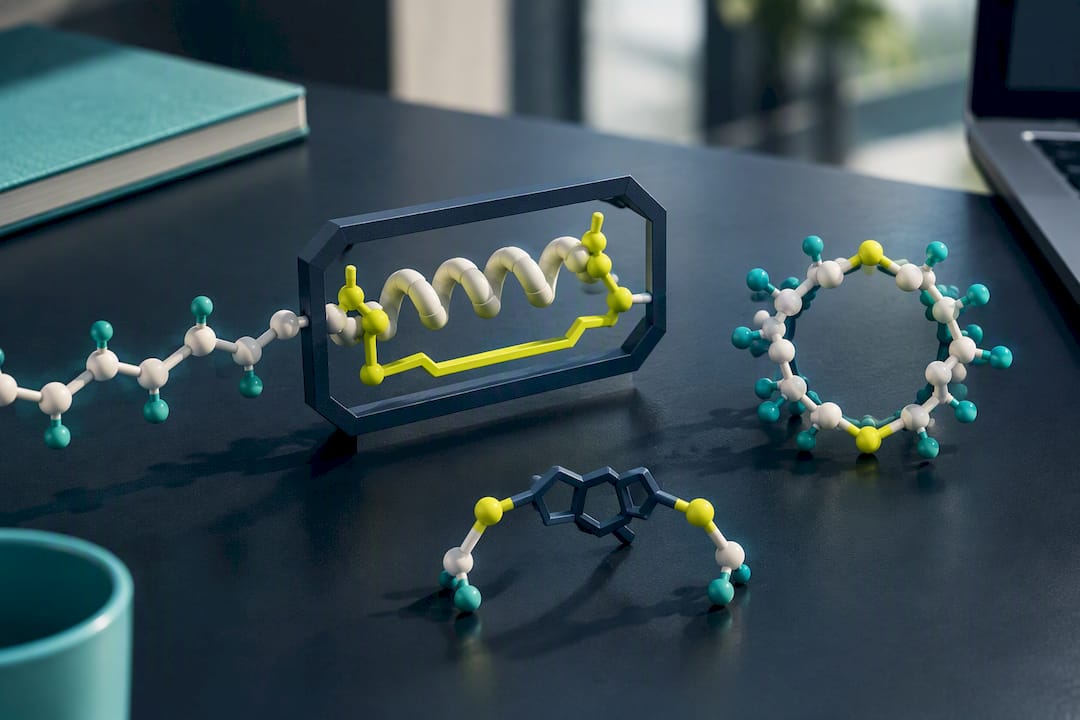
Macrocyclization works on a broader range of secondary structures, not just helices, and comes in several flavors. Head-to-tail cyclization joins the N- and C-termini directly, useful when neither terminus is needed for binding. Side-chain-to-side-chain or side-chain-to-terminus linkers offer more geometric flexibility and let designers choose ring size independently of sequence length. CLIPS (chemical linkage of peptides onto scaffolds) uses a synthetic scaffold to bridge two or three cysteine residues simultaneously, which is particularly useful for mimicking discontinuous epitopes that span loops rather than a single continuous face.
Ring size is not a cosmetic choice. Smaller macrocycles enforce tighter conformational restriction but can force unfavorable bond angles that destabilize the ring; larger macrocycles tolerate more sequence variation but sacrifice some of the entropy benefit that makes cyclization worthwhile in the first place. Cis versus trans amide geometry at the closure point matters just as much. A macrocycle that wants a cis amide but is built from residues that strongly favor trans will fight itself during synthesis, often showing up as a stubborn mixture of atropisomers on HPLC that never fully resolves. The macrocyclization and permeability literature makes clear that the linker chemistry chosen at this stage has an outsized effect on passive cell permeability, since it governs how many polar groups remain exposed on the molecule's surface versus tucked into intramolecular H-bonds.
Here is how the three major approaches stack up when you are choosing one for a new program:
- Head-to-tail cyclization is the simplest to synthesize with standard solid-phase methods, offers moderate stability gains, and permeability depends heavily on the resulting ring size and residue polarity.
- Side-chain linker macrocyclization (lactam, triazole, or thioether bridges) requires more synthetic planning but gives the most control over geometry, typically delivering strong protease resistance and permeability that scales with how many polar side chains stay exposed.
- CLIPS-based multi-point cyclization is the most synthetically demanding of the three, involving orthogonal protection and multi-step scaffold conjugation, but it is the only practical route for mimicking discontinuous, multi-loop epitopes and it delivers the largest stability gains for that target class.
Pro Tip: Run linker chemistry as a parallel screen, not a sequential one. Synthesize three or four candidate macrocycles with different linker lengths and chemistries side by side, then triage on a quick protease stability assay before committing resources to the most promising ring size. It saves weeks compared to optimizing one linker at a time.
Computational and Generative Design Platforms for Peptidomimetics
Rational chemistry gets you a defensible starting scaffold. Computational platforms now let you sample far more sequence and conformational space than a bench chemist could screen manually, and the field has split into three practical tool classes worth knowing apart.
Diffusion-based generative models, following the architecture popularized by RFDiffusion-style approaches, learn to denoise random coordinates into plausible protein and peptide backbones. Applied to peptidomimetic design, these models can propose entire macrocyclic scaffolds and slot in nonstandard residues without being told in advance what the binding site looks like. Recent computational design benchmarks report structural accuracy under 1.5 Å Cα RMSD against experimentally solved structures for de novo macrocyclic binders, a level of geometric fidelity that would have required extensive manual template-based modeling only a few years ago. Tools like PepINVENT push further into non-natural amino acid space, filling masked positions in a peptide sequence with novel residues chosen to satisfy multiple objectives at once, plasma stability and membrane permeability among them, rather than optimizing one property at a time.
Optimization-in-the-loop frameworks take a different philosophy. The Key-Cutting Machine (KCM) approach, described in Nature Machine Intelligence, treats design as an iterative geometric-fitting problem rather than a generative sampling problem. It matches candidate backbones against explicit geometric constraints derived from the target site, refining the fit step by step. Because it does not require retraining a large generative model for each new target class, KCM-style optimization tends to be cheaper computationally and easier to constrain toward synthesizable, backbone-accurate designs, an advantage when a generative model keeps proposing geometries that look elegant on screen but cannot actually be made in a flask.
Sequence-only pipelines fill a third niche. Methods like PepPrCLIP and EvoBind2 design binders directly from target sequence information, without requiring a solved structure or a known binding pocket as input. Related sequence-based binder design work reports that both linear and cyclic peptide binders generated this way can reach nanomolar affinities against protein targets in experimental validation, useful when a crystal structure or cryo-EM map simply is not available yet.
None of these tool classes works well in isolation. A practical hybrid pipeline looks like this:
- Generate candidate sequences and backbones with a diffusion model or sequence-only pipeline.
- Filter structurally with AlphaFold or ESMFold to confirm the predicted fold matches the intended pharmacophore geometry.
- Screen for synthesis feasibility, flagging non-standard residues or ring closures that would blow up step count.
- Triage the survivors on the bench with binding and stability assays before committing to full characterization.
That structural filtering step matters more than teams expect. Generative models can propose designs that look geometrically clean but are synthetically impractical or chemically unstable, which is exactly why optimization-based methods that impose explicit feasibility constraints upfront tend to waste less bench time downstream.
Developability, ADME, and Synthesis Feasibility Checks
A binder with excellent affinity is worthless as a drug candidate if it falls apart in plasma or never crosses a cell membrane. Developability screening exists to catch that failure mode before it consumes months of synthesis time.
The core assay panel most programs run includes:
- Protease stability panels (trypsin, chymotrypsin, and matrix-matched plasma proteases) to flag cleavage-prone bonds early, ideally before macrocyclization locks in a vulnerable sequence.
- Plasma stability assays, run at physiological temperature over multiple hours, to catch esterase or amidase liabilities that protease panels alone will miss.
- Permeability assays such as PAMPA for a quick artificial-membrane read or Caco-2 monolayers for a cell-based estimate closer to intestinal absorption behavior.
- Binding assays like SPR or ITC to confirm affinity and, critically, binding kinetics, since a fast off-rate can undermine a compound that looks strong on equilibrium Kd alone.
The structural and conformational design literature reinforces a pattern that shows up across programs: small, targeted changes tend to outperform sweeping redesigns. An ester-to-amide swap at a single vulnerable position, or one N-methylation that blocks a specific protease recognition site, often delivers most of the stability gain a program needs. Chasing that gain through an aggressive backbone overhaul instead usually costs more synthesis time and frequently degrades binding affinity in the process.
Synthesis feasibility deserves its own line item in early screening, not a review after the fact. Step count matters directly, since each additional coupling or protection step compounds yield loss, and macrocyclization in particular is notorious for yield collapse when ring strain fights the intended closure geometry. Running linker chemistries in parallel, as covered in the macrocyclization section above, is one practical fix. Building synthesis feasibility scoring directly into the in silico filtering stage, before a single gram of resin is used, is the other.
Pro Tip: Add a synthetic feasibility score, even a rough one based on step count and known problematic couplings, as an explicit filter in your computational pipeline. It costs almost nothing to calculate and it will quietly kill a large share of designs that would otherwise waste weeks in the lab.
Peptidomimetic Design in Practice: Protease Inhibitors, Cyclic Binders, and PPI Targets
The strategies above are not abstractions. Marketed and late-stage peptidomimetic drugs map cleanly onto the design choices already discussed, and the pattern of which strategy fits which target is worth internalizing.
- Aspartic protease inhibitors built on hydroxyethylene or related non-hydrolyzable isosteres remain the textbook case for local modification succeeding where a natural peptide substrate would be instantly cleaved.
- Macrocyclic PPI inhibitors targeting extended, shallow protein-protein interfaces consistently favor cyclization over local isosteres alone, since these interfaces need conformational restriction across a longer stretch of sequence than a single bond replacement can address.
- Cyclic peptide binders designed computationally against protein targets have reached nanomolar affinities in experimental validation studies, confirming that macrocyclization's protease-resistance and selectivity benefits translate from rational design into de novo computational pipelines as well.
- Helix-mimetic stapled peptides targeting protein-protein interfaces with a defined helical binding partner show how secondary-structure mimetics outperform simple linear analogs when the bioactive conformation is already known from a crystal structure.
The lesson that recurs across these examples is a matching problem, not a hierarchy. Local isosteres win when the liability is a single hydrolyzable bond and the pharmacophore is otherwise well-defined. Macrocyclization wins when the target interface is extended, shallow, or discontinuous, the kind of surface reviews on undruggable targets describe as sitting in the gap between what small molecules and biologics can each reach on their own. Picking the wrong strategy for the target geometry is a more common failure than picking the wrong specific isostere.
Common Pitfalls and a Working Checklist for Design Iteration
The single most frequent failure mode in peptidomimetic programs is not a bad isostere choice. It is losing pharmacophore geometry during overly aggressive backbone modification, stacking staples, N-methylations, and ring closures onto one scaffold until the molecule no longer projects its binding elements the way the parent peptide did. A minimalist approach, changing the fewest atoms necessary to fix a specific liability, tends to reach a viable lead faster than a maximalist redesign, even when the maximalist version looks more impressive on paper.
A second recurring pitfall is treating synthesis feasibility as an afterthought rather than a design constraint, which is how teams end up with computationally elegant macrocycles that yield in single-digit percentages after three rounds of optimization. A third is running a weak assay cascade, testing binding affinity in isolation without protease stability or permeability data early enough to catch a fatal liability before it is baked into a dozen analogs.
Cross-functional input early cuts down on all three. Medicinal chemists flag synthetic red flags before a design ships to the bench; structural biologists confirm the modeled geometry against any available crystallographic or cryo-EM data; in vitro PK scientists weigh in on assay design before the first analog is even synthesized, not after.
A workable iteration checklist runs in this order:
- Define the target and confirm a validated minimal active sequence or known binding epitope.
- Establish the pharmacophore, the specific side chains, backbone atoms, and spatial geometry required for activity.
- Run in silico design, whether rational isostere selection, macrocyclization planning, or a generative/optimization pipeline, filtered against synthetic feasibility.
- Synthesize a focused analog set, prioritizing parallel screens over one-at-a-time optimization.
- Run biophysical characterization (SPR, ITC, or equivalent) to confirm binding mode and affinity.
- Run the ADME and stability cascade (protease panels, plasma stability, permeability assays) before advancing any candidate further.
Pro Tip: Set a hard rule that no analog advances past step 4 without at least one stability assay result in hand. Teams that defer stability testing until "later" almost always end up re-synthesizing their best binder anyway once the liability surfaces.
Peptidomimetic Scaffold Archetypes: How to Classify a Design
Peptidomimetic scaffolds fall into a handful of recognizable archetypes, and naming the archetype early clarifies which optimization tools actually apply. Type I mimetics keep the peptide backbone largely intact and modify side chains or individual bonds, essentially the local-isostere strategy. Type II mimetics replace the backbone itself while keeping side-chain topology, as peptoids and oligoureas do. Type III mimetics abandon the peptide backbone almost entirely, retaining only the spatial arrangement of pharmacophoric groups on a non-peptidic scaffold, closer to a small-molecule drug that happens to have originated from a peptide lead.
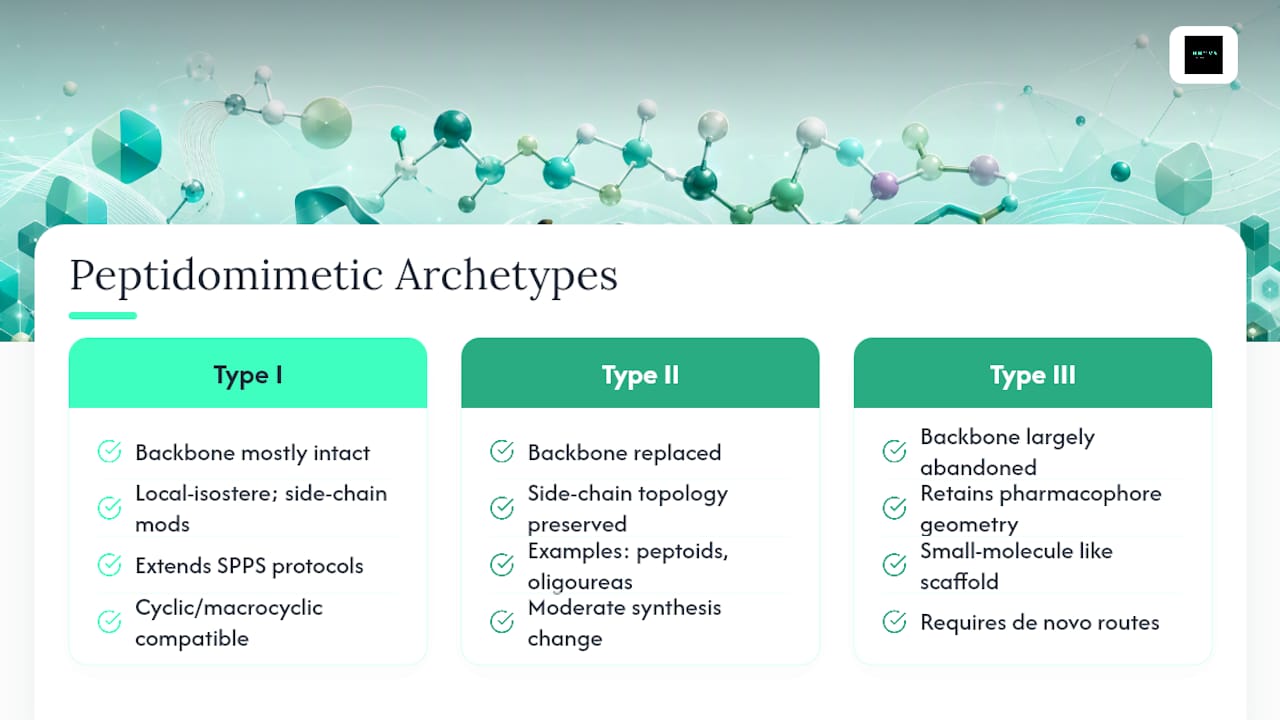
Cyclic and macrocyclic scaffolds cut across all three types rather than forming a separate category, since a macrocycle can be built from an otherwise Type I backbone or from a fully non-peptidic Type III scaffold. Classifying a design this way early in a program matters because it sets expectations for synthetic route complexity: Type I designs generally extend existing solid-phase peptide synthesis protocols, while Type III designs often require de novo synthetic route development closer to traditional small-molecule medicinal chemistry. Knowing which type you are building toward before finalizing a design saves a redundant conversation with the synthesis team later.
How to Measure Binding Affinity and Specificity in Peptidomimetic Candidates
Affinity and specificity are separate questions, and conflating them is a common analytical mistake. Affinity asks how tightly a molecule binds its intended target; specificity asks whether it binds meaningfully weaker, or not at all, to related off-targets.
Surface plasmon resonance (SPR) and isothermal titration calorimetry (ITC) remain the workhorse methods for affinity, each reporting equilibrium Kd but also, in SPR's case, kinetic on- and off-rates that a single Kd number can hide. A compound with a mediocre Kd but a very slow off-rate can outperform a tighter binder with fast dissociation in a cellular or in vivo context. Fluorescence polarization and biolayer interferometry serve as faster, lower-resource alternatives for early-stage triage, useful for ranking a larger analog set before committing SPR instrument time to the top candidates.
Specificity assessment requires a deliberate counter-panel, typically related family members or structurally similar proteins run through the same binding assay. Cell-based competition assays add a further specificity layer, confirming that binding observed in a purified biophysical assay actually translates to selective engagement in a more complex biological environment where off-target proteins are also present.
Improving Oral Bioavailability Beyond Standard Developability Screening
Passing PAMPA or Caco-2 permeability screens is necessary but not sufficient for oral bioavailability, since a compound can permeate a monolayer in vitro and still fail due to first-pass metabolism, efflux transport, or poor aqueous solubility limiting the dose that ever reaches systemic circulation.
Reducing polar surface area through N-methylation or judicious side-chain masking, already covered as a permeability tactic, also reduces susceptibility to some efflux transporters like P-glycoprotein, which recognize polar, H-bond-rich substrates preferentially. Intramolecular hydrogen bonding, engineered so the molecule folds to hide polar groups internally in the lipid bilayer and expose them again in aqueous solution, is a more advanced tactic borrowed from cyclic peptide natural products like cyclosporine, which achieves oral absorption despite a large molecular weight precisely through this chameleonic behavior.
Prodrug strategies, masking a polar group with a cleavable promoiety that is removed after absorption, remain a viable fallback when direct structural optimization cannot close the bioavailability gap. Formulation approaches, including permeation enhancers and lipid-based delivery systems, sit outside the molecule design process itself but are worth flagging early to the formulation team rather than treating oral delivery as a pure medicinal chemistry problem.
Synthetic Advances for Complex Peptidomimetic Constructs
Synthesizing a macrocyclic, multiply-modified peptidomimetic is a fundamentally harder problem than standard linear solid-phase peptide synthesis, and the field has responded with several methodological advances worth tracking.
Flow chemistry adapted for peptide coupling now allows faster, more controlled incorporation of non-natural residues, reducing the epimerization and incomplete coupling issues that plague difficult sequences under standard batch synthesis conditions. Native chemical ligation and related chemoselective ligation methods make head-to-tail and side-chain macrocyclization far more reliable for longer sequences that would otherwise require awkward on-resin cyclization with poor yields. Click chemistry, particularly copper-catalyzed azide-alkyne cycloaddition, continues to expand as a go-to method for both backbone triazole isosteres and macrocycle closure, valued for its chemoselectivity and tolerance of the other functional groups typically present on a peptide chain. Photochemical and biocatalytic methods for installing non-standard stereocenters are also maturing, offering routes to some alpha-alkylated and constrained residues that were previously accessible only through lengthy asymmetric synthesis.
The Practical Verdict on Peptidomimetic Design
The conventional split between "rational chemistry" and "computational design" is mostly artificial. The programs that move fastest treat SAR and structure-based reasoning as the constraint layer that keeps generative and optimization tools honest, not as a separate, older discipline computation is supposed to replace.
What is overrated: chasing the fanciest generative model available. A diffusion model with no synthetic feasibility filter attached will happily hand you elegant macrocycles nobody can make. What is underappreciated: the minimalist edit, one isostere, one N-methylation, done well and validated fast. It reaches a defensible lead candidate faster than most sweeping redesigns.
Prioritize this: define the pharmacophore with real rigor before touching a computational tool, then let optimization-in-the-loop methods like KCM refine within that constraint rather than sampling blind. That order, chemistry first, computation second, structural validation always, is where most successful programs actually differ from the ones that stall.
— Hooman
How Innovabiotech Supports Peptidomimetic Design Programs
Running the full workflow above, chemistry, computation, and developability screening, in-house takes a team most biotech programs do not have fully staffed, especially at the hit-to-lead stage. Some service providers work alongside research teams as an extension of that capability rather than a replacement for internal judgment.

The core services map directly onto the sections above. Peptide Design covers de novo peptide and peptidomimetic scaffold generation, including macrocyclic and constrained candidates built from the same design-in-χ-space principles discussed earlier. Virtual Screening and Hit-To-Lead optimization applies structure-based and ligand-based computational filtering to narrow a large candidate pool down to a synthesizable, testable shortlist. Protein engineering and chimeric protein design supports programs where a peptidomimetic needs to be fused or displayed on a larger scaffold, and Enzyme Optimization addresses stability and activity tuning once a target enzyme system is defined.
Most engagements start with a discovery conversation to define the pharmacophore and project constraints, move through defined design milestones with computational deliverables at each stage, and end with a candidate set ready for bench validation. If your team is weighing whether to build this capability internally or bring in a collaborator for a specific project phase, reach out to Innovabiotech through the peptide design services page to scope what a project would look like for your target.
Sources
The sections above draw on a small set of primary sources worth reading directly for synthetic and computational detail beyond what any single article can cover.
- Peptidomimetics, a synthetic tool of drug discovery - PMC
- Peptidomimetic toolbox for drug discovery - Chemical Society Reviews
- Tailored structured peptide design with a key-cutting machine approach | Nature Machine Intelligence
FAQ
What does "peptidomimetic" mean?
A peptidomimetic is a synthetic compound designed to mimic the structure and biological activity of a natural peptide while resisting the enzymatic degradation and poor bioavailability that limit peptide drugs. It typically retains the peptide's core pharmacophore, the specific spatial arrangement of side chains and functional groups, while replacing vulnerable chemical bonds or constraining the overall conformation, as described in the foundational review on peptidomimetic drug discovery.
What is the difference between peptidomics and proteomics?
Proteomics is the large-scale study of the full set of proteins expressed in a cell, tissue, or organism, usually focused on identification, quantification, and modification of intact proteins. Peptidomics, by contrast, focuses specifically on the endogenous peptide fragments present in a biological sample, often bioactive signaling peptides or protein breakdown products, and uses different extraction and analytical workflows tuned to smaller molecules.
What are peptidomimetic drugs?
Peptidomimetic drugs are pharmaceutical compounds built from a peptide-derived pharmacophore but chemically modified for improved stability, permeability, or selectivity. Marketed examples include aspartic protease inhibitors built on hydroxyethylene isosteres and macrocyclic compounds that achieve oral bioavailability despite high molecular weight, both strategies detailed in the chemical strategies and applications sections above.
How do researchers design a peptidomimetic?
Design starts by identifying the minimal active sequence and pharmacophore from the parent peptide, then applying local chemical modifications, secondary-structure constraints like macrocyclization, or computational generation to build a modified scaffold around that pharmacophore. The process, outlined in the peptidomimetic design workflow, then moves into iterative developability screening covering protease stability, permeability, and binding affinity before a candidate advances. Services like Innovabiotech's peptide design offering support teams through this same sequence when internal computational or synthetic capacity is limited.
When should a program use macrocyclization instead of local isosteres?
Macrocyclization tends to outperform local isosteres when the target is an extended or discontinuous protein interface, such as many protein-protein interaction targets, where conformational restriction across a longer sequence stretch is needed. Local isosteres remain the faster, simpler choice when the primary liability is a single hydrolyzable bond and the rest of the pharmacophore is already well-defined, as discussed in the chemical strategies section above.