
TL;DR:
- Customized biotech solutions are purpose-built tools designed to meet the exact technical and regulatory needs of specific research or therapy programs. Modular platforms enable rapid design of personalized therapies in weeks, leveraging validated components to reduce development time and costs. Integrated CDMOs streamline discovery, formulation, and manufacturing processes, accelerating time-to-market and ensuring regulatory compliance.
Customized biotech solutions are defined as purpose-built biological tools, platforms, and services engineered to meet the precise technical requirements of a specific research or therapeutic program. Generic, off-the-shelf approaches fail when your target is a rare mutation, a novel protein scaffold, or a regulatory filing with tight purity thresholds. The importance of tailored biotech is measurable: modular platform technologies now allow bespoke N-of-1 therapies to be designed in weeks rather than years. Integrated CDMOs, high-purity custom antibodies, and computational biology platforms each represent a different layer of this shift. Together, they define why personalized biotech matters for every serious R&D operation in 2026.
Why customized biotech solutions matter for modular therapy development
Modular platform technology is the single biggest accelerant in personalized medicine today. By reusing shared biological chassis and standardized regulatory components, teams can design a therapy for one patient without rebuilding the entire development pipeline from scratch.

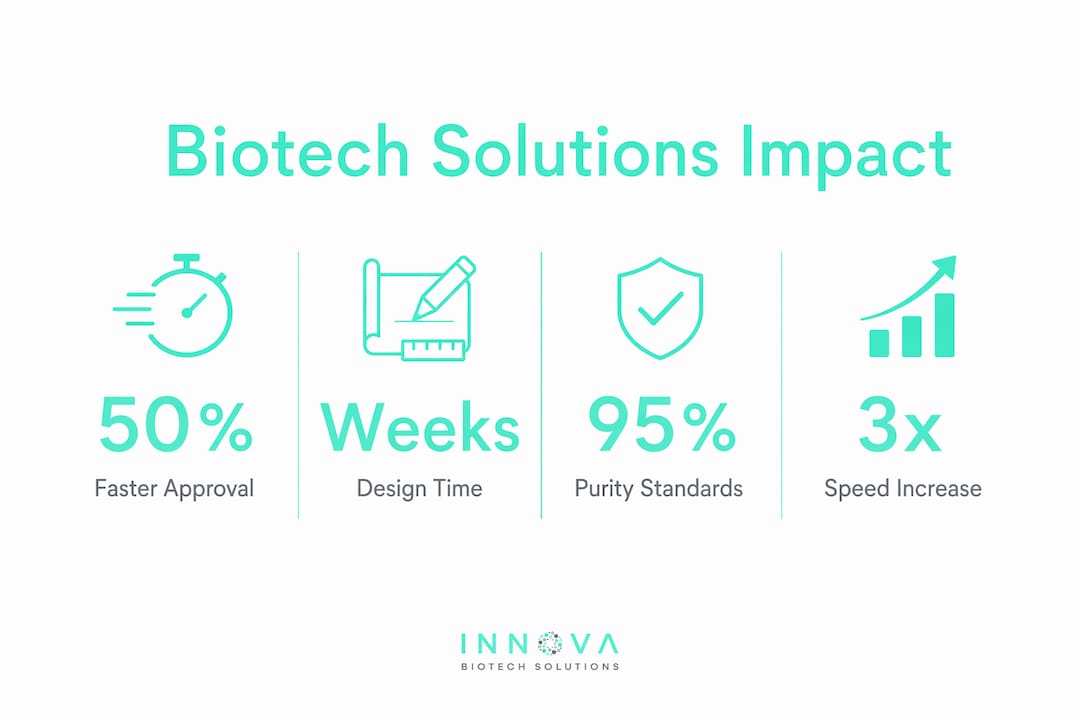
The timeline compression is significant. Bespoke N-of-1 therapies can now be designed in weeks rather than years, and FDA expanded access approval has been achieved in approximately one week for programs built on proven modular frameworks. That is not a marginal improvement. It fundamentally changes what is possible for rare disease programs where waiting years is not a clinical option.
Shared components drive this speed. When a chassis, a delivery vector, or a safety profile has already been validated, each new program inherits that regulatory groundwork. The result is faster iteration, lower per-program cost, and a clearer path to IND submission.
Scalability follows the same logic. Repeatable manufacturing and shared operational playbooks allow bespoke therapies to move beyond single academic centers and reach broader patient populations. Consortia like the NIH's Bespoke Gene Therapy Consortium (BGTC) are formalizing these standards precisely because the field recognizes that customization without industrialization is a dead end.
Key advantages of modular platform technologies include:
- Chassis reuse reduces per-program design time and regulatory burden
- Shared safety profiles accelerate IND filings for novel variants
- Standardized manufacturing steps enable multi-site scale-up
- Regulatory plausible mechanism pathways make economically viable bespoke therapies achievable for rare mutations
Pro Tip: When evaluating a modular platform, audit how many prior programs have used the same chassis and whether those programs have cleared FDA expanded access. Inherited regulatory history is worth more than any single technical specification.
What do integrated CDMOs offer custom biotech projects?
Integrated contract development and manufacturing organizations (CDMOs) solve a coordination problem that slows most early-stage custom programs. When discovery, formulation, and analytical services sit in separate organizations, handoffs create delays, data gaps, and compliance risk.
An end-to-end CDMO eliminates those handoffs. Integrated CDMOs can initiate programs within two weeks of final contract signing. For a custom biotech project where every week of delay has downstream cost implications, that speed is a genuine competitive advantage.
The benefits of working with an integrated CDMO extend well beyond speed:
- Single data chain: Discovery, formulation, and analytics share one data environment, reducing transcription errors and version conflicts
- Regulatory coherence: One quality management system covers the full program, simplifying IND and BLA submissions
- Faster iteration: Analytical feedback loops within the same organization accelerate formulation decisions
- Reduced vendor management overhead: One contract, one point of contact, one audit trail
The impact on time-to-market is direct. Programs that fragment their supply chain across three or four vendors routinely lose weeks to scheduling conflicts and data reconciliation. Integrated services compress that friction out of the timeline entirely.
Custom biotech solutions advantages are most visible at the interface between discovery and manufacturing. That is where standardized CDMOs struggle and where purpose-built, integrated partners deliver measurable returns.
Why are custom antibodies and reagents critical for regulatory compliance?
Custom antibodies are not a premium option for well-funded programs. They are a technical requirement for any project that needs to meet IND filing standards or produce reproducible preclinical data.
Custom antibody services provide purity levels exceeding 95% with low endotoxin levels. That specification matters because regulatory reviewers at the FDA evaluate reagent quality as part of the IND package. A reagent with inconsistent purity introduces variability that reviewers will flag, and that flag costs time.
The role of custom antibodies spans the full development cycle:
- Target validation: Precisely engineered antibodies confirm that your biological target behaves as predicted in the relevant cell or tissue context
- Screening: Custom reagents reduce off-target signal in high-throughput assays, improving hit quality from the start
- Preclinical evaluation: Full traceability from synthesis to characterization supports the data integrity requirements of GLP studies
- Quality control: Custom antibodies support all phases of antibody drug development, ensuring data reliability and regulatory compliance at every stage
Full traceability is the feature that separates custom reagents from catalog alternatives. When an auditor asks for the provenance of a critical reagent used in a pivotal study, a traceable custom antibody provides a complete answer. A catalog reagent from a third-party supplier often cannot.
The downstream effect on R&D risk is real. Programs that use poorly characterized reagents in early discovery frequently encounter reproducibility failures at the transition to preclinical work. That failure costs far more than the premium on a custom antibody.
Pro Tip: Request a certificate of analysis that includes both purity percentage and endotoxin units per milligram before accepting any custom antibody lot. If a supplier cannot provide both figures, treat that as a disqualifying gap in their quality system.
For teams working on target identification in biotech, the quality of your reagents at the discovery stage determines the reliability of every downstream decision.
Customized vs. standardized biotech systems: which fits your program?
The choice between customized and standardized biotech systems is a strategic decision, not a procurement preference. Getting it wrong in either direction costs time, money, and regulatory credibility.
Standardized single-use systems simplify operations and improve consistency across manufacturing sites. Customized assemblies optimize for specific process needs where standard configurations cannot meet performance requirements. A risk-based framework is the correct tool for deciding which path fits your program.
| Dimension | Standardized systems | Customized solutions |
|---|---|---|
| Setup speed | Fast, pre-validated configurations | Longer lead time for design and validation |
| Training burden | Low, widely documented protocols | Higher, requires specialized operator knowledge |
| Process fit | Good for simple or broad workflows | Required for specialized performance targets |
| Multi-site harmonization | Strong, consistent across facilities | Requires deliberate documentation to replicate |
| Regulatory footprint | Smaller, established precedent | Larger, but traceable and defensible |
| Cost profile | Lower upfront, less flexible | Higher upfront, lower rework cost downstream |
The table makes the trade-off visible. Standardization wins on simplicity and harmonization. Customization wins when your process has a performance requirement that a standard configuration cannot meet.
For multi-site manufacturing networks, the decision has supply chain implications. A fully custom assembly that exists only at one supplier creates a single point of failure. The practical answer for most programs is a hybrid: standardize the components that do not affect performance, and customize only where the science demands it.
Platform selection is a strategic business constraint that reduces compliance burdens and frees resources to focus on research. Teams that treat it as a procurement decision consistently underestimate its downstream impact on speed and auditability.
The biotech sector is shifting toward industrializing customization to scale personalized medicine. That shift requires leadership to build repeatable, equitable care pathways, not just technically impressive one-off solutions.
Key Takeaways
Customized biotech solutions deliver measurable advantages in speed, compliance, and scalability when matched to the specific technical demands of each program.
| Point | Details |
|---|---|
| Modular platforms compress timelines | Bespoke N-of-1 therapies can be designed in weeks, with FDA expanded access approval achieved in approximately one week. |
| Integrated CDMOs reduce friction | End-to-end CDMO services can start programs within two weeks of contract signing, eliminating handoff delays. |
| Custom reagent quality is non-negotiable | Antibody purity exceeding 95% with low endotoxin levels is required for IND filings and reproducible preclinical data. |
| Platform choice is a strategic decision | Selecting the right custom or standardized platform lowers compliance burden and accelerates research cycles. |
| Industrializing customization enables scale | Repeatable manufacturing playbooks and shared standards allow bespoke therapies to move beyond single academic centers. |
What I have learned about scaling custom biotech operations
The hardest part of custom biotech is not the science. The science is solvable. The hard part is operational discipline: building repeatable, auditable processes that can survive a personnel change, a site transfer, or a regulatory inspection.
I have watched technically brilliant programs stall at the transition from academic proof-of-concept to clinical manufacturing. The failure point is almost never the biology. It is the absence of a documented, repeatable process that a second team can execute without the original scientist in the room.
Platform selection is where I see the most consequential decisions made poorly. Teams treat it as a vendor comparison when it is actually a commitment to a data architecture, a compliance posture, and a scalability ceiling. Choosing a custom-aligned platform is not just about what works today. It is about what you can audit, reproduce, and defend in front of a regulatory reviewer two years from now.
My honest view is that the teams winning in personalized biotech are not the ones with the most novel science. They are the ones who have built the operational infrastructure to make that science repeatable. Data provenance, reproducibility, and auditability are not compliance checkboxes. They are the foundation of every funding conversation, every partnership negotiation, and every regulatory submission you will ever make.
Balancing customization with standardization is not a compromise. It is the actual strategy. Standardize everything that does not differentiate your program. Customize only where the science demands it. That discipline is what separates programs that scale from programs that stay in the lab.
— Hooman
How Innovabiotech supports your custom biotech R&D
Innovabiotech was built specifically for the kind of work described in this article. Based in San Francisco and founded in 2026, the team delivers peptide design services with bioinformatics validation, protein engineering including chimeric protein design and computational modeling, and enzyme solutions for biocatalysis and therapeutic development. Every project starts with a direct consultation and stays transparent through delivery.
If your program requires de novo peptide design, hit-to-lead optimization, or custom enzyme development, Innovabiotech provides the scientific depth and project management discipline to move from concept to validated result. Explore the full range of biotech advancements and services at innovabiotech.com.
FAQ
What are customized biotech solutions?
Customized biotech solutions are purpose-built biological tools, platforms, and services designed to meet the specific technical and regulatory requirements of a single research or therapeutic program, rather than relying on generic off-the-shelf configurations.
How do modular platforms speed up personalized therapy development?
Modular platforms reuse validated chassis and regulatory components across programs, allowing bespoke N-of-1 therapies to be designed in weeks rather than years, with FDA expanded access approval achievable in approximately one week.
Why does custom antibody purity matter for IND filings?
Custom antibody services with purity exceeding 95% and low endotoxin levels meet the reagent quality standards FDA reviewers evaluate during IND submissions, reducing the risk of data integrity flags that delay approval.
When should a biotech team choose customization over standardization?
A risk-based framework guides this decision: standardized systems suit simple workflows and multi-site harmonization, while customized solutions are required when a process has specialized performance targets that standard configurations cannot meet.
How does patient stratification connect to custom biotech strategy?
Patient stratification defines the biological subgroups your therapy must address, which directly determines the level of customization required in your reagents, assays, and manufacturing processes.