
TL;DR:
- Regulatory science creates new tools and standards essential for evaluating innovative biotech products, shaping decision-making.
- Its early engagement reduces development risks and fosters international regulatory harmonization, attracting investment.
Regulatory science is defined as the multidisciplinary field that develops new tools, standards, and approaches to assess the safety, efficacy, quality, and performance of biotechnology products, converting raw research into evidence that regulators can act on. Without it, the path from laboratory discovery to patient access has no reliable map. For biotech professionals, researchers, and students, understanding why regulatory science matters in biotech is not a compliance exercise. It is a strategic foundation for every product decision you make.
Why regulatory science matters in biotech development
Regulatory science sits at the intersection of biology, chemistry, clinical medicine, statistics, and law. The FDA defines it as the science of developing new tools, standards, and approaches to assess FDA-regulated products, which means it is not static documentation but an evolving discipline that grows alongside the technologies it governs. This distinction separates regulatory science from regulatory compliance. Compliance means meeting existing requirements. Regulatory science creates the requirements themselves, particularly for novel modalities like cell and gene therapies, synthetic biology constructs, and de novo peptides where no prior framework exists.

The practical consequence for biotech development is significant. When your product enters a regulatory pathway that lacks validated assessment tools, you face a dual burden: proving the science and educating the agency simultaneously. Regulatory science reduces that burden by establishing shared methodologies before your submission arrives. It supports consistent regulatory decisions across jurisdictions and technologies, which matters enormously when you are seeking approval in the U.S., EU, and Asia-Pacific markets concurrently.
Consider how this plays out in early development. The FDA's INTERACT meeting program allows sponsors to have informal, non-binding dialogue on manufacturing, toxicology, and clinical design before an IND submission. This is regulatory science in action: structured early engagement that reduces development risk by clarifying evidence expectations before you commit resources to a study design that may not satisfy the agency.
Pro Tip: Submit 3 to 5 tightly scoped questions to FDA INTERACT meetings, each tied to a specific decision point in manufacturing, toxicology, or clinical design. Broad questions produce generic responses. Focused questions produce targeted, actionable feedback that can eliminate unnecessary studies.
| Regulatory science approach | Traditional compliance approach |
|---|---|
| Develops new assessment tools for novel modalities | Applies existing checklists to established product types |
| Engages regulators early to shape evidence expectations | Submits dossiers after studies are complete |
| Manages uncertainty explicitly through frameworks | Assumes uncertainty is resolved by following prior precedent |
| Evolves with emerging technologies | Lags behind innovation cycles |
How regulatory science drives biotech investment and innovation
Regulatory predictability is not a soft benefit. It directly determines where capital flows in the biotech sector. A 2026 AZBio report from Incubate and Manatt found that FDA regulatory uncertainty, leadership turnover, and shifting evidentiary standards increase biotech investment risk and are reshaping capital flows away from U.S. drug development. That finding should concern every professional working in American biotech. When investors cannot model regulatory risk, they reduce exposure or redirect funding to markets with more stable frameworks.
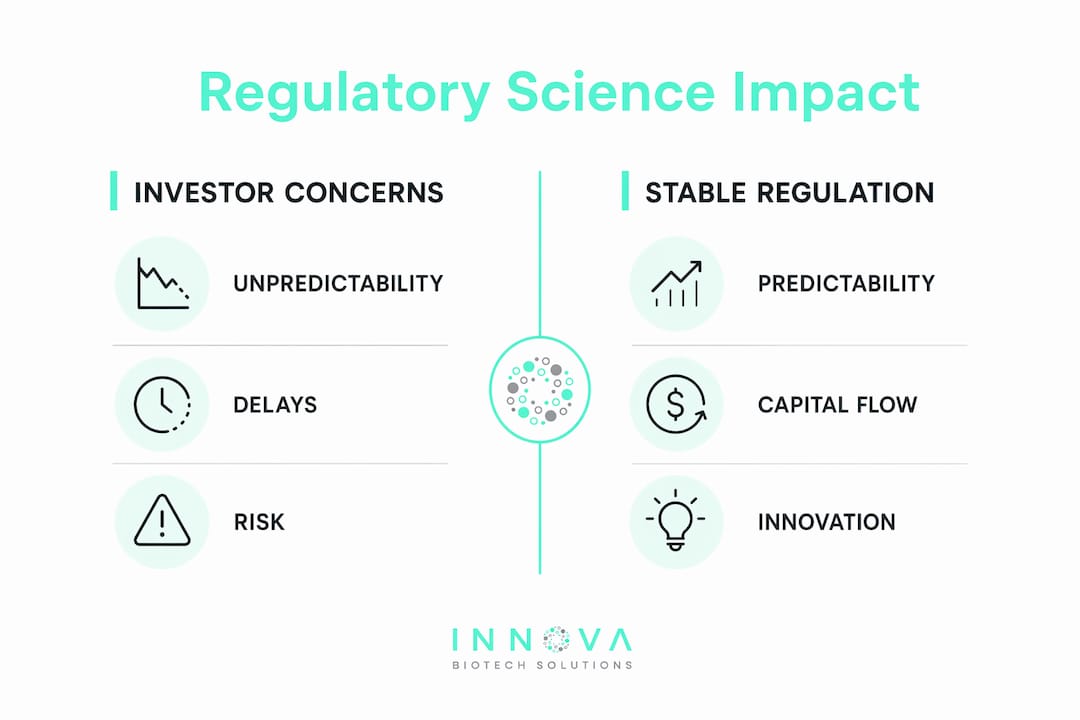
The inverse is equally true. Clear regulatory pathways created by mature regulatory science attract capital because they reduce the probability of late-stage failure. A biotech company with a well-defined regulatory strategy, grounded in established science, can present investors with a credible development timeline and risk profile. That credibility translates directly into valuation and funding terms.
Regulatory science also accelerates responsible innovation by enabling cross-functional collaboration between researchers, clinicians, statisticians, and regulatory specialists. The Swiss Biotech 2026 report from Swissmedic highlights that trusted regulatory assessment depends on cross-functional expertise spanning quality, clinical, vigilance, and legal domains. This is not a bureaucratic observation. It reflects the reality that complex biotech products require teams who understand both the science and the regulatory framework governing it.
| Investor concern under regulatory instability | Benefit of stable regulatory science |
|---|---|
| Unpredictable approval timelines | Defined development milestones and decision points |
| Shifting evidentiary standards mid-development | Consistent evidence requirements from early advice onward |
| Leadership turnover at agencies | Institutional knowledge embedded in published frameworks |
| Jurisdiction-specific regulatory divergence | Harmonized international standards reducing duplication |
For biotech startups and established companies alike, understanding the importance of regulatory science in biotech begins at target identification, not at the IND stage. The earlier you integrate regulatory thinking, the more efficiently you allocate your development budget.
How does regulatory science manage scientific uncertainty?
Uncertainty is inherent in biotech product development. Pre-authorization evidence is always incomplete, and that incompleteness propagates downstream, affecting health technology assessment, reimbursement decisions, and clinical practice. Regulatory science addresses this not by eliminating uncertainty but by making it explicit, characterizable, and communicable.
"Regulatory science is a system-level improvement activity that makes uncertainty management explicit and transparent, improving decision quality over relying on implicit assumptions." — Frontiers in Medicine, 2026
The practical steps for managing uncertainty in regulatory submissions follow a structured logic:
- Identify sources of uncertainty in your evidence package: gaps in mechanistic data, limited population size, surrogate endpoint reliance, or manufacturing variability.
- Characterize each uncertainty as qualitative or quantifiable, since this distinction determines how regulators and health technology assessment bodies will treat it downstream.
- Communicate uncertainty transparently in your dossier rather than minimizing it, because regulators who discover undisclosed uncertainty lose confidence in the entire submission.
- Propose mitigation strategies such as post-market surveillance commitments, risk management plans, or conditional approval pathways that address residual uncertainty.
- Engage collaboratively with researchers, clinicians, and patient representatives to validate that your uncertainty characterization reflects real-world clinical relevance.
This framework reflects a broader truth about regulatory science in biotechnology: it is a shared deliverable among multiple stakeholders, not a unilateral sponsor exercise. The Frontiers in Toxicology 2026 publication on bridging gaps between scientific research and regulatory decision-making in Europe identifies methodological inconsistencies and insufficient communication as the primary weaknesses that undermine decision quality and trust. Addressing those weaknesses requires structured dialogue, not just better documents.
Collaboration among academia, regulators, and policymakers
Academia generates the foundational data that regulatory science depends on. Universities and research institutes produce mechanistic studies, biomarker validation work, and epidemiological evidence that risk assessors at agencies like the FDA, EMA, and Health Canada use to build assessment frameworks. Without that upstream scientific investment, regulatory science has no raw material to work with.
Risk assessors and regulatory agencies then interpret and standardize that data, converting heterogeneous research outputs into consistent criteria that sponsors can design against. Policymakers use those criteria to draft legislation and update regulations, creating the legal architecture within which biotech companies operate. The chain is sequential, but the communication between these groups is rarely as clean as the sequence implies.
The European regulatory science gap between academia and regulators stems from several structural problems:
- Academic researchers optimize for publication impact, not regulatory utility, producing data that is scientifically valid but not formatted for regulatory use.
- Risk assessors lack the bandwidth to engage with primary literature systematically, creating reliance on secondary summaries that may omit critical nuance.
- Policymakers operate on legislative timelines that rarely align with the pace of scientific discovery, creating regulatory lag for emerging technologies.
- Patients and clinicians, who hold the most direct knowledge of real-world treatment needs, are often consulted late in the process rather than integrated from the start.
Structured interactions, including workshops, advisory panels, and formal stakeholder consultations, address these gaps by creating shared vocabulary and mutual understanding of evidence requirements. The regulatory strategy guide from JJCC Group outlines methodologies that help sponsors navigate these multi-stakeholder environments effectively.
Pro Tip: When preparing for advisory panel interactions, map your evidence package against the specific decision criteria the panel will use. Regulators and academics often disagree on what counts as sufficient evidence. Presenting your data in the framework the panel already uses reduces friction and builds credibility.
Practical applications and future directions in biotech
Regulatory science shapes product development at every stage of the biotech lifecycle, from early target validation through post-market surveillance. The table below maps where regulatory science tools apply most directly.
| Development stage | Regulatory science application |
|---|---|
| Target identification and validation | Biomarker qualification, mechanistic evidence standards |
| Preclinical development | Toxicology testing frameworks, animal model validation |
| Clinical design | Adaptive trial methodology, surrogate endpoint acceptance |
| Manufacturing scale-up | Quality by design principles, process analytical technology |
| Regulatory submission | Uncertainty characterization, benefit-risk framework |
| Post-market oversight | Pharmacovigilance standards, real-world evidence integration |
Looking forward, the most significant growth area for regulatory science in biotechnology is synthetic biology. The OECD 2026 publication on anticipatory governance for responsible innovation in synthetic biology identifies harmonized international cooperation and agile regulation as the two mechanisms most likely to keep governance aligned with fast-moving technology. This matters for biotech professionals because synthetic biology products, including engineered organisms, biosensors, and living therapeutics, do not fit neatly into existing regulatory categories.
Regulatory credibility at agencies depends on cross-functional expertise, not just document review. This means the biotech companies that invest in regulatory science talent, whether in-house or through specialized partners, will have a structural advantage as novel modalities proliferate. The clinical development regulatory guide from JJCC Group provides a practical framework for building that capability across development stages. Structural bioinformatics is one area where computational methods are increasingly informing regulatory evidence packages, particularly for protein engineering and enzyme optimization programs.
Key takeaways
Regulatory science in biotechnology is the discipline that converts scientific uncertainty into structured, communicable evidence, and companies that treat it as a strategic asset rather than a compliance cost consistently outperform those that do not.
| Point | Details |
|---|---|
| Regulatory science vs. compliance | Regulatory science creates assessment standards; compliance only meets existing ones. |
| Early engagement reduces risk | FDA INTERACT meetings clarify evidence expectations before costly studies begin. |
| Investment follows predictability | Regulatory instability, as documented in the 2026 AZBio report, directly redirects biotech capital. |
| Uncertainty must be explicit | Characterizing and communicating uncertainty transparently improves regulatory trust and downstream decisions. |
| Collaboration is structural | Academia, regulators, and policymakers require structured interaction to keep frameworks aligned with science. |
Regulatory science as a strategic asset, not a checkpoint
I have worked across enough biotech development programs to say this plainly: the teams that treat regulatory science as a late-stage checkpoint consistently pay for it. They redesign studies, lose months to agency questions that could have been resolved in an INTERACT meeting, and watch competitors with better regulatory integration reach the market first.
What changed my thinking was watching a small gene therapy company use early regulatory engagement not just to satisfy the FDA but to sharpen their own scientific hypothesis. The feedback they received on their biomarker strategy forced them to revisit their mechanistic model, and the revised model was stronger. Regulatory science made the science better, not just the submission.
The 2026 data on regulatory instability at the FDA is genuinely concerning for U.S. biotech competitiveness. But the response should not be to wait for stability to return. It should be to build internal regulatory science capability that can adapt to shifting evidentiary standards rather than being blindsided by them. That means hiring cross-functional regulatory scientists, not just regulatory affairs specialists who manage documents.
For students entering the field: regulatory science is one of the most intellectually demanding and strategically valuable specializations in biotech. It requires you to hold scientific rigor and practical decision-making simultaneously. The professionals who do it well are rare, and the demand for them is only growing as novel modalities multiply.
— Hooman
How Innovabiotech supports regulatory-aligned biotech innovation
Innovabiotech, based in San Francisco, designs its services around the same principles that regulatory science demands: precision, transparency, and evidence quality at every stage.
Innovabiotech's peptide design and optimization services are built for programs where regulatory expectations around structural characterization and mechanistic evidence are high. From de novo peptide design to protein engineering and enzyme optimization, every project is scoped to meet the specific evidence requirements of your development stage. Innovabiotech works closely with clients from initial consultation through delivery, keeping regulatory considerations integrated from the start rather than retrofitted at the end. If your program needs computational rigor aligned with regulatory expectations, Innovabiotech is the right partner.
FAQ
What is regulatory science in biotechnology?
Regulatory science in biotechnology is the discipline that develops new tools, standards, and approaches to evaluate the safety, efficacy, quality, and performance of biotech products. It differs from regulatory compliance in that it creates the frameworks regulators use, rather than simply meeting existing requirements.
Why does regulatory science matter for biotech investment?
Regulatory predictability directly affects capital allocation in biotech. The 2026 AZBio report documents that FDA regulatory instability and shifting evidentiary standards are redirecting investment away from U.S. drug development, making stable regulatory science a prerequisite for sustained funding.
What are FDA INTERACT meetings and why are they useful?
FDA INTERACT meetings are early, informal, non-binding dialogues between sponsors and the FDA covering manufacturing, toxicology, and clinical design before IND submission. Submitting 3 to 5 focused questions produces targeted feedback that can eliminate unnecessary studies and reduce development risk.
How does regulatory science handle uncertainty in biotech evidence?
Regulatory science makes uncertainty explicit by identifying its sources, characterizing it as qualitative or quantifiable, and communicating it transparently in regulatory submissions. This approach improves decision quality for regulators, health technology assessment bodies, and reimbursement agencies downstream.
How does regulatory science support emerging technologies like synthetic biology?
The OECD 2026 publication on anticipatory governance identifies harmonized international cooperation and agile regulation as the core mechanisms regulatory science uses to govern synthetic biology. These approaches allow regulatory frameworks to evolve alongside fast-moving technologies rather than lagging behind them.