
Active learning meaningfully increases hit enrichment and cuts experimental cost, but only when it's built into a real iterative loop with assay feedback and synthetic-accessibility checks. It works best in early hit finding, affinity screens, and data-scarce targets, and works poorly as a one-shot filter bolted onto a static library. What follows covers the workflows, selection strategies, representation choices, lab integration details, and benchmarking practices that separate a well-run active learning drug discovery campaign from a wasted one.
TL;DR:
- Active learning's success relies on an iterative feedback loop with assay results, especially effective in early hit finding and data-scarce targets.
- Pool-based and generative workflows are the main practice variants, with hybrid approaches used to refresh diversity in static libraries.
- Uncertainty sampling with diversity penalties consistently outperforms greedy strategies, particularly in early rounds with small batches.
- Representation quality, such as graph neural networks or learned embeddings, significantly impacts the performance of active learning campaigns.
- Proper lab integration, including matching batch size to assay throughput and logging all data, is critical to avoid operational failures.
Table of Contents
- What Active Learning Means for Drug Discovery Workflows
- How Do AL Workflows Fit Into the DMTA Cycle?
- Which Acquisition Strategy Should You Use?
- What Molecular Representations and Models Work Best?
- How Do You Integrate AL With Real Lab Constraints?
- When Should You Stop an Active Learning Campaign?
- What Do Published Case Studies Show About Real Enrichment?
- Active Learning Checklist: Setup, Pitfalls, and Fixes
- An Operational View From Innova Biotech Solutions
- Ready to Run an Active Learning Campaign With Support?
- Sources
- FAQ
What Active Learning Means for Drug Discovery Workflows
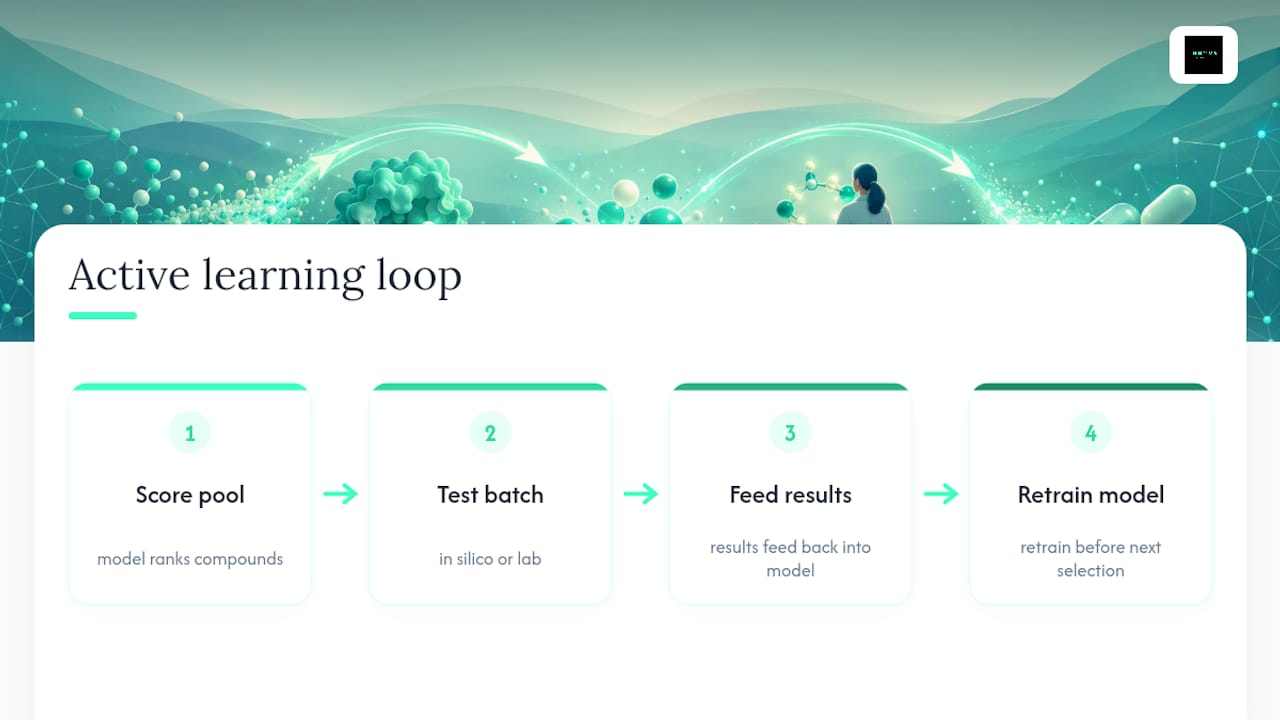
Active learning (AL) is an iterative select, test, retrain cycle. A model scores a compound pool, a batch gets tested (in silico or in the lab), the results feed back into the model, and the model retrains before selecting the next batch. That loop is the entire mechanism. Everything else, acquisition functions, representations, batch sizing, is detail layered on top of it.
Two structural variants dominate practice. Pool-based AL works against a fixed, enumerated library, ranking and re-ranking candidates each round. Generative or de novo AL couples the acquisition step to a molecule generator, so the model doesn't just pick from an existing set, it proposes new structures based on what the last round taught it. The generative variant matters more as programs push into unexplored chemical space where a static library simply doesn't contain the answer.
Three applications account for most of the real-world use of AL in pharma pipelines. Virtual screening and hit finding is the classic case: narrowing a massive library down to a wet-lab-testable batch using model-guided selection instead of pure structure-based docking or brute-force screening. ADMET and property prediction uses AL to reduce the number of expensive absorption, distribution, metabolism, excretion, and toxicity assays needed to characterize a series. Guiding generative models uses AL as the reward signal that steers a generator toward regions of chemical space that are both novel and likely to score well experimentally.
AL isn't the right tool everywhere. If you already have a large, well-characterized dataset covering your chemical space, there's little left to learn iteratively; a standard supervised model trained once will get you most of the way there faster. It also struggles when assay turnaround is too slow to support meaningful retraining cycles, or when the underlying structure-activity relationship is so discontinuous that no representation captures it reliably. In those cases, active learning screening adds process overhead without adding signal.
How Do AL Workflows Fit Into the DMTA Cycle?
Active learning slots into the design, make, test, analyze (DMTA) cycle as the design and analyze steps, compressed and automated. Instead of a medicinal chemist manually picking the next round of analogs, the model ranks the pool and hands back a shortlist, then folds the new assay data straight back into the next ranking.
Two workflow templates cover most implementations:
- Pool-based batch selection. You enumerate or acquire a candidate library up front (commercial catalogs, virtual libraries, an internal compound bank), score the full pool with your current model, select a batch by acquisition function, send it to the assay, and retrain on the combined dataset. This is the easiest template to stand up and the one most teams should start with.
- Generator-embedded AL. A generative model (a VAE, a normalizing flow, or a graph-based generator) proposes candidates directly, the property model scores them, and gradients or reinforcement signals push the generator toward higher-scoring regions. Nested loops, where an inner AL cycle trains the property predictor while an outer loop trains the generator, are increasingly used for de novo peptide and small-molecule design when the target's chemical space isn't well covered by any existing library.
- Hybrid loop with periodic library refresh. Some programs run pool-based selection for several rounds, then use a generative step to expand the pool once diversity starts collapsing. This keeps the operational simplicity of pool-based AL while avoiding the diminishing-returns plateau that a static library eventually hits.
Batch size, retraining cadence, and lab latency have to be tuned together, not separately. A batch that's too small wastes retraining cycles on marginal information gain; a batch that's too large risks selecting redundant, correlated compounds before the model has a chance to learn from the first ones. Most practical implementations settle on batches sized to match what the assay can process in one turnaround window, whether that's 96 compounds for a plate-based biochemical assay or a few dozen for a lower-throughput functional assay. Retraining after every batch is standard for pool-based setups; generator-embedded loops sometimes retrain the property model every batch while updating the generator on a slower schedule, since generator updates are more computationally expensive and more prone to instability if triggered too often.
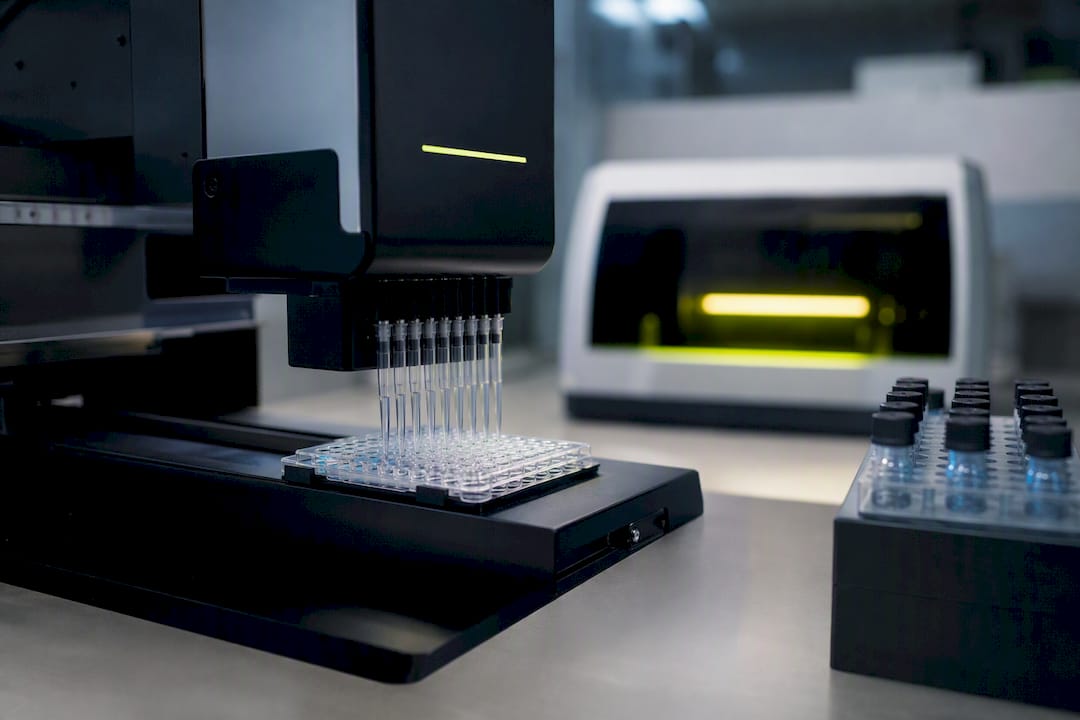
Robotic liquid-handling and automated plate readers make short retraining cycles practical because they remove the human bottleneck between "batch selected" and "results available." Manual DMTA cycles can still run AL, but the cadence has to match what a bench scientist can realistically process, which often means weekly rather than daily retraining.
Which Acquisition Strategy Should You Use?
Uncertainty-based sampling combined with a diversity penalty consistently outperforms pure greedy selection in early screening rounds, and that finding shows up across multiple independent simulation studies. The Query Matters simulation study found that by the final iteration, 37 of the top 50 ranked compounds landed in the top 1% of the evaluated chemical space when uncertainty-driven selection was used, a result that greedy, score-only selection couldn't match.
The four acquisition strategies you'll encounter, and how they actually differ:
- Greedy/score-based selection picks the highest-predicted compounds every round. It's fast and easy to implement, but it collapses toward whatever region the model already believes is good, which means it stops exploring right when exploration matters most.
- Uncertainty sampling selects compounds where the model is least confident, typically measured through ensemble variance or Bayesian posterior spread. This targets the regions where a new data point teaches the model the most.
- Diversity-based selection picks compounds that are structurally distinct from what's already been tested, usually via clustering or distance metrics in chemical space, to prevent the model from oversampling one scaffold family.
- Hybrid uncertainty plus diversity combines both signals, often by first filtering to a high-uncertainty subset and then applying a diversity constraint within it, or by weighting a combined score.
Statistic: In wet-lab conditions, ChemScreener's iterative active learning workflow lifted WDR5 hit rates from 0.49% in the primary high-throughput screen to an average of 5.91% across iterative rounds, with over a thousand compounds screened in single-dose iterative testing and more than a hundred hits identified.
A small randomized fraction inside each batch, usually somewhere in the range of 10 to 20 percent, helps correct systematic biases the model picks up from earlier rounds. Simulation research on active learning in computer-assisted drug discovery shows this exploration allocation trades some immediate top-hit yield for better long-run robustness, which matters more in longer campaigns than short ones.
Practical implementation comes down to a few decisions. Ensemble-based uncertainty (training several models with different seeds or architectures and measuring prediction spread) is the simplest starting point and works well without requiring a full Bayesian treatment. True Bayesian approaches (Gaussian processes, Bayesian neural networks) give better-calibrated uncertainty estimates but cost more compute and don't always scale to large pool sizes. Balanced-ranking approaches, where you rank separately on uncertainty and diversity, then merge the two rankings, tend to be more robust to hyperparameter choices than a single weighted score that requires careful tuning.
What Molecular Representations and Models Work Best?
Representation quality, not acquisition function sophistication, is often the actual bottleneck in an active learning campaign. A more complex acquisition rule applied to a poor representation still ranks compounds poorly; a well-chosen representation with a simple uncertainty rule frequently outperforms it.
The core representation and model decisions:
- Fingerprints (ECFP, MACCS) vs. learned embeddings. Fingerprints are fast, interpretable, and require no training, but they're fixed and can't adapt to what a target actually cares about structurally. Learned embeddings from a trained network adapt to the data but need enough examples to avoid overfitting in early rounds.
- Graph neural networks (GNNs) treat molecules as graphs rather than flattened bit vectors, which captures connectivity patterns fingerprints miss. They tend to shine on larger training sets and struggle more in the earliest AL rounds when data is thin.
- 3D-aware models incorporate conformational and geometric information, which matters when binding depends on shape and spatial arrangement rather than just 2D connectivity, as with many affinity-driven targets. A broad review of molecular representation in AI-driven discovery ties representation fidelity directly to downstream AL performance and to how well models integrate with closed-loop and autonomous experimentation setups.
- Pretraining and transfer learning reduce the cold-start problem that plagues AL at round one, when there's little labeled data to train on. A model pretrained on a large generic chemical dataset and fine-tuned on the first AL rounds converges faster than one trained from scratch.
- Physics-informed or hybrid predictors blend a learned model with a physical scoring term, such as a docking score or a simplified free-energy estimate. These help when data is extremely sparse and a pure data-driven model has nothing to anchor to yet.
Uncertainty calibration deserves its own attention separate from raw accuracy. A model can be accurate on average while being badly miscalibrated on the tails, exactly where uncertainty sampling needs it to be trustworthy. If your acquisition function trusts uncertainty estimates that are systematically overconfident, you'll select compounds the model was wrong to be confident about, and you won't know it until the assay results come back. Deep-batch active learning applied to ADMET and affinity datasets shows measurable performance gains from batch-aware acquisition that accounts for correlations between compounds selected in the same round, which plain per-compound uncertainty scoring ignores.
How Do You Integrate AL With Real Lab Constraints?
The single most common failure mode in a real active learning campaign isn't a bad model, it's a batch cadence that doesn't match assay turnaround. If your assay takes three weeks and your model wants to retrain daily, you're not running active learning; you're running a very slow, very expensive form of static screening with extra steps.
- Match batch cadence to assay throughput. Size each batch and set the retraining trigger to align with your actual turnaround time, not an idealized one. A 96-well biochemical assay running weekly supports a very different rhythm than a low-throughput functional assay running monthly.
- Score synthetic accessibility before selection, not after. Run SA or makeability scoring on the candidate pool before the acquisition function ranks it, so you're not wasting a batch slot on a compound that would take six months to synthesize. This filtering step is cheap compared to the cost of an abandoned synthesis route discovered after commitment.
- Build in counter-screens from round one. Include a counter-screen (aggregation, autofluorescence, promiscuity checks depending on the assay format) alongside the primary readout so artifacts get filtered before they contaminate the training data the model learns from next round.
- Automate the data handoff between assay and model. Manual data entry between the lab and the model introduces delay and transcription error at exactly the point where speed and accuracy matter most. Even a simple automated pipeline (a shared database, a scripted ETL step) removes a surprisingly large source of friction.
- Log everything, including negative results and seeds. Random seeds, model versions, and full batch composition (including compounds that failed) all need to be recorded. Reproducibility failures in AL campaigns are almost always traceable to an undocumented seed or a silently dropped negative result.
Noise handling deserves explicit attention rather than being treated as an afterthought. Assay noise doesn't just add error to individual measurements, it can bias which compounds the acquisition function selects next, since noisy high-variance readouts look like high-uncertainty opportunities to a model that can't distinguish real signal ambiguity from measurement error. Running key compounds in replicate, even a small number, gives you a way to separate the two.
Pro Tip: Keep a running log of every batch's random seed, model checkpoint, and library snapshot from day one. Reconstructing what happened in round four after the fact, once you're deciding whether to publish or extend the campaign, is far harder than logging it as you go.
Teams evaluating whether to build this infrastructure internally or bring in outside support often start by reviewing how a structured virtual screening drug discovery workflow handles the same handoff points between computation and the bench.
When Should You Stop an Active Learning Campaign?
Hit-rate enrichment, the ratio of hits found by AL-guided selection versus random selection from the same pool, is the most direct metric for judging whether a campaign is working. Top-k precision (what fraction of your top-ranked predictions turn out to be real hits) and fold improvement over random selection round out the core scorecard. Scaffold novelty, tracking how many distinct chemical series show up among your hits rather than just counting total hits, tells you whether you're finding real diversity or repeatedly rediscovering the same cluster.
Deciding when to stop matters as much as deciding how to select. A few heuristics dominate practice:
- SAFE-style recall estimators predict what fraction of the total active population you've likely already found, letting you weigh continued screening cost against diminishing returns. Research on stopping heuristics in active-learning screening recommends tying the stopping decision to cost-per-assay and the marginal probability of finding a genuinely novel scaffold, rather than an arbitrary round count.
- Plateau detection watches hit rate or top-k precision across rounds and stops when the curve flattens, since a flat curve usually means the model has extracted most of what the current representation and library can offer.
- Fixed-budget cutoffs simply stop after a predetermined number of rounds or compounds tested. This is the least sophisticated approach but is sometimes the most practical when budget, not discovery yield, is the binding constraint.
Benchmarking your own results, or comparing published ones, requires reporting the details that make replication possible: random seed, library composition and size, the acquisition function's exact parameters, and whether results come from a simulation (retrospective replay against known labels) or genuine wet-lab testing. Simulation results tend to look cleaner than wet-lab results because they don't carry assay noise, so the two shouldn't be compared as if they measure the same thing. The FDA's guidance on AI use in drug development reinforces this point from a regulatory angle, pushing for transparent validation and documentation practices even at the discovery stage, well before any AI-derived evidence would face formal review.
What Do Published Case Studies Show About Real Enrichment?
The clearest wet-lab demonstration of AL's value comes from the ChemScreener workflow applied to a WDR5 inhibitor discovery program.
Statistic: The ChemScreener WDR5 case study reports better than a tenfold increase in hit rate, from 0.49% to 5.91%, moving from a conventional primary screen to an iterative active learning workflow on the same target.
Simulation studies tell a complementary story about why that enrichment happens.
Read together, these two evidence types point to a dependency researchers should plan around rather than a fixed number to expect. Wet-lab enrichment magnitude depends heavily on target tractability, library quality, and assay noise, while simulation studies isolate the selection-strategy effect in a cleaner but less real-world setting. A realistic planning assumption is that well-run AL campaigns on tractable targets can produce multi-fold hit-rate improvements over conventional primary screening, but the size of that improvement is target-specific and shouldn't be assumed to transfer directly from one program to another.
Active Learning Checklist: Setup, Pitfalls, and Fixes
Before launching a campaign, confirm four things are in place: a curated seed set large enough to train an initial model without severe overfitting, SA gating already wired into the selection pipeline, assay capacity confirmed for the batch cadence you're planning, and a compute and retraining plan that matches your team's actual infrastructure, not an aspirational one.
- Curate the seed library deliberately, not just by convenience sampling from whatever's on hand. A biased seed set biases every round that follows.
- Wire in SA gating before, not after, ranking. Filtering unmakeable compounds post-selection wastes the acquisition function's ranking effort on candidates you'll drop anyway.
- Confirm assay readiness and turnaround before committing to a cadence. Mismatched cadence is the most common operational failure in real campaigns.
- Set a retraining and compute plan that survives contact with reality. Know in advance who retrains the model, how often, and on what hardware.
The most common pitfalls to avoid: relying on greedy-only selection past the first round or two, ignoring diversity until the pool has already collapsed to one scaffold family, running a campaign with no defined stopping criterion, and trusting uncertainty estimates from a poorly calibrated model without checking calibration first.
Pro Tip: Reserve 10 to 20 percent of every batch for randomized exploration outside your top-ranked predictions, even when the model looks confident. It's the cheapest insurance against the bias that greedy and near-greedy strategies quietly accumulate.

An Operational View From Innova Biotech Solutions
Innovabiotech maps active learning directly onto the services researchers actually need mid-campaign. Virtual screening and hit-to-lead work uses AL-style iterative selection to narrow libraries efficiently, while protein and peptide design projects apply the same select, test, retrain logic to sequence and structural candidates instead of small molecules.
A typical engagement with such services might start with a consultation to understand your target, existing data, and assay throughput, followed by a pilot AL loop scoped to prove the approach on a limited batch before any scale-up commitment. From there, scaling follows batch size and retraining frequency tuned to your lab's real turnaround, not a generic default.
Engagements generally include documented deliverables covering model choices, seeds, and validation steps, consistent with the transparency regulators increasingly expect even at the discovery stage. Data security and confidentiality protocols apply throughout, and clients get direct scientific contact rather than a black-box handoff.
— Hooman
Ready to Run an Active Learning Campaign With Support?
If you've read this far, you already know the hard part of active learning drug discovery isn't the acquisition function math, it's the infrastructure: curated libraries, SA gating, calibrated uncertainty, and a retraining cadence that survives contact with your actual assay schedule. Such infrastructure is often built as a contracted project instead of provided as a software license to configure yourself.
Innovabiotech's virtual screening and hit-to-lead services apply iterative, uncertainty-driven selection to your compound library with a dedicated scientific team handling model choice, batch design, and documentation at every round. Protein and peptide targets route through the protein engineering and design service or the peptide design service, depending on whether your project centers on structural modeling or de novo sequence generation, and enzyme-focused programs can use the enzyme optimization service for stability and activity work.
Before reaching out, gather three things: your project scope and target class, your realistic assay throughput and turnaround, and whatever initial dataset you already have, even a small or noisy one. That's enough to scope a pilot AL loop. Start the conversation through Innovabiotech's virtual screening page to discuss whether an active learning approach fits your target.
Sources
- Query Matters: How Selection Strategies Influence Active Learning in Drug Discovery
- Artificial Intelligence for Drug Development | FDA
- Artificial intelligence in drug discovery from advanced molecular representation to pipeline applications
FAQ
What Is Active Learning in Drug Discovery?
Active learning is an iterative modeling process where a model selects the most informative compounds to test, learns from those results, and repeats, rather than scoring an entire library once and stopping.
Does Active Learning Actually Improve Hit Rates?
Yes.
Which Acquisition Strategy Works Best for Early Rounds?
Uncertainty sampling combined with a diversity penalty consistently outperforms pure greedy selection in early rounds, with a small randomized fraction, typically 10 to 20 percent of each batch, helping correct systematic bias.
How Do You Know When to Stop an AL Campaign?
Use data-driven stopping heuristics like SAFE-style recall estimators or plateau detection on hit-rate curves rather than an arbitrary round count, weighing continued assay cost against the marginal chance of finding a novel scaffold.
Can Innovabiotech Help Run an Active Learning Screening Project?
Yes. Innovabiotech's virtual screening and hit-to-lead services apply iterative, model-guided selection to compound libraries, with pricing available on request based on project scope.