
Hit-to-lead optimization turns confirmed screening hits into prioritized, initial lead series through limited chemical modification, guided by potency, selectivity, and early DMPK metrics. It sits between hit confirmation and full lead optimization, and the job is to move a compound from micromolar activity toward nanomolar potency while keeping the molecule synthesizable, selective, and drug-like enough to survive animal testing.
TL;DR:
- Effective hit-to-lead campaigns rely on rigorous data curation and early ADME/DMPK screening to prevent wasted efforts in lead optimization.
- Computational methods like virtual enumeration, docking, and reaction prediction are essential for narrowing candidate pools and focusing synthesis efforts on promising compounds.
- Setting clear kill criteria based on potency, ligand efficiency, solubility, and safety before synthesis begins is crucial for efficient series prioritization.
- Combining miniaturized synthesis, high-throughput testing, and structured gate reviews accelerates decision-making and reduces the total cycle time to around one month.
- Partnering with external experts who integrate computational and experimental workflows can help teams avoid pitfalls and focus on compounds with the highest development potential.
Table of Contents
- What Is Hit-to-Lead Optimization in the Drug Discovery Pipeline?
- How Do You Measure a Good Lead Candidate?
- What Computational and Experimental Methods Speed Up H2L?
- How Do You Prioritize Series and Set Kill Criteria?
- What Does a Practical H2L Workflow Look Like Step by Step?
- How Does Innova Biotech Structure an H2L Engagement?
- An Editorial Take on Where H2L Campaigns Actually Fail
- Get Data-Driven Hit-to-Lead Support From Innovabiotech
- Sources
- FAQ
What Is Hit-to-Lead Optimization in the Drug Discovery Pipeline?
H2L is the discrete stage after target validation, assay development, and high-throughput screening, and before formal lead optimization begins. HTS produces hundreds or thousands of raw hits; most are noise, artifacts, or chemically intractable. H2L exists to separate the real signal from the rest and hand lead optimization a short list of series worth the investment.
The core activities break down into three buckets:
- Hit confirmation: orthogonal counterscreens, purity checks, and re-testing to eliminate assay artifacts and aggregators
- Hit clustering: grouping structurally related hits into chemical series and picking three to five worth expanding
- Focused analogue synthesis: making a small set of close analogs per series to build the first structure-activity relationship (SAR) map
A well-run H2L campaign delivers three things to the next stage: a prioritized series (or two), an initial SAR summary that explains which substitutions help or hurt potency, and enough early ADME/DMPK data to know whether the chemotype is worth committing synthesis capacity to. Skipping any of these tends to show up as wasted months in lead optimization, chasing potency in a series that was never going to be soluble or metabolically stable. Rigorous preclinical screening assays at this stage catch that problem early, not after twenty analogs have been made.
How Do You Measure a Good Lead Candidate?
Potency improvement in H2L usually means moving a hit from single or double-digit micromolar activity into the nanomolar range, often one to three orders of magnitude. That number alone tells you almost nothing about whether the compound will survive. A hit can gain 100x potency and still die in lead optimization because nobody checked solubility until month four.
Ligand efficiency (LE) and lipophilic ligand efficiency (LipE) exist to catch that failure mode early. LE normalizes potency against molecular size, penalizing compounds that only got potent by getting bigger. LipE does the same against lipophilicity, penalizing potency gains bought with excess logP. Teams generally look for LipE values above 5 to 7 as a rough cutoff for a series worth carrying forward, though the right threshold varies by target class.
Statistic: In a MAGL case study, a reaction-prediction and machine-learning workflow generated 26,375 virtual products and synthesized just 14 compounds, delivering potency improvements up to roughly 4,500 times the original hit.
Beyond potency and ligand efficiency, an H2L package should flag:
- Aqueous solubility and kinetic solubility under assay conditions
- Microsomal stability (rat and human liver microsomes at minimum)
- Passive permeability, typically via Caco-2 or PAMPA
- CYP450 inhibition against the major isoforms
- A first-pass selectivity window against known off-targets or related family members
None of this needs to be exhaustive at H2L. It needs to be enough to rule out compounds that will fail later for predictable reasons.
What Computational and Experimental Methods Speed Up H2L?
The fastest H2L campaigns now run on a funnel: cheap, high-throughput computation narrows a huge virtual space, and a small number of physical compounds get made to confirm the top picks. Getting the funnel architecture right matters more than any single tool inside it.
Virtual enumeration and docking come first. Teams generate thousands of candidate analogs around a hit scaffold, then dock them against a target structure to propose growth vectors, usually into a pocket or subpocket the original hit did not exploit. This step is cheap and fast, but docking scores are noisy, so it is a filter, not a final answer.
Reaction prediction and synthetic-accessibility scoring come next. Graph neural network (GNN) models trained on large reaction datasets can predict which of those thousands of virtual products a chemist can actually make in one or two steps, which turns an unmanageable enumeration list into a synthesizable shortlist. That combination, reaction prediction plus a multi-dimensional optimization funnel, is what let the MAGL case study compress an entire H2L cycle to about one month, with computation finished in roughly a day and synthesis and testing split across two two-week windows.
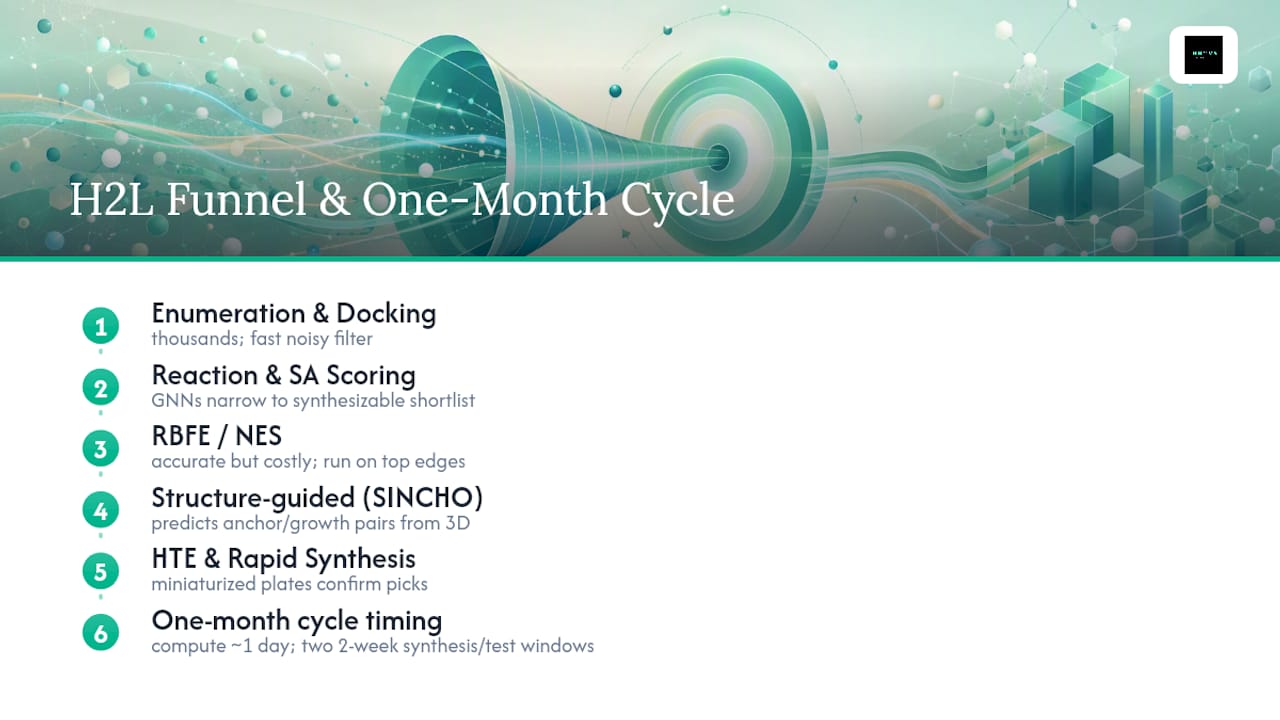
Docking and RBFE/NES sit on opposite ends of a cost-versus-accuracy trade-off. Docking is fast and rough. Relative binding free energy calculations using non-equilibrium switching (RBFE/NES) are far more accurate but computationally expensive, so the smart move is running RBFE only on the small set of top-ranked edges docking already flagged, not the full enumeration. A PDE9A case study combining large-scale enumeration, NES-based RBFE, and ML ADME prediction successfully ranked known leads inside a large candidate pool, though it needed roughly 120,000 GPU hours to do it, made feasible only by scalable cloud infrastructure.
When a protein-hit structural complex or a reliable molecular dynamics ensemble exists, the SINCHO protocol predicts anchor-atom and growth-site pairs directly from the 3D structure, and its rank-1 prediction accuracy improves further when MD ensembles are incorporated. That is a meaningfully more guided way to pick a growth vector than blind enumeration, and it pairs well with protein-ligand docking workflows already in use for hit triage.
Miniaturized high-throughput experimentation (HTE) and rapid synthesis close the loop. Instead of committing bench time to every computational pick, HTE plates let a team test dozens of reaction conditions or analogs in parallel on tiny scale, confirming which computational predictions actually hold up before a full synthesis campaign gets built around them.
Pro Tip: Do not let the computational funnel run open-loop for more than one or two cycles before touching a bench. The value of miniaturized HTE is catching a systematic docking or RBFE bias early, not after fifty compounds have been virtually screened on a flawed assumption.
How Do You Prioritize Series and Set Kill Criteria?
Every H2L campaign eventually has to choose which series live and which die, and the teams that do this well decide the rules before they see the data, not after they have fallen in love with a scaffold.
- Score each series on four axes: potency (current value and trajectory), ADME/DMPK signal, synthetic tractability, and any early safety flags such as reactive metabolites or promiscuous binding.
- Set kill criteria in writing at project start: a LipE that stays below your threshold across three or more analogs, solubility that fails to clear a defined bar, or a CYP liability that reappears after a scaffold modification are all reasonable triggers to walk away.
- Use matched-molecular-pair analysis to extract maximum SAR information from the analogs you have already made, rather than guessing at the next round from scratch. This is where a statistically designed analog set beats an intuition-driven one.
- Decide compute versus synthesis case by case: if RBFE or docking scores for a series are tightly clustered and ambiguous, that is a signal to synthesize a small discriminating set rather than spend more GPU hours trying to resolve noise computationally.
Pro Tip: Write your kill criteria before the first analog comes off the bench. A series that misses its LipE threshold on paper is much easier to abandon than one where three chemists have already invested a month building around it.
What Does a Practical H2L Workflow Look Like Step by Step?
A working campaign generally moves through five gates, and skipping any of them tends to surface as expensive rework in lead optimization.
- Confirm hits with orthogonal assays, counterscreens, and basic ADME triage to eliminate artifacts before investing further chemistry. Validating results at this stage saves months later.
- Cluster hits by chemotype and select three to five series with the clearest path to synthesizable analogs.
- Enumerate R-groups virtually, then apply synthetic-feasibility and early ADME filters to cut the list down to a manageable shortlist.
- Run miniaturized synthesis and HTE on the top computational picks, collecting potency and DMPK data in the same pass where possible.
- Hold a gate review and make an explicit advance-or-kill call for each series based on the criteria set at the start, not on how much effort has already gone in.
This sequence works whether the target is a well-characterized kinase or a novel allosteric site with no crystal structure. The methods inside each step change; the gate structure does not.
How Does Innova Biotech Structure an H2L Engagement?
Innovabiotech runs hit-to-lead engagements as a five-phase project rather than an open-ended research contract, which keeps timelines and deliverables clear from the first conversation.
- Scoping and data ingestion: define the target, assay data, and any structural information available, and set kill criteria with the client before computation starts
- Curation: clean and structure the hit and assay data, since a poorly curated dataset is often the single biggest drag on downstream machine learning accuracy
- Computational funnel: enumeration, reaction-prediction filtering, and selective RBFE/NES where structural or binding-mode confidence justifies the compute cost
- Miniaturized bench validation: rapid synthesis and HTE-scale testing of the shortlist the computational funnel produces
- Gate review: a structured go/kill decision against the metrics defined in scoping, delivered with the SAR summary and DMPK package a lead optimization team needs next
The mapping from computational prediction to synthetic feasibility and DMPK filtering follows the same logic covered above: docking and reaction-prediction models narrow the field, RBFE resolves the closest calls, and the bench confirms what the models got right. Projects that touch structural biology often extend into protein design work when a target needs engineered constructs to support the campaign.
An Editorial Take on Where H2L Campaigns Actually Fail
The conventional advice on H2L still treats it as a chemistry problem: make more analogs, map more SAR, wait for potency to arrive. That framing is outdated. The campaigns that move fast now are the ones treating H2L as a data problem first, where the chemistry gets guided rather than brute-forced.
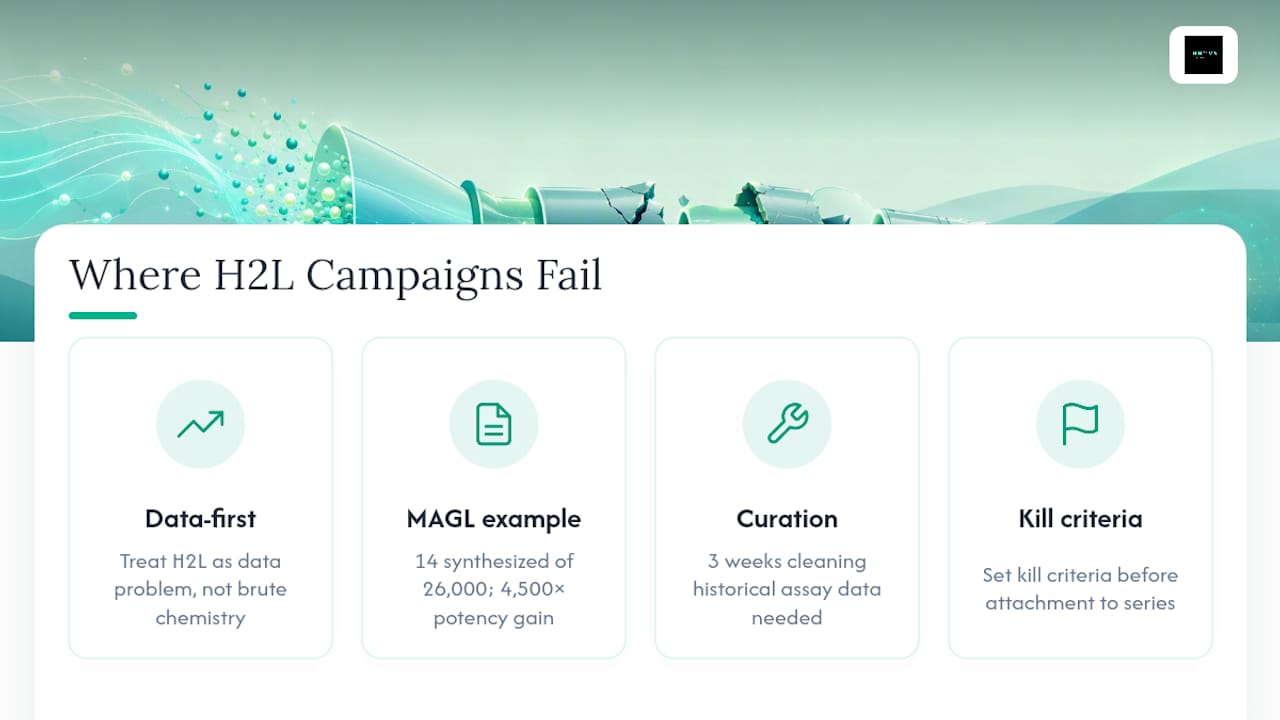
The Nature Communications MAGL work makes the point better than any generic advice could: synthesizing just 14 compounds out of over 26,000 virtual candidates and landing a 4,500-fold potency gain does not happen by making more molecules faster. It happens by making far fewer molecules, chosen far more carefully. That is the actual lesson, and it is uncomfortable for teams whose instinct under pressure is to synthesize their way out of uncertainty.
Where most teams underinvest is curation. Nobody wants to spend three weeks cleaning historical assay data before the interesting modeling work starts, but a GNN trained on inconsistent reaction records will confidently propose garbage. Fix the data before trusting the funnel. And set kill criteria before you are attached to a series, not after.
— Hooman
Get Data-Driven Hit-to-Lead Support From Innovabiotech
If your team is choosing between building an internal compute-to-bench funnel from scratch and bringing in a partner who already runs one, Innovabiotech skips the setup cost. We combine reaction-prediction filtering, selective RBFE/NES, and miniaturized synthesis validation into a single scoped engagement, so your chemists spend time on the analogs worth making rather than the ones a model could have ruled out.

This fits teams that have confirmed hits and a defined target but lack the internal bandwidth to run a full computational funnel alongside bench synthesis. It also fits teams that have tried an ML approach in-house and hit a wall on data curation, which is where most projects actually stall. Innovabiotech's protein design and virtual screening services extend naturally into H2L when a target needs structural work alongside the optimization campaign. Reach out with your target and current hit data, and we will scope a phased engagement with clear gate reviews built in from the start.
Sources
Readers who want the underlying methodology rather than a summary should go to the primary sources directly.
- Expediting hit-to-lead progression in drug discovery through reaction prediction and multi-dimensional optimization | Nature Communications
- Site Identification and Next Choice Protocol for Hit-to-Lead Optimization
- In silico-driven protocol for hit-to-lead optimization: a case study on PDE9A inhibitors | Journal of Computer-Aided Molecular Design
- Hit to lead
FAQ
What Does Lead Optimization Mean?
Lead optimization is the pipeline stage after H2L where a small number of prioritized series undergo intensive medicinal chemistry to improve potency, selectivity, and DMPK properties into a development candidate ready for preclinical studies.
What Is the Rule of Three in Drug Discovery?
The rule of three is a fragment-based screening guideline suggesting fragment hits should generally have lower molecular weight and limited hydrogen bond donors and acceptors, so there is room to grow the molecule during optimization without violating drug-likeness limits.
What Is the Difference Between a Hit and a Lead in Drug Discovery?
A hit is a confirmed active compound from screening with no guarantee of a balanced profile, while a lead is a compound that has cleared H2L with a balanced potency, DMPK, and selectivity profile that justifies further chemistry investment.
What Is the Rule of Five in Drug Discovery?
There is no single universally agreed "rule of five" separate from Lipinski's rule of five, which flags oral drug-likeness risk based on molecular weight, logP, and counts of hydrogen bond donors and acceptors. Definitions of a distinct "rule of five" for H2L specifically vary by source and are not standardized.
How Long Does a Hit-to-Lead Campaign Typically Take?
Timelines vary widely by target and resources, but integrated computational and HTE workflows have compressed full H2L cycles to around one month in published case studies, versus the several months a purely synthesis-driven approach usually requires, as shown in the MAGL study.