
Before you sign anything, a scoped bioinformatics project must produce four things on paper: a single decision endpoint (what the data must tell you), a scored deliverable such as a ranked hit list or annotated sequence set, a reproducible pipeline package, and quantified acceptance criteria tied to milestone payments. If your statement of work is missing any of those four, you're not buying a project. You're buying an open-ended favor.
TL;DR:
- A bioinformatics project scope must clearly define a decision endpoint, detailed deliverables, a reproducible pipeline, and quantified acceptance criteria tied to milestone payments.
- The scope should specify the exact data formats, validation methods, tool versions, and data security measures, especially when handling sensitive or clinical data.
- Milestones typically include data handoff, technical checkpoints, deliverable acceptance, and final handoff, with contingency budgeting for rework phases.
- Vendors should provide examples of similar projects, demonstrate operational reliability, and have clear reproducibility and version control practices.
- Contracts must be built around fixed milestones, acceptance tests, and exportable deliverables, with strong emphasis on early baseline reproducibility checks before full-scale work begins.
Table of Contents
- What Does Bioinformatics Project Scoping Actually Require?
- Technical Design and Data Requirements: Methods, Tooling, and Security
- Structuring the Contract: Milestones, Pricing, and IP Rights
- How Do You Vet a Contract Bioinformatics Provider?
- Getting the Project Started Without Losing Control of It
- How We Approach a Bioinformatics Scoping Consultation
- Ready to Scope Your Next Bioinformatics Project?
- Sources
- FAQ
What Does Bioinformatics Project Scoping Actually Require?
Bioinformatics project scoping means converting a research goal into a document both sides can sign against, not a general description of what a vendor is capable of doing. The single biggest failure mode in outsourced drug discovery and protein engineering work is a Project Description that describes activity instead of an endpoint. "Screen a compound library against target X" is activity. "Deliver 3 to 5 lead sequences with KD below 100 nM by SPR and confirmed functional activity in a cell-based assay" is a decision endpoint. Only one of those lets you know when the project is done.
A workable scope statement forces this translation early, before compute gets booked or a team gets staffed. It also needs to name the deliverables in enough detail that "finished" isn't a matter of opinion.
At minimum, insist on:
- Raw and processed data, in a documented format, handed back to you (not held on the vendor's system only)
- Annotated sequences or scored hit lists, with the scoring method disclosed
- A reproducible pipeline and environment, meaning containers or workflow files you could rerun independently
- A final technical report plus an executive summary written for a non-computational audience
- Interim progress reports at agreed checkpoints
Acceptance criteria are the part sponsors most often leave vague, and it's the part that causes the most billing disputes. State the exact assay (SPR, BLI, a specific functional readout), the numeric threshold, and who signs off on pass/fail. A public contract exhibit covering services agreements shows what mature buyers require as baseline: itemized deliverables, a defined time frame, and a milestone-tied payment schedule, with interim and final reports built in as standard, not optional, extras.
Pro Tip: Write the acceptance criteria before you write the budget. A vendor who balks at quantifying success is telling you something about how the project will end.
Technical Design and Data Requirements: Methods, Tooling, and Security
The technical approach in your SOW should map directly to your objective, not to whatever platform the vendor happens to sell. Virtual screening and hit-to-lead work produce scored compound rankings and require documented docking or scoring methods with stated false-positive rates. Structure-guided protein and peptide design produces candidate sequences plus predicted stability or binding metrics, validated against a held-out test case before you commit to synthesis. Each modality has a different validation plan, and your contract should name it.
Require the vendor to document the exact tool name, version number, and parameter set used for every major computational step. This sounds bureaucratic until a result needs replicating eighteen months later and nobody remembers which model version produced it. Guidance from the Life Sciences AI Handbook is blunt about this: match the tool to the workload, keep sensitive data on local infrastructure rather than external APIs, and never skip the evaluation step just because a tool is popular.
Your data section should specify:
- File formats and metadata standards for every dataset exchanged
- QC metrics reported alongside raw results, not buried in an appendix
- Provenance tracking sufficient to satisfy FAIR data principles
- Explicit rules on data flow: what leaves your systems, what stays local, and under what encryption
If any clinical or patient-derived data touches the project, HIPAA considerations aren't optional add-ons. Get an approved data-flow diagram in writing before a single API call goes out, and confirm retention and deletion terms in the contract itself, not a verbal assurance from a sales call.
Structuring the Contract: Milestones, Pricing, and IP Rights
Keep the Master Services Agreement for the boilerplate. Liability caps, confidentiality terms, indemnification, and general legal framework belong there because they rarely change project to project. The Statement of Work carries everything specific: the decision endpoint, deliverables, timeline, and price for this engagement.
A workable milestone structure usually looks like this:
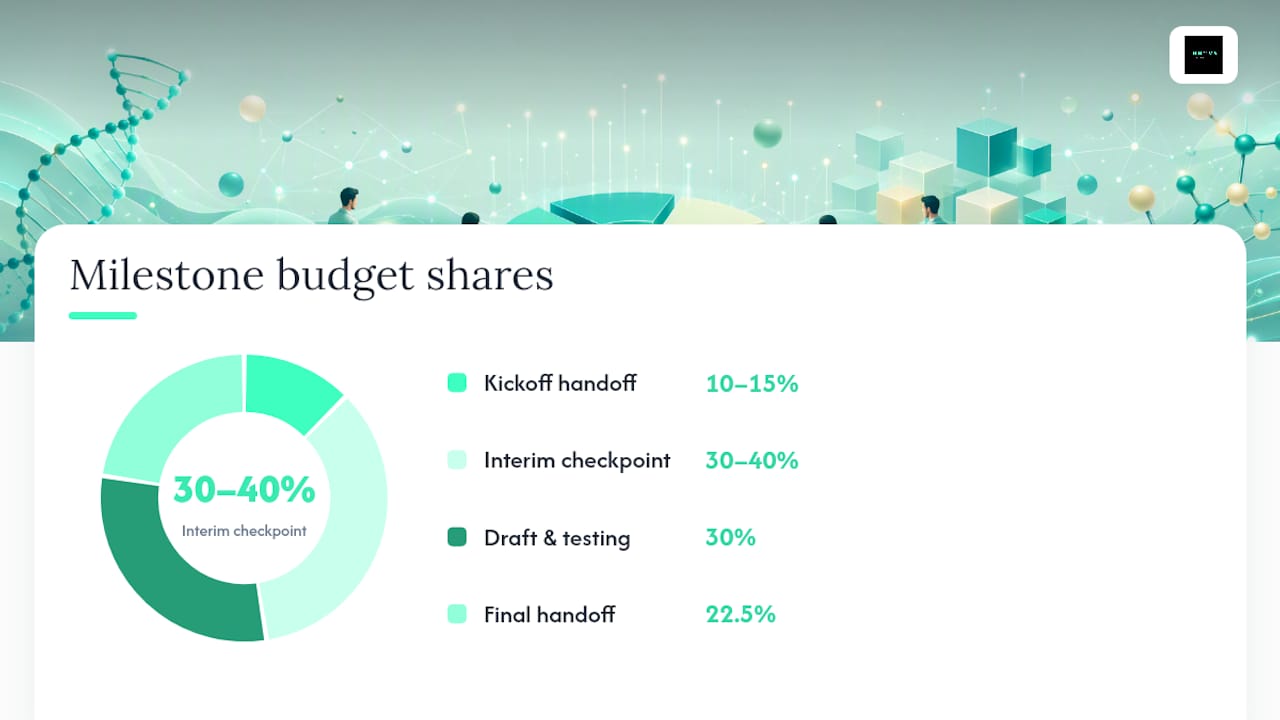
- Kickoff and data handoff (10 to 15% of budget) tied to a signed scope document and a baseline reproducibility check
- Interim technical checkpoint (30 to 40%) tied to a defined minimum viable experiment completed and reviewed
- Draft deliverable and acceptance testing (30%) tied to the scored hit list, sequence set, or design candidates meeting the stated thresholds
- Final report and handoff (remaining balance) tied to delivery of the reproducible pipeline, exportable data package, and executive summary
Build in a contingency line for rework. Virtual screening campaigns and design efforts frequently need a second pass, a re-pan on a scoring cutoff, or additional validation once early results come back ambiguous. Budgeting 10 to 15% extra for this up front is cheaper than renegotiating mid-project from a weak position.
On intellectual property, fee-for-service arrangements with royalty-free deliverables are the norm for sequence-level outputs unless you've specifically negotiated something else. Insist on exportable, CDMO-ready sequence packages so a later manufacturing partner isn't locked into your bioinformatics vendor's proprietary format.
How Do You Vet a Contract Bioinformatics Provider?
Ask for examples of similar targets before you ask about price. A provider who has run hit-to-lead campaigns against your target class, or designed peptides against a comparable structural fold, should be able to walk through what worked and what didn't, ideally under a mutual NDA if the specifics are sensitive. Guidance on choosing research partners consistently flags a platform-first sales pitch as a warning sign: a partner should start from your biological objective and explain trade-offs, not lead with which software they own.
Operational maturity matters as much as scientific chops, and the two get evaluated separately. A team with excellent modeling skills but no version control discipline or workflow automation will slip its own timelines. Ask directly:
- Who is the senior scientist actually running the program day to day, by name
- What reproducibility practices are standard (containerization, workflow managers, version-controlled code)
- What's a realistic timeline range for a program like yours, including likely re-pans
- Can they produce a sample reproducible pipeline artifact from a past project, redacted as needed
The CDMO selection framework used across biologics manufacturing applies just as well here: score scientific fit, operational reliability, and partnership culture as separate dimensions rather than treating compliance or credentials as a stand-in for all three. Vague acceptance criteria, reluctance to name the scientist on your program, or an inability to produce a rerunnable pipeline are all reasons to keep looking.
Getting the Project Started Without Losing Control of It
The first two weeks set the tone for everything after. Run this sequence:
- Formal data handoff with a documented format and provenance check
- A baseline reproducibility run to confirm the pipeline works on your actual data, not a demo dataset
- Agreement on a minimum viable experiment, an end-to-end run on one representative case that validates the approach before scaling to the full campaign
Weekly touchpoints and a milestone review at each contract checkpoint keep both sides honest. Any change to scope, timeline, or budget should route through a written change request tied to a specific decision gate, not a casual email thread. Keep a short risk register naming data quality issues, pipeline failure modes, and who owns resolving each one.
Pro Tip: Run the minimum viable experiment before committing full compute budget. If the pipeline breaks on one representative case, it will break on five hundred.
How We Approach a Bioinformatics Scoping Consultation
A scoping consultation should end with milestones and acceptance tests on paper, not a vague proposal. Innovabiotech converts a research goal into that structure during the initial call, then confirms it against a baseline reproducibility check in the first 30 to 60 days. Sponsors should expect a documented Project Description and an early technical checkpoint before full-scale work begins, consistent with the outsourcing guidance we publish for teams evaluating this decision.
— Hooman
Ready to Scope Your Next Bioinformatics Project?
Innovabiotech works from the decision endpoint backward, not the platform forward. That's the practical difference for R&D teams tired of proposals that describe activity instead of a testable outcome: every engagement starts with a scoping conversation that produces milestones, acceptance thresholds, and a reproducible deliverable package before any compute gets booked.
Whether your project centers on virtual screening and hit-to-lead optimization, protein and chimeric design, enzyme optimization, or de novo peptide design, the scoping process is the same discipline applied to different biology. Come to the first call with your research objective, whatever data you already have, your target decision endpoint, and a rough timeline. That's enough for a working draft of the Project Description before the call ends. Reach out to Innovabiotech to start a scoping consultation and get a contract-ready plan instead of another open-ended pitch.
Sources
For contract examples and deliverable checklists, see the SEC project exhibit. For tool selection and reproducibility practices, consult the Life Sciences AI Handbook toolkit and best practices for biological data analysis.
- Exhibit — Project and engagement structure (public contract example)
- Toolkit for AI-Augmented Bio Research – The Life Sciences AI Handbook
FAQ
What Should a Bioinformatics Project SOW Include at Minimum?
A defined time frame, itemized deliverables, quantified acceptance criteria, and a milestone-tied payment schedule are the baseline components, following standard project and engagement structures. Interim and final technical reports should also be listed as standard deliverables, not optional extras.
How Long Does a Typical Hit-to-Lead or Protein Design Engagement Take?
Timelines vary widely by target complexity and how many rounds of validation the acceptance criteria require, so ask any prospective provider for a realistic range based on comparable past programs rather than a generic estimate. Budgeting extra time and cost for at least one rework cycle is standard practice given how often initial thresholds need adjusting.
Who Owns the IP for Sequences Delivered Under a Bioinformatics Contract?
Fee-for-service arrangements typically deliver sequence-level outputs on a royalty-free basis to the sponsor, unless the contract specifically negotiates a different licensing structure. Confirm this in the SOW and insist on exportable, CDMO-ready packages so the deliverable isn't locked into a proprietary format.
What Data Security Terms Matter Most for Bioinformatics Outsourcing?
An approved data-flow diagram showing exactly what data leaves your systems, combined with explicit retention and access-control terms, should be settled before any external API calls happen. This matters even more when clinical or patient-derived data is part of the project scope.
Does Innovabiotech Offer Pricing for Bioinformatics Scoping Projects?
Pricing for virtual screening, hit-to-lead, protein design, enzyme optimization, and peptide design engagements is quoted per project based on scope, so current details are available by starting a scoping consultation directly with the Innovabiotech team.