
TL;DR:
- Biological data analysis services convert complex biological datasets into meaningful insights for research and drug development.
- Early involvement of bioinformaticians during experimental design prevents costly technical issues and improves data quality.
Biological data analysis services are defined as the systematic process of transforming raw biological datasets, including genomic, transcriptomic, and proteomic data, into interpretable scientific insights that drive research and drug development decisions. For biotech and pharmaceutical researchers, these services sit at the intersection of computational biology and experimental science. They determine whether a dataset becomes a published finding or an expensive dead end. Innovabiotech, founded in 2024 and based in San Francisco, California, delivers tailored bioinformatics services across this exact workflow. The demand for expert biological research data analysis has grown sharply as datasets have grown larger and more complex than any single research team can handle alone.
What do biological data analysis services include?
Biological data analysis services cover the full analytical pipeline from raw data intake to publication-ready output. End-to-end workflows include alignment, quality control, statistical interpretation, and functional analysis, each tailored to the specific research question. No two projects use the same configuration, because the sequencing platform, sample type, and biological hypothesis each shape the pipeline differently.
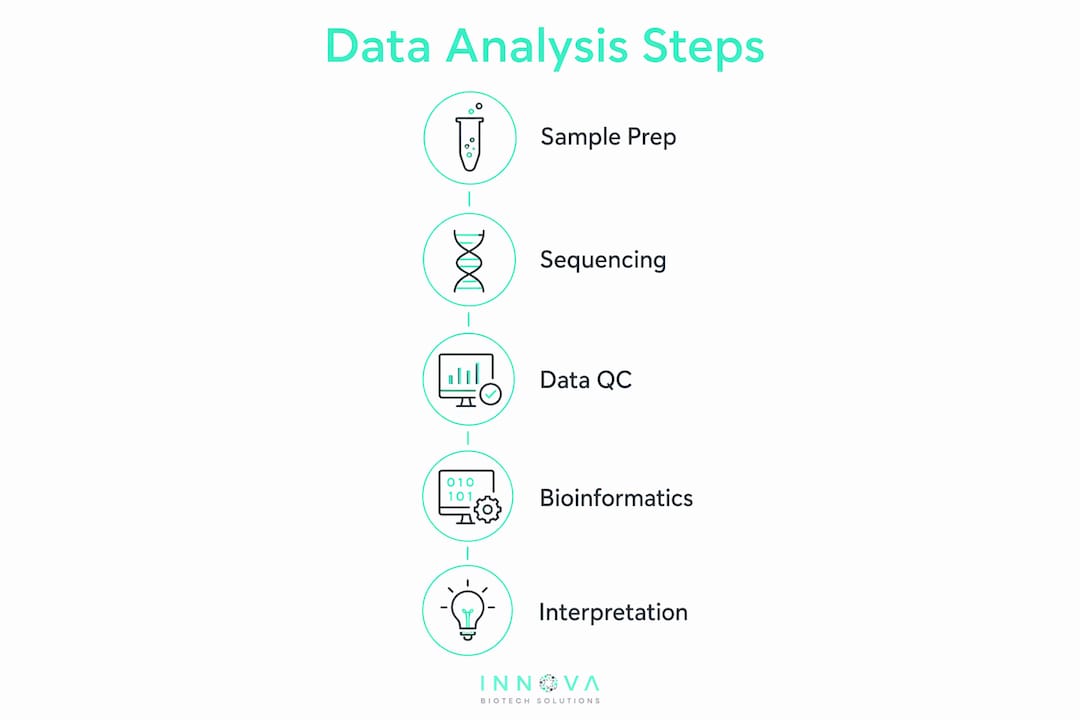
A typical service engagement follows four defined stages:
- Requirement gathering. The provider collects project specifications, including sample metadata, sequencing platform, and research objectives.
- Proposal and quotation. The team defines the analytical approach, deliverables, and timeline based on the gathered requirements.
- Data processing and analysis. Raw data moves through preprocessing, quality control, statistical analysis, and pathway or functional interpretation.
- Data reporting. The provider delivers figures, annotated results, and a written report structured for direct use in manuscripts or regulatory submissions.
Standard turnaround for transcriptomic analysis runs approximately four weeks, with faster options available for standardized packages. That timeline assumes clean data handoff and clear communication at the requirement stage. Delays almost always trace back to ambiguous project briefs or incomplete metadata.
Typical projects span RNA sequencing analysis, single-cell transcriptomics, epigenomics, and metagenomics. Each technology generates distinct data structures that require specialized handling. A provider experienced in bulk RNA-seq may not have the same depth in spatial transcriptomics, so matching expertise to technology matters.

Pro Tip: Before your first call with a provider, prepare a one-page project brief that specifies your sequencing platform, sample count, organism, and the biological question you are answering. This single document cuts requirement gathering time in half and produces a more accurate proposal.
What technical challenges do expert providers solve?
The most common failure point in biological data analysis is not the analysis itself. It is data harmonization. Batch effect correction and data harmonization across platforms and instruments are the primary technical barriers that off-the-shelf tools consistently fail to address. This is especially true in multi-site studies where samples are processed on different instruments or at different times.
Common technical challenges that expert providers address include:
- Identifier reconciliation. Gene and protein identifiers differ across databases and reference versions. Providers check for identifier mismatches and reference genome version discrepancies before any integration step.
- Batch effect correction. Systematic technical variation introduced during sample processing can mask or mimic biological signal. Correcting it requires statistical methods and biological judgment together.
- Reference genome inconsistencies. Using mismatched genome builds across samples produces alignment errors that propagate through the entire analysis.
- Heterogeneous dataset integration. Combining data from different omic layers, such as genomics and proteomics, requires careful normalization and compatibility checks.
Automation and AI support processing large datasets efficiently, but they cannot replace human biological interpretation. A pipeline can flag a differentially expressed gene; only an experienced bioinformatician can determine whether that finding is biologically meaningful or a technical artifact. That distinction separates a publishable result from a misleading one.
Early bioinformatics involvement in experimental design prevents many of these problems before they occur. When a bioinformatician reviews your study design before sample collection begins, they can flag potential confounders, recommend appropriate controls, and specify metadata requirements. Fixing a batch effect after the fact costs far more time and money than preventing it upfront.
Pro Tip: Bring your bioinformatics partner into the conversation during experimental design, not after data collection. A 30-minute design review can prevent weeks of remediation work downstream.
How to evaluate biological data analysis service providers
Pricing for bioinformatics services is customized based on sequencing platform, coverage depth, and cohort size. No credible provider offers a fixed price list without first reviewing project specifications. Any provider offering flat-rate packages without reviewing your data should be treated with caution.
The table below summarizes the key criteria for evaluating a provider:
| Evaluation criterion | What to look for |
|---|---|
| Technology platform expertise | Direct experience with your specific omic data type, such as single-cell or spatial transcriptomics |
| Reproducibility standards | Versioned, containerized pipelines and reproducible reports enabling audit-ready delivery |
| Deliverable quality | Publication-ready figures, annotated results, and version-controlled code |
| Data security | Clear data handling policies, especially for clinical or patient-derived samples |
| Communication approach | Defined points of contact, progress updates, and responsiveness to technical questions |
| Turnaround guarantees | Written timeline commitments tied to project milestones |
Reproducibility is the criterion most researchers underweight. A provider who delivers results without documented pipelines forces you to re-run the analysis from scratch if a reviewer requests changes. Reproducible pipelines and version-controlled workflows are not a luxury. They are a prerequisite for any publication or regulatory submission.
For large biological dataset analysis, the provider's infrastructure matters as much as their scientific expertise. Ask whether they use containerized environments such as Docker or Singularity, and whether their code is deposited in a version-controlled repository.
Pro Tip: Request a "handover package" as a named deliverable in your contract. This package should include all scripts, environment files, and a README that allows your internal team to reproduce every result independently.
How do these services accelerate biotech and pharma R&D?
Multi-omic integration enables biomarker discovery and drug response prediction by combining genomic, transcriptomic, and proteomic data layers. This approach produces a richer biological picture than any single data type can provide. For precision medicine applications, it is the difference between identifying a candidate target and understanding the full mechanism behind it.
Key benefits that biotech and pharmaceutical teams gain from professional data analytics for biology include:
- Faster decision-making. Clean, interpreted data reaches decision-makers weeks earlier than in-house processing typically allows.
- Improved data quality. Expert quality control catches errors that automated pipelines miss, reducing the risk of downstream failures.
- Regulatory compliance support. Providers familiar with FDA and EMA data standards produce outputs formatted for submission packages.
- Biomarker discovery. Systematic analysis of large patient cohorts identifies statistically validated biomarkers for clinical development.
- Drug target validation. Transcriptomic and proteomic analysis confirms whether a proposed target is expressed and accessible in the relevant tissue.
Consider a translational research team working on a Phase I oncology program. They collect tumor biopsies from 40 patients and need to identify predictive biomarkers of drug response. A clinical data analysis services provider processes the RNA-seq data, integrates it with proteomic profiles, and delivers a ranked list of candidate biomarkers with supporting pathway analysis. That output directly informs patient stratification for Phase II. Without expert analysis, the same dataset would take months longer to interpret and carry a higher risk of analytical error.
Bioinformatics services also support hit-to-lead optimization by identifying off-target effects early in the drug discovery process. This application alone can prevent costly late-stage failures. The return on investment for professional life sciences data consulting is clearest at the stages where bad data costs the most: target selection and clinical candidate nomination.
Key Takeaways
Biological data analysis services deliver the most value when providers combine reproducible computational pipelines with expert human interpretation at every stage of the research workflow.
| Point | Details |
|---|---|
| Four-stage engagement | Effective projects follow requirement gathering, proposal, analysis, and reporting in sequence. |
| Early collaboration matters | Involving bioinformatics experts during experimental design prevents costly batch effects and data errors. |
| Reproducibility is non-negotiable | Providers must deliver versioned pipelines and version-controlled code for publication and regulatory use. |
| Multi-omic integration drives discovery | Combining genomic, transcriptomic, and proteomic data layers enables biomarker discovery and target validation. |
| Pricing reflects project complexity | No credible provider offers fixed rates without reviewing sequencing platform, cohort size, and coverage depth. |
What I have learned from watching teams get this wrong
The most expensive mistake I see biotech teams make is treating bioinformatics as a post-experiment service. They collect samples, run sequencing, and then call a provider to "analyze the data." By that point, half the problems are already baked in. Batch effects are locked in. Metadata is incomplete. The reference genome version was never documented. Fixing those issues after the fact is slow, expensive, and sometimes impossible.
The second mistake is over-trusting automated pipelines. I have reviewed reports where a standard RNA-seq pipeline flagged hundreds of differentially expressed genes, and the research team treated every one as biologically real. No experienced bioinformatician would do that. Context matters. A gene that appears upregulated in one condition might reflect a technical artifact from low-coverage samples. Human review catches that. Automation does not.
The providers worth working with are the ones who push back on your experimental design before they accept your data. That friction is a sign of quality, not obstruction. Transparent workflows and reproducibility commitments are the two things I would never compromise on when selecting a partner. Everything else, including turnaround time and price, is negotiable. Those two are not.
If you are evaluating biotech outsourcing options for your next program, start by asking every candidate provider to show you a sample handover package from a completed project. What they show you will tell you everything about how they work.
— Hooman
Innovabiotech's approach to biological data solutions
Innovabiotech supports biotech and pharmaceutical researchers who need more than raw data processing. The team applies bioinformatics validation across peptide design services, protein engineering, and enzyme optimization, connecting computational analysis directly to drug development workflows. Every project starts with a direct consultation to define scope, timeline, and deliverables before any work begins.
Researchers working on de novo peptide design, hit-to-lead optimization, or target validation can engage Innovabiotech for custom solutions built around their specific dataset and research question. The team's approach combines computational biology with transparent project management, so you always know where your project stands. Contact Innovabiotech to discuss your next program.
FAQ
What does a biological data analysis service typically deliver?
A professional service delivers quality-controlled, statistically interpreted results alongside publication-ready figures, reproducible pipelines, and version-controlled code. Most standard transcriptomic projects are completed in approximately four weeks.
Why is human expertise still needed alongside automated bioinformatics tools?
Automation processes large datasets efficiently but cannot determine whether a finding is biologically meaningful or a technical artifact. Expert bioinformaticians provide the contextual interpretation that turns computational output into reliable scientific conclusions.
How is bioinformatics service pricing determined?
Pricing is customized based on sequencing platform, coverage depth, and cohort size. No credible provider offers a fixed price without first reviewing the project specifications in detail.
What is multi-omic integration and why does it matter for drug discovery?
Multi-omic integration combines genomic, transcriptomic, and proteomic data layers to produce a complete biological picture. This approach enables biomarker discovery and drug response prediction that single-omic analysis cannot achieve.
When should a bioinformatics partner be involved in a research project?
The optimal time is during experimental design, before sample collection begins. Early involvement allows the provider to prevent batch effects, specify metadata requirements, and confirm that the data collected will answer the research question.