

TL;DR:
- Bioinformatics validation for peptides confirms sequence accuracy and predicts function using computational and analytical methods. De novo sequencing algorithms like DiNovo and π-HelixNovo2 enable identification of novel peptides and modifications beyond database searches. Combining structural and sequence data improves prediction accuracy and guides design, while orthogonal techniques verify purity, identity, and safety before biological testing.
Bioinformatics validation for peptides is the process of confirming peptide sequence accuracy and functional potential using computational tools combined with analytical methods. In pharmaceutical and biotech research, this validation step sits between synthesis and biological testing. Skip it, and you risk advancing candidates with incorrect sequences, poor bioactivity, or contamination that invalidates your assay results. The field now integrates de novo sequencing algorithms like DiNovo and π-HelixNovo2, structure-aware platforms like PepAnno, and orthogonal lab methods governed by standards including USP <85> and ICH Q2(R1). Together, these approaches define what rigorous peptide sequence validation looks like in 2026.
What are the primary computational methods for peptide sequence validation?
Computational peptide sequence validation has moved well beyond simple database matching. Traditional database search methods depend on known protein sequences, which means any novel peptide, post-translational modification (PTM), or non-tryptic fragment can be missed entirely. De novo sequencing solves this by reading amino acid sequences directly from mass spectrometry data, without relying on a reference database.

DiNovo represents one of the most significant advances in this space. It uses multiple mirror protease digestion pairs combined with deep learning algorithms to dramatically increase coverage. DiNovo sequences 154%–195% more high-confidence amino acids and identifies 29%–34% more high-confidence proteins than trypsin alone. That gap matters when you are trying to confirm the identity of a novel therapeutic peptide with no database entry.
π-HelixNovo2 takes a complementary approach using Transformer-based deep learning frameworks. It handles antibody peptides, multi-enzyme substrates, and non-enzymatic peptides through integrated online platforms, making it accessible to researchers who are not bioinformatics specialists. The practical benefit is reliable peptide identification across a wider range of sample types than any single-enzyme method can cover.
Key advantages of de novo sequencing over database-dependent methods include:
- Novel peptide discovery: Identifies sequences with no database equivalent, critical for first-in-class candidates.
- PTM detection: Captures modifications that database searches routinely miss.
- Mirror protease strategy: Using complementary enzyme pairs generates overlapping fragments that cross-validate each amino acid call.
- Deep learning accuracy: Neural network models reduce misassignment errors that plagued earlier de novo algorithms.
Pro Tip: When running de novo sequencing on a new peptide candidate, use at least two orthogonal protease pairs. The overlapping fragment coverage dramatically reduces false-positive amino acid assignments.
Moving beyond protein databases is vital for modern peptide validation, enabling discovery of novel peptides and PTMs that traditional database searches routinely miss. This is not a minor technical upgrade. It is a fundamental shift in how you confirm what you actually synthesized.
How do integrated platforms improve peptide bioactivity prediction?
Sequence data alone tells you what a peptide is. It does not tell you what it does. Structure-aware platforms address this gap by combining sequence embeddings with 3D structural graphs to predict functional behavior before you run a single bioassay.
PepAnno is the clearest example of this approach. It uses a cross-modal attention mechanism to fuse sequence and structural information, then predicts seven major bioactivities with accuracy that outperforms existing multi-functional peptide predictors. The platform also provides residue-level interpretability, so you can see which amino acids drive a predicted activity. That level of detail directly informs design decisions.
The seven bioactivity categories PepAnno addresses span the most therapeutically relevant peptide functions:
- Antimicrobial activity
- Antiviral activity
- Antifungal activity
- Anticancer activity
- Antihypertensive activity
- Anti-inflammatory activity
- Cell-penetrating behavior
Integrating 3D structural graphs with sequence embeddings enhances both prediction accuracy and interpretability, directly addressing the core limitation of purely sequence-based models. The practical implication is that you can prioritize candidates computationally before committing resources to synthesis and wet lab testing.
High-throughput capability matters too. Platforms designed for batch processing can handle thousands of peptides simultaneously, scoring bioactivity predictions using advanced distance metrics. That throughput changes how you approach early-stage screening. Instead of testing 20 candidates in the lab, you screen 500 computationally and advance only the top tier.
Pro Tip: Use residue-level interpretability outputs from structure-aware platforms to guide your next round of sequence modifications. If a single residue drives 60% of a predicted activity score, that is your most valuable optimization target.
For researchers working on structural bioinformatics in pharma R&D, the shift from sequence-only to structure-aware modeling is the single biggest efficiency gain available right now.
What experimental analytical techniques complement bioinformatics for peptide validation?
Computational validation tells you what a peptide should be. Analytical validation confirms what it actually is. Three orthogonal methods form the standard workflow: reversed-phase HPLC (RP-HPLC) for purity, mass spectrometry for identity, and endotoxin testing for biological relevance.
RP-HPLC and mass spectrometry
RP-HPLC quantifies the proportion of the main peak in your sample. A high purity percentage looks reassuring, but purity percentages can be inflated depending on UV wavelength and column chemistry. Two peptides with identical RP-HPLC profiles can have completely different sequences if co-eluting impurities are present. Mass spectrometry resolves this. For peptides under 3 kDa, molecular mass confirmation within ~0.5 Da on MALDI-TOF or within a few ppm on high-resolution instruments is the accepted standard. ESI-MS adds the ability to detect charge state distributions, which helps confirm folding and disulfide bond formation in cyclic or constrained peptides.
| Method | What it confirms | Key limitation |
|---|---|---|
| RP-HPLC | Purity percentage | Cannot confirm sequence identity |
| ESI-MS / MALDI-TOF | Molecular mass and identity | Does not quantify impurity levels |
| LAL / rFC endotoxin assay | Biological safety for in vitro/in vivo use | Does not assess peptide structure |
Endotoxin testing
A peptide with 99% purity can still fail biological testing. High endotoxin levels invalidate bioactivity assays, because lipopolysaccharides trigger immune responses that mask or amplify the peptide's actual effect. USP <85> and USP <86> mandate LAL or recombinant Factor C (rFC) assays for any peptide intended for biological studies. This step is non-negotiable for in vivo work and strongly recommended for any cell-based assay.
Best practice combines all three methods in sequence: run RP-HPLC first to assess purity, confirm identity with MS, then clear the batch with an endotoxin assay before advancing to biological testing.
What are common pitfalls in bioinformatics validation of peptides?
The most common error in peptide validation is treating a high purity number as proof of identity. HPLC purity assesses the main peak proportion but cannot confirm sequence correctness. Researchers who skip mass spectrometry confirmation have advanced the wrong peptide into expensive bioassays. The fix is simple: always pair RP-HPLC with MS, regardless of how clean the chromatogram looks.
A second pitfall is relying on sequence data without structural context. A peptide sequence can look correct while the 3D conformation is completely wrong for the intended target. Structure-aware validation catches this before synthesis. The third pitfall involves method validation itself. Regulatory batch release requires documenting linearity, precision, and reproducibility per ICH Q2(R1), including system suitability criteria like %RSD < 2% and R² > 0.99. Research labs focused on speed routinely skip this documentation, which creates problems at the regulatory submission stage.
Common validation mistakes to avoid:
- Reporting purity without identity confirmation
- Using a single protease for de novo sequencing
- Skipping endotoxin testing for cell-based assays
- Failing to document system suitability parameters for HPLC methods
- Treating computational predictions as final without orthogonal experimental confirmation
Pro Tip: Build a validation checklist that requires sign-off on all three orthogonal methods before any peptide advances to biological testing. This single process change prevents the most expensive errors in peptide R&D.
Researchers working through common peptide synthesis challenges will recognize that many late-stage failures trace back to validation gaps at this stage, not synthesis errors.
How to apply these validation strategies in peptide design workflows
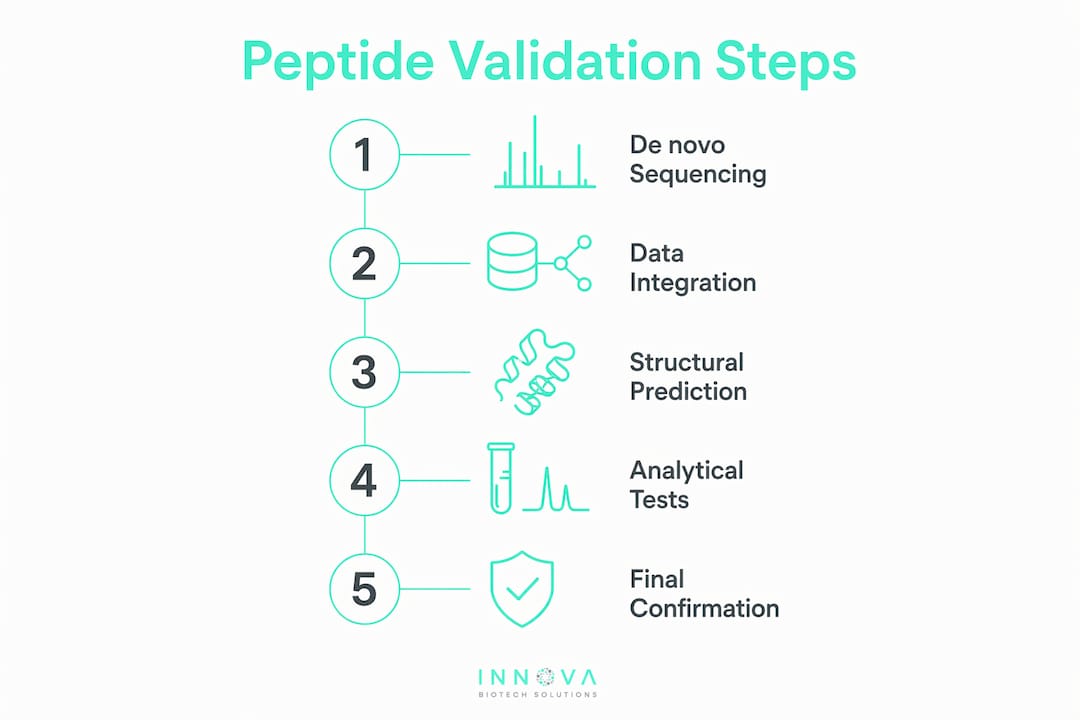
Integrating computational and analytical validation into a single workflow is where efficiency gains become real. The sequence below reflects how leading biotech and pharma teams structure their peptide design and validation pipelines.
- Run de novo sequencing first. Use DiNovo or π-HelixNovo2 to confirm the synthesized sequence matches the design. Do not assume synthesis was correct without sequence-level confirmation.
- Apply structure-aware bioactivity prediction. Feed confirmed sequences into a platform like PepAnno to predict functional behavior across relevant bioactivity categories before committing to biological testing.
- Prioritize candidates computationally. Use batch processing to score hundreds of variants simultaneously. Advance only the top-ranked candidates to wet lab synthesis.
- Confirm purity and identity analytically. Run RP-HPLC and mass spectrometry on every synthesized batch. Document results against ICH Q2(R1) criteria.
- Clear endotoxin testing before biological studies. Apply LAL or rFC assays to every batch destined for cell-based or in vivo work.
- Iterate based on residue-level data. Use interpretability outputs from structure-aware platforms to guide the next design cycle, targeting specific residues that drive or limit predicted activity.
This workflow applies directly to de novo peptide design programs, where no reference sequence exists and every validation step carries extra weight.
Key Takeaways
Rigorous bioinformatics validation for peptides requires de novo sequencing, structure-aware bioactivity prediction, and orthogonal analytical confirmation working together as a single integrated workflow.
| Point | Details |
|---|---|
| De novo sequencing beats database search | DiNovo identifies up to 195% more high-confidence amino acids than trypsin-only methods. |
| Structure-aware platforms predict function | PepAnno combines sequence and 3D data to predict seven bioactivities with residue-level detail. |
| Purity alone does not confirm identity | RP-HPLC must be paired with mass spectrometry to verify sequence correctness. |
| Endotoxin testing is non-negotiable | A 99% pure peptide with high endotoxin levels will invalidate biological assay results. |
| Method validation requires documentation | ICH Q2(R1) demands linearity, precision, and reproducibility records for regulatory batch release. |
The shift I keep watching in peptide validation
The transition from sequence-only models to structure-aware validation is the most consequential change I have seen in this field in years. For a long time, confirming a peptide sequence felt like enough. You ran a database search, got a match, and moved on. The problem is that a correct sequence does not guarantee correct function. A peptide that folds differently than predicted, or that carries a PTM your database search missed, can waste months of downstream work.
What genuinely changed my thinking was watching structure-aware platforms generate residue-level interpretability data. When you can see exactly which amino acid drives a predicted antimicrobial score, you stop treating validation as a checkbox and start treating it as a design tool. That reframe is where the real efficiency gain lives.
The remaining challenge is adoption speed. Many research teams still treat endotoxin testing as optional for cell-based assays, and still report purity without identity confirmation. These are not minor oversights. They are the source of most late-stage failures I have seen in peptide programs. The tools to prevent them exist right now. The barrier is workflow discipline, not technology.
Deep learning methods like π-HelixNovo2 are also making de novo sequencing accessible to labs without dedicated bioinformatics staff. That accessibility matters. The more teams that can run sequence-level confirmation as a routine step, the fewer candidates will advance on false confidence.
— Hooman
Innovabiotech's peptide validation and design services
Innovabiotech works with biotech and pharmaceutical researchers who need more than off-the-shelf bioinformatics tools. The team applies de novo sequencing, structure-aware prediction, and analytical validation methods to each project, building workflows around the specific requirements of your peptide program.
Whether you are designing first-in-class therapeutic peptides or optimizing an existing candidate series, Innovabiotech's peptide design services cover the full validation pipeline from sequence confirmation through bioactivity prediction. The team also supports protein engineering projects where peptide-protein interactions require structural modeling alongside sequence analysis. Every engagement includes direct scientific communication from consultation through delivery.
FAQ
What is bioinformatics validation for peptides?
Bioinformatics validation for peptides is the process of confirming peptide sequence accuracy and predicting functional behavior using computational tools, including de novo sequencing algorithms and structure-aware bioactivity platforms, before or alongside experimental testing.
How does de novo sequencing differ from database search methods?
De novo sequencing reads amino acid sequences directly from mass spectrometry data without a reference database. This approach identifies novel peptides and PTMs that database-dependent methods miss entirely.
Why is RP-HPLC purity not enough to validate a peptide?
RP-HPLC measures the proportion of the main chromatographic peak but cannot confirm sequence identity. Co-eluting impurities can inflate purity readings, so mass spectrometry confirmation is always required.
What does ICH Q2(R1) require for peptide method validation?
ICH Q2(R1) requires documented evidence of method linearity, precision, specificity, and reproducibility, including system suitability criteria such as %RSD < 2% and R² > 0.99 for HPLC methods used in regulatory batch release.
When is endotoxin testing required for peptide batches?
Endotoxin testing using LAL or rFC assays is required for any peptide batch intended for in vitro cell-based assays or in vivo studies, as lipopolysaccharide contamination can severely distort bioactivity results regardless of peptide purity.
Recommended
- Bioinformatics Peptide Optimization: A 2026 Guide for Pharma
- Innova Biotech Solutions: Expert Peptide Design and Optimization Services.bioinformatics validation, custom peptides, peptide design services
- Common Peptide Synthesis Challenges: A 2026 Guide
- Peptide Therapeutic Development Process: 2026 Guide