
TL;DR:
- Biotechnology consulting services help biotech firms advance research, navigate regulation, and improve market access strategies. Innovabiotech provides tailored scientific, regulatory, and commercial support, especially in computational biology and evidence development. Engaging the right model early ensures faster progress, better outcomes, and more efficient resource use.
Biotechnology consulting services are specialized advisory engagements that help biotech and pharmaceutical companies advance R&D, align clinical development with commercialization, and build evidence strategies that satisfy regulators and payers. The industry term for this practice is "life sciences consulting," though "biotechnology consulting services" captures the full scope of scientific, regulatory, and commercial guidance these firms provide. Innovabiotech, based in San Francisco, delivers exactly this kind of tailored support, combining computational biology, bioinformatics, and deep scientific expertise to move drug discovery programs forward with precision. Whether you are a startup building your first pipeline or an established pharma company restructuring a portfolio, the right consulting partner changes outcomes.
What do biotechnology consulting services actually cover?
Biotechnology consulting services span four core domains: R&D strategy, regulatory affairs consulting, health economics and outcomes research (HEOR), and commercial planning. Each domain connects to the others. A regulatory gap discovered late in development can collapse a commercial timeline. A weak evidence package can block payer access even after FDA approval. Consultants who work across all four domains simultaneously prevent these failures before they happen.

Biotech advisory services also include biotech market analysis, which maps competitive positioning, pricing benchmarks, and unmet clinical need. This analysis feeds directly into portfolio decisions. A company choosing between two indication expansions, for example, needs market data tied to clinical feasibility and regulatory precedent, not just revenue projections.
Custom biotech solutions address the gaps that standard advisory cannot fill. These include computational modeling for target identification, virtual screening for lead selection, and hit-to-lead optimization. Innovabiotech specializes in these technical services, which sit at the intersection of scientific execution and strategic consulting. Teams that combine both capabilities move faster and waste less capital.
How do consulting engagement models and timelines work?
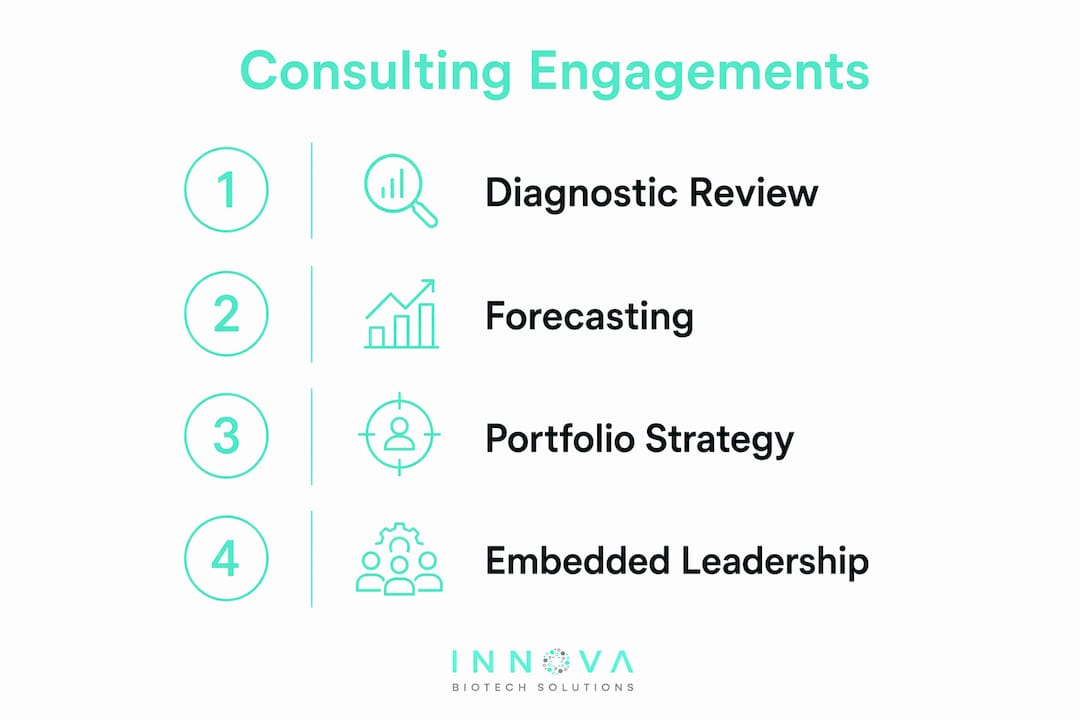
Consulting engagements follow predictable structures, and knowing which model fits your situation saves time and money. Diagnostic reviews last 2–3 weeks, covering a defined scope such as pipeline prioritization, regulatory readiness, or commercial gap analysis. These short engagements produce a clear picture of where a program stands and what needs to change.
Forecasting and portfolio restructuring engagements run 4–8 weeks. They require deeper data access, leadership alignment sessions, and iterative modeling. These are the right choice when a company faces a major inflection point, such as a Series B raise, a pivotal trial design decision, or a licensing negotiation.
| Engagement type | Typical duration | Primary deliverable |
|---|---|---|
| Diagnostic review | 2–3 weeks | Gap analysis and priority recommendations |
| Forecasting and portfolio strategy | 4–8 weeks | Financial models and portfolio roadmap |
| Embedded leadership | Ongoing | Execution accountability and milestone management |
| Regulatory affairs consulting | Project-based | Submission strategy and agency interaction plans |
| Evidence and market access | Continuous | HEOR dossiers and payer engagement plans |
Aligning the consulting timeline with your development milestones is not optional. A forecasting engagement that ends two weeks before a board meeting delivers no value if the outputs are not integrated into the presentation. Biotech project management discipline, applied from day one of a consulting engagement, keeps deliverables connected to decisions.
Pro Tip: Before signing a consulting agreement, map your next three internal decision points and confirm the engagement timeline ends at least one week before each. This forces the consulting scope to serve real decisions, not just produce reports.
How do consultants support AI integration in biotech R&D?
AI integration in biotech R&D is not a technology problem. It is a strategy problem. Most early-stage companies have access to AI tools but lack a plan for connecting those tools to clinical development timelines, regulatory submissions, and commercial milestones. This is where life sciences consulting creates measurable value.
The 90-Day AI Readiness Roadmap provides a structured framework for early-stage biotech companies. It includes eight weeks of intensive preparation that aligns AI-powered R&D with clinical and commercial milestones. Consultants using this framework audit existing data infrastructure, identify model validation requirements, and map AI outputs to regulatory-acceptable evidence standards.
Specific areas where AI consulting accelerates drug discovery include:
- Virtual screening: AI models rank compound libraries by predicted binding affinity, reducing wet-lab screening costs significantly
- Hit-to-lead optimization: Machine learning identifies structural modifications that improve potency and selectivity before synthesis
- De novo peptide design: Generative models propose novel sequences with target-specific activity, a core capability at Innovabiotech
- Protein engineering: AI predicts stability and function changes from sequence modifications, shortening design cycles
- Biomarker identification: Pattern recognition in multi-omics datasets surfaces patient stratification signals earlier in development
Consultants who specialize in precision biotech solutions connect these technical capabilities to business outcomes. They translate AI model outputs into language that satisfies FDA reviewers, payer medical directors, and investors simultaneously. That translation work is where most internal teams lack bandwidth.
Pro Tip: Engage an AI strategy consultant before you select your computational platform. Platform choices made without a regulatory and commercial strategy often require expensive rework when submission requirements become clear.
What strategic advisory services improve evidence generation and market access?
Evidence generation and market access alignment represent the highest-stakes area of biotech advisory services. Integrating evidence, HEOR, and market access as a single coordinated program reduces risk and improves payer acceptance compared to managing these functions separately. The logic is straightforward: payers evaluate clinical evidence, cost-effectiveness data, and real-world outcomes together. Siloed teams that produce these separately create gaps that payers exploit during coverage negotiations.
The Flexible Integrated Team (FIT) model addresses this problem directly. One accountable team maintains continuous ownership of evidence generation and market access strategy, adapting as the program evolves through approval and post-launch. This continuity prevents the knowledge loss that occurs when separate vendors hand off work at each development phase.
| Approach | Evidence ownership | Market access alignment | Regulatory coordination | Post-launch adaptability |
|---|---|---|---|---|
| Integrated advisory (FIT model) | Single team, continuous | Built into evidence plan | Real-time | High |
| Siloed advisory | Fragmented across vendors | Reactive and delayed | Periodic | Low |
Successful biotech firms integrate evidence, HEOR, and market access from the outset for better payer engagement and regulatory approval. Starting this integration at Phase II, rather than Phase III, gives the evidence team enough time to design studies that answer both regulatory and payer questions in a single trial. That efficiency reduces total development cost and compresses the timeline to first revenue.
Innovabiotech's approach to custom biotech solutions reflects this integrated philosophy. Scientific work, from bioinformatics validation to protein engineering, connects directly to the evidence requirements that regulators and payers will eventually scrutinize.
How does embedded leadership consulting differ from traditional advisory?
Traditional consulting delivers recommendations. Embedded leadership delivers results. High-value biotech consulting shifts from slide-deck advisory to embedded models where consultants share accountability with internal teams for execution and outcomes. This distinction matters most for companies with thin internal teams, which describes the majority of clinical-stage biotechs.
Embedded consultants fill specific leadership gaps without the cost and delay of full-time hiring. Common roles include fractional Chief Medical Officer, interim Head of Regulatory Affairs, and project-based Commercial Strategy Lead. These consultants activate quickly because they bring existing regulatory knowledge and cross-functional networks.
Consulting partners rapidly fill niche regulatory knowledge gaps without lengthy onboarding. A consultant familiar with the 505(b)(2) regulatory pathway, for example, can design a submission strategy in days rather than the weeks it would take an internal hire to reach the same level of competence. This speed directly protects development timelines.
The strategic value of embedded leadership extends beyond execution:
- Investor alignment: Senior-led consulting bridges clinical milestones and investor narratives, protecting valuation at each fundraising round
- Regulatory continuity: Embedded consultants maintain agency relationships across multiple submissions, building institutional credibility
- Cross-functional coordination: A single embedded leader who spans clinical, regulatory, and commercial reduces the coordination failures that delay programs
- Risk visibility: Consultants with broad portfolio experience recognize risk patterns earlier than internal teams seeing a problem for the first time
Boutique life science alliances maintain networks of over 600 specialized consultants globally, providing cross-functional GxP compliance and technical support that individual firms cannot replicate internally. That scale means the right expert is available quickly, regardless of how niche the requirement. For biotech outsourcing decisions, this network access is often the deciding factor.
Key Takeaways
Biotechnology consulting services deliver the most value when scientific expertise, regulatory knowledge, and commercial strategy operate as a single integrated program rather than separate workstreams.
| Point | Details |
|---|---|
| Match engagement type to your timeline | Diagnostic reviews fit gap analysis needs; portfolio engagements require 4–8 weeks for meaningful output. |
| Integrate AI strategy early | Align AI tools with regulatory and commercial milestones before selecting a computational platform. |
| Use the FIT model for evidence | One accountable team managing evidence, HEOR, and market access outperforms siloed vendor approaches. |
| Choose embedded over advisory-only | Consultants who share execution accountability protect timelines and capital more effectively than report-only advisors. |
| Align clinical and investor narratives | Senior-led consulting prevents the valuation erosion that follows misaligned milestone communication. |
What I have learned about choosing the right biotech consultant
After working across early-stage and late-stage biotech programs, the single biggest mistake I see companies make is hiring a consultant to solve a symptom rather than the underlying problem. A team struggling with payer rejections often hires a market access consultant. The real problem is usually an evidence package designed for regulators, not payers, which means the market access consultant cannot fix what the evidence strategy broke.
The second mistake is treating consulting as a one-time event. The companies that get the most from their consulting relationships treat consultants as extended team members with ongoing context. A consultant who has been inside your program for six months catches problems in week seven that a fresh engagement would miss entirely.
I am also skeptical of consulting firms that lead with frameworks and methodologies. The 90-Day AI Readiness Roadmap is genuinely useful, but only if the consultant adapts it to your specific data environment, regulatory pathway, and commercial timeline. A framework applied rigidly is just an expensive checklist. The best consultants use frameworks as starting points, not deliverables.
Finally, the companies that protect their timelines and capital most effectively are the ones that demand senior-led engagement from day one. Junior consultants supervised by a senior partner who reviews the work on Fridays is not the same as a senior consultant embedded in your weekly leadership meetings. Ask directly who will be in the room, not just who will sign the report.
— Hooman
Innovabiotech's specialized services for your pipeline
Innovabiotech works with biotech firms and pharmaceutical companies that need more than strategic advice. They need scientific execution.
Innovabiotech's peptide design and optimization services combine de novo peptide design, bioinformatics validation, and custom peptide development to support programs from target identification through lead selection. These services connect directly to the evidence generation and market access goals that consulting engagements define. The team works closely with clients from initial consultation through project delivery, providing technical guidance and clear updates at every stage. If your pipeline needs computational biology support that aligns with your regulatory and commercial strategy, Innovabiotech is built for that work.
FAQ
What are biotechnology consulting services?
Biotechnology consulting services are specialized advisory engagements that help biotech and pharmaceutical companies advance R&D, navigate regulatory requirements, and align clinical development with commercial and market access goals.
How long does a typical biotech consulting engagement last?
Diagnostic reviews typically last 2–3 weeks, while forecasting and portfolio strategy engagements run 4–8 weeks. Embedded leadership and evidence generation programs operate on a continuous basis tied to development milestones.
What is the difference between embedded leadership and traditional consulting?
Traditional consulting delivers recommendations through reports and presentations. Embedded leadership places consultants inside the team as accountable partners who share responsibility for execution and outcomes, not just advice.
How does AI consulting support drug discovery?
AI consulting aligns computational tools, including virtual screening, hit-to-lead optimization, and de novo peptide design, with regulatory and commercial milestones so that AI outputs meet the evidence standards that regulators and payers require.
When should a biotech startup engage a consulting firm?
Consulting for biotech startups delivers the most value before major inflection points, such as a Series A raise, pivotal trial design, or first regulatory submission, when strategic decisions still have time to shape outcomes rather than correct mistakes.