
TL;DR:
- Precision biotech solutions improve drug discovery through highly targeted, accurate, and efficient methods. They enable mutation detection at very low frequencies, fast whole-genome sequencing, and reduced lab work using AI modeling. Customized workflows from Innovabiotech support these advances by aligning scientific needs with advanced computational and experimental techniques.
Precision biotech solutions are specialized methods and technologies designed to improve accuracy, sensitivity, and efficiency across drug discovery, protein engineering, and molecular screening workflows. The field has moved well past generic platform approaches. Today, teams working in pharmaceutical R&D rely on targeted biotech applications that detect mutations at frequencies as low as 1:100,000, sequence whole genomes within a single workday, and reduce physical lab experimentation by up to 64% through AI-driven modeling. Innovabiotech supports this shift by delivering customized biotechnology and bioinformatics services built around the specific demands of each project, from virtual screening through de novo peptide design.
What are precision biotech solutions and why do they matter?
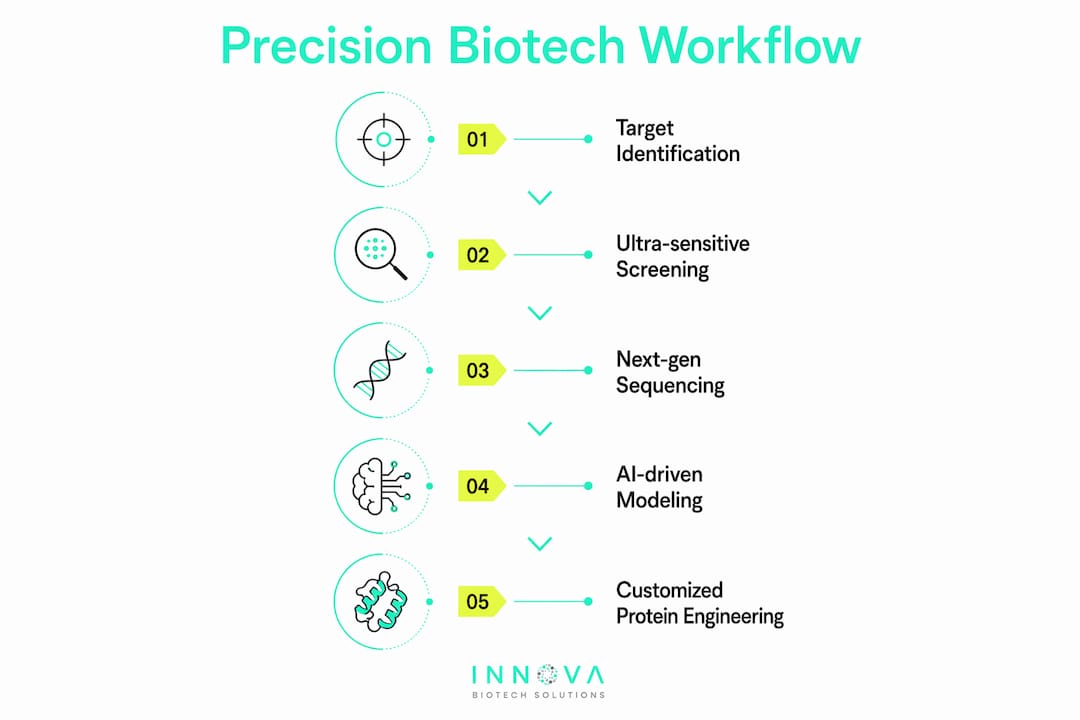
Precision biotech solutions are defined by their ability to act on specific molecular targets with measurable accuracy, rather than applying broad, one-size-fits-all methods. The standard industry term for this category is "targeted biotech applications," though the broader phrase "precision biotech solutions" captures the full scope of tools spanning genomics, proteomics, and bioprocess development. What separates these approaches from conventional methods is specificity at every stage: target identification, candidate selection, and manufacturing scale-up.
The practical consequence for pharmaceutical teams is shorter timelines and fewer failed candidates entering late-stage development. Early precision in target biology directly reduces the cost of attrition downstream. Teams that integrate customized biotech solutions from the start of a program avoid the expensive course corrections that come from discovering manufacturing problems after lead optimization is complete.
Biotech precision technology also matters because regulatory expectations have risen. The FDA and EMA now expect mechanistic justification for process parameters, not just empirical data. Precision tools generate the kind of structured, reproducible data that supports regulatory submissions more efficiently.
How does ultra-sensitive molecular screening improve mutation detection?
The most significant recent advance in molecular screening is the ability to detect low-frequency mutations in complex biological samples without specialized instrumentation. Multiplex assays using rolling circle amplification, specifically the superRCA technology developed by Rarity Bioscience, achieve a sensitivity of 1:100,000, which is up to 100 times more sensitive than many conventional methods. That level of resolution makes measurable residual disease monitoring and early mutation profiling genuinely actionable rather than aspirational.
What makes this practically useful for R&D teams is compatibility with standard laboratory equipment and automation platforms. You do not need a dedicated instrument stack to run these assays. That compatibility means the method integrates into existing workflows without a capital expenditure cycle.
Key applications for ultra-sensitive molecular screening include:
- Measurable residual disease (MRD) monitoring in oncology programs, where detecting one cancer cell among 100,000 healthy cells changes treatment decisions
- Mutation profiling across heterogeneous tumor samples to identify resistance mechanisms early in drug development
- Biomarker identification for patient stratification in clinical trials, reducing the risk of enrolling non-responders
- Liquid biopsy validation, where low-frequency circulating tumor DNA signals require detection below the threshold of standard next-generation sequencing
Pro Tip: When selecting a mutation detection platform, confirm the assay's limit of detection in your specific sample matrix, not just in idealized conditions. Matrix effects in plasma or FFPE tissue can shift sensitivity by an order of magnitude.
Spatial transcriptomics adds another layer of resolution. Solutions like Illumina's StrataMap platform detect twice as many genes per sample compared to traditional panel-based methods. That expanded gene detection reveals noncoding signals that conventional panels miss entirely, which is directly relevant for identifying novel drug targets.
How does next-generation sequencing accelerate genomics workflows?
Whole-genome sequencing has historically been a multi-day process that creates bottlenecks in early discovery programs. The Roche AXELIOS 1 platform changes that constraint. Using sequencing by expansion technology, it enables same-day whole-genome sequencing and variant calling within hours. For teams running iterative screening campaigns, that turnaround compresses the feedback loop between experiment and decision.
The platform's flexibility across small and large batch sizes matters as much as its speed. Early discovery programs often work with limited sample numbers, while later-stage validation requires high-throughput processing. A sequencing platform that handles both without a separate instrument or protocol switch reduces operational complexity significantly.
Practical benefits for pharmaceutical R&D teams include:
- Rapid variant calling that supports same-day go/no-go decisions in screening campaigns
- Whole-genome coverage that captures structural variants and copy number changes missed by targeted panels
- Batch flexibility that accommodates both early-stage discovery and late-stage validation without protocol changes
- Reduced turnaround time that shortens the overall drug discovery timeline by eliminating sequencing as a rate-limiting step
The broader trend here is that advanced biopharmaceutical solutions are converging on speed without sacrificing coverage. Faster sequencing with whole-genome resolution means teams can run more candidates through genomic characterization before committing resources to lead optimization. That is a structural improvement in how drug discovery programs allocate risk.
Can AI-driven modeling reduce experimental workload in bioprocess development?
Hybrid modeling is the most direct answer to the question of how to cut experimental load without sacrificing predictive accuracy. These models combine mechanistic understanding of biological systems with machine learning trained on process data. The result is a digital twin: a computational representation of a bioprocess that can be interrogated in silico before any physical experiment runs.
Digital twins reduce physical lab experimentation by up to 64% while maintaining predictive reliability. That figure represents a structural shift in how bioprocess development teams allocate scientist time and consumable budgets. Fewer experiments means faster timelines and lower development costs, not just marginal efficiency gains.
A phased approach to implementing AI-driven modeling in bioprocess development looks like this:
- Establish a mechanistic baseline. Map the known kinetics of your biological system, including cell growth, substrate consumption, and product formation rates.
- Layer in data-driven models. Train machine learning components on historical process data to capture variability that mechanistic equations cannot fully describe.
- Build and validate the digital twin. Run the hybrid model against held-out experimental data to confirm predictive accuracy before using it to design new experiments.
- Use the twin for design space exploration. Test process parameter combinations in silico to identify the most promising conditions for physical confirmation runs.
- Iterate with each new dataset. Feed physical experiment results back into the model to improve its accuracy over successive development cycles.
Pro Tip: Digital twins deliver the most value when built early in process development, not retrofitted after scale-up problems appear. Starting with a mechanistic framework at the bench stage gives the model enough biological context to make reliable predictions at pilot scale.
Phase-appropriate modular CMC strategies complement this approach. ModularCMC work packages align Chemistry, Manufacturing, and Controls activities with development milestones, preventing over-investment in early stages and reducing regulatory risk as programs advance. The practical effect is that teams avoid building a Phase 3 manufacturing process around a molecule that may not survive Phase 2.
The most common bioprocess development mistake is separating therapeutic design from manufacturing feasibility. Host cell line selection critically impacts final product quality and scalability. Teams that treat cell line development as a downstream problem consistently encounter quality and yield issues that require expensive redesign.
| Approach | Experimental Load | Predictive Accuracy | Timeline Impact |
|---|---|---|---|
| Traditional empirical development | High | Moderate | Slow |
| Mechanistic modeling only | Moderate | High for known systems | Moderate |
| Hybrid digital twin modeling | Low (up to 64% reduction) | High across variable conditions | Fast |
How do customized workflows improve protein engineering and antibody discovery?
Protein engineering and antibody discovery require workflows that match the specific biology of each target, not generic platforms applied uniformly. Protein engineering applications in therapeutics and diagnostics show that computational modeling combined with experimental validation consistently outperforms purely empirical approaches in identifying high-affinity, manufacturable candidates.
Custom antibody production workflows that incorporate controlled Go/No-Go checkpoints manage investment risk throughout the discovery and production stages. Each checkpoint is a structured decision point where data determines whether the program advances, pivots, or stops. That structure prevents teams from carrying weak candidates through expensive downstream stages.
Key features of well-designed precision workflows in protein engineering include:
- Computational modeling integration at the design stage to predict stability, solubility, and binding affinity before synthesis
- Defined Go/No-Go checkpoints at immunization, screening, and production stages to control cost and decision quality
- Tailored expression systems matched to the specific glycosylation, folding, or post-translational modification requirements of the target protein
- Iterative experimental validation that feeds data back into the computational model to refine subsequent design cycles
AI-enabled immune profiling adds precision to antibody discovery by mapping T-cell receptor repertoires against thousands of disease antigens. Platforms that track clonal lineages over time capture disease dynamics that single-timepoint assays miss. For therapeutic antibody programs, that longitudinal view identifies the most disease-relevant clones for downstream development.
Key Takeaways
Precision biotech solutions deliver measurable advantages in drug discovery and bioprocess development when teams apply targeted technologies at every stage, from mutation detection through manufacturing scale-up.
| Point | Details |
|---|---|
| Ultra-sensitive mutation detection | SuperRCA assays detect mutations at 1:100,000 frequency, 100x better than conventional methods. |
| Same-day sequencing is now achievable | The Roche AXELIOS 1 platform delivers whole-genome sequencing and variant calling within hours. |
| Digital twins cut experimental load | Hybrid modeling reduces physical lab experiments by up to 64% while maintaining predictive accuracy. |
| Go/No-Go checkpoints protect investment | Structured decision points in antibody workflows prevent weak candidates from advancing to costly stages. |
| Design and manufacturing must align early | Separating therapeutic design from manufacturing feasibility is the most common and costly bioprocess mistake. |
Why I think most R&D teams underestimate the integration problem
The technology itself is rarely the bottleneck. Teams can access ultra-sensitive sequencing, digital twins, and AI-driven immune profiling today. What I see consistently is that the data generated by these platforms does not flow cleanly between them. A sequencing result from one platform, a bioprocess model from another, and an antibody screening dataset from a third exist in separate silos. The precision of each individual tool does not compound into a precision workflow unless someone deliberately architects the data connections.
The second issue is that teams adopt precision medicine innovations at the assay level but retain empirical thinking at the program level. They run a highly sensitive mutation screen, then make go/no-go decisions based on intuition rather than the structured checkpoint frameworks that the data supports. The tools are precise. The decision process is not.
My practical advice: before adding another platform to your stack, audit how your current data moves between stages. If a scientist has to manually reformat a sequencing output to feed a bioprocess model, that gap costs more than the platform saves. Cross-platform compatibility is not a nice-to-have feature. It is the condition under which precision biotech actually delivers on its promise.
The teams that get this right treat data architecture as a scientific problem, not an IT problem. That shift in ownership changes everything about how precision tools get adopted and used.
— Hooman
Innovabiotech's precision services for your R&D programs
Innovabiotech builds customized workflows for pharmaceutical and biotech teams that need more than off-the-shelf solutions. The team specializes in peptide design and optimization, including de novo peptide design and bioinformatics validation for drug discovery programs. For teams working on protein targets, Innovabiotech's protein engineering services combine computational modeling with experimental validation to accelerate candidate development.
Every project at Innovabiotech starts with a direct consultation to define the specific scientific requirements, followed by transparent updates at each stage of delivery. The team covers virtual screening, hit-to-lead optimization, enzyme optimization, and computational biology, all structured around the timeline and data requirements of your program. Reach out to discuss how a tailored workflow can fit your current R&D stage.
FAQ
What are precision biotech solutions?
Precision biotech solutions are targeted methods and technologies that improve accuracy and efficiency in drug discovery, protein engineering, and molecular screening. They differ from conventional approaches by acting on specific molecular targets with measurable, reproducible results.
How sensitive are modern molecular screening assays?
Multiplex assays using rolling circle amplification, such as superRCA technology, detect mutations at a frequency of 1:100,000, which is up to 100 times more sensitive than many standard methods.
Can digital twins really reduce lab experimentation?
Hybrid modeling approaches that combine mechanistic models with machine learning reduce physical lab experimentation by up to 64% while maintaining predictive accuracy, according to published bioprocess development data.
What is a Go/No-Go checkpoint in antibody development?
A Go/No-Go checkpoint is a structured decision point in an antibody development workflow where experimental data determines whether a program advances, pivots, or stops. These checkpoints control investment risk and improve decision quality throughout discovery and production.
How does Innovabiotech support precision biotech workflows?
Innovabiotech delivers customized biotechnology and bioinformatics services including virtual screening, protein engineering, peptide design, and enzyme optimization, all tailored to the specific scientific and timeline requirements of each client project.