

The best-practice path is straightforward: predict the fusion with AlphaFold or a generative model like APM, iterate on linker design, refine and validate with molecular dynamics, and rank candidates by combining pLDDT/pTM with MD-derived stability metrics. Check AlphaFold DB and Swiss-Model first for template coverage, then run GROMACS for interface validation. If your construct has low homology or a novel junction, bring in a specialized computational team before you commit wet-lab resources.
TL;DR:
- Templates that cover both parent domains are essential for accurate comparative modeling, but they often fail for novel fusion junctions with low homology.
- AlphaFold and AlphaFold-Multimer are preferred when templates are unavailable or the junction is new, with confidence scores guiding initial assessments.
- Running multiple linker variants in parallel and using short MD simulations as a filter improves stability and reduces costly failed designs.
- Extensive MD validation with multiple replicates is critical, as static confidence scores do not reliably predict structural robustness.
- Outsourcing complex or low-homology constructs to specialized services can save time and improve the likelihood of experimental success.
Table of Contents
- What Is Chimeric Protein Modeling and Why Does It Matter?
- What Is the Recommended Workflow for Modeling a Chimeric Protein?
- Which Modeling Approach Fits Your Chimera?
- How Do You Design and Validate the Fusion Linker?
- What Validation Metrics Actually Predict Chimera Stability?
- What Do Practitioners Get Wrong About Chimera Modeling?
- Where Can You Find the Tools for Chimeric Protein Modeling?
- The Field Is Moving Past Static Predictions, and That's the Right Direction
- How Innovabiotech Supports Chimeric Protein Design Projects
- Sources
- FAQ
What Is Chimeric Protein Modeling and Why Does It Matter?
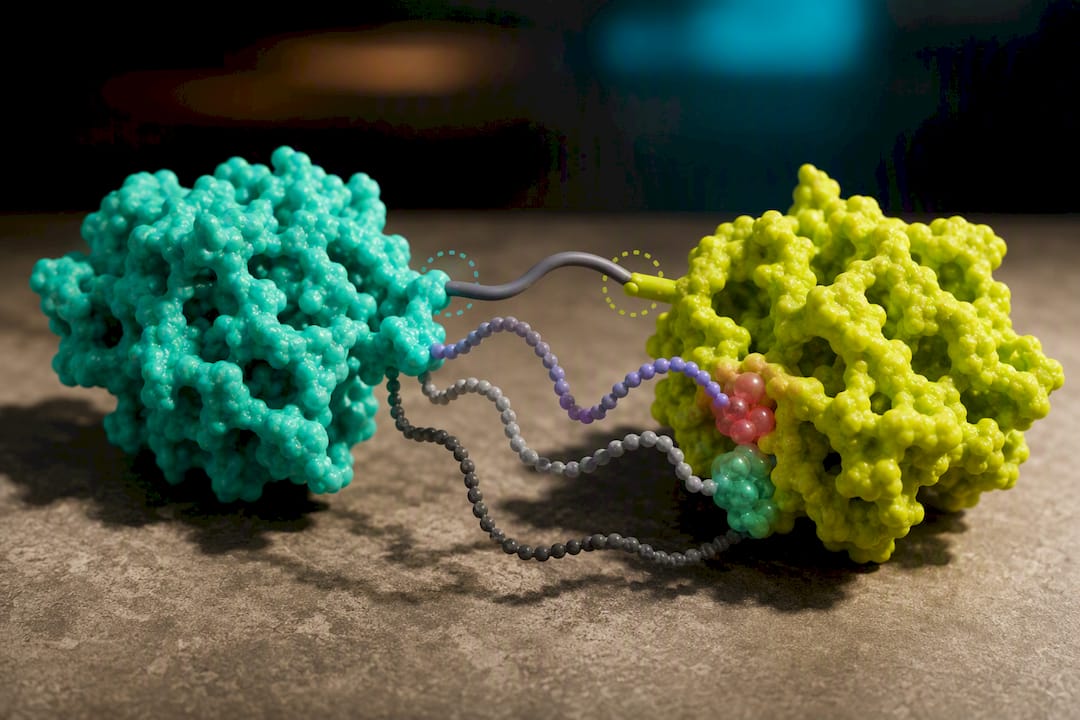
A chimeric protein joins two or more domains from different source proteins into a single polypeptide, usually to combine functions that don't naturally coexist, like a targeting domain fused to a catalytic one, or an antigen scaffold engineered to expose multiple epitopes at once. Chimeric protein modeling is the computational process of predicting how that fused sequence folds, whether the joined domains preserve their native geometry, and whether the new interface between them holds together under physiological conditions.
The modeling goal isn't just getting a folded structure. It's confirming that domain fusion doesn't distort either domain's active site, that the linker doesn't force an unnatural orientation, and that the whole assembly is stable enough to survive expression, purification, and whatever downstream assay you're running. This is fundamentally different from predicting a single natural protein, because chimeras have no evolutionary history at the junction. Nature never selected for that specific interface, so you're modeling a region with zero conservation signal and no template precedent.
That's also why classical protein structure prediction tools sometimes stumble on chimeras. A model trained on evolved sequences has seen millions of natural domain boundaries. It has seen very few artificial ones stitched together by a researcher's construct design.
What Is the Recommended Workflow for Modeling a Chimeric Protein?
A reproducible pipeline moves from sequence planning through experimental handoff in six stages. Skipping steps, especially the MD stages, is the single biggest reason chimera designs fail after synthesis.
- Plan domain boundaries. Use sequence alignments and domain annotation databases (Pfam, InterPro) to identify where each parent domain naturally ends, avoiding fusion sites that clip a structural element like a terminal helix or beta strand.
- Choose an initial prediction method. If a close homolog exists, start with template-based comparative modeling. If not, AlphaFold or a generative all-atom model is the faster and usually more accurate starting point.
- Sample linker variants. Generate several candidate linkers spanning different lengths and flexibilities, then predict each variant rather than committing to one guess.
- Run short relaxation and quick MD. A few nanoseconds of restrained MD filters out designs with obvious clashes or unstable secondary structure before you spend compute on longer runs.
- Run longer MD ensembles on survivors. Multiple replicates, each in the hundreds of nanoseconds, give you the RMSD, RMSF, and interface contact data needed to actually rank designs rather than guess.
- Move to experimental testing. Once a design holds up structurally across replicates, express it and run circular dichroism, thermal shift, or activity assays to confirm the computational call.
Sequence planning deserves more attention than most researchers give it. Domain boundaries pulled from a crystal structure are more reliable than boundaries inferred purely from sequence alignment, because crystallography shows you exactly where secondary structure elements terminate. If you're fusing an enzyme domain to a binding domain, check whether the enzyme's C-terminus sits near its active site. A fusion point fifteen residues from a catalytic pocket can distort function even when the structure prediction looks clean.
For low-homology fusions, or when the scaffold includes an appended tag or unusual motif, prediction accuracy often drops because the alignment signal for that segment is thin. Windowing the multiple sequence alignment, essentially running a separate, appropriately sized MSA for the tag or short fused motif rather than forcing it into the scaffold's full alignment, has been shown to restore prediction accuracy for chimeric constructs that would otherwise get modeled with poor confidence at the junction.
Pro Tip: Run your linker candidates as a batch, not sequentially. Queuing five or six linker length variants through AlphaFold overnight costs you nothing extra in wall-clock time if your GPU allocation supports parallel jobs, and it saves you a full day of back-and-forth redesign later.
The jump from short filtering runs to full validation ensembles is where most budgets get strained, so treat the short MD stage as a genuine gate. A design that shows a stable RMSD trace in a 5-nanosecond screen is worth the investment of a 200-to-500-nanosecond replicate set. A design that's already drifting at 5 nanoseconds almost never recovers.
Which Modeling Approach Fits Your Chimera?
The right method depends on how much homology your fusion shares with known structures, and how novel the interface between domains actually is.
Template-based comparative modeling works when you can find a solved structure, or close homolog, for each domain and, ideally, for a similar fusion architecture. Run a BLAST search against the PDB, select templates with the highest sequence identity and coverage, and check the alignment manually before feeding it into Modeller or Swiss-Model. Swiss-Model and similar template servers have been used in published chimeric vaccine design work where researchers needed a fast, template-anchored starting structure for antigen scaffolds. The catch is that template modeling assumes the junction region resembles something already solved, which is rarely true for a genuinely novel fusion.
AlphaFold and AlphaFold-Multimer have become the default starting point for most chimera projects, largely because they don't require a template at the junction. AlphaFold outputs per-residue confidence scores, pLDDT, and a global predicted TM-score, pTM, which give you an immediate read on where the model is confident and where it isn't. For a fused single chain, run standard AlphaFold with multiple recycling iterations and several random seeds, then compare the resulting structures for consistency at the junction. If your chimera behaves more like an assembled complex than a single folded chain, particularly for engineered receptor constructs, AlphaFold-Multimer's cross-chain training data tends to handle the interface better than the single-chain mode.
Generative all-atom models, like APM (All-Atom Protein generative Model), take a different approach entirely: instead of predicting a structure conditioned on a fixed sequence and template library, they generate plausible all-atom conformations for multi-chain interactions and complexes where template information is limited. That makes them a genuinely useful alternative for chimeras with low homology to anything AlphaFold's training set has seen. AI2BMD extends this into the dynamics domain, running ab initio molecular dynamics on very large biomolecules with chemical accuracy while cutting computational cost relative to traditional density functional theory, useful for large constructs where you need dynamics-level detail without a full DFT budget.
The shift underway in the field isn't subtle: modeling is moving away from template-heavy pipelines toward generative, dynamics-informed methods that handle novel fusion interfaces the way template libraries never could, because there's no evolutionary precedent for an engineered junction to match against.
A hybrid workflow often beats picking one method and sticking with it. Generate an initial fold with AlphaFold, then feed that structure into a generative model or MD-based optimizer specifically to refine the interface region, treating AlphaFold's global fold as scaffolding and the generative pass as targeted repair. On compute: local GPU workstations handle single-chain AlphaFold runs comfortably, but multimer predictions and MD ensembles benefit from cloud GPU clusters, especially when you're running six linker variants times three replicate simulations each.
How Do You Design and Validate the Fusion Linker?
Linker choice is where most chimera designs succeed or fail, and it's also the step researchers most often shortcut. Linker sequence and length strongly influence chimeric protein stability, which means an initial concatenation, just joining domain A directly to domain B with no spacer, is rarely the right final answer.
Three linker categories cover most use cases:
- Flexible linkers (typically glycine-serine repeats like GGGGS) work well when the two domains need independent movement or when steric clashes are a risk at the boundary.
- Rigid linkers (often alpha-helical, proline-rich sequences) suit cases where you need to fix the relative orientation of two domains, such as spacing two binding sites at a defined distance for a bispecific construct.
- Structured linkers derived from natural interdomain connectors work best when you're mimicking a known multidomain architecture and want the junction to behave like its natural counterpart.
Length selection is a sampling problem, not a single calculation. Generate a range of lengths for whichever linker type you've chosen, three to five residues apart, predict each variant, and run a clash check on the resulting model before investing in MD. Fragment libraries and enhanced sampling methods, like replica exchange, let you explore linker conformational space more thoroughly than a single static prediction ever will, which matters because a linker that looks fine in one predicted pose can hide a steric clash that only appears once you let it move.
Interface strain often shows up only under MD, not in the static prediction. Practitioners commonly build an iterative loop specifically for linker adjustment, because initial concatenations frequently produce steric clashes that a static structure prediction simply doesn't flag. When you spot strain in an MD trajectory, small insertions of one or two residues, or targeted rotamer adjustments on side chains right at the junction, usually resolve it faster than redesigning the linker from scratch.
Pro Tip: If two linker length variants produce nearly identical pLDDT scores, don't assume they're equally stable. Run both through even a short MD screen. Static confidence scores can't see the dynamic strain that only appears once the structure starts moving.
What Validation Metrics Actually Predict Chimera Stability?
Static confidence scores tell you how confident a prediction is, not how stable the fused protein will actually behave. Treat pLDDT and pTM as the first filter, never the final answer.
pLDDT gives you per-residue confidence, and it's genuinely useful for spotting which regions of your model AlphaFold trusts. But a high pLDDT score across both native domains combined with a low-confidence junction region is a specific, common failure mode, one that a single overall confidence average will hide completely. pTM tells you about global topology confidence, particularly useful for multimer predictions where you need to know whether the chains are oriented correctly relative to each other, not just individually well-folded.
A more useful downstream metric is relative stability, a value derived from prediction outputs that correlates with actual MD simulation stability and helped researchers rank candidate immunogen designs before running expensive full simulations on every option. That correlation is exactly why relative stability scoring earns a place early in your triage process, ahead of committing GPU time to full MD ensembles on every candidate.
MD validation itself needs a defined protocol, not an ad hoc single run:
- Run at least three independent replicates per candidate design, using different starting velocities or seeds.
- Track RMSD (backbone drift over time) and RMSF (per-residue fluctuation) as your primary stability readouts.
- Monitor interface contact persistence specifically at the fusion junction, since that's where instability concentrates.
- Report simulation length, force field, and software version alongside every result.
Zero-shot chimera predictions frequently fail specifically at the non-native interface, which is exactly why post-prediction MD validation running hundreds of nanoseconds, across repeated replicates, isn't optional for a serious design pipeline. Enhanced sampling and replica strategies extend the timescales over which you can meaningfully assess whether a predicted interface actually holds.
A practical ranking approach: combine your relative stability score from the prediction stage with MD-derived RMSD variance across replicates. A design with a strong relative stability score AND low RMSD variance across three replicates is a far safer bet for wet-lab investment than a design that only clears one of those two bars.
Reproducibility matters as much as the metrics themselves. Report your random seeds, exact software versions for AlphaFold and your MD engine, all simulation parameters (timestep, thermostat, box size), and the variance you observed across replicates, not just a single best-case number.
What Do Practitioners Get Wrong About Chimera Modeling?
The most common failure isn't a bad tool choice. It's skipping molecular dynamics entirely and trusting a static prediction because the pLDDT score looked good.
A high average pLDDT can hide a low-confidence junction, and researchers who stop at the static prediction routinely miss it. The second common mistake is treating linker design as an afterthought, running one default linker sequence instead of sampling several lengths, then wondering why the expressed protein aggregates or loses activity. The third: running a single MD trajectory and treating it as proof, when a lone run tells you almost nothing about whether that stability is reproducible or a coincidence of that particular random seed.
A few workflow efficiencies compound quickly once you've run this pipeline more than a couple of times:
- Batch your linker and construct predictions overnight instead of running them one at a time during working hours.
- Use windowed MSAs for any appended tag or unusual motif rather than forcing it through the scaffold's default alignment.
- Prefilter every candidate with a short, cheap MD run before committing to a longer, expensive ensemble.
- Keep a versioned notebook per project so a design you shelve for six months can be picked back up without reconstructing your parameters from memory.
Pro Tip: Keep a running log of which seed produced which structure for every candidate. When a reviewer or collaborator asks you to reproduce a result eight months later, that log is the difference between a five-minute rerun and a lost afternoon.
Projects that involve genuinely novel fusion architectures, very low homology between the two parent domains, or a tight timeline to an experimental-ready construct tend to benefit from bringing in a dedicated computational team early, rather than after an in-house attempt stalls. Iterative collaboration with clear, versioned deliverables at each modeling stage tends to catch junction problems before they become expensive wet-lab surprises.
Where Can You Find the Tools for Chimeric Protein Modeling?
Every step in this pipeline maps to specific, mostly free software and databases, so there's rarely a reason to build anything from scratch.
Structure prediction: AlphaFold is available through Google's ColabFold implementation for smaller jobs, or as a local install for teams running larger batches. The AlphaFold Protein Structure Database hosts precomputed predictions for hundreds of millions of sequences, worth checking before you spend compute predicting a domain that's already been modeled. For a deeper walkthrough of interpreting AlphaFold's confidence outputs, Innovabiotech's guide to AlphaFold protein structure prediction covers pLDDT and pTM interpretation in more depth than the outline above.
Template-based modeling: Swiss-Model remains the standard web server for comparative modeling when solved templates exist, and it's a reasonable first stop for any chimera built from well-characterized parent domains.
Molecular dynamics: GROMACS is the most widely used open-source MD engine for chimera validation work, paired with the AMBER or CHARMM force fields depending on your system. Both integrate cleanly with standard analysis pipelines.
Generative and dynamics-aware models: APM's code release lets researchers reproduce and locally test generative all-atom predictions for multi-chain complexes, while AI2BMD offers an emerging option for chemically accurate dynamics on large constructs. Researchers comparing broader categories of computational research tools may find this practical guide to AI research tools useful for orienting to the wider landscape beyond structure prediction specifically.
Visualization and analysis: UCSF Chimera and PyMOL cover structural visualization and figure generation, while MDAnalysis handles trajectory analysis in Python, RMSD, RMSF, and contact map calculations across your replicate simulations.
The Field Is Moving Past Static Predictions, and That's the Right Direction
Static structure prediction was never going to be the final word on chimera design, and treating pLDDT as a stability proxy was always a stopgap. What's changed recently is that generative, dynamics-aware models like APM and AI2BMD are starting to close the gap between "this fold looks plausible" and "this interface actually holds together for 500 nanoseconds." That's the real frontier, not incremental accuracy gains on well-templated proteins we could already model reasonably well five years ago.
My honest read: the field still lacks a standardized, interface-specific scoring metric that everyone reports the same way. Relative stability scoring is a genuine step forward, but it's not yet universal practice, and too many papers still report a single pLDDT number and call it validated. Reproducible reporting, seeds, software versions, replicate counts, isn't a bureaucratic nicety. It's the only thing that lets another lab trust your stability claim without rerunning your entire pipeline from scratch.
— Hooman
How Innovabiotech Supports Chimeric Protein Design Projects
A dedicated computational service provider is a practical alternative to running this entire pipeline in-house with a stretched research team and no dedicated compute allocation. When a fusion construct involves low homology between domains, a genuinely novel junction, or a timeline that needs an experimental-ready design rather than another round of internal iteration, that's exactly where a dedicated computational team earns its keep.

Innovabiotech's chimeric protein design services combine AlphaFold and generative modeling with MD-based validation, giving clients a structurally vetted candidate backed by reproducible reporting rather than a single confidence score. Projects involving enzyme fusion constructs may also benefit from Innovabiotech's enzyme optimization work, and teams working on fused peptide scaffolds can explore peptide design and optimization services for related support. If your current fusion candidate has stalled at the linker stage, or you need a validated structure before committing to expression, consider reaching out to a professional service to scope the project.
Sources
- Structural prediction of chimeric immunogen candidates to elicit targeted antibodies against betacoronaviruses | PLOS Computational Biology
- Highly accurate protein structure prediction with AlphaFold | Nature
- Improving prediction accuracy in chimeric proteins with windowed multiple sequence alignment | PMC
- An All-Atom Generative Model for Designing Protein Complexes
FAQ
What Does "Chimeric Protein" Mean?
A chimeric protein is a single polypeptide engineered by fusing domains or sequence segments from two or more different source proteins, typically to combine functions, such as a targeting domain and a catalytic domain, that don't naturally occur together.
What Is Levinthal's Paradox and Why Does It Matter for Modeling?
Levinthal's paradox notes that a protein chain has an astronomically large number of possible conformations, yet real proteins fold to their native structure in milliseconds to seconds, implying folding follows guided pathways rather than random search. It matters for chimera modeling because a novel fusion junction has no evolved folding pathway, which is part of why junction regions are harder to predict confidently than either parent domain alone.
What Does "Protein Modeling" Mean in Structural Biology?
Protein modeling is the computational prediction of a protein's three-dimensional structure from its amino acid sequence, using methods ranging from template-based comparative modeling to deep learning approaches like AlphaFold and generative all-atom models like APM.
What Happens When Humans Have Chimeric DNA?
Human chimerism occurs naturally when an individual's body contains cells with two distinct genetic lineages, most commonly from the fusion of twin embryos early in development or from cell exchange between a mother and fetus during pregnancy. This is a biological phenomenon distinct from engineered chimeric proteins, which are deliberately designed fusion constructs built for research or therapeutic purposes.
How Do You Choose Between Template-Based Modeling and AlphaFold for a Chimera?
Choose template-based modeling when a close structural homolog exists for both parent domains and their fusion architecture; choose AlphaFold or a generative model like APM when homology is low or the junction is genuinely novel, since these methods don't depend on finding a matching template.