

TL;DR:
- AI-driven enzyme design accelerates development from years to weeks by generating novel backbones and predicting beneficial mutations. Combining computational modeling with high-throughput expression evaluation improves yields and balances stability with activity. Autonomous labs and integrated workflows enable rapid iteration toward manufacturable biocatalysts for pharmaceutical applications.
Enzyme design and optimization is defined as the systematic engineering of protein catalysts to achieve targeted improvements in activity, selectivity, stability, and expression yield for pharmaceutical and biotechnology applications. The field now integrates generative AI models, directed evolution, rational design, and high-throughput expression evaluation into unified workflows that compress development timelines from years to weeks. AI-driven pipelines complete enzyme development in as little as one month, a pace that fundamentally changes how pharma teams approach biocatalyst discovery. Innovabiotech applies these methods to accelerate drug development and therapeutic enzyme programs from early design through manufacturing-ready expression.
How does AI transform enzyme design and optimization?
Machine learning has shifted enzyme engineering from empirical trial-and-error to predictive, iterative frameworks. The transition is not incremental. It changes the fundamental logic of how teams allocate experimental resources.
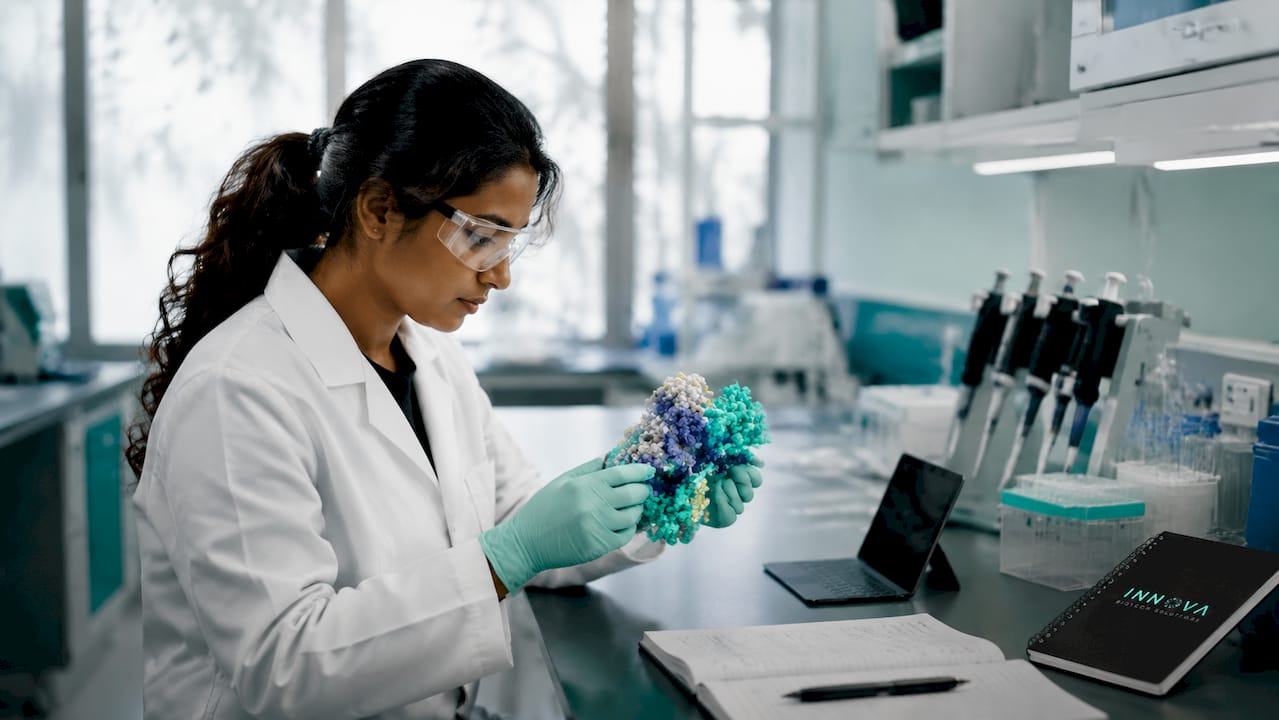
Generative AI models are the most consequential development in this space. RFdiffusion-based backbone design has nearly doubled successful de novo enzyme design campaigns from 2024 to 2026 by generating novel protein backbones with precisely defined active sites that stabilize transition states. That means teams can now specify catalytic geometry first and build the scaffold around it, reversing the traditional sequence-to-structure workflow.
Protein language models extend this capability by representing sequence space at a resolution that amino acid-level models cannot reach. Codon-level modeling with tools like GenSLM captures expression constraints inherent in DNA sequence composition, improving both functional yield and downstream expression efficiency. This matters because a computationally perfect enzyme that expresses poorly in your chosen host system delivers no practical value.
The design-build-test-learn (DBTL) cycle is the operational framework that ties these tools together. ML integration in DBTL cycles transforms enzyme engineering into a self-improving system, where each experimental round feeds back into the model and refines the next round of mutagenesis targets. The result is continuous improvement in catalytic efficiency and substrate specificity with progressively smaller screening libraries.
Key capabilities that AI brings to enzyme engineering:
- Backbone generation: Generative models produce novel scaffolds with defined catalytic pockets, bypassing the need for natural enzyme templates.
- Hotspot prediction: ML models identify mutationally beneficial positions before synthesis, reducing library size without sacrificing variant quality.
- Stability-activity balancing: AI specifically targets the trade-off between structural durability and catalytic performance, a problem that manual design rarely solves simultaneously.
- Experimental feedback integration: Each DBTL cycle improves model accuracy, making subsequent predictions more reliable.
Pro Tip: Run your ML model predictions against at least two independent structural validation tools before committing to gene synthesis. Prediction confidence scores alone do not capture all failure modes in wet-lab expression.
What are the main enzyme engineering techniques?
Three primary methodologies define the current toolkit for enzyme optimization: directed evolution, rational and semi-rational design, and de novo design. Each has a distinct mechanism, a defined strength, and a known limitation.
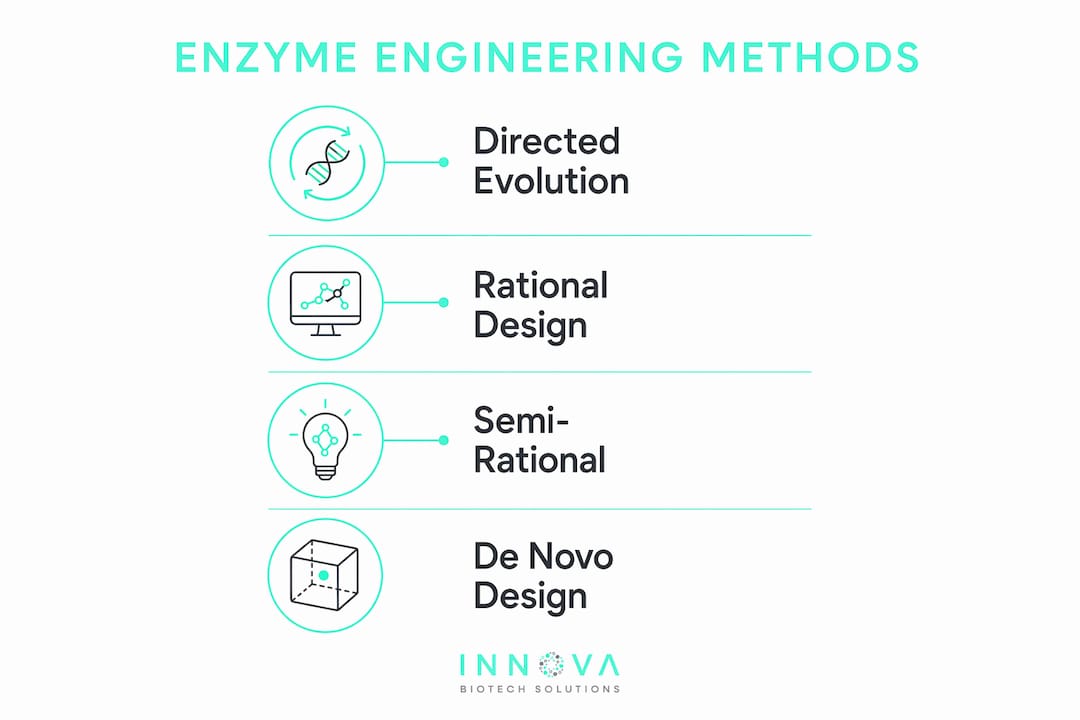
Directed evolution
Directed evolution mimics natural selection in the laboratory by generating large mutant libraries and screening for improved variants across successive rounds. AI augmentation of directed evolution now focuses mutagenesis on predicted hotspots rather than random positions, reducing screening burden while maintaining a high probability of finding improved variants. The limitation is that directed evolution remains constrained by the fitness landscape of the parent enzyme. It cannot easily access catalytic mechanisms absent in the starting sequence.
Rational and semi-rational design
Rational design uses structural data and mechanistic understanding to make targeted substitutions at specific residues. Semi-rational design combines structural insight with small, focused combinatorial libraries to explore local sequence space efficiently. Both approaches require high-quality structural data, ideally from X-ray crystallography or cryo-EM, and benefit substantially from computational docking and molecular dynamics simulations.
De novo design
De novo design builds enzymes from scratch without a natural template. Ensemble-based de novo strategies use multiple backbone conformations identified through crystallographic refinement to capture flexible states that improve catalytic precision. This approach is the most demanding computationally but offers the greatest freedom to engineer entirely new catalytic functions.
| Approach | Core strength | Primary limitation | AI enhancement |
|---|---|---|---|
| Directed evolution | Proven track record, no structural data required | Constrained by parent enzyme fitness landscape | Focused mutant libraries via hotspot prediction |
| Rational design | Precise, targeted substitutions | Requires high-quality structural data | Computational docking and dynamics simulations |
| De novo design | Unrestricted catalytic function | High computational cost, lower experimental success rate | Generative backbone models like RFdiffusion |
Autonomous laboratories integrating AI with robotics now enable closed-loop, continuous optimization cycles with minimal human intervention. These systems have achieved substantial improvements in catalytic efficiency within just a few iterative cycles, pointing toward a future where biofoundries run enzyme optimization programs largely without manual input.
Pro Tip: For pharma applications requiring regulatory documentation, semi-rational design often provides the best balance between novelty and traceability. Every substitution has a documented structural rationale, which simplifies IND-enabling package preparation.
How does expression optimization affect enzyme yield?
Computational design produces a candidate sequence. Expression optimization determines whether that sequence becomes a manufacturable biocatalyst. The two phases are inseparable in practice.
High-throughput expression evaluation systematically tests host systems, vectors, and fermentation parameters to increase yield by tenfold or more before full-scale manufacturing. The deliverables from a rigorous expression study include solubility analysis, SDS-PAGE and Western blot data, optimized vectors, and yield prediction modeling. Each data type answers a specific question about where the bottleneck lies.
The four critical variables in expression optimization are:
- Host system selection: Escherichia coli, Pichia pastoris, mammalian cell lines, and insect cell systems each impose different glycosylation, folding, and secretion constraints. The right host depends on the enzyme's structural requirements, not just convenience.
- Codon optimization and promoter compatibility: Expression system selection strongly influences scale-up success. Ignoring codon bias and promoter strength during design leads to late-stage failures that cost weeks of fermentation time.
- Secretion signals and solubility tags: Signal peptides and fusion tags like SUMO or MBP can dramatically improve soluble yield for enzymes that otherwise aggregate in the cytoplasm.
- Fermentation parameter tuning: Temperature, induction timing, media composition, and dissolved oxygen levels all affect the ratio of soluble to insoluble protein in the final harvest.
Scaling from lab to manufacturing introduces additional complexity. Bioreactor hydrodynamics, oxygen transfer rates, and feeding strategies behave differently at 10-liter versus 1,000-liter scale. Teams that integrate expression forecasting early in the design phase, rather than treating it as a downstream problem, consistently avoid the most expensive scale-up failures.
What are the key challenges in enzyme design for biotech professionals?
The hardest problem in enzyme engineering is not generating candidate sequences. It is generating candidates that work precisely, express efficiently, and remain stable under the conditions your application demands.
Catalytic precision is the first bottleneck. Transitioning from a theoretical active-site model, known as a theozyme, to a fully functional enzyme requires capturing flexible conformational states. Ensemble-based design addresses this by using multiple backbone conformations to accommodate transition state geometry more accurately than single-structure models. Sub-angstrom precision in active-site positioning is achievable with this approach, but it demands high-quality crystallographic data and significant computational resources.
The stability-activity trade-off remains the most persistent challenge in the field. AI models targeting this trade-off allow tuning of enzyme design for structural durability while maintaining or improving catalytic parameters. The practical implication is that teams no longer need to accept a stability penalty as the cost of high activity.
"The greatest challenge lies in engineering enzymes that balance catalytic activity with sufficient structural stability under industrial conditions. AI models such as AlphaFold2 have transformed structural prediction, but closing the gap between predicted and experimentally validated function remains the defining problem of the field."
Data scarcity compounds these challenges. Current ML models perform best when trained on large, high-quality datasets of experimentally characterized variants. For novel enzyme families or rare reaction mechanisms, that data simply does not exist. Teams must plan for more experimental validation rounds when working outside well-characterized enzyme classes.
Mutation epistasis adds another layer of complexity. Beneficial mutations identified individually often interact negatively when combined. Predicting these interactions computationally remains an open problem, and experimental combinatorial screening is the only reliable way to resolve them at present.
Key Takeaways
Enzyme design and optimization requires integrating generative AI, directed evolution, rational design, and expression engineering into a single coordinated workflow to produce pharmaceutical-grade biocatalysts efficiently.
| Point | Details |
|---|---|
| AI compresses timelines | AI-driven pipelines complete enzyme development in as little as one month, versus years with traditional methods. |
| Generative models enable de novo design | RFdiffusion and similar tools build novel backbones with defined active sites, removing dependence on natural templates. |
| Expression optimization is non-negotiable | Codon optimization, host selection, and fermentation tuning determine whether a designed enzyme becomes manufacturable. |
| Stability-activity trade-off is solvable | AI models now tune enzyme design for both structural durability and catalytic performance simultaneously. |
| Autonomous labs accelerate iteration | Closed-loop systems integrating AI and robotics achieve substantial catalytic improvements within a few iterative cycles. |
Why the shift from empirical to AI-driven design changes everything
I have watched this field move from painstaking plate-by-plate screening to generative models that propose novel backbones overnight. The change is not just faster. It is structurally different.
What strikes me most is how the failure modes have shifted. In classical directed evolution, you failed because your library was too small or your screen was not sensitive enough. Now, the failures tend to happen at the interface between computational prediction and wet-lab reality. A model can generate a sequence with excellent predicted stability and zero expression in your chosen host. That gap between in silico confidence and bench-top performance is where most projects stall today.
My practical advice: treat expression compatibility as a design constraint from day one, not a problem to solve after you have your candidate. Enzyme stability improvement and expression yield are linked. An enzyme that folds correctly in your host system is almost always more stable than one that requires refolding from inclusion bodies.
The prospect of fully autonomous biofoundries running closed-loop optimization with minimal human input is real and near. But the teams that will benefit most are those who have already built rigorous experimental validation into their workflows. Automation amplifies good process design. It also amplifies poor process design, just faster.
The future of protein design methods in pharma belongs to groups that treat computational and experimental work as a single integrated discipline, not two separate departments that hand off to each other.
— Hooman
Innovabiotech's enzyme design services for pharma R&D
Innovabiotech combines AI-driven sequence design, generative backbone modeling, and high-throughput expression evaluation into a single service offering for pharmaceutical and biotechnology teams.
The Innovabiotech enzyme design workflow covers the full cycle from computational candidate generation through expression optimization and functional characterization. Teams working on drug development, therapeutic enzyme programs, or biocatalytic synthesis routes get integrated support across every phase. Innovabiotech's bioinformatics team applies codon-level modeling, DBTL-guided mutagenesis, and expression forecasting to reduce the time between initial design and a validated, manufacturable enzyme. For teams that also need protein design services for therapeutic applications, Innovabiotech offers computational modeling and chimeric protein design alongside its enzyme programs.
FAQ
What is enzyme design and optimization?
Enzyme design and optimization is the systematic engineering of protein catalysts to improve activity, selectivity, stability, and expression yield. It combines computational methods, directed evolution, and experimental validation to produce biocatalysts tailored for specific pharmaceutical or industrial applications.
How does AI improve enzyme engineering?
AI accelerates enzyme engineering by predicting beneficial mutations, generating novel backbones with defined active sites, and integrating experimental feedback into iterative DBTL cycles. ML-guided DBTL frameworks reduce screening library sizes while maintaining a high probability of finding improved variants.
What is the stability-activity trade-off in enzyme design?
The stability-activity trade-off describes the tendency for mutations that increase catalytic activity to reduce structural stability, and vice versa. AI models now address this directly by tuning enzyme design parameters to achieve both properties simultaneously.
Why does expression system selection matter for enzyme optimization?
The choice of host system, codon usage, and promoter compatibility determines whether a designed enzyme expresses as soluble, active protein or aggregates as inclusion bodies. Integrating expression forecasting early in the design phase prevents costly late-stage failures during scale-up.
What is de novo enzyme design?
De novo enzyme design builds functional enzymes from scratch without relying on natural templates. Generative AI models like RFdiffusion design novel protein backbones with precisely positioned active sites, enabling catalytic functions not found in nature.