

TL;DR:
- Enzyme stability is maximized through a combination of protein engineering, immobilization, chemical modification, and computational design. Hybrid approaches that integrate these methods outperform single techniques, leading to enzymes that withstand industrial conditions like high temperatures and organic solvents.
Enzyme stability improvement is best achieved through a combination of protein engineering, immobilization, chemical modification, and computational design. No single method dominates; the most effective approach integrates traditional structural modifications with modern machine learning and ancestral sequence reconstruction to produce enzymes that hold up under industrial conditions. Here is what that looks like in practice:
- Protein engineering: Introduce disulfide bonds, salt bridges, and hydrophobic core optimizations to reinforce the enzyme's three-dimensional structure
- Immobilization: Anchor enzymes to solid supports to prevent denaturation, enable reuse, and cut biocatalyst costs
- Chemical modification: Apply PEGylation, polysaccharide conjugation, or surface acetylation to shield the enzyme from thermal and solvent stress
- Computational design: Use tools like Rosetta, FoldX, and machine learning models to predict stabilizing mutations before committing to wet-lab work
- Directed evolution: Screen large variant libraries to select for enzymes with extended half-lives and retained catalytic activity
Thermal and solvent stability are the two most commercially relevant targets. Enzymes that function at elevated temperatures or in organic solvents open up reaction conditions that are simply not accessible with fragile wild-type biocatalysts. The sections below cover each strategy in depth, with real experimental outcomes and industrial context.
How protein engineering enhances enzyme stability
Protein engineering remains the most mechanistically direct path to durable enzymes. By modifying the amino acid sequence itself, you change the physical forces that hold the protein together, rather than just protecting it from the outside.
Disulfide bonds, salt bridges, and hydrophobic cores
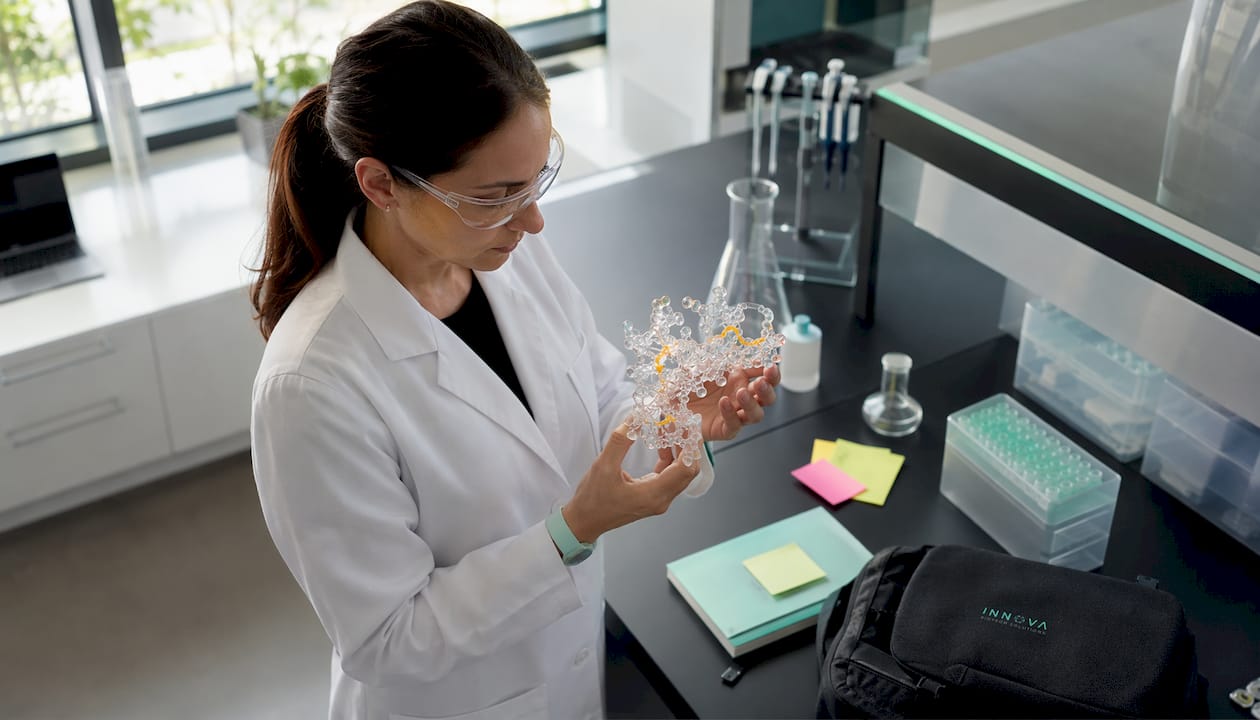
Three structural modifications consistently show up in thermostability studies: disulfide bond introduction, salt bridge engineering, and hydrophobic core optimization. Disulfide bonds create covalent crosslinks between cysteine residues, physically constraining the protein backbone against unfolding. Salt bridges add electrostatic interactions at the surface or at subunit interfaces, while a tighter hydrophobic core reduces the entropic cost of maintaining the folded state at high temperatures. These are not mutually exclusive. Most successful engineering campaigns combine at least two of them, often guided by free energy calculations using tools like FoldX or Rosetta Cartesian ddg.
Pro Tip: Before introducing a disulfide bond, verify that the two target cysteines are geometrically compatible using a tool like DISULFIDE by DESIGN 2.0. A poorly placed disulfide can strain the backbone and actually destabilize the enzyme.
B-factor analysis for mutation targeting
B-factor analysis, derived from X-ray crystallography data, identifies the most flexible and thermally unstable regions of a protein. High B-factor residues are prime candidates for stabilizing mutations because they represent areas where the structure "breathes" most under thermal stress. B-factors also highlight catalytic centers, which typically show low flexibility, so you can target unstable regions without touching the active site.
A study on ketopantoate hydroxymethyltransferase (KPHMT) combined B-factor analysis, folding free energy calculations (ΔΔG), and the B-FITTER tool to screen 25 candidate mutation sites at the dimeric interface. The optimal double mutant increased the enzyme's half-life at 30°C from 8.83 to 15.44 hours, a 3.29-fold improvement. A separate study on ketoreductase CpKR pushed further: by targeting both high B-factor residues and rigid regions, the best quadruple mutant extended the half-life at 40°C from 1.2 minutes to 5,550 minutes, a 463-fold improvement over the wild type.
Directed evolution and site-directed mutagenesis
Directed evolution combined with site-directed mutagenesis produces enzyme variants with substantially prolonged half-lives and improved thermal stability. Directed evolution works by iterating random mutagenesis and selection pressure, mimicking natural selection but on a compressed timescale. Site-directed mutagenesis is more surgical: you pick specific residues based on structural data and swap them out one at a time. The two methods complement each other well. Directed evolution explores sequence space broadly; site-directed mutagenesis then refines the best hits.
Computational stapling, a related structural approach, demonstrated that engineering crosslinks into the protein backbone can raise the melting temperature by +18.0°C and T50 by +16.0°C without sacrificing catalytic activity. That kind of gain from a single structural intervention is unusual and reflects how much room exists in many natural enzymes for stability improvement.
Ancestral sequence reconstruction
Ancestral sequence reconstruction (ASR) infers the probable amino acid sequences of ancient, extinct enzymes by analyzing modern homologs through phylogenetic modeling. Ancestral enzymes tend to be more thermostable than their modern descendants, likely because early life evolved under hotter conditions. ASR gives protein engineers a starting scaffold that is already biased toward stability, which can be further refined through directed evolution or computational mutagenesis. The method does carry uncertainty: reconstructed sequences are statistical inferences, not confirmed historical sequences, so the resulting enzyme properties can vary.
Which immobilization techniques actually improve enzyme durability?
Immobilization anchors enzymes to a solid support, preventing them from drifting into solution, aggregating, or unfolding under process stress. The method you choose shapes the trade-off between stability, activity retention, and cost.
Comparing the main approaches
Immobilization techniques, including physical adsorption and covalent bonding, enhance enzyme reusability and resistance under harsh industrial conditions. Each method has a distinct profile:
| Technique | Mechanism | Stability | Leakage risk | Cost |
|---|---|---|---|---|
| Physical adsorption | Weak surface interactions | Moderate | High | Low |
| Entrapment | Enclosure in polymer matrix | Moderate | Moderate | Low–moderate |
| Covalent bonding | Chemical bonds to support | High | Low | High |
| Cross-linking (CLEAs) | Enzyme-to-enzyme crosslinks | High | Very low | Moderate |
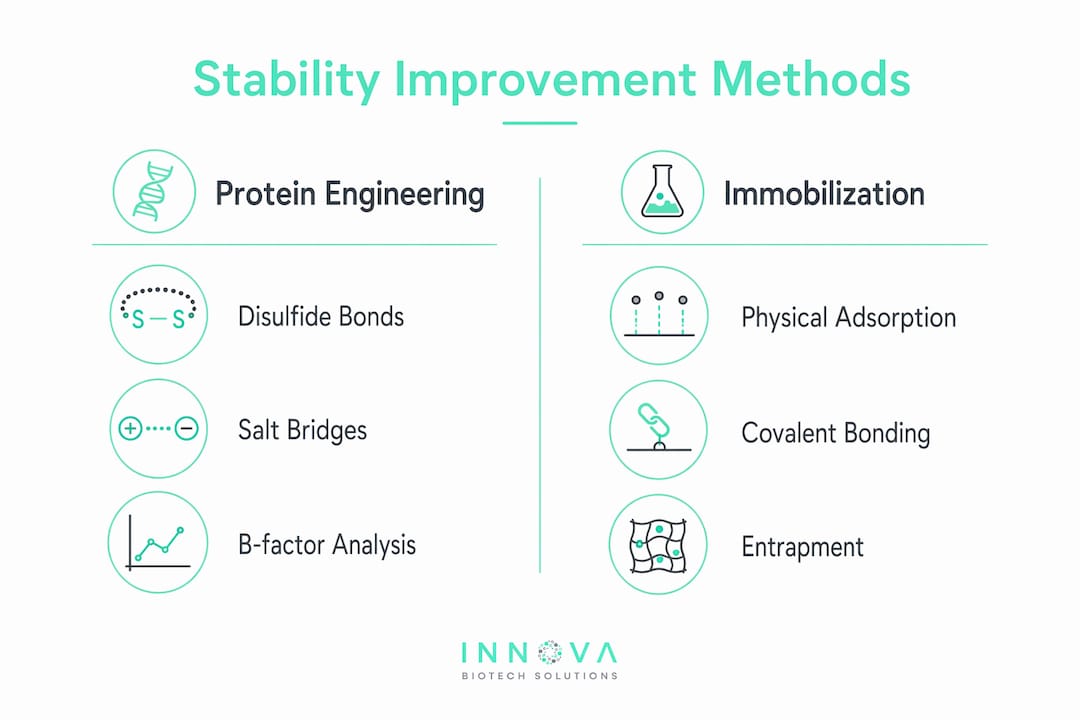
Physical adsorption and entrapment are cost-effective and operate under mild conditions, but enzyme leakage limits their usefulness in continuous processes. Covalent immobilization provides superior durability and enzyme reuse but may introduce diffusion limitations that require support optimization. Cross-linked enzyme aggregates (CLEAs) sidestep the need for a carrier entirely, which reduces cost while maintaining high stability.
Support materials that change the equation
The choice of support material matters as much as the immobilization chemistry. Key options include:
- Chitosan: Biocompatible, inexpensive, and easy to functionalize; widely used for food and pharmaceutical enzyme applications
- Functionalized silicas: Mesoporous silicas offer high surface area and tunable pore sizes, improving enzyme loading and mass transfer
- Metal-organic frameworks (MOFs): Combining immobilization with MOF supports enhances enzyme loading and operational stability; laccase on MOFs retains 88% activity after 28 days
- Magnetic nanoparticles: Allow enzyme recovery by applying a magnetic field, which simplifies separation in batch processes
- Alginate beads: Simple entrapment matrix; balances ease of preparation with acceptable mass transfer
Selecting the right amino acid side chains for attachment, specifically lysine epsilon-amino groups or cysteine thiol groups outside the catalytic site, is critical for high-specificity immobilization that preserves activity.
Industrial payoff
Immobilized enzymes reduce biocatalyst costs by over 60% in biomass refining applications, primarily by enabling repeated use across multiple reaction cycles. Cellulase immobilized on worm-shaped silica nanoparticles (WSNs) retains 80% activity over five cycles; the same enzyme on MOF supports achieves 74% bagasse conversion. These are not marginal gains. For a continuous biorefinery running around the clock, the difference between a free enzyme that degrades after one use and an immobilized one that runs for ten cycles changes the entire process economics.
Pro Tip: When scaling up immobilization, optimize enzyme loading carefully. Overloading the support creates steric crowding that blocks substrate access and introduces kinetic bottlenecks, even when the enzyme itself is stable.
Chemical modifications and additives that protect enzyme function
Chemical modification works from the outside in. Rather than changing the gene sequence, you alter the enzyme's surface chemistry after it has been expressed and purified.
Polysaccharide conjugation and surface chemistry
Chemical modification with polysaccharide derivatives improves thermal stability and reusability in industrial processes. Conjugating dextran, chitosan, or other polysaccharides to the enzyme surface creates a hydrophilic shell that reduces water activity around the protein, slowing unfolding at elevated temperatures. Acetylation, phosphorylation, and sulfation of surface residues alter the enzyme's charge distribution and hydrophobicity, which can shift the optimal pH and temperature range toward more industrially useful conditions.
PEGylation
PEGylation enhances enzyme thermostability and inhibitor resistance, making it one of the most widely used chemical modification strategies in industrial enzyme formulations. Attaching polyethylene glycol (PEG) chains to lysine residues or the N-terminus creates steric shielding that blocks proteases, reduces aggregation, and extends circulating half-life in pharmaceutical applications. The trade-off is a modest reduction in catalytic rate due to increased steric bulk around the active site, though this is usually acceptable when the gain in stability is large.
Common stabilizing additives
Beyond covalent modifications, soluble additives in the enzyme formulation buffer can dramatically extend shelf life and operational stability:
- Polyols (glycerol, sorbitol, trehalose): Preferential exclusion from the protein surface stabilizes the folded state by thermodynamic means
- Bovine serum albumin (BSA): Acts as a sacrificial protein, absorbing surface-active contaminants that would otherwise denature the enzyme of interest
- Reducing agents (DTT, beta-mercaptoethanol): Prevent oxidative crosslinking of cysteine residues during storage
- Metal chelators (EDTA): Sequester metal ions that catalyze oxidative degradation
- Detergents at sub-CMC concentrations: Reduce surface adsorption losses in low-protein-concentration formulations
- Lyoprotectants (mannitol, sucrose): Protect enzyme structure during lyophilization by replacing water in the hydration shell
Formulation design is often underestimated relative to engineering. A well-engineered enzyme stored in a poorly designed buffer can lose activity faster than a wild-type enzyme in an optimized formulation.
How computational tools and machine learning accelerate stability engineering
Computational approaches have shifted from supporting roles to primary drivers of enzyme stability campaigns. The ability to screen thousands of mutations in silico before touching a pipette changes the economics of protein engineering fundamentally.
The standard computational workflow for enzyme stability improvement runs roughly as follows:
- Obtain a high-resolution structure via X-ray crystallography or cryo-EM, or generate a model using AlphaFold2
- Run B-factor analysis to identify flexible, high-priority mutation targets
- Calculate ΔΔG for candidate mutations using FoldX, Rosetta Cartesian ddg, or DeepDDG to filter out destabilizing substitutions
- Apply machine learning models trained on stability datasets (e.g., ProteinMPNN, ESM-2 embeddings) to rank remaining candidates by predicted thermostability gain
- Use ancestral sequence reconstruction as an alternative starting point, generating a consensus ancestral sequence with built-in thermostability bias
- Design a focused mutant library of 50–200 variants based on the top computational predictions
- Express and screen variants using a high-throughput thermal shift assay (differential scanning fluorimetry, DSF) or a half-life assay at the target process temperature
- Combine beneficial mutations through combinatorial mutagenesis, checking for epistatic interactions that could cancel gains
Machine learning and ancestral sequence reconstruction are emerging as powerful tools guiding enzyme stability engineering with promising accuracy. The key limitation of ML approaches remains training data: models trained on small or biased datasets generalize poorly to novel enzyme families. ASR carries its own uncertainty because reconstructed sequences are probabilistic inferences. Neither method works well in isolation, which is why the workflow above combines them with experimental validation at step 7.
Hybrid strategies integrating traditional biochemical modifications with machine learning and ancestral reconstruction consistently outperform single-method approaches. The practical implication is that computational tools are most valuable as filters and prioritizers, not as replacements for experimental screening. A computational campaign that narrows 10,000 possible mutations down to 100 high-confidence candidates saves months of wet-lab time even if the models are only moderately accurate.
For researchers building a protein stability prediction pipeline from scratch, the combination of AlphaFold2 structural models with FoldX ΔΔG calculations and a curated training set from the ProThermDB database is a practical starting point that does not require proprietary software.
How Innovabiotech approaches enzyme stability engineering
Innovabiotech, based in San Francisco, California, integrates computational protein design with classical biochemical methods to deliver custom enzyme stability solutions for industrial and research clients. The team works across the full pipeline: from initial structural analysis and mutation prediction through experimental validation and formulation optimization.
Innovabiotech's enzyme optimization services cover thermostability and solvent stability engineering, immobilization support selection, and formulation design. For clients in pharmaceutical manufacturing, the team also addresses inhibitor resistance and storage stability, two factors that are often overlooked until late in process development. Projects are scoped from the first consultation with a clear deliverable: a characterized enzyme variant or immobilized biocatalyst that meets the client's defined performance criteria.
The integration of computational and experimental methods is what separates a targeted campaign from a random mutagenesis screen. Innovabiotech's protein engineering services use structural modeling and ΔΔG prediction to build focused libraries, cutting screening costs while improving the hit rate for stabilizing mutations. For industrial clients where enzyme cost is a direct input to process economics, that efficiency translates directly to project ROI.

Key Takeaways
Enzyme stability improvement requires combining protein engineering, immobilization, chemical modification, and computational design, since no single method reliably delivers the thermal and solvent resistance that industrial processes demand.
| Point | Details |
|---|---|
| B-factor analysis targets instability | Identifying high B-factor residues guides mutation selection without disrupting the catalytic site. |
| Computational stapling raises Tm significantly | Protein stapling techniques increased melting temperature by +18.0°C and T50 by +16.0°C in documented studies. |
| Immobilization cuts biocatalyst costs | Immobilized enzymes reduce biocatalyst costs by over 60% in biomass refining through repeated reuse. |
| Hybrid strategies outperform single methods | Combining ML, ASR, and classical modifications consistently delivers better stability than any one approach alone. |
| Formulation design matters as much as engineering | Additives like trehalose, BSA, and EDTA extend operational and storage stability without modifying the enzyme sequence. |
FAQ
How do you improve enzyme stability?
Combine protein engineering (disulfide bonds, salt bridges, B-factor-guided mutagenesis), immobilization on solid supports, chemical modification such as PEGylation or polysaccharide conjugation, and computational tools like FoldX and machine learning models to predict and validate stabilizing mutations before wet-lab screening.
What makes an enzyme stable?
Stability comes from the balance of forces holding the folded structure together: hydrophobic packing in the core, electrostatic interactions at the surface, covalent crosslinks like disulfide bonds, and the rigidity of loop regions. Enzymes from thermophilic organisms naturally optimize these features, which is why ancestral sequence reconstruction uses phylogenetic inference to recover thermostable ancestral scaffolds.
How do you increase the stability of a protein?
Targeted mutagenesis guided by B-factor analysis and ΔΔG calculations is the most direct route. Introducing proline residues in flexible loops, adding salt bridges at subunit interfaces, and tightening the hydrophobic core each reduce conformational entropy and raise the melting temperature. Chemical modifications like PEGylation add an external layer of protection without altering the gene sequence.
What are the key catalytic strategies enzymes use?
Enzymes accelerate reactions through proximity and orientation effects, acid-base catalysis, covalent catalysis, and metal ion catalysis. These mechanisms are distinct from stability engineering, but they are relevant because stabilizing mutations must preserve the geometry of the active site residues responsible for these catalytic functions.
Why is enzyme stability important for industrial applications?
Industrial processes typically run at elevated temperatures, in organic solvents, or at extreme pH values. Enzymes that denature quickly under these conditions require constant replenishment, which drives up costs. Stable, reusable industrial biocatalysts reduce enzyme consumption, enable continuous processing, and make enzymatic routes economically competitive with chemical alternatives.