
TL;DR:
- Protein stability prediction uses computational models to estimate how amino acid mutations affect protein folding, focusing on free energy changes. Advanced methods combine deep learning, physics-based calculations, and experimental data to improve accuracy and speed in protein engineering. Integrating lightweight screening with higher-accuracy models and experimental measurements enhances reliability and reduces development time.
Protein stability prediction is the computational estimation of how amino acid mutations alter a protein's folding stability, quantified by changes in Gibbs free energy (ΔΔG) or melting temperature (Tm). For biotech researchers and pharmaceutical scientists, this discipline sits at the center of therapeutic antibody engineering, enzyme design, and understanding disease-causing mutations. The field has moved well beyond simple physics-based scoring. Deep learning architectures now unify sequence and structural data, while physics-informed neural networks enforce thermodynamic laws to produce predictions that are both fast and physically consistent. Getting this right early in a drug development workflow separates candidates that survive formulation from those that fail in the clinic.
What are the main computational methods for protein stability prediction?
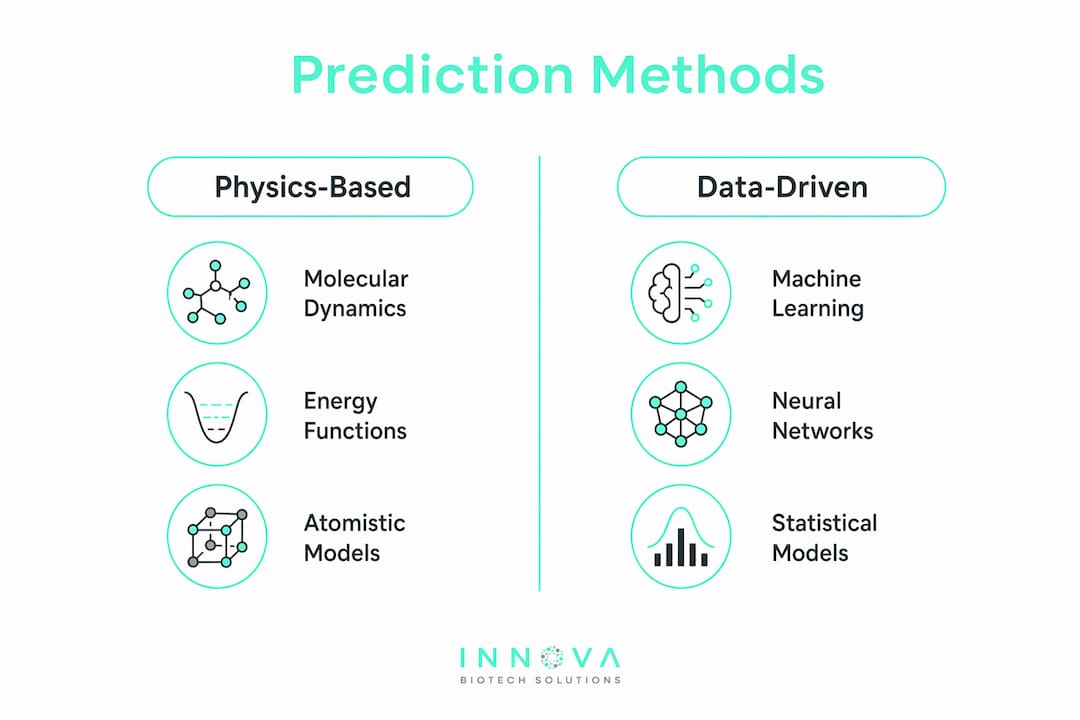
Computational approaches to predicting protein stability fall into three broad categories: physics-based methods, data-driven deep learning models, and hybrid physics-informed neural networks. Each carries distinct tradeoffs in speed, accuracy, and data requirements.

Physics-based methods, including molecular dynamics (MD) simulations and Rosetta energy functions, calculate stability changes from first principles using force fields and thermodynamic cycles. They are interpretable and do not require large training datasets. The cost is speed. A full MD free energy perturbation calculation for a single mutation can take hours to days on a GPU cluster, making saturation mutagenesis scans impractical at scale.
Deep learning models address this bottleneck directly. Transformer architectures trained on protein sequence databases extract rich evolutionary and structural features without requiring explicit 3D coordinates. JanusDDG represents the current state of the art in sequence-based prediction, using a bidirectional cross-attention transformer that captures mutation-induced perturbations while enforcing thermodynamic constraints like antisymmetry and transitivity. It matches or exceeds structure-based methods on standard benchmarks. That result matters because it means you no longer need a solved crystal structure to get reliable ΔΔG estimates.
At the lightweight end of the spectrum, knowledge-based models using 19 physicochemical features can complete 1,235 mutation scans in 2.3 seconds on a single CPU core without GPUs or external APIs. That speed makes them ideal for early-stage saturation mutagenesis screening across entire protein sequences.
- Physics-based (MD, Rosetta): High interpretability, no training data needed, slow at scale
- Sequence-only deep learning (JanusDDG, language models): Fast, no structure required, strong generalization
- Unified sequence-structure models (ProStab-Former): Highest accuracy, requires structural input, moderate compute
- Knowledge-based lightweight pipelines: Fastest throughput, best for early screening, lower ceiling accuracy
- Physics-informed neural networks: Thermodynamically consistent, interpretable, good for multi-point mutations
Pro Tip: Run a lightweight knowledge-based scan first to rank all single-point mutants by predicted stability, then apply a higher-accuracy model only to the top candidates. This two-stage approach cuts compute time without sacrificing final prediction quality.
How do unified sequence-structure models improve prediction accuracy?
Most early deep learning models treated sequence and structure as separate inputs, fusing them at a late stage through concatenation or simple attention. That design misses the tight coupling between residue identity and spatial context. Unified representation models solve this by embedding sequence and structure into a shared feature space from the start.
ProStab-Former is the clearest example of this architecture. It combines Stability-Aware Attention Layers (SAAL) with Epistatic Interaction Modules to capture both local structural effects and long-range non-additive interactions between mutations. SAAL incorporates structural priors and mutation-aware gating, directing model attention toward residue pairs that are spatially and chemically relevant to the mutation site. The result is a model that generalizes well to multi-point mutations, which are notoriously difficult for models trained only on single substitutions.
The performance numbers are concrete. ProStab-Former achieves a median Spearman correlation of 0.84 on megascale test sets, outperforming traditional physics-based methods and earlier deep learning models. A Spearman correlation of 0.84 means the model ranks mutant stability with high fidelity across diverse protein families. That level of generalization is what you need when engineering a therapeutic protein with no close homologs in the training set.
Large-scale pre-training on protein databases provides the foundation for this performance. Foundation protein models extract structural and evolutionary features that transfer well to downstream stability tasks, even with limited labeled stability data. This is why fine-tuning a pre-trained protein language model on your specific protein family consistently outperforms training a model from scratch on a small experimental dataset.
| Model type | Input required | Multi-point mutations | Relative speed |
|---|---|---|---|
| Physics-based (Rosetta, MD) | 3D structure | Limited accuracy | Slow |
| Sequence-only (JanusDDG) | Sequence | Good | Fast |
| Unified sequence-structure (ProStab-Former) | Sequence + structure | State of the art | Moderate |
| Lightweight knowledge-based | Sequence | Basic | Very fast |
Pro Tip: For multi-point mutation analysis, always use a model with an epistatic interaction component. Summing single-point ΔΔG values to estimate double mutants introduces systematic errors that compound with each additional substitution.
Why does modeling the unfolded state matter for accurate predictions?
Protein folding stability (ΔG) is defined as the free energy difference between the folded and unfolded states. Most computational models focus almost entirely on the folded state, either ignoring the unfolded ensemble or approximating it with a generic reference state. That assumption introduces systematic errors, particularly for mutations that alter backbone flexibility or involve insertions and deletions (indels).
The IFUM model addresses this directly. It jointly predicts ΔG and folded/unfolded residue-pair distance distributions using the Flory random coil polymer physics model to represent the unfolded ensemble explicitly. This approach aligns predictions with fundamental thermodynamic principles rather than treating the unfolded state as a black box.
The practical consequences are significant:
- Models ignoring the unfolded state systematically underestimate the destabilizing effect of mutations that increase backbone entropy in the unfolded chain.
- Indel mutations, which shift the chain length and therefore the unfolded state distribution, are essentially unpredictable without explicit unfolded state modeling.
- IFUM predictions correlate more accurately with experimental melting temperatures across diverse protein families, not just the globular proteins that dominate most training sets.
- Explicit unfolded state modeling also improves absolute ΔG estimates, not just relative ΔΔG rankings, which matters when you need to predict whether a protein will unfold at physiological temperature.
The thermodynamic rationale is straightforward. A mutation that destabilizes the folded state by 2 kcal/mol has a very different phenotype depending on whether it also stabilizes the unfolded state. Models that cannot distinguish these cases will misrank candidates in ways that only show up during experimental validation, costing time and resources.
What are the best practices for applying these tools in drug development?
Effective protein stability analysis in a drug development context requires more than picking the highest-accuracy model. Workflow design, data integration, and computational resource planning all determine whether predictions translate into successful candidates.
The industry-standard workflow follows a design-validate-verify cycle. Generative design tools produce candidate sequences, inverse folding models score sequence-structure compatibility, and structural stability checks confirm folded state geometry. Skipping any stage of this loop consistently leads to synthesis failure. The cycle is not optional overhead. It is the minimum viable process for protein engineering in a regulated drug development context.
For high-throughput screening, start with a NumPy-based lightweight pipeline that scans all single-point mutants across the full sequence in seconds on a standard laptop. Reserve GPU-intensive neural network models for the shortlisted candidates. This resource allocation strategy keeps compute costs proportional to the confidence level at each stage.
Experimental data integration is the single highest-leverage improvement available to most teams. Blending sequence-based predictions with even modest-quality experimental melt curve data using R²-weighted averaging reduces median absolute error from 5.8°C to 1.8°C. That improvement is large enough to change candidate ranking decisions. If your lab generates any differential scanning fluorimetry (DSF) data, feed it back into the prediction pipeline immediately.
- Run a lightweight saturation mutagenesis scan across all single-point positions to generate a full stability landscape.
- Filter candidates by predicted ΔΔG threshold and apply a unified sequence-structure model to the top 5–10% for refined ranking.
- Integrate available experimental Tm data using R²-weighted blending to correct systematic biases in the computational predictions.
- Validate top candidates through the design-validate-verify cycle before committing to synthesis.
- Flag indel mutations for IFUM-style unfolded state modeling rather than standard ΔΔG pipelines.
Pro Tip: For peptide stability prediction, be cautious with standard protein benchmarking tools. The Peptide Property Benchmark (PPB) shows that protein-oriented clustering methods produce overoptimistic accuracy estimates on short peptides due to a "clustering bottleneck" effect. Use peptide-specific data splitting strategies to get honest performance numbers.
Key Takeaways
Accurate protein stability prediction requires integrating physics-informed constraints, unified sequence-structure representations, and experimental data within a structured design-validate-verify workflow.
| Point | Details |
|---|---|
| Unified models outperform single-input approaches | ProStab-Former's SAAL architecture achieves a median Spearman correlation of 0.84 by jointly encoding sequence and structure. |
| Unfolded state modeling is non-negotiable for indels | IFUM's explicit Flory random coil representation is required for accurate predictions involving insertions and deletions. |
| Experimental data integration cuts error sharply | Blending melt curve data with sequence predictions reduces median absolute Tm error from 5.8°C to 1.8°C. |
| Lightweight models belong at the screening stage | Knowledge-based pipelines complete 1,235 mutation scans in 2.3 seconds, making them the right tool for early-stage ranking. |
| Workflow completeness prevents synthesis failure | Skipping any stage of the design-validate-verify cycle consistently leads to failed candidates in drug engineering. |
The field is moving faster than most labs realize
My honest assessment is that the gap between what the best models can do and what most drug development teams actually use has never been wider. I see labs still running Rosetta on single mutations when physics-informed transformers like JanusDDG deliver comparable accuracy in a fraction of the time. The barrier is rarely computational. It is familiarity and workflow inertia.
The shift toward unified sequence-structure embeddings is the most consequential development of the past two years. Multi-point mutation analysis used to require either expensive MD simulations or accepting large prediction errors. Models with epistatic interaction modules have changed that calculus. If you are engineering an antibody with three or more simultaneous substitutions, you need one of these architectures. Summing single-point ΔΔG values is not a valid approximation at that scale.
The explicit unfolded state modeling work is underappreciated outside a small group of computational biophysicists. Researchers working on intrinsically disordered regions or peptide therapeutics should pay close attention. The thermodynamic argument is airtight, and the accuracy gains on experimental Tm data are large enough to matter in practice.
My recommendation for teams navigating model selection: start with a lightweight scan, use a unified model for shortlisted candidates, and always integrate whatever experimental data you have. The peptide binding affinity and stability prediction fields are converging, and the teams that build integrated computational-experimental workflows now will have a durable advantage in candidate quality and cycle time.
— Hooman
Protein stability prediction services at Innovabiotech
Innovabiotech works with biotech researchers and pharmaceutical scientists who need more than off-the-shelf prediction tools. The team applies unified sequence-structure modeling, physics-informed scoring, and experimental data integration to real protein engineering projects, from therapeutic antibody stabilization to enzyme optimization.
If you are building a high-throughput mutagenesis pipeline or need accurate ΔΔG estimates for multi-point mutations, Innovabiotech's protein design services cover the full design-validate-verify cycle with computational and experimental support. For peptide-based programs, the peptide design and optimization service includes bioinformatics validation and stability-aware sequence engineering. Contact the team to discuss your project requirements and get a tailored approach from the first consultation.
FAQ
What does protein stability prediction actually measure?
Protein stability prediction estimates the change in folding free energy (ΔΔG) or melting temperature (Tm) caused by amino acid mutations. A negative ΔΔG indicates a stabilizing mutation; a positive value indicates destabilization.
Which model type gives the most accurate stability predictions?
Unified sequence-structure models like ProStab-Former currently deliver the highest accuracy, achieving a median Spearman correlation of 0.84 on megascale benchmarks. For speed at scale, lightweight knowledge-based pipelines are the practical choice for early screening.
Do I need a crystal structure to predict protein stability?
No. Sequence-only models like JanusDDG match or exceed structure-based methods on standard benchmarks by using thermodynamic constraints and transformer-based sequence representations. A solved structure improves accuracy but is not required.
How do I handle multi-point mutations in stability modeling?
Use a model with an epistatic interaction component, such as ProStab-Former's Epistatic Interaction Modules. Summing single-point ΔΔG values to estimate multi-point effects introduces compounding errors that make candidate ranking unreliable.
Can experimental data improve computational stability predictions?
Yes. Integrating experimental melt curve data with sequence-based predictions using R²-weighted blending reduces median absolute Tm error from 5.8°C to 1.8°C. Even modest-quality DSF data produces a meaningful accuracy improvement when fed back into the prediction pipeline.