
TL;DR:
- Industrial enzyme optimization now combines advanced protein engineering, machine learning, and process design to improve performance.
- Focusing on in vivo unit yield and integrated workflows increases enzyme yield and reduces costs in large-scale bioprocesses.
Industrial enzyme optimization is the systematic enhancement of enzyme activity, stability, and production yield to meet the rigorous demands of industrial bioprocesses. The field has moved well beyond classical mutagenesis. Today, protein engineers combine directed evolution, computational design tools like PROSS, and machine learning frameworks to achieve gains that were unthinkable a decade ago. Active-site redesign paired with oligomer state modulation, for instance, has pushed substrate conversion from 67.99% to 100% under real industrial conditions. Innovabiotech works at exactly this intersection, delivering custom enzyme engineering programs that integrate computational modeling with experimental validation for clients across biochemical manufacturing.
What are the main strategies for industrial enzyme optimization?
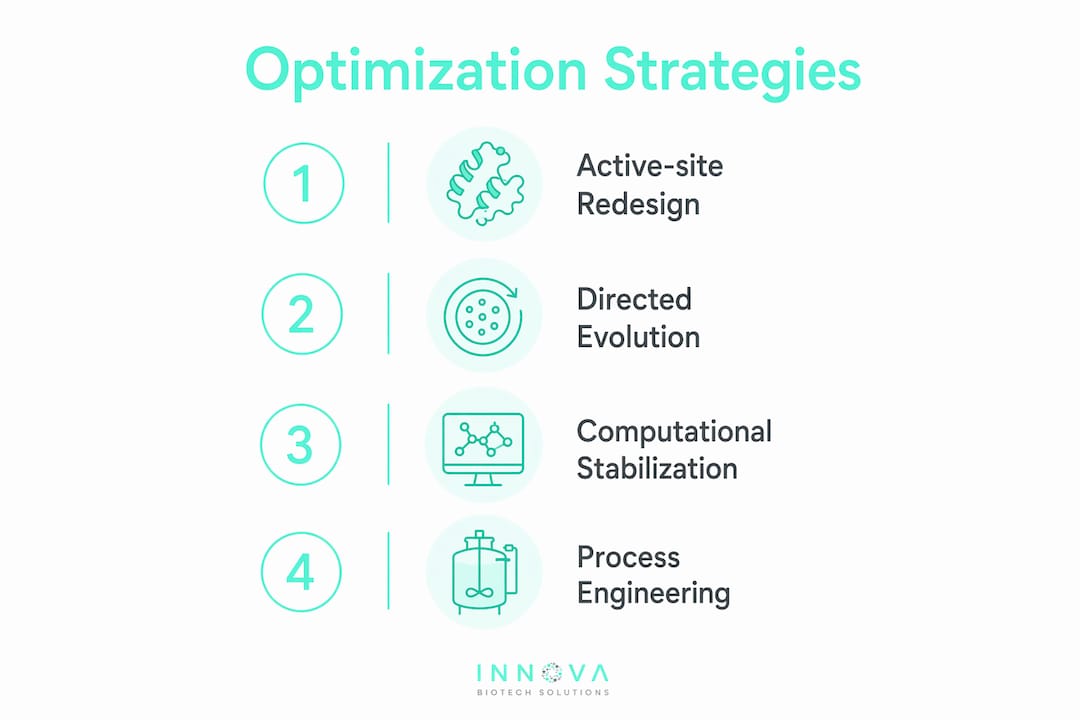
The three most productive strategies for improving enzyme performance are active-site engineering, directed evolution, and computational stabilization. Each targets a different bottleneck, and the strongest programs combine all three.
Active-site redesign and oligomer modulation
Active-site redesign changes the geometry of the catalytic pocket to improve substrate binding or turnover. Oligomer state modulation adjusts how enzyme subunits assemble, which directly affects thermal stability and half-life. Together, these approaches increased activity by 36.9% and extended enzyme half-life 6.8-fold in engineered nitrilase variants. That kind of half-life gain translates directly into longer reactor runs and lower enzyme replacement costs at scale.

Directed evolution with few-shot learning
Classical directed evolution screens thousands of variants to find improvements. Combining it with few-shot learning and causal inference cuts that number dramatically. A 73-fold enzyme yield increase was achieved using only 12 mutation combinations, with the full workflow requiring just 60–100 experimentally examined variants as input. That is a fundamental shift in how much wet-lab work is needed per unit of performance gain.
Targeting in vivo unit yield rather than aqueous kinetic parameters like kcat/Km also matters here. Unit yield captures the actual output per expression event inside the cell, which is what determines manufacturing economics. Traditional kinetic metrics can look excellent in a cuvette while failing completely in a bioreactor.
Computational stabilization with PROSS
The PROSS algorithm redesigns surface and core residues to improve thermodynamic stability without disrupting the active site. Applied to CYP152 peroxygenases, PROSS improved hydrogen peroxide tolerance up to fourfold and achieved turnover numbers up to 48,333 in preparative-scale experiments. Researchers can read a detailed breakdown of PROSS and related tools in this protein stability prediction guide for biotech researchers.
| Strategy | Primary benefit | Typical gain | Key challenge |
|---|---|---|---|
| Active-site redesign | Higher catalytic activity | Up to 36.9% activity increase | Requires structural data |
| Directed evolution + few-shot learning | Yield improvement with fewer variants | Up to 73-fold yield gain | Needs good fitness metric |
| PROSS computational stabilization | Thermostability and oxidant tolerance | Up to 4-fold tolerance gain | Computationally intensive |
| Oligomer state modulation | Extended half-life | Up to 6.8-fold half-life gain | Protein-specific outcomes |
Pro Tip: Use in vivo unit yield as your primary fitness metric from the start. Optimizing for kcat/Km alone often produces variants that perform well in assay conditions but disappoint in fermentation.
How can machine learning accelerate enzyme production optimization?
Machine learning has become the fastest path to high-performing enzyme variants. Three distinct approaches now cover expression prediction, immobilization discovery, and secretion improvement.
-
MPEPE for expression prediction. Protein language models like MPEPE predict expression propensity across dozens of host organisms, enabling rational selection of mutations that improve titer without compromising enzymatic properties. This removes much of the guesswork from host engineering and codon optimization decisions.
-
Bayesian optimization for immobilization. Parallelized hybrid-space Bayesian optimization (PHBO) explores reaction spaces covering over 10 million conditions in silico, then uses iterative experimental feedback to converge on the best carrier formulations. PHBO workflows achieved 90–100% enzyme activity recovery from a limited number of physical experiments. That level of activity recovery in immobilized systems is exceptional and directly reduces enzyme loading requirements.
-
Deep learning-guided mutagenesis. Deep learning models trained on sequence-function data identify mutations that improve secretion efficiency and folding fidelity simultaneously. When applied to alkaline proteases expressed in Komagataella phaffii, this approach substantially increased expression yields while preserving catalytic properties.
The common thread across all three is iterative feedback. A computational prediction generates candidates, experiments validate them, and the results retrain the model. Each cycle narrows the search space and raises the performance floor.
Pro Tip: Do not treat computational predictions as final answers. Run at least two experimental validation rounds before committing to a variant for scale-up. Models trained on limited data can overfit to assay conditions that do not reflect bioreactor reality.
For a deeper look at how directed evolution integrates with these machine learning workflows, the directed evolution optimization guide covers the 2026 state of the field in detail.
Which process engineering choices drive large-scale enzyme yield?
Upstream protein engineering sets the ceiling for enzyme performance, but downstream process design determines what fraction of that ceiling you actually capture at manufacturing scale.
Signal peptide selection
Signal peptide optimization is protein-specific and cannot be reliably predicted from sequence alone. Improper signal peptide selection causes intracellular accumulation of mature enzyme, which damages the host cell and reduces total yield. Empirical screening of multiple signal peptide candidates for each target protein is not optional. It is the difference between a functional secretion process and a failed fermentation.
Integrated downstream processing
Co-optimizing cellular engineering with downstream unit operations produces the largest cost reductions. Integrating fusion protein strategies with Pulsed Electric Field-assisted lysis, for example, cuts total production costs by more than 50% compared to traditional bead-milling methods. That cost reduction at scale changes the economics of enzyme-based manufacturing entirely.
| Approach | Yield impact | Cost impact | Scale readiness |
|---|---|---|---|
| Signal peptide screening | High (avoids yield loss from cell damage) | Low added cost | Lab to pilot |
| Pulsed Electric Field lysis | Moderate yield gain | >50% cost reduction | Pilot to industrial |
| Fusion protein co-optimization | High expression improvement | Moderate added design cost | Lab to pilot |
| Traditional bead-milling | Baseline | Baseline | Industrial |
Heterologous expression bottlenecks extend beyond gene sequence and require integrated engineering of folding, trafficking, and degradation machinery. Teams that address only the gene sequence and ignore these cellular systems consistently underperform on titer.
What are the main challenges in enzyme immobilization and stability?
Immobilized enzymes are the workhorse of continuous bioprocesses, but they introduce two problems that free enzymes do not face: substrate diffusion limitations and mechanical fragility.
Substrate diffusion slows reaction rates when the carrier matrix restricts access to the active site. Enzyme fragility under shear stress, pH swings, and elevated temperatures causes activity loss over time. Both problems compound in industrial reactors where conditions are far harsher than bench-scale assays.
Machine learning-guided workflows address these problems by rapidly screening carrier materials, crosslinking densities, and surface chemistries. PHBO-based approaches explored over 10 million conditions in silico before selecting candidates for physical testing, reaching 90–100% activity recovery in preparative experiments. That efficiency is not achievable with one-factor-at-a-time experimental design.
Common pitfalls to avoid in immobilization and stability engineering:
- Choosing carriers by cost alone. Low-cost carriers often have poor surface chemistry for a given enzyme class, leading to low loading efficiency and rapid activity loss.
- Skipping diffusion modeling. Assuming that high activity in solution will transfer to the immobilized state without modeling mass transfer leads to systematic overestimation of reactor performance.
- Ignoring pH microenvironments. The local pH at a carrier surface can differ significantly from bulk pH, shifting the enzyme's apparent optimum and reducing apparent activity.
- Over-crosslinking. Excessive crosslinking rigidifies the enzyme structure and blocks substrate access, reducing activity even when the enzyme is structurally intact.
- Testing only at optimal conditions. Industrial conditions include temperature spikes, solvent traces, and substrate inhibition. Stability data collected only at pH 7 and 25°C is not predictive of industrial performance.
Key Takeaways
Enzyme performance in industrial bioprocesses depends on integrating protein engineering, machine learning, and process design from the start, not as sequential steps.
| Point | Details |
|---|---|
| Use unit yield as your fitness metric | In vivo unit yield predicts manufacturing performance better than aqueous kinetic parameters. |
| Combine directed evolution with ML | Few-shot learning with causal inference achieves large yield gains from far fewer experimental variants. |
| Screen signal peptides empirically | Predictive tools alone are insufficient; improper selection causes cell damage and yield loss. |
| Co-optimize upstream and downstream | Integrating cellular engineering with advanced lysis methods cuts production costs by more than 50%. |
| Apply Bayesian optimization to immobilization | PHBO workflows reach 90–100% activity recovery by exploring vast carrier spaces computationally. |
Why I think most enzyme programs fail before they reach the bioreactor
The most common failure mode I see is not a bad enzyme. It is a good enzyme designed in isolation from the process it will run in. Teams spend months engineering a beautiful variant with excellent kcat/Km, then watch it fall apart when signal peptide selection is wrong, or when the downstream lysis step destroys half the yield.
The field has the tools to avoid this. PROSS, MPEPE, PHBO, and few-shot learning frameworks are all mature enough for production use. The gap is not technology. It is workflow integration. Computational predictions need to feed directly into experimental design, and experimental results need to feed back into the model. That loop is what separates programs that hit their targets from programs that produce great papers and mediocre titers.
The other thing I would push back on is the instinct to optimize catalytic parameters first. Unit yield is the right target for industrial work. An enzyme that expresses at ten times the titer with half the kcat will outperform a catalytically perfect enzyme that the cell can barely secrete. The economics are not close.
The next five years will bring protein language models that can predict immobilization behavior from sequence alone, and Bayesian frameworks that close the loop between reactor performance data and variant design. Teams that build those feedback systems now will have a structural advantage that is very hard to replicate later.
— Hooman
Innovabiotech's enzyme engineering services for industrial bioprocesses
Innovabiotech brings together computational protein engineering, machine learning-guided variant design, and custom bioprocess consulting under one program. The team applies tools like PROSS-based stabilization, expression prediction modeling, and enzyme design services to deliver measurable improvements in activity, stability, and production yield.
Every project starts with a detailed technical consultation to map the specific bottlenecks in your current process, whether that is expression titer, thermal stability, or immobilization efficiency. Innovabiotech's protein engineering services cover the full workflow from computational modeling through experimental validation and scale-up support. If your enzyme program needs to move faster and perform better in 2026, Innovabiotech is the team to call.
FAQ
What is industrial enzyme optimization?
Industrial enzyme optimization is the process of improving enzyme activity, stability, and production yield for use in large-scale bioprocesses. It combines protein engineering, computational design, and process optimization to meet industrial performance requirements.
Which machine learning tools are used for enzyme optimization?
Tools like MPEPE predict protein expression across multiple hosts, while PHBO algorithms explore vast immobilization conditions to identify high-activity carrier formulations. Both reduce the number of physical experiments needed to reach high-performance variants.
How much can enzyme production costs be reduced through process optimization?
Integrating cellular engineering with advanced downstream processing methods like Pulsed Electric Field-assisted lysis reduces total production costs by more than 50% compared to traditional bead-milling approaches.
Why is signal peptide selection so critical for enzyme expression?
Signal peptide choice is protein-specific, and a mismatch causes intracellular accumulation of mature enzyme, which damages the host cell and reduces total yield. Empirical screening of multiple candidates is required for each target protein.
What is the best fitness metric for industrial enzyme engineering?
In vivo unit yield, which measures enzyme activity output normalized to expression level, is a more reliable target than aqueous kinetic parameters like kcat/Km for industrial applications. It directly reflects manufacturing economics rather than idealized assay conditions.