
Professional molecular docking services give researchers a computational shortcut that would otherwise take months of wet-lab trial and error. At their core, these services use physics-based and AI-assisted algorithms to predict how a small molecule, peptide, or protein binds to a biological target, generating ranked poses, interaction maps, and binding affinity estimates. The best providers handle the full pipeline: ligand preparation, protonation state assignment at physiological pH, docking simulation with engines like AutoDock Vina, GOLD, or OEDocking, post-docking interaction profiling with tools like PLIP, and a reproducible report your team can act on.
Key features you should expect from any credible service:
- Protein-small molecule docking for lead identification and optimization
- Protein-protein and protein-DNA docking for target interaction mapping
- Reverse docking to identify off-targets or repurpose existing compounds
- Flexible peptide docking for biologics and peptidomimetic programs
- Automated interaction profiling using PLIP or equivalent tools
- Reproducible scoring and ranked pose reports with raw data files
- NDA-protected workflows and secure data handling throughout
What types of molecular docking services do major US providers offer?
The four providers most visible in the US market cover overlapping but meaningfully different ground. One lead-in worth noting: Creative Proteomics appears twice in this space, once as a general proteomics platform and once as a dedicated docking service with its own quality framework.
| Provider | Service type coverage | Technology | Customization | Reporting quality | Client support | Confidentiality |
|---|---|---|---|---|---|---|
| Creative Proteomics | Protein-small molecule, protein-protein, reverse docking, virtual screening | AutoDock Vina, GOLD, AI-assisted docking (Gigadock Warp) | Moderate | Detailed pose reports, interaction maps | Standard | NDA available |
| Creative Biolabs | Structure-based drug design, flexible docking, ensemble docking | GOLD, OEDocking, custom workflows | High | Customizable report formats | Dedicated project managers | NDA standard |
| BioCode | AI-enhanced docking, large library screening, bioinformatics integration | Hybrid AI plus standard engines | Moderate to high | Automated profiling outputs | Responsive, technical | Confidentiality agreements |
| Creative Proteomics Molecular Docking Service | Specialized docking with emphasis on reproducibility, protein-DNA, peptide docking | Standard engines plus strain-energy correction | Moderate | Reproducible code and full data packages | Clear milestone communication | Strong NDA framework |
Creative Proteomics covers the widest service catalog, including AI-assisted screening with Gigadock Warp for ultra-large compound libraries. That makes it a practical choice when you need to triage thousands of candidates before committing to synthesis.
Creative Biolabs stands out for customization depth. If your project requires ensemble docking across multiple receptor conformations or a non-standard scoring function, their workflow flexibility accommodates it. Their dedicated project management model also reduces the back-and-forth that slows down complex studies.
BioCode positions itself at the intersection of AI and classical docking, which suits teams running high-throughput screens where cost per compound matters. The hybrid approach maintains accuracy close to traditional methods while cutting computational overhead.
Creative Proteomics Molecular Docking Service is the most focused of the four on data integrity. Reproducible code delivery and a documented NDA framework make it the right call when your results feed directly into regulatory submissions or IP filings.
Why professional docking services outperform DIY approaches
Setting up a reliable docking pipeline in-house is harder than it looks. Input structure preparation, including correct protonation states and hydrogen placement at physiological pH, is a step that trips up even experienced computational chemists. Get it wrong and your top-ranked poses may be artifacts, not real binders.
Professional providers address this systematically. They apply induced-fit modeling to account for receptor flexibility, which rigid docking misses entirely. They also run strain-energy correction to filter out poses that look favorable on paper but require the ligand to adopt an unphysical conformation.
The practical benefits:
- Faster hit identification through automated PLIP-based interaction profiling
- Structural visualization outputs ready for presentation or publication
- Secure data handling with signed NDAs before project kickoff
- Clear milestone reporting so you always know where the project stands
Pro Tip: Docking scores rank compounds relative to each other; they do not predict absolute binding affinity. Always validate your top-ranked hits with an orthogonal experimental method, such as SPR, ITC, or a functional assay, before advancing to lead optimization.
How to choose the right molecular docking service provider in the US
The decision comes down to five concrete criteria, not vendor marketing copy.
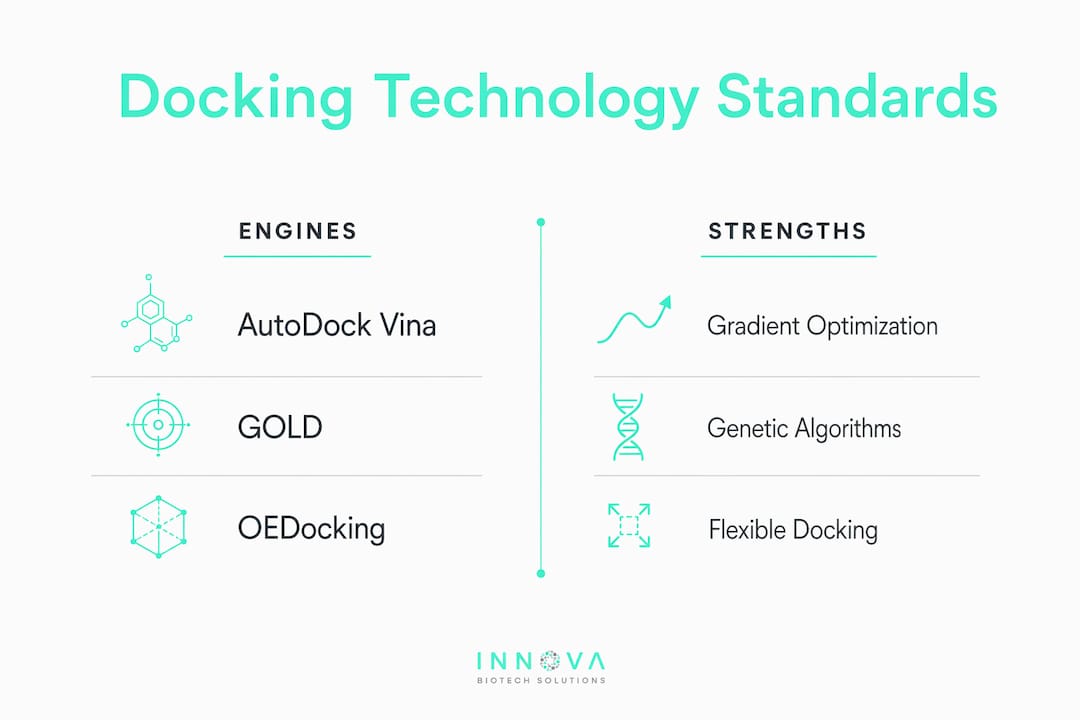
- Technology stack: Confirm the provider uses validated engines. AutoDock Vina is open-source and widely benchmarked; GOLD uses a genetic algorithm with four scoring functions and handles covalent, ensemble, and flexible docking scenarios. OEDocking from OpenEye rounds out the standard toolkit.
- Service scope: Match the provider's menu to your target class. Protein-DNA docking and flexible peptide docking require specialized protocols that not every platform supports.
- Reproducibility assurances: Ask whether they deliver raw data files and the scripts used to generate results. Reproducible code is the difference between a report and a defensible dataset.
- NDA and data security: A signed NDA before data transfer is non-negotiable for proprietary compound libraries.
- Communication model: Request a sample report and ask how often milestone updates are delivered. Slow or opaque communication compounds delays on already-tight timelines.
On pricing and timelines: most providers do not publish fixed rates publicly, since project scope varies by target complexity, library size, and report depth. Request a scoped quote with a line-item breakdown. For post-delivery support, ask explicitly whether the provider will answer follow-up questions about result interpretation, since that is where most researchers need help after receiving a docking report.
What technology standards define a high-quality docking service?
| Engine | Algorithm | Key strengths | Best use case |
|---|---|---|---|
| AutoDock Vina | Gradient-based optimization | Open-source, fast, widely validated | Standard protein-small molecule docking |
| GOLD | Genetic algorithm | Four scoring functions, covalent and ensemble docking | Flexible receptor scenarios |
| OEDocking | Shape-based + chemgauss | High-throughput virtual screening | Large library triage |
| Gigadock Warp (AI-assisted) | Deep learning augmented | Ultra-large library screening at reduced cost | Hit identification at scale |
Automated interaction profiling with PLIP is an often-overlooked quality marker. It standardizes how hydrogen bonds, hydrophobic contacts, and salt bridges are detected and reported, which matters when you are comparing results across a multi-week campaign. Providers who skip this step hand you raw pose files and leave interpretation to you.
Innovabiotech's computational team applies this full stack: validated docking engines, induced-fit protocols, strain-energy filtering, and PLIP-based interaction analysis, with transparent milestone reporting at every stage. For researchers who want to understand the broader context, the virtual screening workflow guide covers how docking fits into a complete drug discovery pipeline.
What does the typical service process look like?
Most professional providers follow a five-stage workflow. First, a project scoping call to define the target, binding site, and compound library. Second, structure preparation: receptor cleaning, protonation, and binding site definition. Third, docking runs with the agreed engine and scoring function. Fourth, post-docking analysis including PLIP profiling and pose clustering. Fifth, delivery of a final report with ranked compounds, interaction maps, and raw data files.
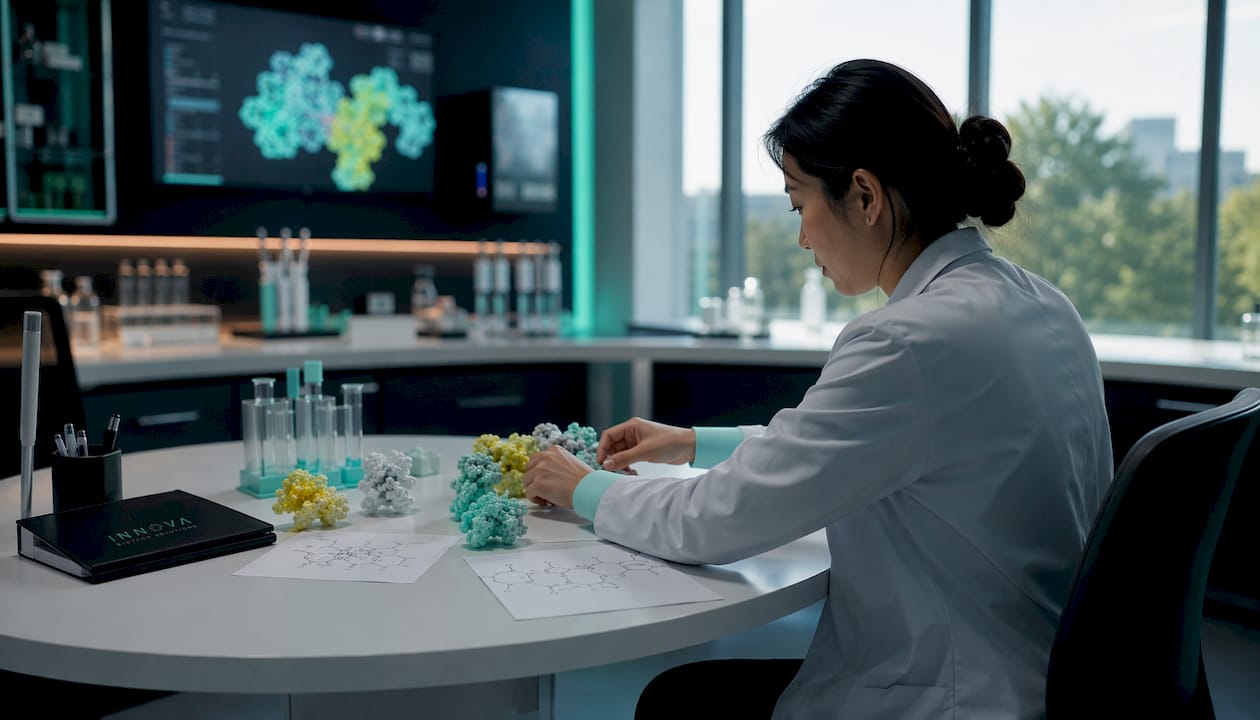
Deliverables typically include a PDF summary report, SDF or MOL2 files for top poses, interaction diagrams, and, from providers who prioritize reproducibility, the scripts used to run the analysis.
How much do molecular docking services cost?
Pricing varies widely and is almost never published as a fixed menu. Simple single-target docking of a small library may run in the low hundreds of dollars per project. Large-scale virtual screening campaigns against multiple receptor conformations, with full interaction profiling and a detailed report, can reach several thousand dollars. AI-assisted screening with Gigadock Warp-type tools tends to cost less per compound than traditional docking at scale, which makes it attractive for libraries above 100,000 compounds.
The most reliable approach is to request a scoped quote with a clear breakdown of what is included: number of compounds, docking engine, report format, and post-delivery support hours.
How long does a molecular docking project take?
Timeline depends almost entirely on library size and report complexity. A focused docking study of 50–200 compounds against a single target typically completes in 1–2 weeks from structure submission. A virtual screening campaign covering tens of thousands of compounds with full interaction profiling usually runs 3–6 weeks. Projects requiring ensemble docking across multiple receptor conformations or extensive post-docking analysis can extend to 8 weeks or more.
Ask your provider for a milestone schedule at kickoff, not just a delivery date. Knowing when structure preparation ends and docking runs begin lets you catch problems early.
Examples of how docking services accelerate real projects
Protein-ligand docking has guided lead identification in kinase inhibitor programs, where researchers used ranked docking poses to prioritize which analogs to synthesize first, cutting the number of compounds entering assay by more than half. In GPCR drug discovery, ensemble docking across multiple receptor conformations has helped teams identify allosteric binders that rigid docking would have missed entirely.
Reverse docking has found a second life in drug repurposing: screening an approved drug against a panel of off-target proteins to find unexpected activity. Providers like Creative Proteomics and Creative Biolabs have documented this application in their technical resources, though published case-specific outcome data varies by project confidentiality.
What post-delivery support should you expect?
A docking report is not the end of the engagement. The most useful providers offer a result interpretation call after delivery, where a computational chemist walks through the top-ranked poses and flags anything that warrants experimental follow-up. Some also offer iterative rounds: you run an assay on the top hits, share the data, and the provider refines the docking model based on what actually bound.
Ask specifically whether post-delivery questions are included in the project fee or billed separately. Creative Biolabs and Creative Proteomics Molecular Docking Service both describe ongoing client communication as part of their standard process, which matters when your medicinal chemistry team has questions three weeks after delivery.
Innovabiotech brings a direct, collaborative approach to computational biology
If you are weighing the providers above and want a team that treats your project as a scientific collaboration rather than a ticket in a queue, Innovabiotech offers a different model. Founded in San Francisco in 2024, Innovabiotech provides customized computational biology services including virtual screening, hit-to-lead optimization, flexible peptide docking, and protein design with direct scientist-to-scientist communication at every stage. There are no black-box reports: you get the methodology, the scripts, and a team that answers your follow-up questions. For early-stage biotech teams and academic labs that need expert computational support without a long-term retainer, Innovabiotech is worth a direct conversation.
FAQ
What is molecular docking used for in drug discovery?
Molecular docking predicts how a small molecule or peptide binds to a protein target, helping researchers rank compound libraries and identify candidates for experimental validation before synthesis.
Which docking engines do professional services use?
The most widely used engines are AutoDock Vina, GOLD, and OEDocking. AI-assisted tools like Gigadock Warp are increasingly used for large-library screening where computational cost matters.
How accurate are molecular docking scores?
Docking scores rank compounds relative to each other rather than predicting absolute binding affinities. Top-ranked hits should always be validated with experimental methods such as SPR or ITC.
Do molecular docking providers offer NDAs?
Most professional providers, including Creative Proteomics Molecular Docking Service and Creative Biolabs, offer signed NDAs before any data transfer, which is standard practice for proprietary compound libraries.
Can Innovabiotech handle flexible peptide docking projects?
Yes. Innovabiotech's services include flexible peptide docking and bioinformatics validation, detailed further in their peptide design services offering.
Key Takeaways
Professional molecular docking services deliver reproducible, expert-guided computational predictions that accelerate drug discovery and reduce experimental waste when paired with proper validation.
| Point | Details |
|---|---|
| Structure preparation is critical | Correct protonation at physiological pH is a fundamental step that determines docking reliability and reproducibility. |
| Docking scores rank, not predict | Scores reflect relative compound enrichment; always validate top hits with SPR, ITC, or a functional assay. |
| AI-assisted docking scales efficiently | Tools like Gigadock Warp screen ultra-large libraries at reduced cost while maintaining near-equivalent accuracy to traditional engines. |
| NDA and reproducibility are non-negotiable | Demand signed NDAs before data transfer and reproducible code delivery as baseline requirements from any provider. |
| Innovabiotech offers direct collaboration | For teams needing customized computational biology with transparent methodology and scientist-to-scientist support, Innovabiotech is a strong alternative to larger catalog providers. |