
What is off-target interaction prediction in drug discovery?
Off-target interaction prediction is the computational process of identifying unintended protein targets that a drug candidate binds to, beyond its intended therapeutic target. Getting this right early is one of the most consequential decisions in drug discovery. Undetected off-target binding drives adverse events, preclinical failures, and post-market withdrawals.
The field has moved well past simple sequence homology searches. Today's approaches combine chemical similarity, quantitative structure-activity relationship (QSAR) modeling, molecular docking, and machine learning into integrated pipelines that screen millions of compound-target pairs before a single assay runs.
Key components and frameworks shaping modern non-target effects prediction:
- OTSA (Off-Target Safety Assessment): A hierarchical computational framework using 2D chemical similarity, QSAR, 3D pocket similarity, automated docking, and machine learning algorithms including artificial neural networks (ANNs), support vector machines, and random forests.
- Interactome-based deep learning: Models that simultaneously infer drug-target interactions and their downstream transcriptional effects by simulating cellular signaling networks, not just isolated binding events.
- Artificial neural networks (ANNs): The top-performing model class across multiple off-target panel benchmarks, outperforming random forests and AutoML approaches in head-to-head comparisons.
- Multi-omics integration: Combining chemical structure data, transcriptomics, and protein interaction networks to capture context-dependent off-target effects that binding assays alone miss.
- Drug repurposing potential: OTSA analysis of 857 drugs found that 51.5% of high-scoring predicted interactions for discontinued drugs had not been previously reported, opening repurposing opportunities.
- Safety attrition reduction: Early computational screening reduces the proportion of candidates that fail in preclinical and clinical phases due to undetected polypharmacology.
Table of Contents
- Novel computational frameworks for predicting off-target interactions
- Machine learning and deep learning models used in off-target prediction
- How to validate predicted off-target interactions
- Challenges and future directions in off-target prediction
- Practical insights from Innovabiotech on off-target profiling
- Innovabiotech's tailored off-target prediction services
- FAQ
- Key Takeaways
Novel computational frameworks for predicting off-target interactions
The OTSA framework
The OTSA framework is the most thoroughly documented hierarchical approach to off-target prediction for small molecules. It draws on a training set of over one million compounds, tracking more than 20 million compound-structure activity relationship data points from patents, journals, and public databases. Applied to 857 drugs (401 FDA-approved, 456 discontinued), OTSA predicted 7,990 total interactions, averaging 9.3 interactions per drug, and correctly identified known pharmacological targets for more than 70% of those compounds.
What makes OTSA practically useful is its layered architecture. Each layer filters candidates before passing them to a more computationally expensive method:
- 2D chemical similarity: Tanimoto-based fingerprint comparison for rapid candidate filtering
- Similarity Ensemble Approach (SEA): Statistical comparison of compound fingerprint sets against target-annotated libraries
- Local QSAR models: Target-specific activity models trained on curated bioactivity data
- 3D surface pocket similarity: Shape-based comparison of binding site geometry across the proteome
- Automated molecular docking: Pose prediction and scoring for shortlisted target-compound pairs
- Machine learning scoring: ANN, SVM, and random forest models that integrate outputs from upstream methods
The framework covers more than 7,000 targets, roughly 35% of the human proteome, and more than 246,000 preclinical and clinical alerts. Its extensibility means new targets and compound classes can be incorporated without redesigning the pipeline.
Interactome-based deep learning
Where OTSA treats targets as discrete entities, interactome-based deep learning models the cell as a network. This approach trains ensembles of ANNs on transcriptomic response data, simultaneously inferring drug-target interactions and simulating their downstream effects on transcription factor activity through a prior knowledge signaling network.

The practical payoff is substantial. In a case study of Lestaurtinib, the model predicted inhibition of CDK2 alongside the drug's known FLT3 target, which cascades into downregulation of FOXM1, a transcription factor critical to cell cycle control. That CDK2 interaction was subsequently confirmed in a kinase inhibition study with a Kd of 20 nM, a result absent from both the training data and DrugBank.
Pro Tip: When evaluating interactome-based models, check whether the framework uses cell-line-specific training. Generic signaling models miss context-dependent off-target effects that only appear in specific tissue types.
Multi-modal data integration is the other defining feature of modern frameworks. The most capable pipelines combine:
- Chemical structure encodings (ECFP4 fingerprints, graph-based representations)
- Known drug-target interaction matrices from resources like the Broad Institute Repurposing Hub
- Pairwise Tanimoto similarity between drugs as a proxy for shared target space
- Transcriptomic perturbation data (L1000 assay outputs)
- Protein interaction networks as structural priors
The OPLE platform illustrates a complementary hybrid approach, pairing Tanimoto 2D similarity with calibrated ML probabilities to output percentage likelihoods of off-target activity per safety target, improving recall above 80% and minimizing false negatives.
Machine learning and deep learning models used in off-target prediction
Model architectures and performance
The Off-targetP ML framework benchmarks five ML approaches across a 50-target safety panel: Neural Networks, Random Forest, Auto-Sklearn, AutoGluon, and H2O. Neural networks outperformed all other approaches across protein classes with varying dataset sizes and high class imbalance, and the framework implements built-in calibration to address that imbalance directly.
The HDPC-LGT model represents the current performance ceiling for multi-label off-target prediction. This hybrid deep learning architecture combines:
- Graph-based ligand representations
- Protein language models for sequence encoding
- Structural priors from known binding geometries
- Cross-attention mechanisms linking ligand and protein context
HDPC-LGT achieves a ROC-AUC of approximately 0.996 on held-out test sets and outperforms other drug-target interaction prediction models by 3–7%, with outputs that map to catalytic residues and interaction regions for biological interpretability.
| Model | Architecture | Key Strength | Benchmark Dataset |
|---|---|---|---|
| Off-targetP ML (Neural Network) | Feedforward ANN with ECFP4 inputs | Best overall across 50 targets, handles class imbalance | In-house 50-target panel |
| HDPC-LGT | Hybrid graph + protein LM + cross-attention | ROC-AUC ~0.996, 3–7% gain over baselines | External DTI datasets |
| CRISTA | Random forest, multi-feature | Strong for high-frequency off-target sites | GUIDE-seq, HTGTS, BLESS |
| Interactome ANN ensemble | Cell-line-specific ANN ensemble | Transcriptional effect inference, causal network extraction | L1000 transcriptomic data |
| OPLE | 2D similarity + calibrated ML | Recall >80%, percentage likelihood output | Safety target panels |
Ligand and protein encoding
Graph-based ligand representations preserve molecular topology in ways that ECFP4 fingerprints cannot, capturing ring systems and bond order information that matters for selectivity prediction. Protein language models like ESM-2 encode evolutionary and structural information from sequence alone, enabling prediction on targets with no crystal structure. The combination, as implemented in HDPC-LGT, is what drives generalization to novel compound-target pairs outside the training distribution.
Pro Tip: For multi-target prediction tasks, use multi-label classification architectures rather than stacking single-target binary classifiers. Single-task models miss correlated off-target activities that multi-label models capture through shared representation layers.
Interpretability methods
Integrated Gradients, as used in the interactome-based ANN framework, traces which input features (specific drug-target interactions, signaling edges) most strongly drive a predicted transcriptional outcome. Grad-CAM applied to graph neural networks highlights which molecular substructures contribute to predicted off-target binding. Both methods produce outputs that medicinal chemists can act on: modify this scaffold feature, avoid this pharmacophore, prioritize this structural analog.
Computational off-target prediction that a medicinal chemist cannot interpret is a black box. Interpretability tools convert model outputs into structural hypotheses that guide synthesis decisions.
How to validate predicted off-target interactions
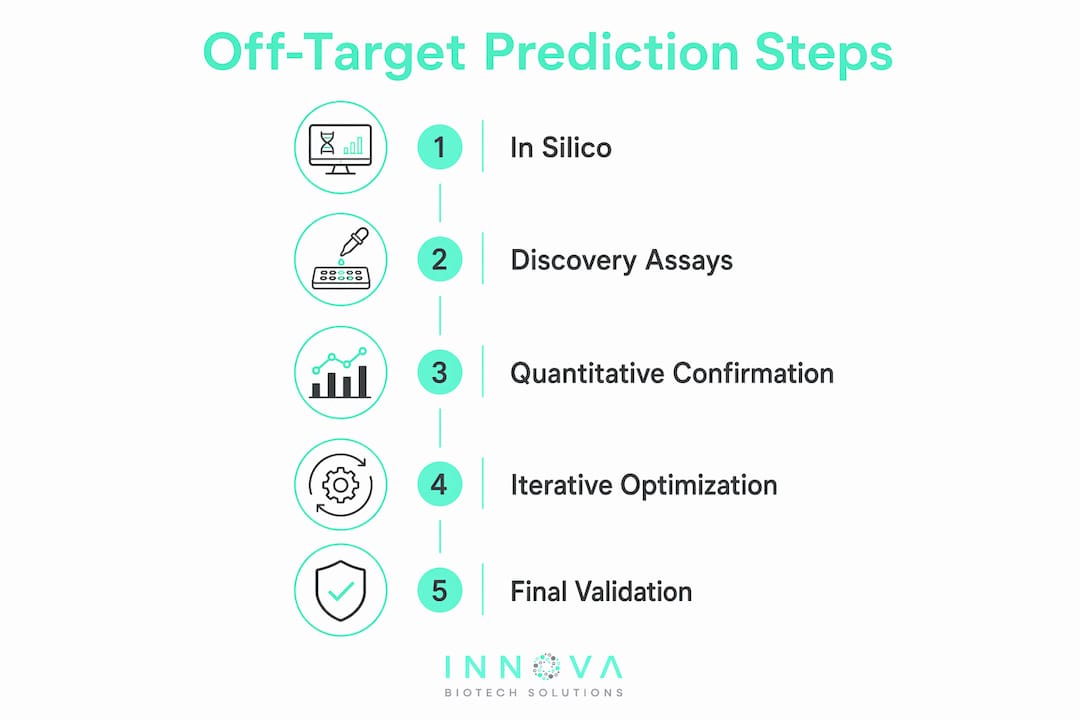
Predicted interactions are hypotheses. Validation converts them into evidence. The American Society of Gene and Cell Therapy (ASGCT) recommends a three-step validation strategy that applies broadly beyond gene editing to any therapeutic modality:

Step 1: In silico prediction. Generate a candidate list of potential off-target sites using computational tools. No single tool is sufficient; using multiple orthogonal approaches reduces the risk of missing true positives that any one method would rank below the cutoff.
Step 2: Genome-wide discovery assays. Screen the candidate list experimentally using methods capable of detecting low-frequency events. For gene editing applications, GUIDE-seq and HTGTS are established genome-wide approaches. For small molecules, transcriptomic profiling and broad biochemical panel screens serve the equivalent function.
Step 3: Quantitative confirmation assays. Confirm off-target effects at candidate sites in the actual target cells or an appropriate surrogate, using next-generation sequencing (NGS) or functional readouts. NGS amplicon sequencing detects indel rates down to 0.1–0.01%, though sensitivity for larger structural alterations remains lower.
Key validation practices:
- Run at least one in silico tool alongside at least one experimental genome-wide method; concordance between methods is high for high-frequency off-target sites but diverges at low-frequency events below 0.5% editing rate.
- Include transcriptomics and cellular signaling readouts to capture functional consequences beyond binding, particularly for targets with complex downstream networks.
- Flag any predicted off-target site overlapping a tumor suppressor gene or oncogene for immediate risk assessment, regardless of predicted frequency.
- Define and report the detection limits of every assay used; a negative result is only meaningful relative to a known sensitivity threshold.
- Cross-validate computational models on independent datasets not used in training to assess true generalization.
A common pitfall is treating a single high-ranking computational prediction as sufficient evidence for a safety decision. Off-target effects vary by cell type, nuclease expression level, and epigenetic context. Confirmation must happen in the cells or tissue relevant to the therapeutic application.
Challenges and future directions in off-target prediction
Where current methods fall short
Dataset bias is the most persistent problem. Most training data comes from biochemical assays run under standardized conditions that do not reflect cellular reality. A compound that shows no binding in a purified protein assay may still produce off-target effects in a cell where the target protein exists in a different conformational state or complex. Ignoring cellular context leads to systematic misclassifications that only surface in later-stage experiments.
There is also no gold-standard experimental method for off-target profiling. Practitioners combine computational screening, in vitro panels, and functional readouts like transcriptomics, but the field lacks a consensus benchmark that would allow direct comparison of predictive frameworks across labs. This makes it hard to know whether a new model is genuinely better or just better tuned to a specific dataset's quirks.
Balancing sensitivity and specificity is a genuine tension. A model tuned for high recall flags many false positives, wasting experimental resources. A model tuned for high precision misses real risks. Ensemble approaches that aggregate predictions from multiple algorithms tend to perform better on both dimensions than any single model, but they add computational cost and interpretive complexity.
Pro Tip: Combine at least two orthogonal computational methods with different underlying assumptions before committing to an experimental validation list. A compound flagged by both a similarity-based method and a structure-based docking model is a much stronger candidate for follow-up than one flagged by only one approach.
Emerging trends
Automated, low-code ML pipelines are closing the gap between computational biology and medicinal chemistry. Tools like Off-targetP ML require minimal programming expertise, letting chemists run predictions directly from chemical structures without needing to configure neural network architectures. That accessibility accelerates the iteration cycle before synthesis.
Foundation models trained on large-scale protein sequence and structure databases are beginning to generalize across target families in ways that earlier task-specific models could not. Paired with multi-omics data integration, including proteomics, epigenomics, and single-cell transcriptomics, the next generation of off-target prediction frameworks will likely model tissue-specific and patient-specific risk profiles rather than population-average binding probabilities.
The bioinformatics acceleration of drug discovery workflows is also pushing toward real-time prediction during lead optimization, where off-target liability scores update automatically as chemists modify structures, rather than being computed as a separate downstream step.
Practical insights from Innovabiotech on off-target profiling
Innovabiotech's approach to off-target profiling combines virtual screening, protein engineering, and peptide design services into a single integrated workflow rather than treating each as a separate service. The practical advantage is that off-target liability data feeds directly into hit-to-lead optimization decisions, so structural modifications are guided by predicted selectivity profiles from the start.
For computational biologists running these pipelines, a few patterns consistently improve outcomes:
- Start with ensemble predictions. No single algorithm dominates across all target classes. Combining similarity-based, QSAR, and structure-based scores before ranking candidates reduces the false negative rate more reliably than tuning any one method.
- Incorporate protein context early. Use protein language model encodings rather than simple sequence features when the target family includes structurally diverse members. This matters most for kinases, GPCRs, and ion channels, where selectivity is determined by subtle binding pocket differences.
- Automate the data curation step. Duplicated compound identifiers, inconsistent activity thresholds, and inter-target measurement overlap are the most common sources of model degradation. Automated curation, as implemented in Off-targetP ML, catches these before training.
- Use interpretability outputs to drive synthesis. Integrated Gradients and attention maps from cross-attention architectures identify which molecular substructures drive predicted off-target binding. That information belongs in the medicinal chemist's hands before the next synthesis round.
- Validate in cell-type-specific assays. Computational predictions trained on purified protein data need experimental confirmation in the actual cell type of interest. Off-target effects that depend on protein expression levels or co-regulatory partners will not appear in generic biochemical screens.
Pro Tip: For hit-to-lead optimization, run off-target predictions iteratively after each structural modification rather than once at the start of the campaign. Scaffold changes that improve potency often shift the off-target profile in ways that a single early screen will not capture.
Innovabiotech's team works directly with clients through each stage of this workflow, from initial computational peptide screening to bioinformatics validation, maintaining transparency at every decision point. The goal is not just a prediction output but a defensible, experimentally grounded selectivity profile that holds up through preclinical review.
Innovabiotech's tailored off-target prediction services
Predicting off-target liabilities accurately requires more than running a single tool. It requires integrating chemical structure data, protein context, and experimental validation into a workflow that actually informs synthesis decisions.
Innovabiotech delivers exactly that: a San Francisco-based team of computational biologists and bioinformatics specialists who build custom off-target prediction pipelines tailored to your compound class and target space. Unlike generic screening platforms, Innovabiotech combines virtual screening, protein engineering, and peptide design into a single coordinated workflow, so off-target liability data is available at the moment it changes a synthesis decision, not weeks later. Every project runs with direct client communication, clear technical updates, and results you can take into a preclinical review. Reach out to Innovabiotech to scope your off-target profiling project and get a workflow designed around your specific pipeline stage.
FAQ
What is off-target interaction prediction?
Off-target interaction prediction is the computational identification of unintended protein targets that a drug candidate binds to, beyond its primary therapeutic target. Frameworks like OTSA and interactome-based deep learning models are the current standard approaches.
Which machine learning model performs best for off-target panel prediction?
Neural networks outperformed random forests and AutoML approaches across a 50-target safety panel in the Off-targetP ML benchmark, with built-in calibration to handle class imbalance across diverse protein families.
How does the OTSA framework predict off-target interactions?
OTSA uses a hierarchical pipeline combining 2D chemical similarity, QSAR, 3D pocket similarity, molecular docking, and machine learning algorithms. Applied to 857 drugs, OTSA predicted an average of 9.3 interactions per drug and correctly identified known pharmacological targets for more than 70% of those compounds.
What validation steps are required after computational prediction?
The ASGCT recommends a three-step strategy: in silico prediction, genome-wide discovery assays, and quantitative confirmation assays in target-relevant cells, with NGS as the gold-standard readout for indel detection.
How does Innovabiotech support off-target prediction workflows?
Innovabiotech builds custom computational pipelines integrating virtual screening, protein engineering, and peptide design, providing iterative off-target liability scoring throughout hit-to-lead optimization with direct bioinformatics support at each stage.
Key Takeaways
Computational off-target interaction prediction, when built on ensemble ML models and validated through multi-stage experimental confirmation, reduces preclinical attrition and surfaces repurposing opportunities that conventional assays miss.
| Point | Details |
|---|---|
| OTSA framework coverage | OTSA covers more than 7,000 targets and predicted an average of 9.3 interactions per drug across 857 compounds, correctly identifying known pharmacological targets for more than 70% of those compounds. |
| HDPC-LGT performance | This hybrid deep learning model achieves ROC-AUC ~0.996 and outperforms baseline drug-target interaction models by 3–7%. |
| Three-step validation | ASGCT recommends in silico prediction, genome-wide discovery assays, and quantitative NGS confirmation in target-relevant cells. |
| Ensemble models reduce error | Combining multiple orthogonal computational methods lowers false negative rates better than tuning any single algorithm. |
| Innovabiotech workflow | Innovabiotech integrates virtual screening, protein engineering, and peptide design into a single iterative off-target profiling pipeline. |