
Yes, for most preclinical drug discovery programs, outsourcing computational chemistry is the faster, lower-risk path to a validated candidate list, and the right next step is a scoped pilot rather than a long-term contract. Run a four-to-eight-week virtual screening or hit-to-lead pilot with a defined success metric before committing further budget. Industry guidance from MassBio and the Medicines Discovery Catapult both frame outsourced in silico work as a practical way to cut wet-lab waste and compress timelines. Innovabiotech runs exactly this kind of pilot engagement for biotech and pharma teams.
What changes fastest once you outsource:
- Faster hit triage, because a specialist team runs docking and scoring against your target the week you hand off the protein structure.
- Fewer wasted syntheses, because computational filtering removes weak binders and problem ADMET liabilities before chemists ever touch a bench.
- Access to methods and licenses (Schrödinger, GROMACS, OpenMM) you would otherwise have to buy and maintain yourself.
Key Takeaways
Outsourcing computational chemistry reduces wet-lab waste and speeds candidate selection when the engagement starts with a scoped, metric-driven pilot rather than an open-ended contract.
| Point | Details |
|---|---|
| Start with a pilot | Run a four-to-eight-week virtual screen or hit-to-lead pilot before committing to a larger contract. |
| Match method to stage | Use docking for early screening and MD/QM free-energy work only when ranking close analogs. |
| Demand named deliverables | Require ranked hit lists, docking poses, ADMET profiles, and SAR suggestions in writing. |
| Lock in IP terms early | Confirm NDA, data segregation, and code ownership before any data changes hands. |
| Innovabiotech pilot model | Innovabiotech scopes discovery calls into fixed-timeline pilots with PhD-level teams and named deliverables. |
Table of Contents
- Outsourcing Computational Chemistry: What It Actually Buys You
- Where Outsourced Computational Chemistry Pays Off Fastest
- Why Teams Choose to Outsource Rather Than Hire
- When Should You Build In-House Instead of Outsourcing?
- What to Expect From an Outsourced Engagement
- How Do You Choose a Computational Chemistry Vendor?
- How Innovabiotech Structures an Outsourced Project
- Sources
- FAQ
Outsourcing Computational Chemistry: What It Actually Buys You
Computational chemistry uses in silico modeling to predict how a molecule will bind, behave, and fail before anyone synthesizes it. That prediction layer is what makes outsourcing computational chemistry attractive: you're buying speed and risk reduction, not just headcount.
The core toolkit a vendor should bring to the table includes:
- Virtual screening to rank large compound libraries against a target, often using Schrödinger's Glide or similar docking engines.
- Structure-based design, meaning docking and pose analysis when a crystal structure or reliable homology model exists.
- Ligand-based design, useful when no structure is available but you have known actives to build a pharmacophore from.
- Molecular dynamics (MD), run in GROMACS or OpenMM, to test whether a docked pose actually holds up over time.
- Quantum mechanics (QM) and free-energy calculations for the cases where docking scores alone aren't trustworthy enough to rank close analogs.
- Machine learning and QSAR/ADMET prediction, frequently built on RDKit, to flag toxicity or solubility problems early.
The Medicines Discovery Catapult has documented measurable gains in lead identification and optimization from these methods, and outsourcing is what makes them affordable for teams too small to run a full-time modeling group.
Where Outsourced Computational Chemistry Pays Off Fastest
Not every stage of discovery benefits equally from an external partner. The impact concentrates in a handful of places:
- Hit identification. A virtual screen against a library of hundreds of thousands of compounds returns a ranked hit list, cutting the number of compounds you need to test at the bench by an order of magnitude.
- Hit-to-lead triage. Docking poses and quick ADMET flags separate promising scaffolds from dead ends before medicinal chemists invest synthesis time.
- Lead optimization. SAR suggestions from structure-activity modeling guide which analogs to make next, rather than testing blindly.
- ADMET/property triage. ML-based prediction catches solubility, metabolic stability, or hERG liability issues early, before they show up as a costly failure in later assays.
- Scaffold hopping and fragment-based design. A vendor with broad target-class experience often spots alternative chemotypes an internal team, focused on one series, misses entirely.
- Free-energy rescoring. MD and QM-based free-energy methods refine a ranked hit list when docking scores alone aren't precise enough to choose between close analogs.
Docking handles the first pass; MD and QM earn their cost when you need to rank the final handful of candidates with confidence.
Why Teams Choose to Outsource Rather Than Hire
The financial logic is straightforward: outsourcing converts a fixed cost, salary, benefits, software licenses, into a variable one you pay only when there's active project work. That distinction matters most for smaller biotechs running episodic discovery cycles rather than a constant pipeline.
Cost isn't the only driver, though; collaborating with specialist teams for primary antibodies and research reagents often accelerates workflows and enhances discovery outcomes. According to MassBio, the real value of outsourcing often comes from access to specialized expertise and niche software that would otherwise sit unused between projects, along with broader target-class experience that helps avoid the tunnel vision internal teams develop after years on one program.
Common triggers that push a team toward outsourcing:
- Hitting a preclinical milestone that requires modeling depth the current team doesn't have.
- Handing a program to a contract research organization and needing computational support that matches that pace.
- Planning around a patent cliff, where speed to a differentiated candidate matters more than building permanent infrastructure.
- A sudden capacity peak, like three programs needing screening support the same quarter.
When Should You Build In-House Instead of Outsourcing?
The decision usually comes down to four questions: how often will you need this work, how strategic is it to your pipeline, how sensitive is the IP, and how predictable is your budget?
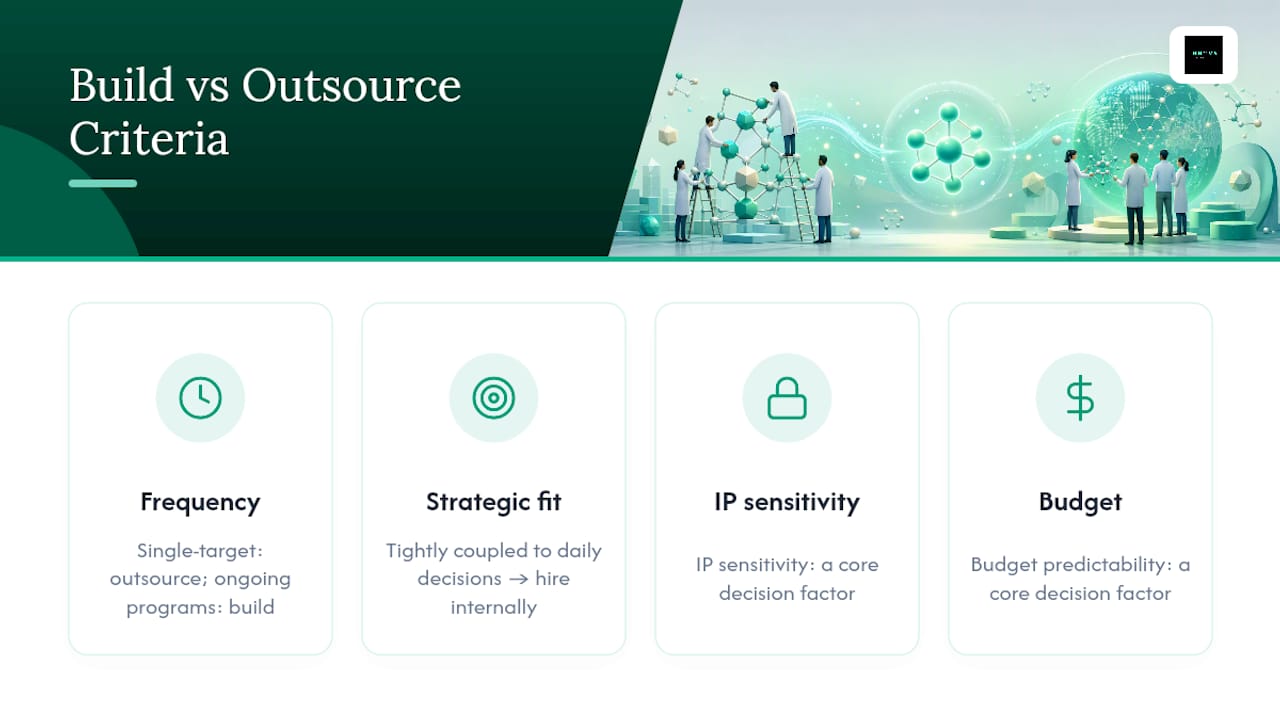
A single-target virtual screen for a near-term milestone almost always favors outsourcing. Building a full-time capability for one project rarely pencils out. On the other end, an organization running continuous discovery across a dozen programs a year, with modeling tightly coupled to daily decisions from medicinal chemists sitting down the hall, usually justifies an internal hire. Genentech's postings for principal computational scientists show what that bar looks like in practice: deep MD/QM expertise embedded in cross-functional teams.

Most companies land somewhere in between. A hybrid model, retaining one or two scientists for daily triage while outsourcing compute-heavy screens or specialized free-energy work, is often the most efficient setup once a pipeline matures.
What to Expect From an Outsourced Engagement
Scopes and timelines vary by project, but a few patterns hold across most vendors. A focused virtual screen typically runs a few weeks from library receipt to ranked hit list. Hit-to-lead work, which usually involves iterative docking, MD checks, and medicinal chemistry feedback, tends to run longer, often several weeks to a couple of months. Lead optimization cycles repeat in shorter loops, often two to four weeks per round, as SAR data comes back from the wet lab.
Standard deliverables you should ask for by name:
- Ranked hit lists with scoring rationale, not just a spreadsheet of numbers.
- Docking poses and binding mode analysis you can review with your chemistry team.
- Free-energy estimates for the shortlist, when ranking depends on subtle potency differences.
- ADMET profiles flagging liabilities before synthesis.
- SAR suggestions tied to specific analog ideas.
- Workflow documentation and code artifacts, so the work is reproducible internally later.
Pricing models generally fall into four buckets: fixed-price for a defined scope, milestone billing tied to deliverables, hourly or day rates for open-ended work, and retainers for ongoing support. Cost drivers to watch include library size, how compute-intensive the methods are (QM and MD cost more than docking), software licensing fees passed through, and how much data cleaning the vendor has to do before work even starts.
Before signing anything, confirm the IP and security basics: a signed NDA, data segregation from other clients, clear code ownership terms, and audit-ready result packages you can hand to regulators or partners later.
How Do You Choose a Computational Chemistry Vendor?
Use a structured checklist rather than judging on a sales deck alone:
- Does the vendor's scope match your actual need, not a generic package?
- Are deliverables specific and named upfront, not vague promises of "insights"?
- Does the team include PhD-level computational chemists with a visible publication record?
- What software stack do they run, and can they justify the choice for your target class?
- Can they show a retrospective validation example, a case where their method predicted a known outcome correctly?
- What are their data handling and IP terms in writing?
- Can they provide references from comparable biotech or pharma clients?
- Will they run a small paid pilot before a larger commitment?
Questions worth asking directly in a vendor call:
- How do you validate your scoring function against known actives for a similar target class?
- Who specifically works on my project, and how much of that time comes from senior scientists versus junior staff?
- What raw data formats do I receive, and can I reproduce your results independently?
- What compute environment do you run, and are there additional licensing costs I should expect?
Red flags include vague deliverables, no PhD-level scientist named on the project, an inability to produce a single validation case study, and weak or absent data security language in the contract.
Pro Tip: Ask for one retrospective validation example before you ask for a proposal. A vendor that can't show you a case where their method correctly predicted a known result is asking you to take their science on faith.
How Innovabiotech Structures an Outsourced Project
A typical Innovabiotech engagement starts with a discovery call to define the target, library, and success metric, usually within the first week. A pilot phase follows, typically four to eight weeks depending on scope, covering a virtual screen or hit-to-lead pass with a clearly defined deliverable set. If the pilot hits its metrics, the engagement scales into a longer lead optimization or protein design contract.
Project teams are built around PhD-level computational chemists, medicinal chemistry liaisons who translate modeling output into synthesis priorities, and data scientists handling ML-based ADMET prediction. The technology stack draws on Schrödinger, GROMACS, OpenMM, and RDKit depending on the target and question.
Every engagement runs under a signed NDA with data segregated per client, and clients can request full code and model ownership as part of the deliverable package. A typical pilot request includes:
- A ranked hit list with scoring rationale.
- Docking pose ensembles for the top candidates.
- An ADMET triage report flagging early liabilities.
- A written success metric agreed on before work starts.
A note from the lab
Innovabiotech was built on the idea that biotech teams shouldn't have to choose between speed and scientific rigor. If you're weighing a pilot, request a capabilities brief and we'll scope it against your actual target.
Get a Computational Chemistry Proposal Started
If your team needs virtual screening, hit-to-lead triage, lead optimization, or peptide and protein design support without the overhead of a permanent hire, Innovabiotech runs these programs as scoped engagements built around your target and timeline.
Our services cover the areas this article walks through directly:
- Virtual screening and hit identification against your target structure.
- Hit-to-lead and lead optimization with SAR-driven analog suggestions.
- Protein and peptide design, including de novo peptide work and chimeric protein modeling.
- Enzyme stability and activity optimization for biologics programs.
Requesting a proposal starts with a short discovery call to define scope, followed by a pilot quote with a fixed timeline and budget estimate. If you're ready to see what a focused pilot could do for your candidate list, start with our peptide design services page or reach out directly to scope a virtual screening pilot against your current target.
Sources
For further reading on the business case and technical scope of outsourced computational chemistry, see MassBio's case for outsourcing, the Medicines Discovery Catapult's overview of computational chemistry's value, International Pharmaceutical Industry's outsourcing guide, and Scientific Computing's feature on the field's shift toward flexible models. For a sense of the in-house hiring bar vendors compete against, Genentech's and AbbVie's computational chemistry postings are worth a look.
- The case for outsourcing computational chemistry in drug discovery - MassBio
- The value of computational chemistry - Medicines Discovery Catapult
FAQ
What Does Outsourcing Computational Chemistry Mean?
It means contracting an external team to run in silico modeling, like virtual screening, docking, or MD simulations, instead of building that capability with permanent staff.
How Much Does an Outsourced Virtual Screen Cost?
Pricing depends on library size, compute intensity, and licensing fees, and typically runs as a fixed-price project, milestone billing, or hourly rate rather than a flat number.
Is Outsourcing Computational Chemistry Safe for Sensitive IP?
Yes, when the vendor provides a signed NDA, data segregation, and clear code ownership terms before any project data changes hands.
Should a Small Biotech Outsource or Hire In-House?
For episodic or single-target projects, outsourcing is usually more cost-effective; ongoing, multi-program pipelines with daily medicinal chemistry collaboration tend to justify an internal hire.
What Should a First Pilot With a Vendor Look Like?
A focused four-to-eight-week engagement with a defined library, target, and success metric, such as the pilot model Innovabiotech runs for new clients.